Sunday, January 19, 2020

A Journey of Faith ~ Erick and Caroline Gunderson ~ by David R. Gunderson


With permission of David R. Gunderson, we include the following book to our blog.   I will do a few increments at a time, as I have done with the Andrew Madsen and James Monsen histories.  I will also paste the pages over to David's own blog page: http://davidrgunderson.blogspot.com/
This book will be of interest to not only the Gunderson Family but also to the Brotherson, Ericksen, Peel,   Madsen, Larsen and more.

Saturday, January 18, 2020

from our archives.........Kinema Burns Down


The Elite Theater was built in 1913.

In the late 1920s, 
L.C. and Nada Lund changed the name of the movie house to Star Theater.  Their son, Truxton, later took over the family business and changed the name Kinema. 

The theater, which was considered fireproof when it was built, burned down in 1990.

 Did you Know?  Kinema  is  the British Version of Cinema.    and there are or were hundreds of Kinema's across the United States and world. 

The word ‘cinema’ comes from ‘Kinema’-toscope and is derived from the Greek word kinema-matos meaning the science of pure motion.


  ..And I always thought that it was a cute expression of    "Kinna Ma Go to the Movies?"


Our Relic Home on the far left.


December 25th, 1912 the Elite Theatre, now the Star, presented their first show. Prior to this, some show places had been operat­ing, among them the one on State Street, conducted by C. Purring­ton. History of Mt. Pleasant, Hilda Madsen Longsdorf p. 197

Thursday, January 16, 2020


Elliot Julius Arnoldson


5/20/1927 ~ 1/9/2020


Well, we’ve done it. We finally discovered how long an Arnoldson can truly live. Our track record wasn’t very spectacular until now. At age 92, Elliot outlived his mother and wife by three years, eighteen years longer than his sister, one son by 40 years, his father by 61 years, and his brother by 86 years. All with his staple diet of mutton and gravy.
Elliot Julius Arnoldson escaped the shackles of Alzheimer’s disease and dementia on the morning of January 9, 2020 in Centerfield, Utah after sustaining injuries from a fall a month prior. He was born in Moroni, Utah sometime between May 20th and May 24th in 1927 to Elyoung and Henrietta Christensen Arnoldson. Records were not meticulously kept in those days so no one was certain exactly which day he was born. Tragedy struck early in his life when his six-year-old brother died of diphtheria when Elliot was only four years old and his father died just two years later. Despite tremendous losses and under the grip of the Great Depression he grew up happily pulling pranks and farming under the tutelage of his bachelor uncles, mother, and stepfather, Clark Cloward. Within days of graduation form Moroni High School; Elliot was drafted into the army and served in the Philippines during the final months of World War II. He remained there as part of the occupational forces but was able to come home once on furlough. While attending a dance in Ephraim, he was introduced to a cute little filly named LaRane Bjerregaard. He and LaRane wrote letters to each other during the remainder of his military service and were married upon his return on July 16, 1947. They made their first home on the farm where Elliot attended Snow College and their only daughter, Rinda, was born. The young family soon moved to Preston, Idaho where Elliot taught school and attended The Agricultural College of Utah (Utah State University). He became the first in his family to earn a college degree- but far from the last. They also welcomed their first son, Gary, before moving back to Sanpete. Elliot farmed, taught school, and added a third child, Clair, to their growing brood. The next move took them to Seattle, Washington where Elliot continued his studies and child number four, Layne, joined the family. Their next move took them from the verdant green slopes of Seattle to the grey sagebrush flats of Milford, Utah where Elliot was the principal of the elementary school for two years. Their nomadic lifestyle came to an end with a move back to their beloved Sanpete Valley where he and LaRane rounded out their family with the arrivals of Earl then Wesley.
Elliot worked in educational administration with the North Sanpete School District adding up a total of 38 years in service to students. He was a city councilman and served two terms as mayor of Moroni in the 1970s accomplishing many improvements that are still visible today. Elliot owned a restaurant and campground in Hanksville, Utah for 43 years which was a loved hobby for him and the bane of existence for the rest of the family. He was a lifelong and proud Democrat who believed that the purpose of government is to serve its citizens and he acted accordingly.

Elliot was an avid hunter and fisherman who counted among his favorite memories those in which he was able to be outdoors with family and friends. He was a good natured and gregarious gentleman who loved being around people. He was generous up to the point he would give you the shirt off his back except he was too modest to be seen without a shirt. He had an unparalleled work ethic. To him, Labor Day simply meant you labored more on that day. He instilled in his children and grandchildren the strong value of an education- likely his greatest legacy.
Those missing him most are his grateful children: daughter Rinda (John), sons Gary (Leslie), Clair (deceased), Layne (Sheri), Earl (Christine), Wesley (Ellen), and daughter-in-law and son-in-law JoAnn and Allan Nielsen. He is preceded in death by his wife of 72 years, LaRane, son Clair, great-grandson Danny, sister Maxine, brother Sherwin, and his parents.
A viewing will be held on Wednesday, January 15, 2020 from 6:00 to 8:00 p.m. at Rasmussen Mortuary, 96 N. 100 W., Mt. Pleasant. Funeral services will be held Thursday, January 16, 2020 in the Moroni Stake Center at 11:00 with a viewing from 9:30 to 10:30. Interment will be in the Moroni City Cemetery. The family would like to thank the dedicated professionals at Country Lane Assisted Living Center and Centerfield Community Rehabilitation Center. Their compassionate service to Elliot and his family did not go without notice.

Wednesday, January 15, 2020

SCANDINAVIAN LIFE IN UTAH and SANPETE COUNTY

Scandinavian Life in Utah

SCANDINAVIAN LIFE IN UTAH INCLUDED A UNIQUE SENSE OF HUMOR
Kent Powell
History Blazer, October 1995
During the last half of the nineteenth century Sanpete County became home to hundreds of Mormon converts from the Scandinavian countries of Denmark, Sweden, and Norway. Aspects of this heritage remain in the buildings, traditions, foods, stories, and humor that were essential elements of Scandinavian life in Utah.
A closer look at one aspect—humor among the Sanpete Scandinavians—shows that it ranges from the nicknames they gave each other, to humorous incidences involving their use of the English language and their unmistakable accents, to elaborate stories involving social relationships and situations that brought out their individual human characters.
In an area where practically everyone shared his Scandinavian name with several other people, the Jens Jensens, Neils Andersons, Hans Hansens, Lars Larsens, Olof Ottosons, Peter Petersons, and others with commonly shared names were given nicknames by their peers that stayed with them all their lives and for some became more real than their given name. For example, a man arrived in Ephraim and informed a group of Danes gathered around the post office that he was looking for a man named Jacob Jensen. No one could help him, but the stranger persisted, indicating he had his address: “He lives in the South Ward, four blocks east of Main Street. Are you sure you don’t know Jacob Jensen?” Finally a light came on as Jake Butcher, one of the old-timers, scratched his head and said, “Hell, that’s me.” Others were given names like Painter Hansen, Dan Wheelmaker Jensen, Chris Cellar, Chris Tallerass Christensen, Big Mart, Dirty Mart, Soren Chickenheart, Faithful Andrew, Long Peter Peterson, Olof Coffee Pot, False Bottom Larsen, Chris Golddigger, Stinkbug Anderson, Fat Lars, Peephole Soren, Alphabet Hansen, Absolutely Anderson, Bert Fiddlesticks, Otto By-Yingo Anderson, Pete Woodenhead, Little Peter, and Salt Peter.
One of the most enduring of these individuals was a habitual drunk known as “Old Okerman.” On one occasion, when an LDS bishop was berating him for his drinking problem in front of a group of other church members, the church leader asked if Okerman had anything to say for himself. He responded sadly, “Vel, Biscop and Brodders, you haf all de time asked me how much visky I haf drunk, and scolded me for drinking it; but you nefer did ask me how tirsty I vas.”
Old Okerman had run up against the Mormon church teaching that strongly discouraged the consumption of alcohol, tobacco, tea, and coffee. This proved to be a real trial for the coffee-loving Danes. At the funeral of one Dane, the speaker reported that his friend had gone to that “happy hunting ground where there is no pain nor tears–nor Word of Wisdom.” On another occasion when members of the congregation could stand and express their thoughts in the church meeting, one member boasted that he did not use coffee, tea, liquor, or tobacco, and claimed that these things were only for the “yentiles” (gentiles–or non-Mormons). When he sat down, another brother jumped up and asked: “Brodders and sisters, vy iss it dat all the good tings shall be for the yentiles?” Most Scandinavians brought with them a very helpful device–humor–for coping with a new home and environment in the isolated valleys of Utah. In doing so they remind us that not always taking ourselves so seriously can often be good for the soul.
Source: William A. Wilson, “Folklore of Utah’s Little Scandinavia,” Utah Historical Quarterly 47 (1979).

Tuesday, January 14, 2020

Autobiography and Journals of CHRISTIAN NIELSEN LUND Sr. 1918


EDITOR C. N. LUND, JR.

IS MOBBED AT SALINA
Editor C. N. Lund, Jr. of the
Sevier Valley Call was mobbed
at Salina last Friday evening
on account of his writing and
publishing two very pointed
stories relative to the conduct
of the citizens of that communi--
ty.
Both stories were rather
severe. One treated upon the
subject of a married mail
attempting to rape a fourteen
year old girl, and the other related
to bootlegging.
This is the first time we have
heard of an editor being mobbed
for trying to uphold the
law, and it is the first time we
ever heard of an editor in Utah
running away from the job.
There- is no cause for Mr.
Lund's departure from Salina,
if he told the truth The law-
-and the state press will hack
him up if he will stay at his
post.
Mr. Lund said that he was
threatened by 100 or more citizens
of the town. They wanted
to tar and feather him. He
is now at Mount Pleasant.
Mr. Lund says he wants to
start a paper at Mount Pleasant.
And to help you out, Mr.
Lund, we will gladly sell you
the Pyramid and save you the
trouble of starting a new one.
One paper is enough for any
valley. All you need to do is
to get us the money so we can
get out into a higher field.
This field is scarcely large
enough for us as it is, and we
will gladly move on to greener
fields if you want this one.


Monday, January 13, 2020

Charles Washington Averett and Elizabeth Coates


MOUNTAINVILLE The Round Hills or Round Knolls as they have been known since the first settlers homesteaded in the vicinity of the five small round hills, are situated just to the southeast of thc, center of the valley between Mt. Pleasant and Fairview. The hills are chiefly gravel formation covered with brush and cedars. The little farming community to the east and north of these very distinctive hills took its name from them. Later the name of Mountainville was given to the small community. As far as has been determined, Washington Averett and his wife Elizabeth Coates were the first to homestead in this community. Their homestead lay directly east of the Round Hills. It is not known the exact year he took up the land, but it has been ascertained that it was before 1877. He built a home that was located, close to where Doug and Julie Shelley now live. Charles Washington Averett was a farmer and lumberman, son of Juththan and Polly, was born in Perry County, Alabama, July 13, 1836. In 1852 the family came to Utah and located in Salt Lake City. In 1860 they removed to Springville, where Charles assisted in constructing a threshing machine, which he ran there; and in the fall of 1861 he brought it to Mt. Pleasant. He served in the Black Hawk war and was in many skirmishes. His first wife was Elizabeth Coates, daughter of Joseph and Ann Dutton Coates and niece to John and Sarah Higginbotham Coates. They were married February 24, 1862 and had nine children: Charles W., William, John, Frank, James, Annie, Mary, Emma and Delia. His wife died April 25 o 1891 and he was married again October 1, 1891 to Emily Seeley Coates, a widow of George Coates who was his first wife's brother. Emily was a daughter of William and Elizabeth Seeley, born in Nashville, Iowa. (History of Sanpete and Emery Counties) Jacob Christensen bought Washington Averett's land and built an adobe house down at the northeast corner of the hills for his first wife, Inger Kristine Thomsen. His second wife, Ingerborg Anderson, lived in the house built by Mr. Averett up by the choke cherries.

Also See: Juduthan Averett — FamilySearch.org.html

Charles Washington Averett Obituary


Wednesday, January 8, 2020

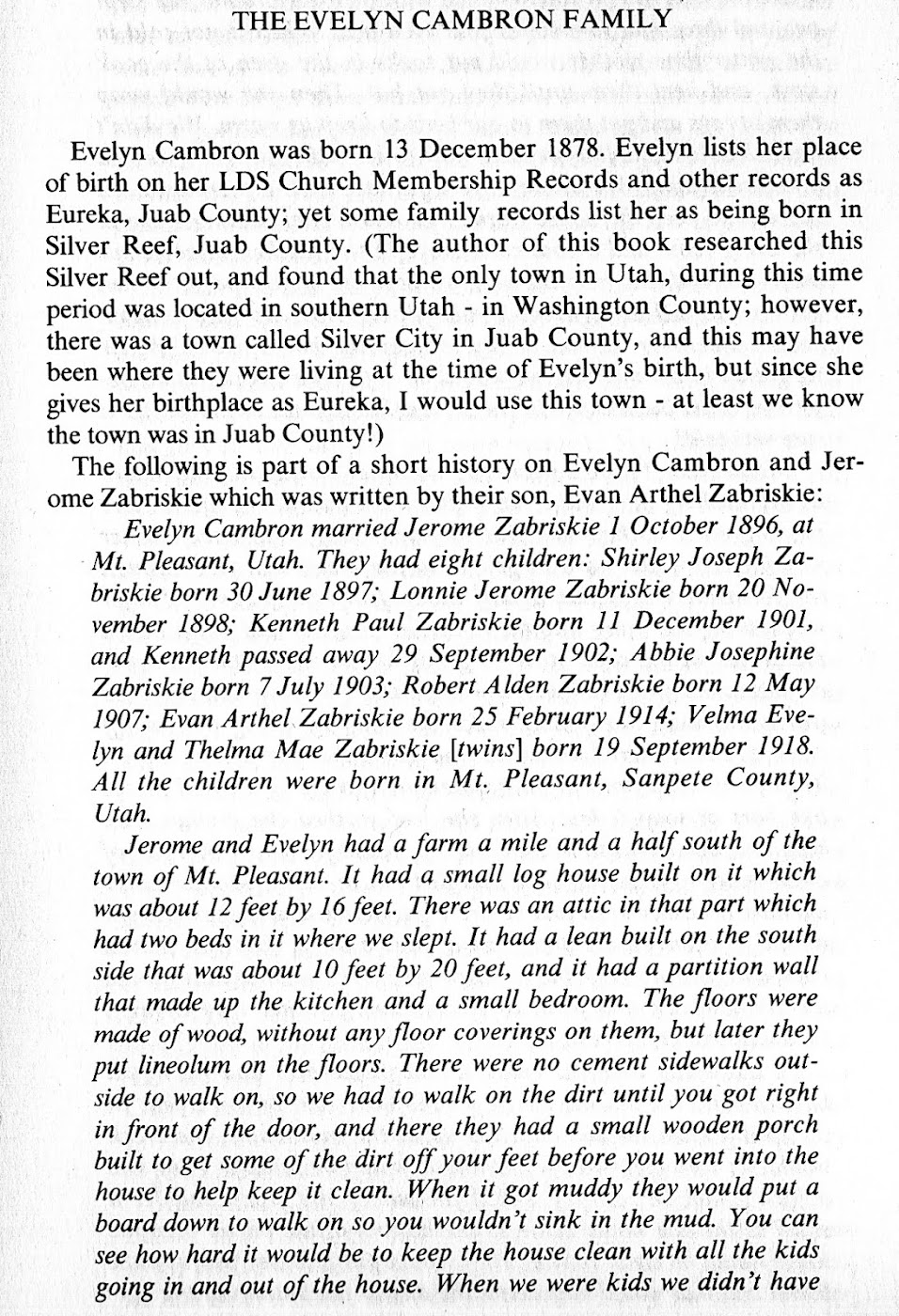
THE EVELYN CAMBRON FAMILY

This History is taken from the book "The Family History of William Bristol, Ane Marie Sophie Clausen, Joseph Cambron, and their Descendants ...... Written by Pat L. Sagers. 


Tuesday, January 7, 2020

Emma Sanders Tidwell


Emma Sanders Tidwell


HISTORY OF EMMA SANDERS TIDWELL Born 23 Jan 1841 — Nauvoo, Illinois Died 5 Oct 1916 — Moroni, Sanpete Co., Utah Came to Utah 1850 Married James Harvey Tidwell — 1857 History filed by Granddaughter Ora H. Lund D.U.P. Historian History arranged by Nora Lund, D.U.P. Historian Information furnished by a Grandaughter, Ora Hutchinson Petersen Arranged by Nora Lund, D.U.P. historian HISTORY OF EMMA SANDERS TIDWELL Emma Sanders was born 23 Jan. 1841 in Nauvoo, Hancock County, Illinois. She was the 9th child in a family of 12 children born to Moses Martin and Amanda Armstrong Faucett Sanders. Her brothers and sisters were: William, Carl - died young, Richard Twigg, John Franklin, Rebecca Ann, Martha Brown, David Walker, Joseph Moroni, Sidney Rigdon, Eliza Jane, Hyrum Smith and Moses Martin Jr. Emma’s parents were from the deep South. Her father was born in Georgia and her mother in Tennessee. The family made their home in Tennessee until 1829 when they moved to Montgomery County, Illinois. On the 28th of January, 1835 her parents were baptized member of the Church of Jesus Christ of Latter—Day Saints. They moved to Far West, Missouri where the Mormons were gathering at that time. By 1839 we find them living in Nauvoo, Illinois assisting in the building up of the City, participating in the ******** of the temple, where they received their endowments in January of 1846. The prophet Joseph Smith loved little children and took a special interest in grandmother, naming her Emma after his wife Emma. She remembered sitting on his lap. It was a great sorrow to the Sanders family when the Prophet was killed. When Emma was 5 years old her family left their home in Nauvoo and took refuge in Iowa. Her father was one of the stalwart men who assisted all he could in getting the Saints across the Mississippi river that cold winter of 1846. Thousands of people who had fled with scarcely nothing but their lives made quite a city at Winter Quarters. Early in January of 1847 the Lord made it known to Brigham Young. President of the twelve apostles, who was leading the Saints, that it was time to go the long distance to the Rocky Mountains to find refuge for his harassed people. Martin Sanders and his family made the necessary preparations to cross the Plains in 1850 and arrived in the valley of the Great Salt Lake that fall. Martin didn’t remain long in Salt Lake because President Young sent him on to colonize new settlements. His history says he was called to different towns He was one of the first to move to Fillmore and in 1859 he was called to settle Fairview Sanpete Co. and he stopped in Mt. Pleasant. His family story is that Emma was working at a boarding house in Fillmore. As she came down the stairs into the main dining room, she immediately attracted the attention of one of the men there. This man was James Harvey Tidwell, a freighter. He had a wife and child at home in Pleasant Grove, and had no particular thought of going into polygamy, though the practice was being encouraged by the Church authorities. But as he beheld this beautiful, young 16 year old girl with golden red hair, sparkling blue eyes and a pleasant smile, he knew that he was going to marry her. He made her acquaintance, courted her and married her in the Salt Lake Endowment House Feb 26, 1857. Emma’s first child was born in Pleasant Grove 26 Nov. 1858. His name was John Franklin Tidwell. He married Caroline Johanson. It was in June of 1859 when Emma’s husband accepted the call to Sanpete County and they made their way to Pleasant Creek (Mt. Pleasant). No doubt Emma’s folks were among the group, which would naturally please her, The north end of Sanpete Valley was indeed promising for new homes. Emma was strong and healthy, willing and able to do her part in aiding in the pioneering of this lovely valley. She lived in the Fort which was the first thing built for protection from the Indians who were always lurking around. Added to the ever present Indian danger there was the concern about the food lasting until another harvest, and about obtaining clothing with which to keep warm. As soon as a log cabin could be built, or a dug—out made, families moved from the Fort to their own settlement lots. Their place vacated in the Fort was occupied by a new settler. When the drum would beat, all would rush back to the square for safety. John Tidwell and Hans Simpson were the “Minute Men” of that day. Their horses were left saddled and bridled so that in case of Indian trouble they could ride quickly to Manti or Thistle Valley for help where soldiers were stationed. Black Hawk and his painted warriors terrorized the women and children, and he led his braves in many battle against the white people. (Taken from the book “These Our Fathers”, Mt, Pleasant write—up.) From the family group sheet at hand, we notice that Emma Tidwell regularly gave birth to new babies after coming to Mt. Pleasant. Her 2nd child, William was born l8 July, 1860. He married Ana Draper; 3rd Child, James, born 6 Feb. 1862 married Lauraetta Draper; 4th child, Martha Ann, born 22 Dec. 1863, married John William Pritchett; 5th child, Joseph Martin. born 18th Dec., 1865, married Martha M. Morgan; 6th child, Albert, born 9 Feb. 1868, died 1876; 7th child Rosetta, born 30 Nov. 1869, married John Johansen; 8th child, Willis Hyrum, born 17 Feb. 1871, married Esther Nielson; 9th child, David (twin) born 3 Nov. 1873 -lived 3 hours; 10th child, Nathan Alvin (other twin, lived to maturity but never married); 11th child Cyrus Delbert, born 28 June, 1876, married Calista Vicena Bai1ey; 12th child, Amanda Venretta, born 12 April, 1879, married John U. Bailey; 13th child, Lewis Willard, born 13 Feb. 1881, married Macel Evella Cook; 14th Child, Emma Irene (my mother) born 1 May, l883, married Sidney James Hutchinson. In 1865 Emma Tidwell bid farewell to her parents and brothers and sisters because her father had been called to the Dixie Cotton Mission in St. George. It was there her father died on Nov. 8th, 1878. Her mother died in Tonto Basin, Gila, Arizona where she gave birth to Moses Martin Jr. who was born when his parents were sent there to help colonize that section. James Harvey Tidwell established a home for his wife, Emma, and her little children on the farm called “The Bottoms”, located about half way between Mt. Pleasant and Moroni. Her home was of logs with a dirt floor. Gunny sacks were hung at the windows in lieu of glass. Emma was so very frightened when the Indians would come and stick their heads through the opening demanding——”piggy meat and sugar”. Other frightening experiences she and her children encountered were when the U.S. Marshals would come looking for her husband, trying to arrest him and put him in prison for co—habitation. On the farm, she and the little boys would break and milk wild range cows. From the milk, she would make butter and cheese. Besides supplying her own family, she kept the 1st wife and her family supplied with these commodities also. Finally Emma’s husband moved her and her family to Moroni where some of the older children were living. Her home was a comfortable two—story frame house, made out of rough lumber. Here she remained the rest of her days. Emma had a natural talent for taking care of the sick. She was the first person called, or sent for, when help was needed in sickness. She was away from home a good deal of the time in her lifetime taking care of the sick. She knew the medicinal value in herbs and was very successful in using them. She was only 55 years old when she was left widow. Her husband, James Harvey, went to Wellington, Carbon County, to visit his son William Henry. While there he took sick and died Sep. 2, 1896. It was a great sorrow and loss to his wives and children when he was brought back in a casket. He was laid to rest in the Mt. Pleasant cemetery. Emma lived on being lovingly cared for by her children until Oct. 5, 1916 when she died at the age of 75 years. She was buried beside her husband in Mt. Pleasant, Sanpete County, Utah.