Saturday, May 9, 2020

Journey of Faith ~ Erick and Caroline Gunderson ~ by David R. Gunderson


With permission of David R. Gunderson, we include the following book to our blog.   I will do a few increments at a time, as I have done with the Andrew Madsen and James Monsen histories.  I will also paste the pages over to David's own blog page: http://davidrgunderson.blogspot.com/


````


Sunday, May 3, 2020

WUHAN, CHINA ~~~ Submitted by Larry Staker

Did you ever wonder what the city of Wuhan, where the coronavirus started, looks like?  Wuhan is a city of 11 million on the Yangtse River east of Municipality of Chongqing (pop. 30 million) and west of Shanghai (pop. 24 million).  
 

Saturday, May 2, 2020

May 30th 2020 FlyOver Utah


Hill AFB jets offers a majestic thank you to those on front lines of pandemic with statewide flyover. 

The four-person pilot group was led by the Air Force F-35A Lightning II demonstration team’s  Capt. Kristin Wolfe, accompanied by Capt. Zachary Saunders, Capt. Heath Williams and Capt. Shaun Dickinson — all members of the 388th Fighter Wing at Hill Air Force Base.

Our Son Jon Hafen merged two photos to create this masterpiece. The planes flew over the Sanpete Valley Hospital.
  

Friday, May 1, 2020

Andrew and Louise Beckstrom ~~~ Pioneers of the Month ~~~ May 2020


Andrew and Louise Beckstrom 


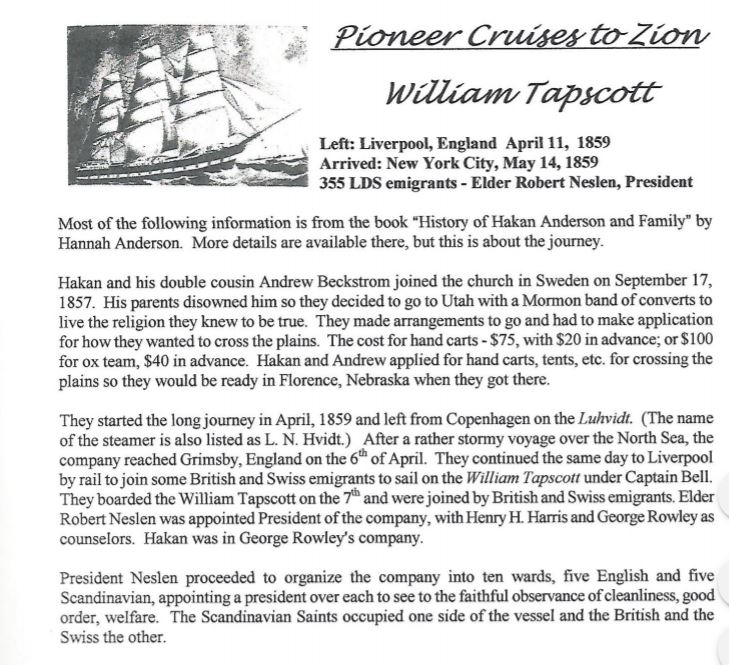
  1. Conversion and immigration of Andrew Beckstrom and his cousin Hakan Anderson from the history of Haken Anderson written by his daughter, Hanna Anderson Hanson.

Hakan Anderson had a cousin by the name of Andrew Beckstrom, who was about his own age. Two brothers had married two sisters, so Hakan and Andrew were double cousins and were always good pals. Andrew had learned the trade of blacksmith and was a jolly fellow and they had some good times together. One day his cousin Andrew came to see him and said that he had some news. He said as he was walking down the lane, he met two gentlemen dressed very nice. They passed the time of day and told him they were going to hold a meeting that night at Peter Jenson’s house. “Would you please tell your neighbors and friends about it?” they asked. “So here I am to tell you Hakan. Let’s go and hear what they have to say. I happen to think they might be Mormons, but let’s go see for ourselves just what kind of people they are.” Hakan said that he would go if the boss would let him off. They went to the meeting that night. To their surprise, the preachers read the same verses out of the Bible that they had already heard their minister read. “It must be the same Bible,” Andrew said. “The only thing, they make it sound clearer.” And it seemed to them that this must be the true Gospel. Everything that was said was good, so how could the people say evil against them. If only they would go and hear for themselves. These are the thoughts the boys had. As the cousins were walking home, Hakan said, “I want to go again, don’t you Andrew?” “Sure,” Andrew said, “Only you know what father and mother will say when they find out.” Hakan said, “The last time I was home, father gave me a lecture about the Mormon missionaries and warned me to beware of them, that they were evil and were murderers. ‘Don’t go near them, son, I am warning you,’ he said, so now I don’t know how to break the news to them. As you know, my father is a very determined man.” But nevertheless, Hakan did tell his father that they had gone to the Mormon meeting. His father said the Mormons should be horse whipped out of town. “To think they would come to Sweden to convert people,” he said, “We have the true gospel and do not want to hear anything new.” Hakan and Andrew kept going to the Mormon meetings. The more they heard, the more they wanted to hear, so on September 17, 1857, they applied for baptism and were baptized. After they had joined the Church, father was so happy that he went home to tell his parents the good news, but his father was very angry, and said, “It is too bad they didn’t tie a rock around your neck so you could have stayed under. To think those awful Mormons have come and converted a son of mine. It is enough to break my heart. Now Hakan you belong to them, go – you have disgraced our whole family. You don’t belong to us anymore. Don’t ever darken our door again.” Hakan said, “I won’t bother you again, father. Goodbye mother and all of you.” Hakan left and never saw his family again. He was thinking now of going to Utah with a Mormon Band of converts and there live the religion he knew to be true.


Per memory of Beverly Smith Berntsen (granddaughter) , Louisa walked the plains at the age of 14.


The following are quotations from the Mt. Pleasant History Book where "Beckstrom" is noted:


When the building of the Deseret Telegraph Line was in pro­gress, President Brigham Young called a number of young men to learn telegraphy. Anthon H. Lund was among those called; on his return to Mount Pleasant, he built a Telegraph office, and when the Deseret Telegraph Line was extended through the south­ern settlements, he took position as operator and also conducted a daguerreotype photograph gallery. This place became a popular gathering place for the young people of the community. The tele­graph office and photograph gallery was built on the west side of State Street about one-fourth block south between Main and First South. This site was purchased from Andrew Beckstrom by Anthon H. Lund, who paid a large clock in part payment for same. About this time, John Knudsen Sr. also purchased his city lot, giving their choice feather bed in payment


President Brigham Young's Visit


September 12th, President Brigham Young and a number of the apostles and elders visited Mount Pleasant. A suitable wagon, drawn by four fine horses, was fitted up and driven by Rasmus Frandsen and Andrew Madsen, taking the Mount Pleasant Brass Band to Fountain Green, where they met the party. Coming back by way of Moroni, they led the procession and furnished the music. James Hansen leading the band, among others who were members were John Waldermar, Daniel Beckstrom, Andrew Beckstrom, Andrew Anderson, Bent Hansen and Mortin Rasmussen.


Brass Band Organized

The following was recorded by Mrs. Louise Hastler: "In the autumn of 1869 the governor sent out a notice to the citizens of Sanpete County that a military drill would be held the first week

in November, did requested all soldiers and men that could bear arms to be ready and on hand for a three-day drill. The gathering place would be between Ephraim and Manti. All captains and officers of the Indian War organizations should be represented and also the Military bands . . . . When this notice was served the brethren wanted to make a good showing and made necessary preparations. John Hastler had arrived in Mt. Pleasant in October and brought with him a full set of musical instruments from Switzerland. Bishop Seeley and the leading brethren engaged him to organize a Brass Band at once. This was affected about the 15th of October, 1869, with John Hastler, James Hansen, Bent Hansen, John Waldermar, Andrew Beckstrom, Daniel Beckstrom. James C. Meiling, August Wall, Aaron Oman, Peter Syndergaard. Andrew Syndergaard, Soren Hansen, Lars Nielsen (Fiddler), Mortin Rasmussen, Jacob Hafen, Ulrich Winkler, Oscar Barton, Charlie Hampshire, and Paul Coates. John Hastler and Olaf Rosen­lof were chosen as their leaders. John Hastler distributed the instruments at once. In three weeks, at the appointed time, they were able and ready to play six or more of our national and popular tunes, which made a good showing for Sanpete County. Their efforts were much praised and appreciated by the visiting staff."

At these drills all the Indian War officers and soldiers wore blue coats trimmed with brass buttons. These coats were home­made, but, in the different communities there were a number of tailors as well as women who came to the various homes and made men's clothing. It is remembered that Mrs. Jepsen Stohl, as well as others, were thus employed.


An act to pension the survivors of certain Indian Wars from

January 1, 1859, to 1891 was approved March 4, 1917. Coming at this late date the majority of those who had served in the early days had passed away. The following named are those who at that time proved up in Mt. Pleasant: Martin Aldrich, Claus An­derson, C. W. Anderson, Rasmus Anderson, Oscar Barton, Rudolph Bennett, Andrew Beckstrom, Martin Bohne, Martin Brother­son, Joseph Burton, John Carlson, James Christensen, Robert Eiertson, Rasmus Frandsen, James Hendricksen, Neils Johansen, Andrew Jensen, Sophus Johnson, John Knudsen, Brigham Lee, Peter Monsen, Bennett Monk, James Olson, Ole Arlson, Olof Rosenlof, Conderset Rowe, Hyrum Seely, John H. Seely, William Seely, Olof Sorensen, John Waldermar, August Wall, Thomas Wrest, Hazzard Wilcox, Alma White, Joseph Wise, Oscar Ander­son, Wesley Bills, Joseph Coates, Henry Ericksen, Peter N. Jensen, Peter Rasmussen, Joseph N. Seely, Andrew Rolph, S. A. Barton, Edmond C. Johnson, William Olson. The last four named are living in Mt. Pleasant, in 1939, as are the widows of Martin Aldrich, Joseph Burton, Sophus Johnson, Oscar Barton, Hazzard Wilcox, John Carlson, Peter M. Jensen, Oscar Anderson and A. G. Omen.


Wednesday, April 29, 2020

Biographical Sketch of Jacob Christensen (excerpts) FROM OUR ARCHIVES


Biographical Sketch of Jacob Christensen (excerpts)


Jacob Christensen, son of Christen Petersen and Maren Thompsen, eldest of ten children, was born in Vennsyssel, Hjoring, Denmark, September 21, 1827. His father was the son of Peter Peterson and Mette Christensen. His father, Christen Peterson was born in Lendum, Jutland, Denmark and his mother Maren Thomsen was born in Napstyert, Jutland Denmark.


His boyhood days were typical of the times in which he lived. His parents earned their scanty living by fishing. When a young man he spent two years in the service of his king, as was customary. He served as a sailor.


Jacob joined the L.D.S. church in his native land on February 20, 1853 and was a traveling elder for the following two years. He married Inger Kristine Thomsen January 19, 1855. She became the mother of nine children, the eldest being born in Denmark before immigration.


In 1857 they immigrated to the United States. a perpetual emigration fund came into being through the desires of the church leaders to bring to this land those too poor to provide themselves with the transportation money which was needed.


Jacob's mother accompanied them to Omaha, Nebraska, where she died a short time later. They were compelled to stay here for two years, because of lack of funds to go further. Here, although he took whatever employment he could get at sawmills and adobe yards, they lived under the most trying circumstances. One time he was obliged to trade one shirt, of his meager supply of two, for a bushel of frozen turnips, which they boiled and then warmed up in tallow. While crossing the plains Jacob and his good wife encountered a great misfortune. Their only child died.


They located in Mt. Pleasant, among the first settlers in the fall of 1859, living in a dugout until the fort was built. Jacob helped to build the south wall of the fort, furnishing team, wagon and his own work. Homes were built against the inside walls of the fort where the settlers lived. By the fall of 1859 Mt. Pleasant had a population of 800 people.


Jacob Christensen Grave Marker

The First Ward was organized at Mt. Pleasant, July 9, 1859, by Elders George A. Smith and Amasa M. Lyman. William S. Seely was ordained bishop. Jacob Christensen became his first counselor. The Bishop and his counselors were looked upon as the leaders of the group. They were the superintendents, planners, confidant tribunal, directors, ecclesiastical tribunal, the leaders of the group, in fact the responsibility of the settlement rested upon their shoulders.


They were all busy people those days, building homes, a fort, clearing and plowing land, planting crops, building fences, canals, fighting and guarding against Indians, harvesting crops and a score of other jobs.


Thereafter, Jacob devoted much of his time to building up of this community. He was a shareholder in Mt. Pleasant's first cooperative institution and organizer of the United Order here. He served as Counselor to Bishop William S. Seely for seven years and as president of the High Priest's quorum for twenty five years.


January 14, 1865, he married Ingeborg Anderson, daughter of Christian and Karen Anderson. Ingeborg was the only daughter and the youngest of a family of four, born in Seiland, Denmark, April 28, 1846. Her father was a tailor, and Ingeborg had a comfortable childhood attending the schools of the town until her parents accepted the Latter-day Saint Church and decided to leave their homeland for Utah, where her three brothers had already settled. This was in 1862.


Plurality of wives was in flower at that time. Those who could afford two families and were worthy could get permission of the Church authorities to marry a second wife. Jacob asked Ingeborg to marry him, and after due consideration she accepted his offer of marriage. The were married, January 1865. She was 19 years of age and he was double her age, but it seems at that time, this was often the case. Ingeborg became the mother of seven children, two dying in infancy.


About this time Jacob took a very active part in the Black Hawk War, being captain of Company A, Mt. Pleasant Militia and was in several engagements with the Indians. He was also a Councilman in Mt. Pleasant's first city council.


On March 15, 1869, he married his third wife, Anna Christena Marberg, daughter of Johannes and Christine Peterson Marberg, who was born March 2, 1850 at Leitse, Gutland, Sweden. She was the second child in a family of four daughters.


They were married in the Endowment House in Salt Lake City. Their first home was the Haage home about 411 South State Street, Mt. Pleasant (now vacant). This house, built by Jacob Christensen was considered one of the finest residences of the early days.


Anna became the mother of ten children, three dying in infancy, one in youth and two in middle life.


Jacob died March 9, 1915, having been an invalid for eleven years.


Monday, April 27, 2020

F.C. Jensen Heritage Lives On At Wasatch


Frederick C. Jensen
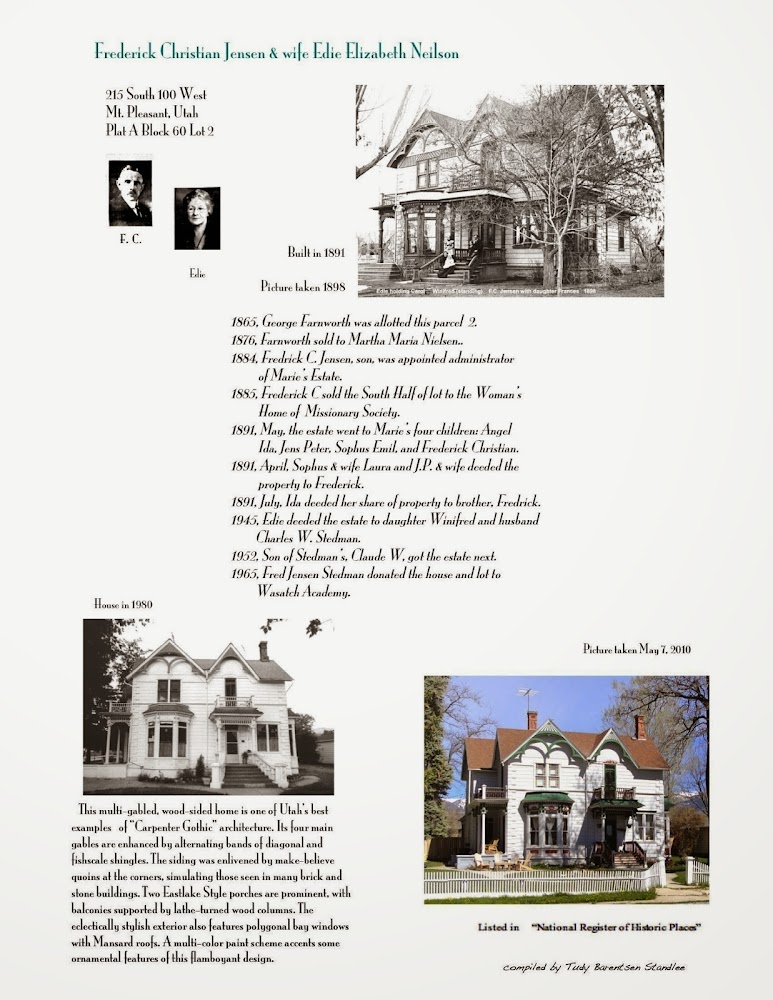
Jensen was a staunch Presbyterian, although his parents were Mormon converts from Denmark, where he was born. Apparently the family was affluent; Frederick’s mother paid for the Atlantic crossings of many poor Danish converts as well their own emigration to Utah in 1862 after the death of Frederick’s father. Jensen was a cabinetmaker par excellence who met the furniture needs of wealthy local sheep owners. His furniture store was considered the finest in the region. He helped organize the Mt. Pleasant Bank and was a sheep owner and wool marketer with a flock of some 5,000 animals. He was active in politics, served on the town council and purchased the town’s first Cadillac in 1909. He gifted his home to Wasatch Academy before his death in 1925.


found in History of Sanpete and Emery Counties p. 246; published in 1898


The Mt. Pleasant Commercial & Savings Bank was incorpo­rated with a capital stock of fifty thousand dollars, with N. S. Nielsen as President; F. C. Jensen, Vice President; Soren Nielsen acted as Cashier . History of Mt. Pleasant, Longsdorf p 171

There were fully 500,000 head of sheep owned in the county, and with Mt. Pleasant, the Queen City of Sanpete, fast becoming the commercial center, two prominent wool companies were formed. In 1893 the Mt. Pleasant Wool & Live Stock Company was organized by N. S. Nielsen, J. H. Seely, F. C. Jensen, James Larsen, W. D. Candland, A. S. Nielsen, and Richard Whittaker. This company built a large frame storehouse west of the D. & R. G. Railroad track, and shipped large quantities of wool. The other company, a similar one organized a little later, was known as the Union Wool & Live Stock Company, and did similar busi­ness with Andrew Madsen, president; N. P. Nielsen, vice presi­dent; Neil M. Madsen, secretary; J. D. Page, Simon T. 'Beck, A. J. Aagard, and C. W. Anderson as directors. Many million pounds of wool and many thousand head of sheep were shipped out and marketed.  History of Mt. Pleasant, Longsdorf pp173,174


In 1895 the Consolidated Furniture Company was organized by F. C. Jensen, with F. C. Jensen, President, and Ferdinand Clark, Secretary.  History of Mt. Pleasant p 175

During the year, (1908) the Progress Mercantile Company, which became very prominent in the business world, was incorporated with James Larsen, president; F. C. Jensen, vice president; H. C. Jacobs, secretary-treasurer; S. E. Jensen, James Monsen, Andrew Larsen, John Strom and Andrew Swenson, directors. Their place of busi­ness was established in the Equitable building, formerly occupied by the Aldrich Brothers. History of Mt. Pleasant p 183

In 1909, Dr. W. P. Winters purchased a Buick, and Frank Waldermar an E. M. F. About a year or so later, Christian Hansen purchased a ,Buick, Showman Longsdorf, a Case, and F. C. Jensen, a Cadillac. Among other early cars were those owned by Lyman Aldrich, Wallace Petty and Hyrum Merz.  History of Mt. Pleasant p 195

1894-5. Mayor, Abram Johnson; Recorder, J. D. Page ; Marshal, Thomas Braby; Justice of the Peace, Ferdinand Clark; Treasurer, H. C. Beaumann; Assessor and Collector, W. E. Watson; Councilors, N. S. Nielson, Abner Crane, Peter Matson, F. C. Jensen, W. D. Candland.  History of Mt. Pleasant p 236

1898-9. Mayor, Ferdinand Ericksen; Recorder, C. J. Jensen; Treasurer, Candace B. Wilcox; Marshal, Joseph Monsen; Jus­tice of the Peace, Andrew Neilson;" Councilors, James Larsen, William Olson, George H. Marshall, Rasmus Anderson, C. W. Sorenson, (15) F. C. Jensen.  History of Mt. Pleasant p 236

"By this time (1895) there had been built a number of modern school buildings throughout the city, but the people clamored for a Cen­tral School building, and a new modern twelve room building, at a cost of fully $20,000.00, was erected on the southwest corner, intersection of Main and First East. D. C. Jensen became princi­pal, he having served for three years previous. Mr. Jensen was assisted by the following well trained teachers: Lydia Hastier, Mary Johansen, Caroline Lovegren, John Lovegren, C. N. Lund Jr., 

Joseph Hughes was chosen principal in 1904, serving until 1907, when he was succeeded by P. M. Nielsen, who served for several years, also giving entire satisfaction. Twenty-four large and beautiful pictures were purchased for interior decoration at the school. The pictures made the halls most attractive. They were intended to create in the pupils a desire for fine art, that the homes might also be decorated with the proper kind of pictures.  "The trustees of the school at this time were F. C. Jensen, C.N. Lund, and Abner Crane. "History of Mt. Pleasant p 262

Frederick C. Jensen House

2nd West & 2nd South
Mt. Pleasant, UT 84647