Saturday, December 3, 2022

SCOUTING ON THE SKYLINE ~~~ James L. Jacobs ~~~ Photos Included

 James L. Jacobs

1052 Darling Street

Ogden, Utah 84403

Senior Citizen Division

Second Place Historical Essay


Boy Scout camping trips were never better than those we Scouts

of Mt. Pleasant enjoyed in the mountains east of town in 1920 and

1922, The five-day trips each August were filled with high adven-

- ture and great scouting activities. Hiking, swimming, fishing,

nature study, games and sports, and practicing Scout lore in a

choice mountain setting were thrilling amd stimulsting.

The first trip included thirty-two Scouts of Troop 1 - the

North Ward boys - and a mumber of men officiating. Soren M.

Nielsen was scoutmaster and Ray Riley was his assistant. Daniel

Rasmussen of the stake presidency, Bishop H. C. Jacobs, and several

other men assisted with the trip.

Teans and wagons to haul us and our gear to canp were furnished

at no cost by Joseph Seely, Daniel Rasmussen and Amasa Scovil.

We rode in the wagons on our bedrolls and tents by way of North

Creek to our camp. We walked up all the steep hills to spare the

horses.

Canp was set up on Hog Flat - a rich mountain meadow surrounded

by a forest of spruce, fir and aspen trees. Tents were pitched

on the fringe of the forest. "Pine bough beds" were made of evergreen

tranches piled deep, with the tender tips up to meke spr'ngy

and fragrant mattresses. Clear spring water, abundant firewood,

colorful wildflowers, fresh mountain air and scenery, lush fordge

for horses, and stately trees made an ideal setting for the camp.

Cleveland Reservoir furnished excellent swimming, a five-mimite

walk away. Log seats were placed around a fireplace circle where

campfire programs were held. The camp was named “Camp Heber J.

- Grant® to honor the Church President.

A bugle call at six each morning summoned everyone to a flagraising

ceremony to start the day's activities. These were carefully

planned to promote scouting principles and provide enjoyment

to all who participated.

On Tuesday a hike was made to the top of Seely Mountain..

re we repeated the scout oath, law, and motto while we viewed

the beauties of the mountains. On Wednesday we visited the Larsen

coal mine and had scouting lessons on the mine dump. Everyone went

fishing on Thursday and caught speckled trout in the mountain streanms.

On Friday we returned home by way of Gooseberry ana Fairview Canyon.

o

Each day we studied hard to learn more about scouting and

qualify for advancement in the scouting program. Twenty-five of

the boys passed tests to make them tenderfoot scouts, and several

achieved second class rank.

Both Troop 1 and Troop 2 from the South Ward participated in

the 1922 trip. Many brought their fathers along, so there were 65

boys and men in the party. J. Seymour Jensen served as camp director,

Harold Oliverson was scoutmaster of Troop 1 With Evan Madsen

as assistant; Calvin Christensen was scoutmaster of Troop 2 with

Marvin Anderson as assistant. Frank Bohne was chief cook, Harry

Ericksen was butcher, and R. W. Weech was photographer, Additional

teams and wagons were furnished by Bruce Seely, Byron Hampshire and 9

Clair Jacobsen.

Some of the boys in the party, identified from a photograph

were; Nelson Aldrich, Ray Aldrich, Waldo Barton, Willie Barton,

Elvin Bills, Ray Bohne, Allie Christensen, Barl Christensen, Theodore

Christensen, Robert Ericksen, Boyd Hafen, Lynn Jensen, Ray

Jorgénsen, James Jacobs, Ralph Jacobsen, Kemnis Johansen, Floyd

Larson, Evan McArthur, Chesley Norman, Arley Munk, Nathan Nielson,

Edgar Olsen, Owen Olsen, Paul Rasmussen, Paul Reynolds, Theodore

Reynolds, William Reynolds, John Rosenberg, Carlton Seely, Ray

Seely, Theron Seely, Clayton Sorenson, Miles Sorenmson, Gordon Staker,

Charles Wall, Wendell Wall, Aristol White and Perry Wright.

We were organized into patrols of eight Scouts each. The

patrols competed with each other in learning scout lore, in passing

advancement tests, in games and sports, and in giving stunts at

the evening campfire programs. The patrols were named for animals

or birds. I was a member of the Beaver patrol, amd we worked like

the beavers we were to be the best patrol in camp.

To qualify for tenderfoot rank the Scouts had to know the

scout law; oath, sign, salute, motto, care and history of the U.S.

flag, and tle nine required knots. When one of the boys learned

to tie the difficult carrick band knot, he danced around the camp

chanting repeatedly, "I can tie the carrick band."

We also learned safety rules, first aid to the injured, signalling

by Morse code, semaphore and wigwag, how to use knife and

axe properly, to cook on a campfire, to read maps and to use a

compass. «

Forest Ranger Merrill Nielson, who was statloned at nearby

Lake Ranger Station, and Deputy Forest Supervisor Serrin Van Boskirk

took us on a nature hike and taught us to identify many native

plants. I still remember the beautiful columbine, bluebell, paintbrush,

elderberry, wild geraniun, niggerhead, and the names of the

trees in the forest. These men also showed us how to fight and

prevent forest fires, and to keep from getting lost in the woods.

Food never tasted so good. Cook Frank Bohne and his helpers

were experts at preparing camp meals. They served mutton we got

from a nearby sheep herd, beans, potatoes, and all the trimmings,

including gallons of dixie molasses we spread on bread for dessert.

We ate each meal like it was to be our last one.

Swinming in Cleveland reservoir was a special delight and we

21l swan every day in our birthday sults. Swimming races were held,

and some of the boys passed tests for advancement, including quali-

. fying for swimming merit badges.

There was one crisis. Senior Patrol Leader Theodore Christensen

supervised the boys while they were swimming. One of the swim-

- mers came running up to Theodore with tears streaming down his cheeks

and cried, “We can't find Paul anywhere. He must have drowned."

There was a frantic, fruitless search for the missing boy, then the

boys were ordered to dress and return to camp. There in his tent,

on his pine bough bed, Paul was found peacefully sleeping.

Foot-races were held daily on the smooth slope of the reservoir

just above the water level, which made an ideal racetrack. A

baseball game was played with the boys against their fathers, and

the boys won by a small margin. We leaped and rolled and tunbled

in a large sawdust pile which had been left by an old sawmill.

After supper each night everyone gathered around the campfire

for a program. There were stories and recitations, appropriate

talks by the leaders, and peppy stunts acted out by the patrols.

But the part T enjoyed most was the lusty singing of songs. We

sang patriotic songs, church hynns, and many of the lively songs

fron the Boy Scout Songbook. We always bellowed forth our favorite

ditty, which ran something like this:


Friday, December 2, 2022

STONEHENGE ~~~ Shared byJeff McDonald


~~~~


In the 1950s, a major project was underway to restore some fallen stones at Stonehenge. This included an entire trilithon that had fallen in 1797. Even with the technology of the day, it proved to be a huge challenge and one of the largest cranes in the country had to be brought in for the job.
The specialist crane, known as a Curran crane, was built for lifting an aircraft up to 60 tons and there happened to be one nearby at Boscombe Down. The heaviest of the stones combined with its cradle weighed around 60 tons, so it was right on the edge of its maximum capability.
Crane operator David Healy remembers when he got the call to help with the restoration work at Stonehenge:
‘At RAF Boscombe Down we were preparing numerous aircraft for the Cold War … I was asked to help the crane operators at Stonehenge … I knew about cranes from the aircraft … We got into the main circle … one of the main sarsen stones had fallen down … we got it up into position and the other workers packed stones round the bottom … we got one of the lintel stones up and put up a blue stone on the way out.’

Thursday, December 1, 2022

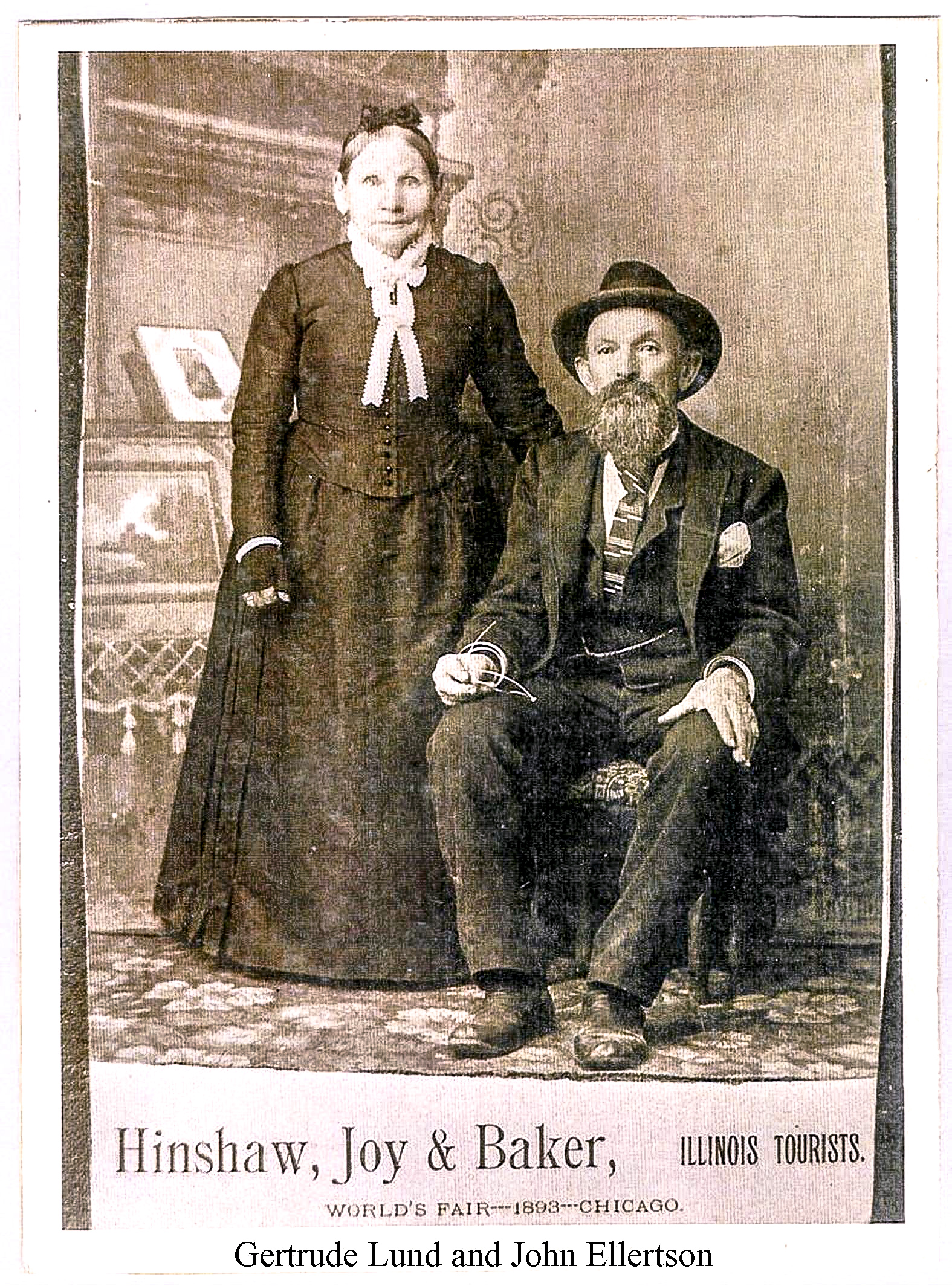
THE ELLERTSON FAMILY ~~~ Pioneers of the Month ~~~ December 2022


Even though John and Gertrude Ellertson were not listed as Mt. Pleasant Pioneers, many of their family
were.  And many of the family still live here in Mt. Pleasant.
Including Speakman, Reams, Barentsen,Syndergaard 


   HISTORY OF JOHN EILERTSEN & GERTRUDE CHRISTENA LUND


by Ephraim Ellertsen


   John Eilertsen was born on 13 September 1823 in Carlsgave, Frederiksborg, Denmark, the son of Eilert & Barbara (Schadt) Henriksen.  John’s father was a cottager and tailor in Carlsgave.   


   Eilert & Barbara’s family consisted of 10 children, 2 of them dying in infancy.  When John was seven years old his father died leaving his family of eight, with the youngest only four years old.  Because of this death, the family became scattered very young.  John left home between the ages of ten and thirteen years and went to Copenhagen where he learned the trades of blacksmithing and milling. After several years he seldom heard from his family.

  His mother lived to be 92 years old. 

On April 13, 1844 John Eilertsen married Gertrude Christena Lund, daughter of Hans Peter & Gertrude Margareth (Larsen) Lund.  To them were born seven children, the first four being born in Denmark while the other three were born in America.


  In June 1850, Erastus and Willard Snow arrived in Copenhagen as missionaries.  They became very dear friends to the Lunds and Eilertsens.  Two of the Eilertsen children bear their names as also do some in the next generation.


   Gertrude Christena Eilertsen joined the Church with the first converts.  Later that year (1850) John Eilertsen, his mother-in-law Gertrude Margareth Larsen Lund, and her children Hans Peter Lund and Barbara Christena Lund, and her step-children Lars Peter Lund and Angelica Christena Lund.


   John Eilertsen did some missionary work in Copenhagen and then, Friday morning  November 7, 1854, John, his wife Gertrude Christena, three children, mother-in-law, and Lars Peter Lund set sail for America.  Barbara Christenea Lund planned to come to America but at the last minute changed her mind and never did emigrate.  Hans Peter Lund remained to do missionary work.  He came to America in 1857 and returned on the second mission in 1860. The others believed in the Gospel taught by the elders but did not feel that it would be the right thing to give up all they had and emigrate.


  The Ellertsens spent their last night with Sophia Louise who after became the fifth wife of Apostle Orson Hyde.


   They sailed on the steamer “Cimbra”, under the direction of Peter O. Hansen.  They safely arrived at Fredrickhaven on the east coast of Jutland where more emigrants joined them.  Upon leaving there, a fierce wind began to blow.  After several days of practically drifting around, the captain, though an experienced sailor, deemed it necessary to seek the nearest harbor in Norway.  This brought them into a beautiful harbor called Mendel, surrounded by very high cliffs.  In a few days, they again put out to sea.  The captain soon learned that the change was only for a short spell.  He then decided to go back to Mendal, but could not.  They were forced to go back to Fredrickhaven, their first stopping point.  They arrived there on December 9th, 1854.  On the 20th they set sail again.  The weather was worse than ever before.  For two days the ship fought her way against the raging winds and was forced to start back.  The wind suddenly changed, and immediately they steered for Hull landing there on the 24th of December.  The following day they continued their journey by rail to Liverpool, England. 


   They were checked to sail on the ship Helios, but because of the delay, they sailed on the James Nesmith.  Captain Mills was secured for their company.  They set sail from Liverpool on January 7, 1855.  They landed in New Orleans on February 8, 1855.


They sailed up the Mississippi, arriving at St. Louis, Missouri.  In March they continued their journey to Mormon Grove, Weston, Missouri, where Norman Willard was born on the 16th of April 1855.  They remained there for six weeks.  From there they crossed the plains in Noah T. Guyman’s Company.  They arrived in Salt Lake City on September 9, 1855.  They lived in Salt Lake City on 3rd East Street between 7th and 8th South, in part of the home of Lars Peter Lund’s three daughters.  Their mother had died while crossing the plains.  Later John Eilertsen bought two lots between 9th and 10th East and 8th and 9th South Streets.  They then moved o Spanish Fork in 1856 where they bought a home. 


It was there that John Louis and Ephraim were born.  John Eilertsen’s mother-in-law died in Spanish Fork at the age of eighty in 1861.


   John Eilertsen was the first councilor to the Bishop, and his wife was the Relief Society President.  He also married a second wife, Mary Hansen, and one son was born to them, John Paul Eilertsen.


   In January or April 1863 they moved to Spring City, Sanpete County, Utah, where they again bought a home and some farming land.  From there they moved to Mona, Juab County, Utah in June of 1873.  They owned a home on the main street and kept campers and travelers and also worked in the mercantile business.  Gertrude Christena died there on March 26, 1900.  He then married Christena Burrison but lived only one and one-half years after his marriage.


Addendum:

1. From another letter, probably by Ephraim Ellertsen, states:

a. The father of John Ellertson died at age 50.

b. the children of John Ellertson were Henry Peter, Julian Barbara, 

    Hannah Rosetta, Erastus, Norman Willard, John Louis, and Ephraim.

c. Erastus died shortly before they came to America at one year of age.

d. Those remaining said the Lord had blessed them wonderfully and felt

   they should stay and take care of it

2. The fifth wife of Apostle Orson Hyde was Sophia Margaret Lyon.

3. This history as relayed through the Ellertsen Family organization indicated

    that the Eilertsen home in Mona is still standing and that it was purchased by Ray Newton in the winter of 1929 and has been remodeled.  John Louis and his wife Eveline Dinitia lived in this home, after the death of their daughter Floosie  Rosetta lived in the home.  Mrs. Ray Newton was living in the home, in 1977.

4. The spelling of the Eilertsen name was changed to Ellertson.  The descendant of  John, Paul Ellertsen took the name of Ellison.


Transcribed by Elaine Speakman


Neola Gertrude Ellertson Olson One very special spiritual experience for Neola, occurred when she was twelve years old. Because her mother was the Relief Society president, she often attended the meetings to help with the music by playing the organ. She had been taught by her mother and was quite gifted. In one of the meetings, a woman stood and spoke in tongues. She said that Neola would one day cross the waters to preach the Gospel. Another woman then stood and gave the interpretation of this prophecy. This would indeed come to pass because she later served a mission for the Church in the Hawaiian Islands. A cousin who was in attendance at this meeting would later stand and relate the events at another church function. (Neola, my grandmother, told me this story.)


George and Neola Ellertson Olsen


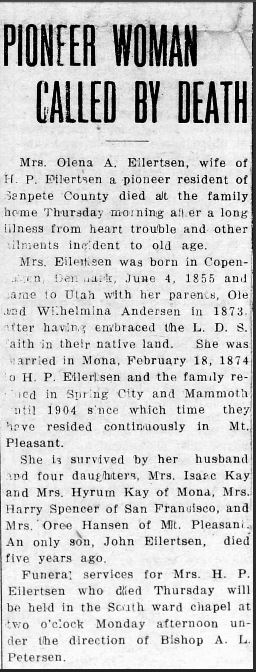
Henry P. Ellertson
A veteran of the Indian War
listed ninth from the bottom 


more information and pictures (including names)
can be found at: https://www.familysearch.org/photos/artifacts/17849010?p=40159700&returnLabel=Neola%20Gertrude%20Ellertson%20(KWCP-GDB)&returnUrl=https%3A%2F%2Fwww.familysearch.org%2Ftree%2Fperson%2Fmemories%2FKWCP-GDB


Tuesday, November 29, 2022

Robert Dean Draper (BOB) ~~~ A Mt. Pleasant Stalwart Citizen


1928 – 2022

Robert Dean Draper (Bob) passed away on Nov. 4, 2022, leaving a void in the world, and in the hearts of his loved ones.

Bob was born to Edward Clifton & Wilhelmina Christensen Draper on January 11, 1928, in Mt. Pleasant, Utah. He graduated from North Sanpete High School in 1946. He believed in hard work and at a very young age, he started logging and working in the family sawmill. They logged with large workhorses, and his dad used 2-man hand saws to cut down trees. Generations have been blessed with the sights, smells, and memories of the sawdust piles, the barn, rows of stacked logs, and fresh-cut lumber. Bob’s children, grandchildren, & great-grandchildren cherish the memories of him running the sawmill, and chainsaw.

Bob married his wife, Doris in 1949. They were blessed with 4 wonderful children: Barry, Tanna, Tammy, and Coy, 14 grandchildren, 37 great-grandchildren & 5 great, great-grandchildren. Bob and Doris were married for over 73 years and have lived in their Mt. Pleasant home for 40 years. Thru the years they have welcomed countless friends & family into their home to enjoy one of Doris’ delicious, homemade meals.

Bob has a great love for nature, animals, and the mountains. One of the mountains that Clifton, Bob, and Barry logged in was Twin Creek. Bob is known for building the road there, and over the years people built homes and gated off the road. (However, they honored Bob’s building it and provided him passage.)

Bob was a natural-born artist and loved to draw, paint and carve. In his later years, he combined his artistic talent with his skill of wielding a chainsaw. He became a renowned chainsaw carver, using only a chainsaw to carve fine details including a skewer-width Indian spear or the tender fetlock of a horse. He dominated chainsaw carving competitions and produced carvings that captured far more than met the eye. Bob has been featured in many magazine and newspaper articles, as well as TV shows. Most notably, the show “That’s Incredible” documented him carving and finishing one of his most prized pieces of art.

Bob was a devout servant of Jehovah and freely shared his beliefs. He is authentic, honest, and full of knowledge. He loved to show the kids and grandkids herds of elk or the beauty of a sunset, and he always gave credit to The Creator.

He is from “the old school” where right and wrong matter. His handshake was better than any legal document ever drafted. He had integrity, and compassion, and believed a man’s word meant everything. They don’t make ’em like him anymore!

He liked to put a smile on other people’s lips with his catchy little jokes and his sense of humor, (which he used right to the finish). When Bob was asked how he was doing he would often reply, “I’m Super Colossal” or “I’m in good shape for the shape I’m in.” Bob’s special way of wording or doing things, will continue to live through his posterity. His one granddaughter expressed it well by saying, “We try to emulate the qualities that grandpa taught us.”


Bob's friends & family are invited to share treasured memories in a way he would want to be remembered. Online condolences at rasmussenmortuary.com.

Monday, November 28, 2022

Home of Andrew Alonzo Cahoon and his wife Mary Ann Erickson ~~~ Researched and Compiled by Tudy Barentsen Standlee


Tudy is currently updating many of the homes as they have been sold and remodeled.   I love this home and spent much time there as a child when Miles and Jewel Sorensen lived there. 


Sunday, November 27, 2022

Home of William Marsh Farnworth and his wife Mary Yates ~~~ Researched and Compiled by Tudy Barentsen Standlee

Tudy is currently updating many of the homes as they have been sold and remodeled.   I love this home and spent much time there as a child when Miles and Jewel Sorensen lived there. 


Saturday, November 26, 2022

Do You Need A New Washer


Company history  *comes from wikipedia*

The Maytag Washing Machine Company was founded in 1893 by businessman Frederick Maytag. In 1925, Maytag Washing Machine Company became Maytag, Inc. Frederick's son Elmer Henry Maytag took over as president of the company from 1926 until his own death in 1940. In the early 1930s, photographer Theodor Horydczak took pictures of the plant and some of its workers.[1] During the Great Depression of the 1930s the company was one of the few to make a profit. In 1938, Maytag provoked strikes by the company's workers because of a 10% pay cut.[2] The company was able to beat the strike because of the intervention of four military companies, including a machine gun company, of the 113th Cavalry Regiment, Iowa National Guard.[3] At his father's death in 1940, Fred Maytag II, grandson of the founder, took over the presidency. During World War II, the company participated in war production by making special components for military equipment. In 1946, production of washing machines was resumed; in 1949, the first automatic washers were produced in a new, dedicated factory. In 1946, Maytag began marketing a separate line of ranges and refrigerators made by other companies under the Maytag name. During the Korean War, the company again produced parts for military equipment, although washing-machine production continued.

During the 1950s, the 'white goods,' or laundry and kitchen appliance industry, grew rapidly. Maytag first entered the commercial laundry field at this time, manufacturing washers and dryers for commercial self-service laundries and commercial operators. In response, other full-line appliance producers began to compete with Maytag in the white-goods consumer market. These included 'full-line' manufacturers such as Whirlpool, General Electric, Westinghouse, and Frigidaire, who built not only washing machines and dryers, but also refrigerators, stoves, and other appliances. Since Maytag was much smaller than the full-line producers, the company decided to limit itself to the manufacture of washers and dryers, alongside marketing ovens and refrigerators built by other companies, as a small, premium-brand manufacturer. The company capitalized on its reputation by renaming its corporate address in Newton, Iowa, "One Dependability Square".

By 1960, Maytag had ceased marketing ovens and refrigerators, but later started again to expand into kitchen appliances with its own design of portable kitchen dishwasher and a line of food-waste disposers. Upon the death in 1962 of Fred Maytag II, the last family member involved in the company's management, E. G. Higdon was named president of the company, with George M. Umbreit becoming chairman and CEO. By the late 1970s, over 70 percent of U.S. households were equipped with washers and dryers, and with approximately 18,000 employees worldwide, the company was established as a dominant manufacturer of large laundry appliances. After the company's acquisition of Magic Chef, Inc., in 1986, a move which nearly doubled its size, the company acquired a new corporate name, Maytag Corporation.

In 1988, Maytag acquired Chicago Pacific Corporation, which was formed using the remnants of the bankrupt Chicago, Rock Island & Pacific Railroad. Chicago Pacific Corporation owned Hoover US and Hoover UK as well as Thomasville Brand Furniture. Maytag quickly sold off the Thomasville Furniture brand. Maytag Corporation, led by Chairman Daniel Krumm, next planned to make Maytag a worldwide organization.[4] The UK part of Hoover was to help Maytag expand into Europe. Hoover UK was not doing well financially and offered customers a round-trip ticket anywhere if they purchased a vacuum. This campaign cost the corporation $50 million to settle. Subsequently, Maytag sold off Hoover UK. This was a huge setback for the amount of cash Maytag had in hand and thus started the downward spiral financially.

In 1991 Maytag built a new plant in Jackson, Tennessee, for the manufacture of newly designed plastic tub dishwashers. The Plastic tub was developed in Newton, Iowa, but in 1996 Engineering was transferred to Jackson because Mr. Len Hadley, then president of Maytag Corporation, wanted the plant to be self-sufficient. This engineering team engineered a Stainless Steel dishwasher, Tall-Tub Plastic and Tall-Tub Stainless steel product. Engineering crescendoed with a Double Drawer dishwasher which today is manufactured in Findlay Ohio at the Whirlpool Plant, the only Maytag legacy product built in the Whirlpool Appliance line-up. The Jackson plant evolved into a streamlined manufacturing facility that could build thousands of dishwashers daily on multiple lines. This plant was the most efficient plant and was a hallmark for other facilities. Whirlpool closed this plant in 2009.

In 1997, Maytag Corporation purchased G.S. Blodgett Corporation, a maker of commercial ovens. At the time of this purchase Maytag was looking at the Turbo Chef line they had been working on up to this point.

Prior to 1997, the Maytag engineering team, at Maytag Laundry Appliances Research and Development, developed the Maytag Neptune line of front-load washers.[5] A matching dryer was introduced to accompany the new washer. The company claimed that the new Neptune model saved energy costs over traditional washer/dryer sets. Production of the Neptune line was later switched to Samsung Electronics. In 2001, the company acquired the Amana Corporation and its appliance assembly facilities. That same year, Ralph F. Hake became the last chairman and chief executive officer (CEO) of Maytag Corporation, serving in that post until March 2006. Once renowned as the standard for laundry appliances, by 2003 the company faced increasing competition from new appliance brands in the US market, as well as from existing appliance manufacturers who had outsourced production a decade earlier in order to reduce costs.[6][7] While Maytag had begun the process of shifting appliance production to lower-cost assembly plants outside the United States, in 2004 the company was still producing 88 percent of its products in older U.S.-based factories.[8] In an apparent move away from traditional company marketing strategy, company management decided on a plan to stimulate consumer purchases of new Maytag appliances before their old ones had worn out.[9]

Costs incurred in Maytag's acquisition and integration of Amana and an increased corporate debt load led to aggressive internal cost-cutting efforts in direct materials, manufacturing, and distribution costs.[8][10] Maytag introduced a value-priced appliance line under a separate label, Performa by Maytag. To increase sales, the company also marketed Maytag-branded 'Legacy Series' washing machines that were otherwise identical to low-end Amana models, and built at the formerly Amana assembly plant in Searcy, Arkansas. The rebranded Maytag models, later termed Amanatags by dissatisfied owners, received poor customer reviews after reports surfaced of major mechanical and/or durability problems.[11][12] The company also consolidated warehouse operations and cut the number of Maytag vendors. Between 2002 and 2004, Maytag corporate management cut new-product investment by 50%.[8]

An increasing chorus of consumer complaints concerning product reliability and customer service, assisted by the rapid growth of internet consumer forums, began to affect the company's reputation with customers.[13][14][15][16] The company was also slow to react to customer complaints regarding its flagship Neptune washer and dryer line (labeled the Stinkomatic by dissatisfied customers because they would become moldy in a way that could not be easily cleaned), resulting in further damage to the company's reputation and a $33.5 million payout to settle several class-action lawsuits arising from the Neptune problems.[17][18][19][20] By 2005, Maytag's market share had declined to all-time lows, sales were flat, and customer satisfaction surveys ranked Maytag near the bottom of the appliance field.[8] The problems with the Neptune line continued; in 2007, 250,000 Neptune washing machines became part of a nationwide safety recall by the Consumer Product Safety Commission due to fire danger.[21]

In 2005, Haier sought to expand its share of foreign markets by acquiring rival white-goods OEMs and by expanding overseas production capacity. With backing from two large U.S. private equity funds, Haier made a bid to acquire U.S. appliance maker Maytag for $1.28 billion. The bid failed and Maytag was bought by Whirlpool for $1.7 billion.[22]

On April 1, 2006, Whirlpool completed its acquisition of Maytag Corporation. In May 2006, Whirlpool announced plans to close the former Maytag headquarters office in Newton, as well as laundry product manufacturing plants in Newton, Iowa; Herrin, Illinois; and Searcy, Arkansas by 2007.[23] Following the Maytag headquarters closure, all brand administration was transferred to Whirlpool's headquarters in Benton Harbor, Michigan. The Maytag name would now be used on Whirlpool-designed appliances. Most Maytag employees were terminated, but some were offered jobs at Whirlpool. The board of directors of Maytag all received five years' severance pay.[citation needed] Former Maytag chairman and CEO, Ralph F. Hake, received two years' base salary and two years' target bonus under his severance agreement.[24]

Museum exhibit in Amberley Museum. Hotpoint Maytag 'Gyrofoam' washing machine, circa 1927

On January 1, 2009, Maytag (under the ownership of the Whirlpool Corp.) changed the vested lifetime benefits of the Maytag retirees. There is a lawsuit pending in the Southern District Court of Iowa where Whirlpool has asked for permission to change the UAW bargained benefits. The benefits in question were subsequently changed despite any resolution of the lawsuit.

Chronology[edit]

YearEvent
1893Frederick Louis Maytag, his two brothers-in-law, and George W. Parsons each contributed $600 for a total of $2,400 to start a new farm implement company named Parsons Band-Cutter & Self Feeder Company. They produced threshing machines, band-cutters, and self-feeder attachments invented by Parsons.
1893Threshing machine-related injuries were all too common, and a strong need for a safer threshing machine was present. The company successfully met this need by developing a threshing machine feeder, a device which fed straw more safely into the threshing cylinder.
1902The company was the largest feeder manufacturer in the world, and, by 1904, the Ruth was the most popular model.
1905Maytag introduced the Success Corn Husker and Shredder.
1907Maytag's first washing machine, the "Pastime", was produced. F.L. Maytag decided to produce these machines during the periods of seasonally related downturns in farm-implement sales. The "Pastime" washers used a wooden tub. A dolly was turned by a hand crank via wooden pegs. This turning action would pull clothes through the water and force the clothes along the corrugated tub sides producing cleaning action. A pulley allowed the machine to be operated from an outside power source such as a tractor or a windmill.
1911A model of the Pastime with an electric motor was unveiled.
1915Maytag developed its Multi-Motor gasoline-engine washer. This allowed customers in rural areas without electricity to utilize the automatic washers.
1919The first aluminum washer tub was produced by Maytag. Prior to this, it had been believed in the industry that aluminum tub washers could not be built. This aluminum tub proved to have numerous advantages over the wooden tub, which had issues with leaking and rotting.
1920L. B. Maytag, son of the company's founder, began serving as company president.
1922Howard Snyder invented the vaned agitator. The agitator is placed inside the tub and mounted in the bottom of the tub. The concept was that, instead of washboarding or dragging the clothes, they would be gently agitated. Maytag first introduced this new washer, the 'Gyrafoam', and became exclusively an appliance company.
1924By 1924, one of every five washing machines were made by Maytag in Newton, IA.
1924Maytag introduced its first iron.
1925Maytag was listed on the New York Stock Exchange.
1926The company was now headed by Elmer Henry Maytag, another son of F.L. Maytag.
1926On October 12, five trainloads packed full with Maytag Washers were shipped out to the country. At this time, it was the world's largest single shipment of merchandise. Maytag broke its own record in May 1927, and shipped out eight trainloads.
1927Maytag had produced over a million washers.
1929Maytag realized earnings of $6,838,883, a pre-war high. Maytag also survived the Great Depression without having a loss for any year.
1934Maytag begins production of Maytag Toy Racer automobiles on October 11.
1938Maytag hit by strikes because of 10% pay cut, survives labor unrest only through intervention and backing of four troops (companies) of the 113th Cavalry, Iowa National Guard.[3]
1940E. H. Maytag died and his son, Frederick Louis Maytag II (grandson of F.L. Maytag), became Maytag's head at the age of 29.
1941Maytag Toy Racer production ends on December 1. During World War II Maytag no longer produced washing machines and instead concentrated on the war effort. From 1941 to 1945, Maytag made design improvements on, and manufactured special components for, military airplanes. These parts were used in sixteen different types of combat aircraft, including the B-29 Super Fortress, the B-17 Flying Fortress, B-26 Marauder, and the P-51 Mustang.
1946The war ended and washing machine manufacturing was geared back up in Newton, IA. Maytag began selling ranges and refrigerators.
1948Maytag's second plant was opened in Newton, Iowa. This facility manufactured Maytag's first automatic washers, the "AMP", introduced that year. This was the start of a new age in washing machines for Maytag.
1951The Korean War was underway, and Maytag built parts for tanks and other military equipment alongside the washing machines.
1953Maytag introduced its first automatic dryer.
1954Maytag's first television advertisement was aired.
1958Maytag introduced the commercial coin-slide washers used in laundromats.
1961Maytag's corporate headquarters building was dedicated.
1962Upon the death of F. L. Maytag II, George M. Unibreit became chairman of the board and chief executive officer, and E.G. Higdon was named president. The company would never again be led by a Maytag family member.
1966Maytag produced its first line of portable dishwashers. Licensed its first Maytag home appliance center.
1967Character actor Jesse White appears in the first "Maytag Repairman" TV commercial.
1972Daniel L. Krumm succeeded E.G. Higdon as Maytag president and treasurer, and two years later he was named chief executive officer.
1975Maytag introduced Maytag-equipped home style laundries.
1981Maytag acquired Hardwick Stove Company.
1983Maytag discontinued production of wringer washers, after 76 years.
1985Maytag introduced the first-ever stacked washer/dryer.
1986The Maytag Company became the Maytag Corporation. It acquired Magic Chef and Norge Appliance Company, and started selling a full line of appliances.
1987Maytag Corporation added a line of front-loading commercial washers.
1989Maytag acquired the Chicago Pacific Corporation, parent of Hoover.
1989Gordon Jump of WKRP in Cincinnati fame first appears as The Maytag Repairman.
1991Maytag contracted with Montgomery Ward & Co, who had previously sold its own brand of appliances which were manufactured by Norge Appliance Company (Owned by Magic Chef and later acquired along with Magic Chef by Maytag in 1986.) for the exclusive use of the Admiral brand (acquired in the Magic Chef/Norge acquisition) on its consumer electronic goods. (Following Montgomery Ward & Co's bankruptcy and the closure of all its stores in 2002 Admiral would later become exclusive to Home Depot after Whirlpool acquired Maytag).
1992Maytag began manufacturing dishwashers in Jackson, Tennessee.
1994Hoover introduced the first SteamVac extractors.
1997Maytag introduced the first domestically produced high-efficiency washer, the Maytag Neptune. Manufacture of these products were later switched to Samsung Electronics in Korea.
2001Maytag acquired Amana. Maytag relabels some Amana-built models with the 'Maytag' brand, selling them as Maytag products.
2002A class-action lawsuit is filed against the company on behalf of Neptune washing machine consumers.
2004Maytag Corporation announces a loss of $9 million.
2005Maytag became the subject of a takeover battle between a private investment group in the United States. (Ripplewood); a three party group composed of Blackstone, Baird and Haier Corporation, a Chinese appliance manufacturer; and the Whirlpool Corporation. On December 22, Maytag stockholders agreed to sell Maytag to Whirlpool, ending Maytag's 112-year history as an independent company.
2006On March 31, Whirlpool completed its acquisition of Maytag and began integrating the two appliance companies.