
Saturday, January 27, 2024

Friday, January 26, 2024

Thursday, January 25, 2024

Wednesday, January 24, 2024
Home of John Carter and his wife Almeda Jannette McArthur (Researched and Compiled by Tudy Barentsen Standlee)

Tuesday, January 23, 2024
Erick and Caroline Gunderson (from our archves)

Our friend, David R. Gunderson, (Now has passed on) has just published a book entitled “Erick and Caroline Gunderson’s Journey of Faith from Norway to Sanpete”. He has been assisted by a cousin, Betty Gunderson Woodbury. Both are contributors to our Mt. Pleasant Pioneer Blog. David has been working on this book for a long time. His research and personal knowledge of, not only the Gunderson family but also of Mt. Pleasant history is extensive. Betty has been working on the family genealogy and collecting items of Utah family history all of her life.
With David’s permission, we post January’s Pioneers of the Month: Erick and Caroline Gunderson, excerpts taken from the book:
In times of crisis, the fate of peoples and nations is often described as "hanging on a thread". In fact, the fate of our Gunderson family did hang by the threads that held a big black button on the foul weather smock that Erick was wearing during a storm on the North Sea. During this storm, a huge wave crashed over his small fishing boat and washed him overboard. He was able to get back to his boat, and save his life (and that of our family), because this button caught on a line or a piece of netting that was trailing out from his boat and the button's threads held.
Erick brought this button with him when he came to Utah and my Uncles Doug, Shy, and Glen recalled of playing with it when they were children. It would be nice to have this button now but it has been lost. But it must have looked like the one shown here.

The families of both Erick and Caroline lived in Riser, Aust-Agder (East-Agder) Provence, Norway, which is a small fishing and resort village located about 125 miles south of Oslo. It borders the North sea and Oslofjord. Risor was known from Viking days for its strong ships and expert seamen. Like all Norse communities, it had a tradition of Viking raids on England, France, and other parts of Europe. In the early 19th Century, Risor, though small, had become an important shipping center in Norway and roughly 100 sailing ships made it their home port. It was in this small community on August 27, 1830, that Erick Gunderson, a son of Gunder Ericksen and Annie Jensen, was born into the world.
At this time Norway was actually a part of Sweden, having been annexed in 1815 from Denmark at the close of the Napoleonic wars, after nearly 400 years of Danish rule. Opportunity for education above elementary school was not readily available to the people of Norway, unless they were a member of the clergy or of the aristocracy. The family had always been close-knit and must have had the means to allow the children to receive a little better than the average education and training. (At this time, Norway was still using patronymic names so Erick Gunderson’s father’s name was Gunder Ericksen) Not much is known about Erick’s growing up years, but he was a fisherman by trade and probably went to sea with every fishing expedition available to him in order to help meet the family’s needs.
The Aurora Borealis is seen from Norway. Erick and the other members of the family would have been familiar with these spectacular sights.
In about 1851, when Erick was 20 or 21 years old, he went to Scotland (Glasgow) to learn the trade of shipbuilding. It is not known how long he apprenticed in Scotland, but it was probably for about one year. Since English is the common language among the sailors of the North Sea, Erick must have had some command of the English language before he went to Scotland. While there, his English skills probably improved markedly. This must have aided him greatly when he came to America.
The first Mormon missionary to Norway was Elder Hans F. Petersen. He was brought to Norway by a Norwegian sea captain, Svend Larsen, of Osterrisor (Risor), who had become interested in the message of the church, while delivering a load of lumber at Aalborg, Denmark. Elder Petersen arrived on 11 September 1851 and with the help of Captain Larsen began to lay the foundation for the work on the next day. In Norway the missionaries received a mixed welcome. Some Norwegians readily accepted them and embraced the Gospel, while others tried to have them jailed or expelled.
It was to this situation that Erick returned to Norway from Scotland. Some members of his family had heeded and accepted the Gospel. Other family members were bitterly opposed. As a result, Erick withdrew from the family, decided to just ignore the Mormon problem, and married his childhood sweetheart, Inger Elizabeth Evensen on 13 January 1853. Some of her family members had also accepted the missionary’s message and joined the new Church but she apparently remained indifferent.
Saddened by his lack of interest in this new religion, his younger sister, Torbor, pled with Erick and Inger to just listen to the Elders and then decide. Finally, they agreed. He and Inger soon accepted the message and were baptized on 23 April 1853. He was the 35th member and she the 36th member added to the Church rolls in Norway according to the records. His father, Gunder Ericksen; his mother, Anne Jensen; his sister, and other family members preceded them as members. His parents joined the Church 19 September 1852. The first baptisms in Norway were on 23 September 1851. (Note that Erick’s future wife, Caroline and her blind mother Maria became the 7th and 8th members of the church in Norway on 25 June 1852.)
Svend Larsen, the ship captain who brought the first missionaries to Norway was baptized 23 September 1851 in Aalborg, Denmark. He immigrated to Utah in 1854.
About one year after they joined the LDS Church, Erick and Inger were blessed with a beautiful baby girl whom they named Anne Torine. She must have been a wonderful and welcome addition to their home.
Erick, along with other family members, heeded the call to gather in Zion. In mid-November 1854, Erick (age 24), Inger Elizabeth (23), their daughter, Anne Torine (nearly a year old), his father, Gunder (50), his mother, Anne (48), his sister, Torbor (18), his brother Jens (22), Jens’ wife Anne (22), Erick’s Uncle and Aunt Henrik (36) and Ingeborg (35) Erickson and their family, Erick Bertel (13), Torborg (10), John Andreas (5) and Ingeborg (6 months), departed their beloved Norway together. However, due to a problem with ships in Liverpool, Jens and his family had to cross the Atlantic on the next ship, the Charles Buck. Karen Dorthea and her husband Niels Johannes Petersen probably stayed in Norway to settle up the estate and to care for their grandparents Erick and Torborg, who died in 1857 and 1858 respectively. The Petersons emigrated in 1863.
One cannot help but wonder how the family members felt as the familiar scene of the Risorflekken, the large white stone, that marks Risor harbor, faded into the distance for the last time, as they sailed out into the North Sea. This would be the last sight they would ever have of their beloved hometown, Risor.
The first leg of this trip was from Norway to England. This passage was carried out on a 132-ton Danish paddlewheel steamship called the Cimbria. This voyage has been clearly described in the book “Saints on the Sea”. “There is no other body of water quite like the North Sea. It is often unpredictable, violent and treacherous - - and particularly so during the winter monts. Of all the North Sea passages made by Mormon emigrants, probably none was as terrifying as that of the small Danish steamer Cimbria. It left Copenhagen on 24 November 1854. Some 300 Scandinavian Saints were crowded on board when the 132-ton paddle-wheeler sailed out of the harbor. Although the sea was very rough, the Cimbria reached Fredrikshavn on the east coast of Jutland the following morning. There 149 additional emigrants from Aalborg and Vendsyssel joined the company, further crowding the 160-foot ship. (Our Gunderson family members probably crossed to Denmark to join this company of emigrants at Fredrikshaven.)
On 26 November the steamer resumed her voyage and the weather was fair until the next afternoon. Then a strong wind came up, and its rising fury forced the captain to seek haven in the nearest Norwegian port. He put into Mandal (formerly known as Vesterrisor), an excellent harbor sheltered by high and steep granite cliffs. Here the Norwegians offered the Saints accommodations on shore for several days until the wind diminished. The elders preached to some of the villagers, and several were later converted.
On 7 December the Cimbria once again put to sea, but the improved weather soon changed for the worse. Before the end of the day a violent storm struck. The waves became mountainous, and the wind shrieked through the rigging. Tons of water crashed over the bow, shattering the bulwarks and some boxes on deck. The captain once more sought safety in Mandal’s harbor, but the strong currents and winds made it too dangerous to head toward Norway. The vessel returned to Fredrikshavn, where she anchored on the ninth. During this storm the emigrants huddled below decks, suffering from the cold, the pitching of the ship, and seasickness. Once on shore again, a few of the less hardy refused to travel farther, but most of the Saints recovered their courage and even held public meetings.
It was not until 20 December that the captain felt the weather would permit setting out again for England. For a day the sea was favorable, but the following night the storm returned with the appalling savagery of a mindless beast. Great masses of water threatened to capsize the little steamer, and the twisting troughs between waves seemed designed to break her back. For hours the Cimbria battled the ferocity of the winds and the high seas, while the miserable passengers were too cold and sick and too busy holding on to their bunks, tables, or anything secure to think of much else but prayer and survival. The vessel, shuddering and quivering with each wave, tried to turn back for a third time. Then, in the afternoon of the twenty second, the wind veered to the north. The captain changed course and continued on to Hull. On 24 December the battered steamer with her exhausted crew and thankful passengers anchored in the River Humber. The following day-Christmas-the Scandinavian Saints traveled by rail from Hull to Liverpool, where most boarded the Yankee square rigger James Nesmith bound for New Orleans.”
The Cimbria passengers arrived a day or two too late for the ship they had been scheduled to use, and the Church Immigration Agency hurriedly located the ship James Nesmith. It was quickly equipped for passengers and on 7 January 1855, with 440 Scandinavian Saints, and one English Saint, it sailed for America. (The ship being too small for the whole company, 24 people were left to come later. Jens and his family were probably among these.) The company leader of the Saints on board both the Cimbria and the James Nesmith was Peter O. Hansen, a returning missionary. The voyage began with the ship being towed out of the Liverpool harbor down the river Mersey, past the light house and into the open sea where the sails were unfurled and a course was set for the new world.
During the winter, the prevailing winds in the North Atlantic are westerlies, and emigrant ships had to tack (sail into the wind) for most of their crossings. This results in a fairly rough and long voyage. However, crossing the Atlantic in the winter made it possible to cross the plains in the summer and this was crucial.
Many of the Mormon emigrant ships had wonderful choirs which performed during the dedication and prayer for safe journey services which were always held at the outset of each emigration voyage. One of the great gathering hymns, “Ye Elders of Israel” with its inspiring message, “O Babylon O Babylon we bid thee farewell, we’re going to the mountains of Ephraim to dwell” was one of the favorites. Both the emigrants and many of the ships officers and seamen took courage from these dedication ceremonies and the continued prayers for safe voyage. Over the 30 years of emigration by sail only one vessel, in 176 was lost.

The 1850s travel on the rivers was fraught with many dangers. Among these were diseases, especially cholera, exploitation by unscrupulous gamblers and boat personnel, running aground or being caught on a snag, sinking, falling overboard and being ignored, thievery, etc. However, until 1856, when the railheads were extended to Iowa, it was the best means of transportation available. The Charles Buck, on which Erick’s brother, Jens traveled, was the last Mormon emigrant ship to land at New Orleans. It departed from Liverpool on 17 January and arrived at New Orleans on March 14, 1855, after a 53 day passage.
Within a day or two after their arrival the Gunderson/Ericksen family began their voyage up river. Two steamboats, the Moses Greenwood and the Oceana, carried James Nesmith travelers to St. Louis, where they arrived March 7. Those who could not immediately afford passage to Salt Lake City took the steamboat Polar Star to Weston, where they sought employment.
On March 12, 1855, about 175 of the Mormon emigrants from the ship James Nesmith resumed their passage from St. Louis to Atchison, Kansas aboard the steamboat Clara. It was a trip bedeviled by delay and disease. At Leavenworth low water compelled the steamer to lay up for a time during which another Mormon company arrived. There twenty Saints died of cholera and on the way to Atchison nine more deaths were recorded. This 351 ton sidewheeler was skippered and partly owned by Joshua Cheever. A year later the Clara was sunk by ice at St. Louis.
On 25 March 1855 while the family was at Ft. Leavenworth, Kansas, Erick’s younger sister Tobor Kristine (18) married Simon Fredrick Halversen (26) from Brekke Osnoy Ostfold, Norway.
Erick’s parents, and his Aunt and Uncle, Henrik and Ingeborg Ericksen, and the rest of their family members that came on the James Nesmith, reached Mormon Grove at Atchison, Kansas in early June. There they began preparations to cross the plains and with the exception of Erick and his family, they continued west with the Secrist-Guyman Wagon Company which left from Mormon Grove on 13 June and entered the Salt Lake Valley on 7 September 1855 after a 57 day crossing. They settled in Spanish Fork and prepared for the arrival of the rest of the family.
Erick remained in Mormon Grove at Atchison, Kansas until 1856. Family records say that Inger, who was pregnant, contracted cholera. The baby, a boy who they called Earl Even, was born on 25 October and soon passed away. Inger died two days later and they were both buried at Mormon Grove. The rest of the family had left in June and it was too late for Erick to find and join a company and follow his family to Utah in 1855, so he worked to prepare to go on to Utah during the next immigration season. In 1856 he arrived in Utah during the week of the 16th of September 1856, after an 81-88 day crossing and joined the family in Spanish Fork.
A Wife for Erick Comes from Norway
Erick left Norway in late 1854 with his parents, his sisters, a brother-in-law and a small child and other family members. In 1857, two years later he was a single widower in Utah probably living with his parents. How lonely he must have been. However, things were about to get better.
As the Gundersons and other families, one by one left Risor to go to Zion, another member of the Risor Branch of the Church, Caroline Johnson, longed to go to Zion also, but she just couldn’t leave her widowed and blind mother alone in Norway. Recognizing the strong desire of her daughter to join the Saints in Zion, Maria encouraged her to go. However, Caroline always replied that she could never leave her mother alone in Norway. Finally, Maria said, “If you won’t go without me, I will have to go with you.” When Caroline asked how they could do that her mother said that “they would just face the problems, one at a time. “ In the spring of 1857, they did just that.
Maria (age 54) and Caroline (age 22) departed Norway on Saturday, 11 April 1857, with a group of saints from Christiania (Oslo), Norway and sailed to Copenhagen aboard the Norwegian steamship Viken. In a calm sea, the vessel arrived at the Danish port the following day. After a five-day delay this company-about 540 emigrants under the direction of Hector C. Haight, President of the Scandinavian Mission, boarded the Danish screw steamer L.N. Hvidt and traveled to Grimsby (just south of Hull). From that English port they traveled by train to Liverpool. Soon after they arrived in Liverpool, they boarded the ship Westmoreland.
The Westmoreland left Liverpool on Saturday, 25 April 1857 and arrived at Philiadelphia, Pa on Pentecost Sunday, Sunday, 31 May 1857 after a 36 day passage. The emigrants then boarded the train to go to the trail head in Iowa City, passing through Baltimore and Wheeling along the way.
At Iowa City, they joined the Seventh Handcart or Christian Christiansen Handcart Company which departed on 12 June and, traveling over the Mormon Trail, arrived in the Valley on Sunday, 13 Sep 1857.
One of the other passengers on the Westmoreland was C.C.A. Christensen who was a convert to the LDS faith in Denmark and had served a mission in both Denmark and Norway. Before his mission, he had studied painting and illustration in Copenhagen for several years. It is interesting to note that he lived for a time in Mt. Pleasant and took an active roll in the early developments of that community.
The Arrival of the Christiansen Handcart Company in the Salt Lake Valley
“Along the way lay the skeletons of worn out oxen, but these heroes and heroines endured …With their lips half eaten up by saleratus dust, and clothed in rags, with almost bottomless shoes on their feet, yet they greeted with songs of delight the rising sun which let them see Salt Lake City for the first time.”
“What changes have taken place since that time in less than one week our emigrants are now brought here from the Atlantic coast, where they disembark after a few days pleasant ocean voyage by steamship, while we in those days were tumbled about by sailing ships for several weeks , uncertain of the time when we could expect to see the promised land. And then the journey by land over the great, empty plains and high mountains on foot, poorly supplied with food and clothing- in short, subjected to almost every deprivation that people could bear and endure, and that for all of thirteen weeks.” (taken from Nebraska History p. 344 “By Handcart to Utah, the Account of C.C.A Christensen, translated by Richard L. Jensen)
Caroline and Erick Meet, for the second Time, and Start Life Together
On his arrival in Utah on 16 September 1856, Erick joined his parents in Spanish Fork and began to work to further establish the family in Utah. He probably worked as a carpenter and also at farming, but nothing else is known about this first year in Utah, except that we guess he was very lonely.
Caroline and her mother arrived in Utah on 13 September 1857, about one year after Erick’s arrival. As noted, they had traveled in the Christiansen Handcart Company which crossed the plains together with the Cowley Ox Cart Company in which Erick’s brother Jens Gunderson traveled. While crossing the plains, Jens and his family surely would have become acquainted with their Norwegian friends. Caroline and her mother, Maria that they had probably known for many years, maybe even from childhood, and associated with the Osterrisor Branch of the LDS Church in Norway.
Since they were friends from “home” and had crossed the plains together, it would only be natural for Jens and his family to invite Caroline and her mother to join them in Spanish Fork. Communication between family members in Utah and family members in the Midwest may have been difficult in those days, but some information must have been exchanged, if only by word of mouth. In any case it is likely that Jens knew or was able to find out where the rest of the Gunderson family was located.
How happy the Gundersons in Spanish Fork must have been to have Jens and his family safely in Utah, and to greet friends from “home”, and to get all the latest news about their friends and family back in Norway. They all must have had a wonderful reunion.
Quickly, Caroline and Erick became interested in each other and on Monday, 12 October 1857, only about four weeks after Caroline’s arrival; they were married (sealed) by none other than President Brigham Young in the President’s Office in Salt Lake City at 12:30 p.m. They were late endowed in the Salt Lake Endowment House on 22 November 1861 with B. Young, W. Woodruff, and S.L. Sprague officiating.
Imagine finding a partner from “home” in far off Utah. One that spoke your native tongue, and who remembered the Risorflekken, the midsummer festivals, the picturesque Risor Harbor, the beautiful church by the sea. One who loved all the special Norwegian foods and songs, one who knew all the old friends from “home”, and one who remembered all the other special things that you remembered from your past. Then you will know how blessed Erick and Caroline must have felt to have found each other.
On 6 September 1858, Erick and Caroline had a daughter who they named Lurine Elizabeth Gunderson. She was born in Spanish Fork and died on 28 December 1861 in Mt. Pleasant.

Considering many factors, we believe that Erick came to Mt. Pleasant in the spring of 1859. It is likely that Caroline came a bit later after the birth of her second daughter, Maria Elizabeth, which occurred on 17 Feb 1860. Therefore, Erick would have been in Mt. Pleasant to assist in building the first and second forts, to divide up the land, and to clear it for planting. They would also have participated in the defenses mounted during the Black Hawk War, probably joined the United Order and played a major role in the erection of the first Mormon Church in Mt. Pleasant. They would have participated in the building of the first plants and mills and obtaining new farm equipment.
Being a carpenter by trade, his services were greatly in demand as he helped build many of the early and later homes, churches and school houses in Central Utah. He worked on every temple that was erected in Utah during his lifetime as well as the Salt Lake Tabernacle, and for the most part, he volunteered his services.
Erik passed away in his 68th year on Monday, 1 March 1898. He was an honest upright man, respected by all. He was the father of eleven children with his wife Caroline. He also had two children with his first wife, Inger. Both passed away early along with their mother durin emigration.
Caroline Johnson Gunderson passed away March 23, 1903 in her 73rd year. She was a respected pioneer who had crossed the plains with the7th handcart company.


Monday, January 22, 2024

Sunday, January 21, 2024

Saturday, January 20, 2024
Friday, January 19, 2024
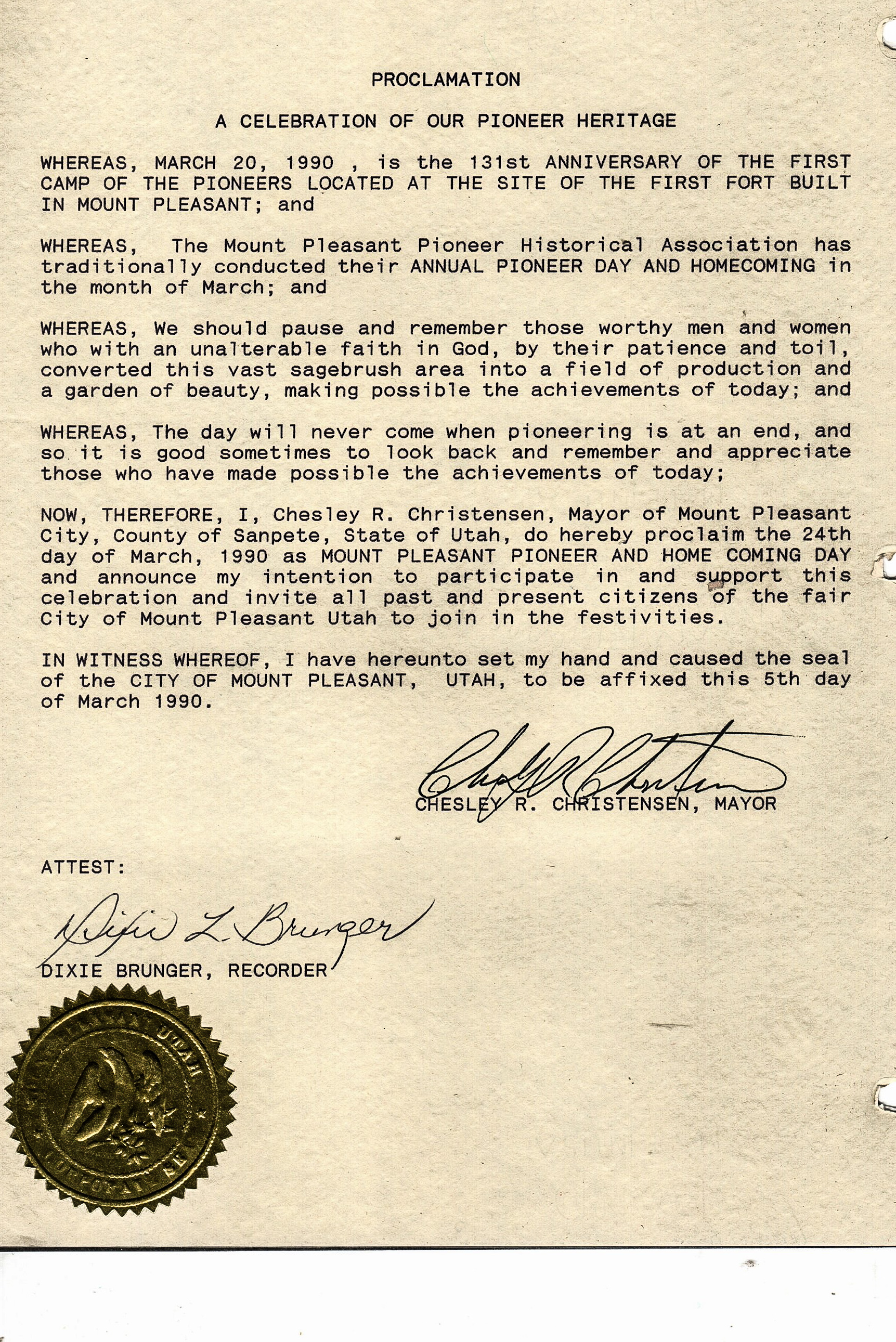
MAYOR'S PROCLAMATION ~~~ 1990 Pioneer Day

Dean and Evelyn Johansen would always furnish the Chicken Dinners.
Thursday, January 18, 2024

Wednesday, January 17, 2024
WORDS OF YESTERDAY ~~~ Poem written by Owen Sanders
I remember Owen as a salesman. When he was up this way in Sanpete County he would stop and say hello. He was a salesman for Scholzen Products in Hurricane. He knew that I (Kathy) was a descendant of Moses Martin Sanders and that made us distant cousins.
He was well known for his poetry. Many poems of his can be found on our blog.
 |
| Owen Sanders |
Words we used in 'Olden Days'
Today, we'll bring them back again
And place a few in rhyme.
Singletrees and neck yokes
Doubletrees and blinders,
Belly band and martingale
Tug chains lines and binders
Bolsters bows and reaches
Stay chains, tongues, and thimbles;
Fellies, spokes and kingpins
Croupers, hames, and spindles
Chimneys, wicks, and tallow
Sadirons, flatirons, trivets;
Scrub boards, churns, and dashers,
Half soles, brads, and rivets.
Steelyards, toils, and tally sticks
Snath and Scythe and sickles;
Grindstones, rasps, and cradles
Spigots, barrels, and pickles.
Thunder mugs and cauldrons
Hearths and blackened kettles;
Woolen dyed with walnut--
Horsehair padded settles.
Brigham Tea and Pine Gum Salve
Golden seal and yarrow;
Shampoo soap from yucca roots
Hardwood teeth for harrow.
Plodding ox and stubborn mule
Buckboards, carts, and sleds;
Ising glass for windows
Rawhide springs for beds.
Corn shucks for the mattress
Straw and limbs for sheds;
Logs for rustic cabins
Shakes for roofs o'er heads.
Button shoes and button hooks
Muffs and padded bustles
Petticoats and bloomers
Hatpins shawls and ruffles.
Weaving, braiding, plaiting
Knitting, netting, tatting;
Stitching, darning, quilting
Carpet rags and batting.
We could write in endless rhyme
Until all heads were reeling
But we believe we've said enough
To give an Old Time Feeling !!!


Tuesday, January 16, 2024

Monday, January 15, 2024
Lone Tree Shrine
The following Comes From Wikipedia
 Material in the Utah History To Go site may be reprinted for non-commercial, educational, or media use. All that is needed is to acknowledge the Utah State Historical Society.er 1997, 265-Monument near the site of the Lone Cedar Tree. | |
 | |
| 40.7625°N 111.8738°W | |
| Location | 720 East Ashton Avenue Salt Lake City, Utah United States |
|---|---|
| Designer | Central Company |
| Completion date | July 4, 1933 |
| Restored date | 1960 |

The Lone Cedar Tree is a historical monument located 600 East between 300 and 400 South, near downtown Salt Lake City, Utah, United States. According to Mormon Pioneers, it was the location of the only tree growing in the valley in 1847, when they arrived. On July 4, 1933, the Daughters of Utah Pioneers erected the monument to honor the Mormon heritage and history of Salt Lake City.
Monume272.nt[edit]
The tree was fenced in to protect it from vandals in 1924.[1] The monument was erected in 1933.[2]
Plaque[edit]
A plaque on the monument reads "The street to the north was originally Emigration Road - the only approach from the East. Over this road the pioneers of 1847 and subsequent years entered the valley of the Great Salt Sea. They found growing near this site a lone cedar and paused beneath its shade. Songs were sung and prayers of gratitude offered by those early pilgrims. Later the cedar tree became a meeting place for the loggers going to the canyons, children played beneath its branches, lovers made it a trysting place. Because of its friendly influence on the lives of the early men and women, the site is dedicated in their memory."[3]
Vandalism[edit]
On the evening of September 21, 1958, vandals cut away the remaining trunk on the memorial, leaving only a flat stump. A $100 (equivalent to $1,014 in 2022) reward was offered by the Daughters for return of the missing part.[4] Ashes supposedly from the stolen tree were found later in a bus locker.[5][6] However, the ashes proved to be from a Douglas fir.[7] A bronze replica was installed in its place.[8] The stump was later sawed off and stolen.[9] The monument is still standing.
UTAH HISTORY TO GO
http://www.sltrib.com| Will Bagley | |||||||
| Published: | 07/23/2000 | Edition: | Final | Section: | Utah | Page: | B1 |
One of the most colorful fights over Utah's history--the Battle of the Cedar Tree Shrine--concerned what the Salt Lake Valley looked like when Brigham Young first saw it 153 years ago this Monday. Salt Lake City schoolchildren used to be taught that the only tree growing in the valley when the Mormon pioneers arrived was a cedar (actually, a juniper) standing in the middle of what is now 600 East just below 300 South.
Several 1847 journals reveal this simply wasn't so. The clerk of the Pioneer Camp, Thomas Bullock, wrote that the "very extensive valley" was "dotted in three or four places with Timber." But facts seldom get in the way of a beloved legend, especially one that celebrated the belief that the Mormon pioneers found a wasteland and made the desert "blossom as a rose."
True or not, the Lone Tree tale was enshrined in bronze on Pioneer Day in 1934 when the Daughters of Utah Pioneers erected a columned "peristyle" shrine around what was left of the cedar on the median of 600 East. A plaque told how the pioneers of 1847 paused beneath the shade of the lone cedar to offer songs and prayers of gratitude. The 1847 Mormons actually missed the tree by a mile, since they followed the Donner Party trail to present-day 1700 South and took "a strait road to a small Grove of Cotton Wood Trees" on City Creek at 300 South and State streets. This is only one of several "stretchers" enshrined on the marker, including the unlikely proposition that the tree was a favorite "trysting place" for lovers.
But then, on the evening of Sept. 21, 1958, sometime before 11 p.m., someone sawed off and absconded with the Lone Tree. The Daughters' president, the redoubtable Kate Carter, noted how hard the society worked to preserve old relics and how discouraging it was when "vandals come along and tear down our good work."
That might have been the end of the story had not an enterprising reporter phoned A.R. Mortensen, head of the state historical society. "Kind of secretly," the reporter asked the state's chief historian if he believed that the cedar was the only tree growing in the valley in 1847. Mortensen burst out laughing and asked, "Hell no, do you?" That afternoon the front-page of the Deseret News claimed he had called the revered Lone Tree "a historical fraud" and "a dead stump with little historical value."
These offhand remarks ignited a firestorm and brought down the wrath of Carter and 300,000 Daughters on Mortensen's unsuspecting head. The controversy nearly cost him his job and led the historical society's board to denounce the "wanton destruction" of the Lone Tree and censure Mortensen's "unfortunate comments." Mortensen stuck to his guns. He was, after all, right. The combatants eventually patched up their differences and when Mortensen wrote Carter's obituary, he saluted her as "a great and noble lady."
The Lone Stump monument still stands, graced by a 1960 plaque that acknowledged there were other trees in the valley in 1847.
But there's a part of this tale that has never been told in print--the solution to the mystery of the stolen cedar. Not long after the desecration, Salt Lake Tribune Editor Art Deck got a call telling him to check a locker at the Greyhound Depot if he wanted to know the fate of the Lone Tree. Inside the locker was a sack containing the ashes of one of Utah's most beloved landmarks.
_________
Will Bagley is a Utah historian and writer. For more on this story, see Gary Topping's article in the Utah Historical Quarterly.
_________
Will Bagley is a Utah historian and writer. For more on this story, see Gary Topping's article in the Utah Historical Quarterly.
Material in the Utah History To Go site may be reprinted for non-commercial, educational, or media use. All that is needed is to acknowledge the Utah State Historical Society.er 1997, 265-272.
Subscribe to:
Posts (Atom)