Taken from History of Mt. Pleasant by Hilda Madsen Longsdorf
pp 308-313
"PIONEER MEMORIES"
By Swen O. Nielson,
1934
I am very happy to be with you on this occasion, for the purpose of allowing our minds to revert to the days when that noble band of pioneers had the fortitude to start this settlement
I came here in September 1863; four and one-half years after the first pioneers came. There are some outstanding features in connection with this settlement that I cannot forget. It takes my memory back to the time when I was a poor immigrant boy.
My mother left Denmark with three children, I being the eldest. We left my father and elder brother to come two years later. We buried my sister on the Plains and mother gave birth to a boy a few days after we arrived here. Mother lived wherever she could
I was away working for my board most of the time, as we were absolutely poverty stricken.
Mother had a hard time of it. Had it not been for the generosity of the people here she could not have pulled through-but she never suffered more than other people.
Mads Anderson was an old friend of ours from Denmark When we came he was building a house and he promised that when it was completed we could live in it for the winter.
The way he built it was this: He staked it out. Then he put down a layer of mud. When that was dry he put on another layer of mud, until he had it up to the square. Then he laid the gables and put the ridge poles on, then small poles and birches were laid over these, and then straw and dirt was put on top of the poles and birches. There was no floor in the house. It had one door and two windows. No lumber was used except for the door and windows. It was a one-room house with a large fireplace in it. Large sagebrush was the only fuel we had. The two families lived there all winter.
I was in Ephraim most of the time.
Mother took up a city lot. Our first home was just across the street, south of the Second Ward Schoolhouse, First South and Third West. No one cared for this lot as it had two hollows running through it. The generous people of Mt. Pleasant built her a house on this lot. It was on a hill, part underground. There were logs on top, covered with earth roof and the floor was also of earth, but it was a home and a sweet home at that.
I had my first pair of shoes in Utah in the fall of 1865, after my father came. The leather was tanned by an old man named Larter, who lived just one block west of your meeting house. A shoemaker made my shoes. The hair was not all off the leather. I had them on during the first snow storm. The water went through the leather, and the shoes stretched so much that I kicked them off. They dried during the night and that shrunk them up so that I could not get them on until after I had soaked them up.
My mother made a few candles by dipping wicking into warm tallow. When completed they were one-half an inch at the top and one and one-half inches at the bottom. Mother gave me one of them and it was accepted as my ticket for the theatre. When I went to the theatre, I would go out just before the play was over. They would give me a pass-out ticket. I would go home and the next play I would pass in on my ticket. This worked most of the winter until they changed door keepers and thus ended my theatre going.
Remembering all the kindness which was showered on us, I would be an ingrate now not to have a feeling of love for those sturdy pioneers. In. discussing the early settlement of Utah, It must be borne in mind that this territory was settled under different circumstances to that of any other. We were far away from
civilization, in a wild country, with many Indians to feed or to fight. Hence it was necessary to build in colonies and work together. Since that time and having had experience in pioneering. I have marveled at what was done in the three and one-half years before I came.
I can imagine a caravan in the spring of 1859) pulling in on Pleasant Creek.
Let me here describe the home-seekers of that day. Usually the wagon was drawn with two yoke of oxen. The wife and children sat in front with their bonnets on. There would be the rifle and powder horn hanging in the bows of the inside, and a plow and harrow on the outside, with two boxes tied to the rear of the wagon, containing two or three pigs and a dozen chickens; the cat being held by the children. The older children drove the loose stock. This will about describe or give you a picture of the first settlers of Mt. Pleasant.
I imagine about the first thing they did was to wander through the brush and select a site for the future city. They had a splendid man and pioneer at their head, and whatever he decided was accepted.
I assume that the first thing that was done was to make a survey of lots, numbering them, and then they drew lots for the lots. Next would be to grub their lots and get some cottonwoods to build a pig pen and chicken coop. Then the building of the roads into the canyons to get out poles and house logs and timber. Next they would be making ditches and fencing and surveying the field land and clearing the lands.
Women in many instances drove oxen. Sarah Scoville drove her own ox team from the Missouri River, thereby getting the name of Captain Mac. Women and children raked the wheat into bundles and bound them. Women always did their full share.
The usual thing was for all to be out of flower by harvest. The first wheat to ripen would be cut and put in the sun to dry, then trodden out with oxen and horses. We had no threshing machines then. Our grain would be threshed out by oxen and horses, then put through a fanning mill run by hand. Our houses were generally dirt floor and dirt roof.
When I moved to Fairview in 1867, there were only. three houses with shingle roofs. Many lived in dugouts. We had no machinery; all hay and grain was cut by hand. I have seen blacksmiths stand and make nails by hand. It would seem nowadays a slow process. But when you think of it. it had to be done, as a few nails had to be used. Hales and pins could not be used in all places.
In 1867, when our meeting house was built at Fairview, we paid a big price in Salt Lake for nails. Many no doubt will wonder how we obtained them. This probably was not so bad during the gold rush to California and the rush to Arizona. The Indians set fire to the grass on the plains and burned many trains, leaving nothing but the track, which was free to all. Plows were made from the tires.
We had to live on what we produced. The women and girls carding and spinning the yarn; others doing the weaving. Color did not cut much figure; warmth and wear then were the essentials.
If we broke a wagon wheel, we would go to the mountains and get maple and make spokes. The people were a group of self-supporting people in nearly all respects.
We had no such thing as a butcher's shop. We could not kill the cattle, as the steer calves were needed for oxen and the heifers for cows. We did have some pigs to kill in the fall.
Besides our own burdens, we had other troubles. We had to feed or fight the Indians. We sent eight or ten young men with as many wagons, with four yoke of oxen to the wagon, after immigrants. About six hundred immigrants were brought in and had to be cared for.
As we had no hay, we had to haul it from Chester with our ox teams. This was a very slow process.
But with all our hardships, we were happy. We had no social classes. We were all on a level. All rejoiced together and all shared each other's sorrows. The success of the colony can be summed up in this way:
The unity of the community-their faith in God and men; their willingness to do their share of all public work; their generosity to the needy; in fact, they lived as one family, never complaining, but all willing to put their shoulders to the wheel and push. There was never any bickering or fault finding with the leadership; they all pulled together. In unity there is strength.
I have a few observations which I made here in early days.
There was an old Englishman by the name of Lee, who lived here.
He was the father of Brig Lee; he was working at a shingle mill. In some way he got his arm in the machinery, and it was crushed. He was taken to his home. I happened along about that time. I stood on the outside, so I could hear all that went on. As we had no doctors or anesthetics, the crudest method had to be resorted to. Mr. Lee was placed on a table. Four men held him. Old man Tidwell performed the operation of amputating the arm. After it was over Mr. Tidwell described in detail the operation. It took forty minutes. It was terrible to hear the screams of this old man. It still lingers in my memory. All the tools they had were a knife and a meat saw. The old man recovered and lived many years after.
There was no real post office in Mt. Pleasant when I came here. Moroni was the nearest real post office. From there it would be hauled by anyone who happened to be coming here and be distributed in some way to the people. At that time letters could be sent from foreign countries and the amount collected at its destination. When my mother received word that a letter was there for her, she would skirmish around and raise the money. then walk to Moroni and get her letter. As I recollect, it was Mrs. David Candland who was the first postmaster.
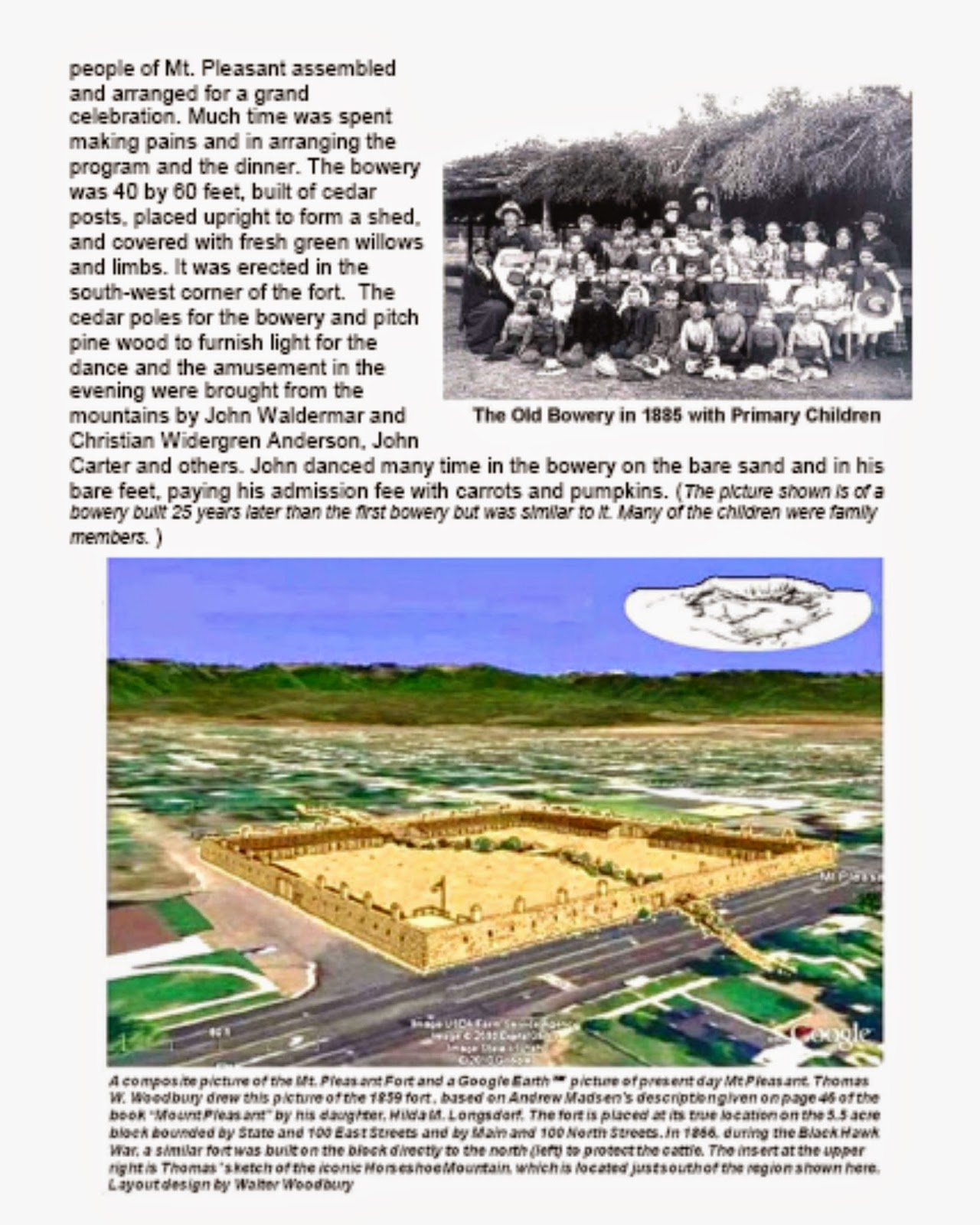
I attended the organization of the first Sunday School. A man by the name of Stansforth, who was managing a little store for Jennings and Sons, was the organizer. It was held in the old Bowery. Our seats were all made from heavy slabs with five two. inch holes with oak stakes driven in for legs. Four of these benches were set in a square. The teacher would sit in the middle of one of these. I belonged to the Bible class with Anthon H. Lund as the teacher.
This same bowery was used as a dancing pavilion. Many danced barefooted and enjoyed themselves.
I desire to mention one incident which I saw. You have all heard about smoking the pipe of peace. This, with the Indians, was like the white men putting his seal on a public document. Our Indian War closed by the Treaty of Peace in the fall of 1867. In the spring of 1868. Sowiette, the chief of all the branches of the Utes, came and camped one-half mile west of Fairview. He sent word to Bishop Tucker to call on him. At that time I was living with Bishop
Tucker. We took some lunch to him and an interpreter with us. After lunch, the chief ordered his pipe, filled and lit. He took a puff, then handed it to the Bishop, who took a puff. This was continued until it was all smoked. During all this time a continued discussion was going on regarding the Black Hawk War. The chief expressed himself as being very much opposed to the war. He promised he would do all in his power to prevent further hostilities. I think Sowiette was the oldest living man I ever have seen. His hair was absolutely white; he was blind; and he was rather slender, about six feet tall.