Showing posts with label Harbro. Show all posts

Sunday, July 9, 2023

The COPENHAGEN DISTRICT Of Mt. Pleasant (From our Archives) taken from Knudsen Chronicles page 59

COPENHAGEN DISTRICT

The Knudsen family lived in the southwest quarter of town, called the
"Copenhagen District" 
 because so many Danes made their homes there.
 An interesting culture developed.  Because there 
were so many Sorensens, Madsens, Olsens, Hansens,
 Rasmussens, Jensens, etc.,
 nicknames based on former hometown,
 physical characteristics, or a humorous happening 
became common.  For instance, 
James Christensen, 
who came from the town of Hobro, was commonly called
James Christensen Harbro.  
Ole Sorensen, who said the word 'absolutely' often, 
was called Ole Absolutely
 Examples of other amusing names were
Olaf Coffee Pot
Chris Golddigger
Stinkbug Anderson
Fat Lars
Dirty Mart
Alphabet Hansen, 
Bert Fiddlesticks,
Otto By-Yingo Anderson
Pete Woodenhead, 
Long Peter
Little Peter,
Salt Peter,
Shimmy Soren
and Shingle Pete.

The Word of Wisdom was not stressed so much at the time, 
so they followed the customs of their homeland and
 continued to drink coffee and homemade brew called 
Danish Beer. 
 Symbols of hospitality were the coffee pot simmering
 at the back of the stove and freshly-made cinnamon buns
 or cookies covered with a colorful cloth waiting to be shared.  
If anyone chided them, they commonly replied with a smile,
 "Brother Joseph never meant the Word of Wisdom
 for the Danes."

One Dane explained, "Not all the goot tings should 
be left to the yentiles."

Preaching at a funeral of a friend, a Dane said, 
"He has gone to Heaven where there is no sorrow, or pain, 
or Word of Wisdom."

The Danes had a great ability to laugh at themselves: 
"The Danes of Mount Pleasant, it was said, 
had pretty wives, 
while the Swedes had homely wives. 
 The reason:  
the Swedes were hard workers, while the Danes
 loafed around and picked out the 
pretty girls when they came to town."

At times, old prejudices from Europe caused
 problems, but laughing about it seemed to help 
defuse anger:  "A Dane and a Swede were arguing 
about the virtues and vices of the two nations.  
As the argument reached its peak, the furious
 Swede demanded, 'What could be dirtier than 
a dirty Dane?' To which the Dane triumphantly 
responded, 'A clean Swede."'

Monday, January 19, 2015

Tales of Copenhagen District ~ Southwest Quarter of Mt. Pleasant


Written by Eli A. Day           


Joseph Page and Joseph Day taught one winter in the second ward schoolhouse. I went to their school. We called that part of the town Copenhagen because so many Danes lived there. There was some rivalry between the Danish boys and the English or Americans, so we had to wrestle and scuffle to see who was champions. Sometimes it was fights. I managed to throw down a very tough match, the champion of Copenhagen, a boy my own age and size, but got through the winter without any fights. In fact, I do not remember having a real fight at any school. When the end of the school was near, Joseph Page examined our class, (I was then in the third reader) and said I was the best in the class. He promoted several of the class to the fourth readers. We were not classed in grades, but in readers. Our books were primmer, first, second, third, fourth, and fifth readers. We had about three spelling classes. No other lessons [were] taught in classes.

One night, while playing in the streets of the old town, my crowd heard a racket down in "Copenhagen," so we went down to see and enjoy the fun, but it came near not being fun, for we found a crowd of boys abusing a few girls that were with them. We promptly demanded that they stop their abusive talk and actions. They wanted to know who we were, and we told them we would soon show them who we were if they did not let those girls alone. We nearly had a battle royal on our hands, but they concluded to behave themselves. This does not mean that the boys of that part of the town were any worse than those in other parts, for there were hoodlums in every quarter of Mt. Pleasant.

One night, while playing in the streets of the old town, my crowd heard a racket down in "Copenhagen," so we went down to see and enjoy the fun, but it came near not being fun, for we found a crowd of boys abusing a few girls that were with them. We promptly demanded that they stop their abusive talk and actions. They wanted to know who we were, and we told them we would soon show them who we were if they did not let those girls alone. We nearly had a battle royal on our hands, but they concluded to behave themselves. This does not mean that the boys of that part of the town were any worse than those in other parts, for there were hoodlums in every quarter of Mt. Pleasant.

Another time the crowd I was with heard an awful racket nearly in the same part of "Copenhagen." So down we went to enjoy the fun. We found a large gang of boys around a wagon with a hayrack on it in the street. There were boys there, I guess, from nearly all parts of the town and such a shouting as they were making. They had been in to Foutin's melon patch, but had found it bare. "Bring out your melons! Where have you hid your melons? Don't be so stingy." And even worse things were being shouted by the disappointed crowd of would-be pilferers.

I had been there only a few minutes when the house door opened and out came Mr. Foutin. Hoop! Skat! How that crowd scattered and ran. I soon found myself standing alone by the wagon and rack. Thomas Foutin came very quietly up to me and spoke very nicely to me. I told him I had heard the noise from up in town and had come down to see what was going on. He said the crowd had been there for about an hour, running through the garden and corrals and stables, shouting for melons, but he could not give them any for his melons were all gone. He made no threats, but wished the crowd would go away or keep quiet so that he could sleep.


THE DANES IN MT. PLEASANT (taken from Knudsen Chronicles page 59)

COPENHAGEN DISTRICT

The Knudsen family lived in the southwest quarter of town, called the "Copenhagen District" because so many Danes made their homes there. An interesting culture developed. Because there were so many Sorensens, Madsens, Olsens, Hansens, Rasmussens, Jensens, etc., nicknames based on former hometown, physical characteristics, or a humorous happening became common. For instance, James Christensen, who came from the town of Hobro, was commonly called James Christensen Harbro. Ole Sorensen, who said the word 'absolutely' often, was called Ole Absolutely. Examples of other amusing names were Olaf Coffee Pot, Chris Golddigger, Stinkbug Anderson, Fat Lars, Dirty Mart, Alphabet Hansen, Bert Fiddlesticks, Otto By-Yingo Anderson, Pete Woodenhead, Long Peter, Little Peter, Salt Peter, Shimmy Soren, and Shingle Pete.

The Word of Wisdom was not stressed so much at the time, so they followed the customs of their homeland and continued to drink coffee and homemade brew called Danish Beer. Symbols of hospitality were the coffee pot simmering at the back of the stove and freshly-made cinnamon buns or cookies covered with a colorful cloth waiting to be shared. If anyone chided them, they commonly replied with a smile, "Brother Joseph never meant the Word of Wisdom for the Danes."

One Dane explained, "Not all the goot tings should be left to the yentiles."

Preaching at a funeral of a friend, a Dane said, "He has gone to Heaven where there is no sorrow, or pain, or Word of Wisdom."

The Danes had a great ability to laugh at themselves: "The Danes of Mount Pleasant, it was said, had pretty wives, while the Swedes had homely wives. The reason: the Swedes were hard workers, while the Danes loafed around and picked out the pretty girls when they came to town."

At times, old prejudices from Europe caused problems, but laughing about it seemed to help defuse anger: "A Dane and a Swede were arguing about the virtues and vices of the two nations. As the argument reached its peak, the furious Swede demanded, 'What could be dirtier than a dirty Dane?' To which the Dane triumphantly responded, 'A clean Swede."'

Tuesday, September 2, 2014

Andrew Madsen's Journal ~ Malitia Organized, Thrashing Machine, Brigham Young Visits

Andrew Madsen


On July 15th,   General W. S. Snow was put in command of the Sanpete District and ordered against the Indians.  Three companies were at once organized at Mt. Pleasant and officers appointed.  Company "A" with Frederick Neilson, who resigned later and Lauritz Larsen succeeded him.

Company "B" with Jacob Christensen as Captain and myself (Andrew Madsen), First Lieutenant.  "Home Guard" called the Silver Grays consisted of the elder men with John Tidwell as Captain.

While the organization of the Militias were being effected throughout the county, Robert Glisby and Anthony Robinson were attacked and killed by Indians in Sevier County. Glisby being a resident of Mt. Pleasant was brought here for burial.

General Snow, with Captain Ivie, Orange Seely, Peter Christofferson, Aaron Bennet, George Frandsen, W.W. Brandon, Joseph Gleddel, Jefferson Tidwell, William Stevenson and Neils Madsen from Mt. Pleasant and a number of others from other settlements at once started and on July 16th surprised a party of hostile Indians in Grass Valley.  Twelve of them were killed and the balance were routed.  The command then went east to Green River.  Robert Bennet swam over the river, found Indian tents and wikiups, which had just been vacated by the fleeing Indians.  They suffered much of the journey by long marches and for want of supplies.

July 26th,  the raging savages raided Glenwood, Sevier County, wounding some of the settlers and killing a number of horses and driving away nearly all the cattle belonging to the people.

On July 30, 1865, we organized a Sunday School.  H. P. Miller became Superintendent and A.H. Lund became Church Recorder.

August 6th, a meeting was held at Manti, consisting of the Bishops throughout the county and several of the authorities of the militia.  It was decided and agreed to have a standing army and pay the men for their services.

John Ivie was appointed Commander of the Militia in the northern settlements of the county.

Charles Durkie, Utah's first Governor, commissioned the officers and captains.  The system of paying the men was by assessment upon the settlers.  My portion was $75.00 per year.  Some of the men could not fit themselves out.  We were ordered to let them have such articles as they could use and receive credit for it.
Besides the above assessment, I furnished them a horse, bridle and saddle, kept it on hand for them and together with this, One Ballard Rifle and one cap and ball revolver.  Others did likewise.

After being equipped, the Company at once started south on Indian Campaigns, while the Home Guards remained at home, and were called out by the call of a bugle to answer to roll call and some detailed for Guards each day.

The Militia was also called out at various times during the three years of their services, for encampments and inspections, which were held at Chester, Ephraim, and Manti.
Sunday School commenced at Mt. Pleasant August 6, 1865 with 150 scholars: Joseph Stanford, Superintendent; George Farnworth, Edward Cliff, Germia Page, A.H. Lund, Mrs. Charlotte Hyde, Mrs. Susan Holly, S. Anderson, and Miss Jeanette McArthur, teachers.  Previous to this, George Farnworth had taught in the bowry as early as 1860. 

Another Visit from Brigham Young


First Thrashing Machine

During this season the first imported thrashing machine was brought into our city.  The name of it was "PITTS".  It was manufactured in Buffalo, New York.  It was shipped up the Lawrence River and around by way of South America around to San Francisco in a sail vessel and from there it was hauled overland by Alma Bennet to this point, being several months on the way.  

It was ordered by C.W. Anderson, Peter Madsen, Hans Y. Simpson, Rasmus Frandsen and myself, Andrew Madsen.

November 1, 1865 a number of missionaries were called to settle Muddy (now in Nevada).  John L. Ivy, Paul Stark, Peder Nielson, C.P., Larsen, James C. Harbro, George Merrick, Bendt Hansen, Martin Rasmussen, Soren Jacobsen and Hyrum Winters.


Thursday, July 1, 2010

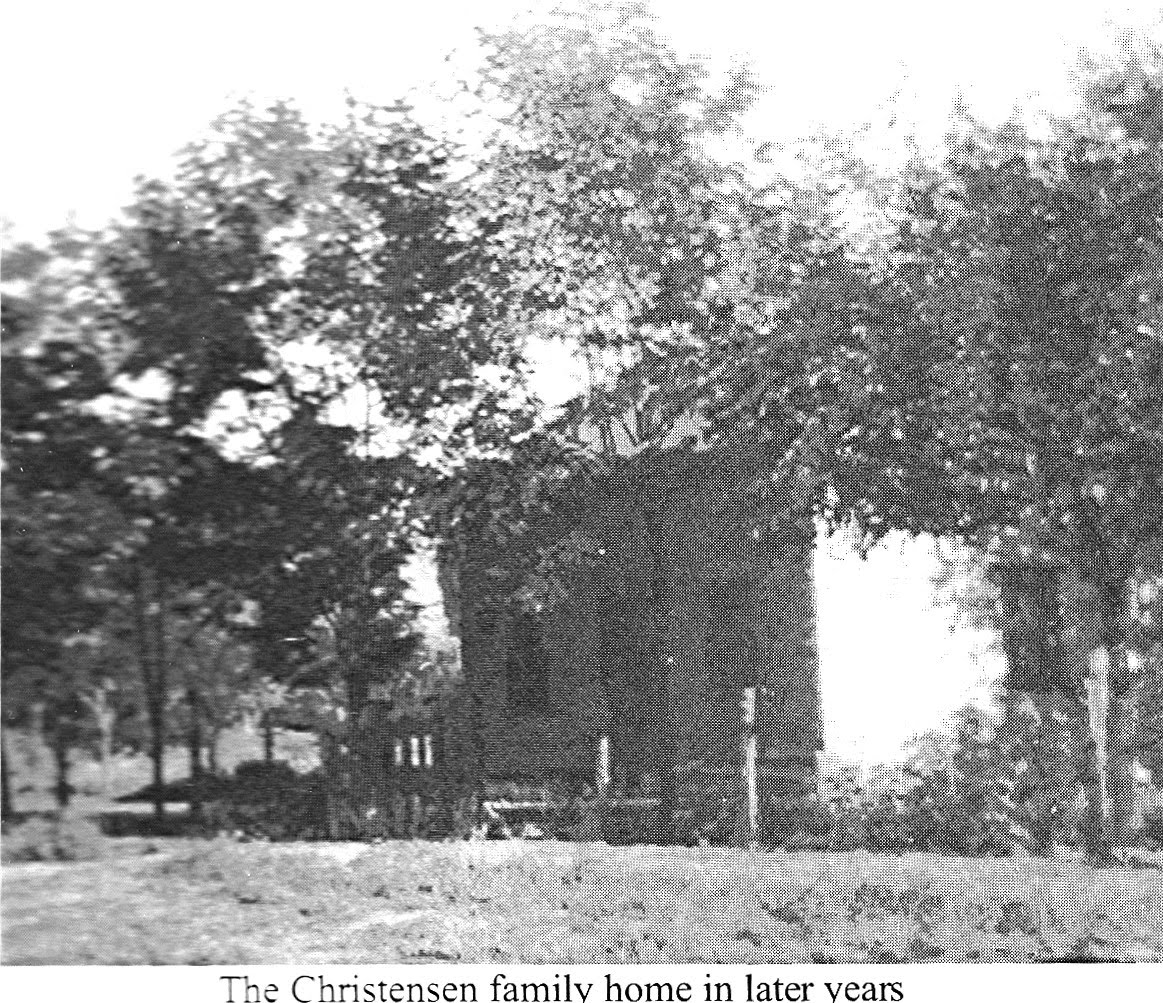
James and Christena Christensen ~ Pioneers of the Month ~ July 2010


James and Christena Christensen

  the following is taken from Knudsen Chronicles by Shirley Parkin Porath

James Christian Christensen
Born: 24 Jun 1825 ~ Horbro, Veijle, Denmark
Married Christena Madsen December 1859 in Mt. Pleasant
Died: 23 October 1880 ~ Mt. Pleasant, Sanpete County, Utah

Christena Madsen Christensen
Born:  27 January 1843 ~ Jyderup Hollsbaek, Denmark
Died:  15 November 1900 ~ Mt. Pleasant, Sanpete County, Utah

Children                                                                       Born
Hannah Christena                                                         27 Apr 1862
Annie Johanna                                                               7 Nov 1864
Emma                                                                          24 Mar 1867
Dianthe Dorthe                                                             22 Oct 1870
James                                                                             5 Oct 1872
Hans                                                                            26 Oct 1875
Caroline Andrea                                                           29 Mar 1879

Christena's Early Experiences in Utah 
Christena's early life and experiences coming to Utah are chronicled in "Willie Handcart Pioneers," chapter 15.  Saints in Salt Lake City provided food and shelter while the members of the Willie Company rested 
and recuperated from their arduous trek.  Information about Christena's life after she reached Uta is found in a short history written by her daughter, Annie.

"The family lived as best they could, doing whatever they could find to do to keep body and soul together.  When Sanpete County was colonized, Mother and the two older girls, Hannah and Christena, remained in Salt Lake City to work.  In order to live they had to work every day, so they were not able to go to school.  Finally these two girls went to Ephraim to join their mother and their younger sister and brother."

The journey of these two young girls to Fort Ephraim is related in Christena's own words:
"We managed to get to the town of Nephi thinking we would be able to get to Ephraim along with some people who might be going there to live.  After several days of waiting, we found a man who was going to drive a cow to that place.  We persuaded him to take us along.  We had to walk, but we wanted to get where Mother lived.  The weather was cold, and the only shoes we had were moccasins.  He drove the cow, and when we reached the Sanpitch River, he put us astride the cow while he waded and led us to safety.  Arriving at Ephraim at midnight, we went from house to house to find Mother and our younger brother and sister.  We finally located them and found them sleeping on the floor covered only by a quilt.  We cried for joy at beholding them again.  Cold and hungry though we were, we were happy together.  The next day we secured work and went to live with our employers."

Pioneer Settlers in Mt. Pleasant 
Annie continued: "Christena worked for a time at whatever employment she could find.  At Ephraim she met James Christensen Harbro. Christena and James were married in Ephraim in December of 1859.  In the spring of 1860 they moved to Mt. Pleasant, Sanpete County, Utah, known at that time by the name of Hamilton.  Father and Mother thus became pioneer settlers of Mt. Pleasant.  There the name Harbro was informally added to his name to distinguish him from many other Danes who carried the surname Christensen.

"He helped build the old fort and many bridges and passed through all the hardships of those days, half of which will never be known."  Christena's brother, Andrew, and youngest sister, Anna Marie, lived with Christena and James for many years.  In his younger years, Andrew was known by the name Andrew Harbro instead of Madsen because there were so many other Madsens in Mt. Pleasant."

Hannah was one of the first children born in Mt. Pleasant.  from her biography we learn details about their family:

"Their home was a crude log cabin with a dirt roof.  It contained very meager furniture.  However, this was home sweet home to those faithful, devoted Latter-Day-Saints who came to this country from their native land in order to worship the true and living God and be among the people of Zion."


Family Life
Their daughter's autobiography emphasizes: "The holiest and sweetest thoughts coming to me from those early days are the lessons my parents taught me ~ my Pioneer Parents whom my soul revered.  Kindness, tenderness, and love filled their hearts and home each day."

"At the age of four years while riding to the fields in her father's wagon, Hannah was miraculously saved from death.  The horses became frightened because of a roller which her father had tried to the back of the wagon.  They dashed southward while the wagon box containing the child bounced and bumped over huge rocks and boulders until it fell to the ground.  Hannah crept from the wagon box and found shelter and safety under a fence where she was later found by her father and many others who witnessed the runaway.  They thought she had been killed.  They took her home where Christena wept with joy at seeing her child alive.  She carefully examined the tiny body and found Hannah had suffered only a few light bruises.  However, one horse was killed in this mishap."

Hannah often helped James in the fields and sometimes remained all night with her father while he irrigated their acres of land.

Annie wrote:  "I always helped my father in the fields.  I loved nature and did all kinds of outdoor work.  My father called me "Jim" as I was always on hand to work for him ~~lifting wagon boxes, hay sacks, and other things.  I did man's work in the field.  I rode horses and met with many accidents but was never seriously hurt.  I never gave up work because the boys were too small to help father."

In the fall of 1867, Indian threats increased, and James became a Minute Man during the Black Hawk War.  Many times he stood guard to protect property or rode out to search for and try to retrieve stolen cattle.

Because of their poverty, at times James "hired out" his older daughters to work for others.  Hannah tells mof working for C.N. Lund where she "did all kinds of work as well as their chores."  She also worked in chester for her Uncle Andrew Madsen for fifty cents a wek.  After three weeks of hard labor.."she was able to buy a pair of shoes with copper toes."  She also bought material for her dresses, which were all made at home.

Annie wrote:  "when I was twelve years old my father came to me and said, "I have hired you out to work for J.C. Jensen to care for their baby, a sweet little girl named Hattie."  I sang the baby to sleep and washed dishes and did other household duties for fifty cents a week.  I worked there off and on for years as they needed help.  As I grew older, I was paid seventy-five cents a week.  This helped to buy cloth for my dresses."  She worked all one summer for C. Brotherson.  "I went with him to the fields and helped weed his wheat fields.  He paid me twenty five cents extra for this work.  I lived there and worked all of one summer.

In later years of his life, James made several trips to the mining camps to take loads of grain to sell in order to get money to pay his taxes.  On one of these trips, he contracted a severe cold, but he traveled night and day when he learned of the death of his infant daughter, Caroline Andrea, eleven months old, who died 22 February 1880, while he was away.  When he reached home, he was grief stricken over the loss of his little one and remarked, "I see you are all here but one."

James Passes Away

Again we quote from Annie's autobiography: "In the fall of 1880 when I was fifteen years old, my dear father became very sick with typhgoid fever.  Day and night for three weeks we watched over him.  One day he called me to him and said, "You stay with me.  You are more able than Mother."  (Christena suffered ill health much of the time.)

"I did the best I could.  I sat and held his hand and cried.  He told us what to do with some of the cattle and that he could not remain with us.  On October 22, 1880, at the age of forty-five, he passed away, leaving poor mother with four unmarried children to care for .....Hannah had been married in May.  Emma was thirteen, James was eight and Hans but five when father passed away."

Annie expressed her admiration for both her parents in this poem:

MY PIONEER PARENTS
My mother, Pioneer so loved, so true
Can I sufficient honor show to you?
Shall I not speak your name among the rest
Whose children now arising call them blest?
In looking back, my inner eyes behold
Tear-dimmed what cheerily you told.
How with your parents you left friends and home
Over rough rivers, plains, and hills to roam
To live the Gospel, newley then restored,
And be in fellowshiup with Christ, the Lord.
You heard His messengers His truth expound;
It touched your hearts, you hearkened to the sound,
Obeyed the call, did what it bade you do,
Repented, were baptized, and then you knew
That Christ had now His marvelous work begun:
A boy had seen the Father and the Son.
Converted by the Lord's own perfect laws,
You knew that Joseph Smith His prophet was.
The testimony of the Lord is sure,
His statutes right, His commandments pure.
With honest hearts you did His truth embrace,
Ready all hardships, even death, to face.
Father and Mother, noble Pioneers
Heroic, beautiful your life appears.
Hard, grievous trials in your path were cast,
But you proved brave and faithful to the last.
And now I bless you for the sacred touch
Of faith sublime for which you bore so much,
And which inspires my soul to follow too
And gain the prize, Eternal Life with you..

Christena Passes Away
Annie wrote: "When we celebrated my birthday on November 7th, my mother was with us and was so happy.  My niece, Sina Clark, played a lively tune called 'The Cakewalk' on our organ, and how Mother danced around the table.  Howerver, within the following week she was stricken and suddenly passed away on the 15th of November."

Christena spent much time caring for Emma's daughter, Vida, who at the time was about five years old.  During her illness, Christena worried, "What will my little Vida do without me?"

About her mother, Annie wrote this tribute:  She was kind, generous, and full of faith.  She was loved by all who kenw her.  She knew the want and privation of pioneer life and walked her trail in this life uncomplainingly, with a smile on her lips and joy in her heart.  She taught her children the priceless heritage of the Gospel of the Son of God as she understood it.  If she could now see the faithfulness of her children and grandchildren, she would weep with joy and thank God for them all."