Showing posts with label Guyman. Show all posts

Sunday, April 19, 2026

PIONEER DAY BALL INVITE 1913 (taken from the Elva Guyman Collection)


This would be what your Pioneer Day Ball invitation would look like in 1913.  


All were requested to be in "Old Fashioned Dress."


And it was to be held at the Mt. Pleasant Opera House.  


Tickets 50 cents  ~  Extra ladies 25 cents.


Sunday, December 14, 2025

SEELY BARN


North of the residence of Ray and Mildred Seely (1981) at 430 West Main Street in Mt. Pleasant, Utah stands a large barn, the first built in that pioneer community.  It's construction is unique to the present day and stands as a reminder of the hard work and physical labor of those early settlers.

From information obtained through Ray Seely, and his sister, Elva Guyman, it was built in approximately 1862, 3 years after Mt. Pleasant was colonized.  Huge timbers were brought down from the east mountains with teams of horses and the inner structure was built by craftsman who didn't use a single nail!  All the beams were hewn and pegged so that they fit together perfectly to make a sound sturdy building. 


When the men were lifting the timbers, one man, who they called "Joe Heave", would call out "heave" so that they could lift together the heavy beams into place.  It's original construction site was on 5th west, halfway between Main Street and 1st North.  It was later moved to Main Street on the creek just east of Aunt Miranda's home, so that the animals could have water more readily.  From there it was moved to its present location.


Orange Seely, brother of Joseph Seely and Uncle of Ray, was the first owner and Henry Wilcox, brother of Clarissa Jane who was a Grandmother to Ray, was the builder with much help from other members of the family and the settlement.  One can picture in his mind these men all working together with the horses and the tremendous amount of toil and labor it would have taken to move the heavy beams and hew the rough boards into the work of art that they are.

In that day, there was always the danger of Indian aggression.  Chief Black Hawk and his painted warriors terrorized the women and children.  So horses were kept saddled and ready in the barn 24 hours a day so that the minute men could ride quickly to Manti or Thistle for help.  Also, Indian squaws were kept as prisoners there during times of battle.  It was also used as a place for dancing where good times were shared by many.


When Dad (Ray Seely) move to Mt. Pleasant, from Moroni, he purchased the lot where the home now stands and the barn went with the property.  Uncle Orange had moved to Castle Dale so Dad became the rightful owner of the barn.  And no prouder owner could there have ever been!  It was his most prized possession, and he loved to tell of its history to all who would listen.  He had great respect and love for the hands who built it, and always did all he could to preserve it and maintain it.  The reverence and love that Dad had for the barn has been passed onto his family and posterity- - -a memory we all cherish.

(written in 1981)


Photograpy by Tudy Barentsen Standlee

Wednesday, June 25, 2025

MANTI TEMPLE ARTICLE ~~~ Taken from the Elva Guyman Collection


This is a repost.  We posted the photo of the Manti Temple above, but inadvertently missed the article. 


Some of the article was cut off when clipped out of the paper.

Thursday, June 1, 2017

Niels Widergren Anderson and wife Louise Lindberg Anderson ~ Pioneers of the Month ~ June 1917

`6
Anderson, Neils Widergreen  (North Room)_edited_edited

   Niels born 4 Nov 1809  Malmo Sweden                        

Anderson, Louisa Lindberg (North Room)  _edited
Louisa born 4 April 1810  Opmana Scona Sweden ???
see https://en.wikipedia.org/wiki/List_of_cities_in_Sweden
Niels Widergren Anderson and his wife Louise Lindberg Anderson


This Couple with their family suffered many hardships crossing the plains during early pioneer days with the Noah T. Guyman Company. 


 They were first settled in Brigham City in the year 1853.  From there they were called with a company of others to settle Ephraim,  They lived in Ephraim until the early spring of 1859 at which time they were again called with a group of others to settle in Mt. Pleasant, arriving there in March of 1859.  They were parents of two children:  C. W. Anderson and Johanna E. Madsen.


The following are snippets from History of Mount Pleasant by Hilda Madsen Longsdorf recognizing the contributions of Niels Widergren Anderson and others to the settling and development of Mount Pleasant. 

September 1858:  September 14th, the committee returned to Fort Ephraim and notified the petitioners who at once called a meeting, where the letter from President Young was presented and the contents noted. The advice given was favorably received. At this meeting, James R. Ivie, Joseph Clement, and Isaac Allred were appointed as a committee to wait upon the surveyor at Manti and get him to survey town lots and farming land on Pleasant Creek. This committee with surveyor Albert Petty, of Manti, then visited the present site of Mount Pleasant and selected and surveyed a site where the fort was to be built, which was about one and one-half miles east of the former site of Hambleton, together with a number of city lots and about 1300 acres of choice farm land in twenty­ acre lots. Upon their return to Fort Ephraim, about the middle of October, a meeting was called, and later the settlers drew by number for the land and lots which were pointed out to them by the committee the following spring. January 10, 1859, the petitioners again called a meeting for the purpose of organizing and making preparations for moving to the new quarters. This meet­ing was held in the school house. After discussion of some length, James R. Ivie Sr. was chosen their president and Reddick Allred was chosen bishop. Later, however, Reddick Allred, not being sure he would move north with the party in the spring, declined to accept the position.
About the middle of February, Mads Madsen, Peter Madsen, Andrew Madsen, Niels Madsen, Christian Madsen, George Frandsen, Rasmus Frandsen, Christian Jensen 1st, Mortin Rasmussen, Peter Monsen, James Larsen Sr., Niels Johansen 1st, Alma Allred, Peter Johansen, Niels Widergren Anderson, Christian Widergren Anderson, Mickel Christensen, Soren Jacobsen, James C. Meiling, and Hans Y. Simpson moved north until they were just west of where the settlement was to be located.  Longsdorf, History of Mt. Pleasant p. 31

Niels built One of the first homes  in the community 
Building Homes on City Lots
The people had been told by President Brigham Young not to build on city lots until they had a house in the fort. During the early months of the year 1861, many other families who now had the houses, moved out of the fort into their homes on their city lots. The houses thus vacated were immediately filled with other settlers. As soon as possible, fences were built, some rock, some adobe, some poles, some woven of birch and other willows. Listed as among the first houses built outside the fort this year, was one built by Hans C. H. Beck, which is thought to be the first adobe house, and was built on his city lot, southwest corner, intersection of First South and Second East. One by W. S. Seeley, State Street

between First and Second South, one by Mads Madsen, northeast corner of intersection, Second North on State Street, one by Niels  Widergren Anderson, southeast corner, intersection of First South and Second West, and one by ……….. Christensen, northeast corner of intersection, Third South and Third West, and a log house by James Lemmon, and a house built by Amasa Tucker, northeast corner, intersection of First South and Third East.
History of Mt. Pleasant , Hilda Madsen Longsdorf pp 68,69

Sunday, October 28, a call was made for the people to move south to the St. George country, in order to settle that part and also for the purpose of raising cotton. Those called were Joseph Clemens, Moses M. Sanders, Christian Widergren Anderson, Yeppe Iverson, Niels Widergren Anderson, N. C. Sandberg, James Lem­mon, Andrew Jensen, Peter Iverson, Oke Sandberg, and Amos Moss.  Longsdorf: page 76

This same year (1876) a late and up-to-date Sugar Cane press,
com­monly known as a molasses mill, was purchased in Salt Lake City and brought to Mt. Pleasant by Niels Widergren Anderson, C. W.  Anderson, and Andrew Madsen. It had three iron rollers for grinding the cane. This was a great improvement over the older type mills used. The mill was placed on Sixth South and Third East. Niels Johansen (Weaver) and Andrew Christensen run it for  years and later purchased it.  John Knudsen Sr. and others assisted in operating it. Sugar cane was extensively raised in Mt. Pleasant, as well as in Spring City, which was marketed in Mt. Pleasant.
Longsdorf: p 141 

Later Niels Widergren Anderson imported a later,
up-to-date model which was placed in the old Tannery lot, Sixth South and Third West. For some time it was run by Weaver Niels Johansen and Andrew Christensen, who later purchased it.
Longsdorf p. 288

Wednesday, March 14, 2012

Pioneer Day Invite ~ March 21, 1913 ~~~ Elva Guyman Collection


 This would be what your Pioneer Day Ball invitation would look like in 1913.  


All were requested to be in "Old Fashioned Dress."


And it was to be held at the Mt. Pleasant Opera House.  


Tickets 50 cents  ~  Extra ladies 25 cents.

Sunday, November 14, 2010

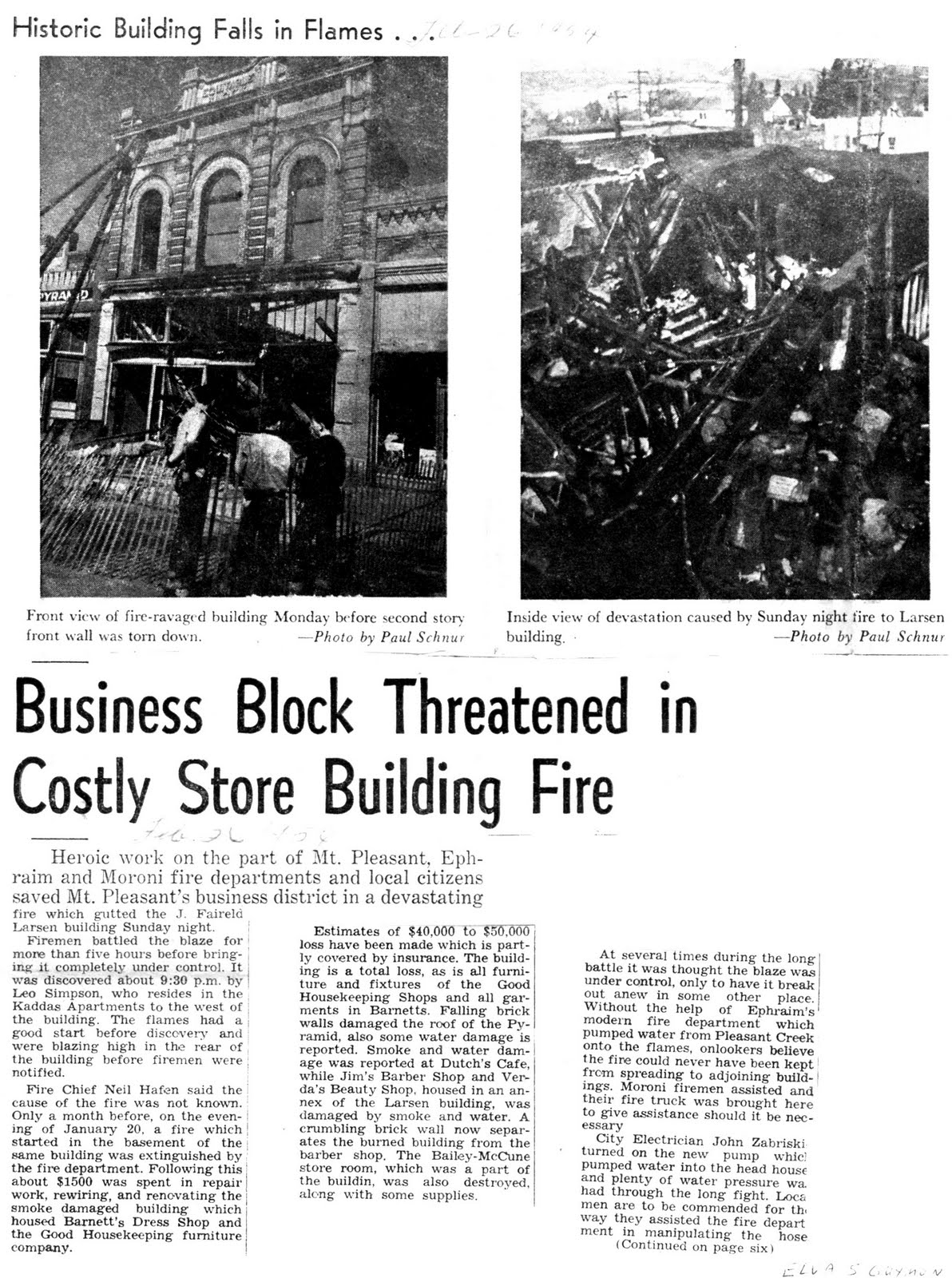
Business Block Threatened ~ February 1954 ~Newspaper Article ~ Elva Seely Guyman Collection

                                                                                                                incomplete

Saturday, July 31, 2010

Early Mt. Pleasant Main Street ~ Elva Guyman Collection

Marlane Harless brought in this picture from her Aunt Elva Guyman's Collection.  The upstairs window of the far right building says "Doctor Cassaday".  Does anyone have any knowledge or history of Doctor Cassaday?  Can you identify the era when this picture was taken? Was it before the automobile?  Was it before the famous Main Street Fire?  We have our ideas, but we would like to hear yours.

Sunday, June 13, 2010

"THE BARN" by Sue Ann Seely Croshaw


North of the residence of Ray and Mildred Seely (1981) at 430 West Main Street in Mt. Pleasant, Utah stands a large barn, the first built in that pioneer community.  It's construction is unique to the present day and stands as a reminder of the hard work and physical labor of those early settlers.


From information obtained through Ray Seely, and his sister, Elva Guyman, it was built in approximately 1862, 3 years after Mt. Pleasant was colonized.  Huge timbers were brought down from the east mountains with teams of horses and the inner structure was built by craftsman who didn't use a single nail!  All the beams were hewn and pegged so that they fit together perfectly to make a sound sturdy building. 


When the men were lifting the timbers, one man, who they called "Joe Heave", would call out "heave" so that they could lift together the heavy beams into place.  It's original construction site was on 5th west, halfway between Main Street and 1st North.  It was later moved to Main Street on the creek just east of Aunt Miranda's home, so that the animals could have water more readily.  From there it was moved to its present
location.


Orange Seely, brother of Joseph Seely and Uncle of Ray, was the first owner and Henry Wilcox, brother of Clarissa Jane who was a Grandmother to Ray, was the builder with much help from other members of the family and the settlement.  One can picture in his mind these men all working together with the horses and the tremendous amount of toil and labor it would have taken to move the heavy beams and hew the rough
boards into the work of art that they are.


In that day, there was always the danger of Indian aggression.  Chief Black Hawk and his painted warriors terrorized the women and children.  So horses were kept saddled and ready in the barn 24 hours a day so that the minute men could ride quickly to Manti or Thistle for help.  Also Indian squaws were kept as prisoners there during times of battle.  It was also used as aplace for dancing where good times were shared by many.

When Dad (Ray Seely) move to Mt. Pleasant, from Moroni, he purchased the lot where the home now stands and the barn went with the property.  Uncle Orange had moved to Castle Dale so Dad became the rightful owner of the barn.  And no prouder owner could there have ever been!  It was his most prized possession, and he loved to tell of its history to all who would listen.  He had great respect and love for the hands who built it, and always did all he could to preserve it and maintain it.  The reverence and love that Dad had for the barn has been passed onto his family and posterity- - -a memory we all cherish.

(written in 1981)
Photograpy by Tudy Barentsen Standlee