Showing posts with label Faucett. Show all posts

Tuesday, June 17, 2025

Joe Duncan


The picture above shows the Prophet Joseph Smith dressed in his Lieutenant General uniform. The Prophet rode this horse in maneuvers of the Nauvoo Legion and many other occasions.


While living in Nauvoo, Moses Martin Sanders and his wife Amanda Armstrong Faucett Sanders lived as neighbors to the Prophet, Joseph Smith, and they cherished their association with the Smith Family. Moses owned a very beautiful, but unruly horse. As Moses was often away from home, performing church duties, it fell to the lot of Amanda to lead this horse to water and she was really afraid of him. He was very high spirited.


One day the Prophet Joseph said to his neighbor, Moses, "Brother Sanders, give the horse to me and I'll promise that you will never lose by it." Moses Martin replied, "I would, but I am afraid that he may hurt you." Then the Prophet said, "No, he would never hurt me." So Moses tossed him the rope and said, "He is yours." The horse was called "JOE DUNCAN", a very beautiful, intelligent animal.


Moses Martin Sanders Sr. and Amanda Armstrong Faucett Sanders 


Wednesday, July 26, 2023


While living in Nauvoo, Moses Martin Sanders and his wife Amanda Armstrong Faucett Sanders lived as neighbors to the Prophet Joseph Smith.  They cherished their association with the Smith Family.

Moses owned a very beautiful, but unruly horse. As Moses was often away from home, performing church duties, it fell upon Amanda to lead the horse to water.  She was really afraid of him.  He was very high-spirited.

One day the Prophet Joseph said to his neighbor, Moses "Brother Sanders, give the horse to me and I'll promise that you will never lose by it".

Moses Martin replied, "I would but I am afraid that he may hurt you."  Then the Prophet said, "No, he would never hurt me." So Moses tossed him the rope and said, "He is yours." 

The horse was called "JOE DUNCAN",  a very beautiful intelligent animal.

Sunday, April 30, 2023

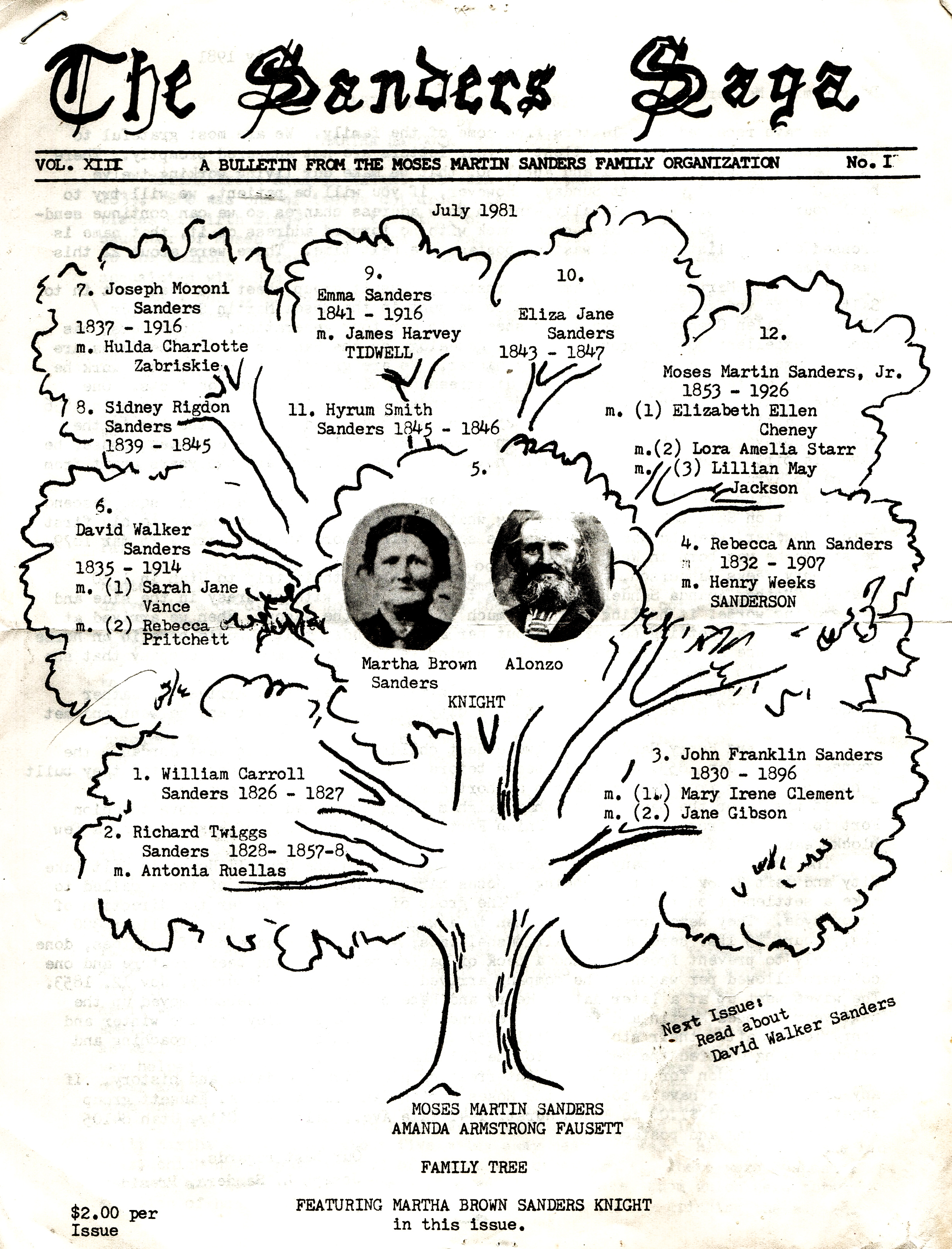
Sanders Saga ~~~ 1981

Have been going through some of my mother's things and found this old Saga.
It had been mailed to my Grandma, Sarah Rigby.  I thought maybe someone 
might enjoy it.  I will include more pages if there is more interest.
Kathy Rigby Hafen


Martha Brown Sanders Knight 


Tuesday, January 7, 2020

Emma Sanders Tidwell


Emma Sanders Tidwell


HISTORY OF EMMA SANDERS TIDWELL Born 23 Jan 1841 — Nauvoo, Illinois Died 5 Oct 1916 — Moroni, Sanpete Co., Utah Came to Utah 1850 Married James Harvey Tidwell — 1857 History filed by Granddaughter Ora H. Lund D.U.P. Historian History arranged by Nora Lund, D.U.P. Historian Information furnished by a Grandaughter, Ora Hutchinson Petersen Arranged by Nora Lund, D.U.P. historian HISTORY OF EMMA SANDERS TIDWELL Emma Sanders was born 23 Jan. 1841 in Nauvoo, Hancock County, Illinois. She was the 9th child in a family of 12 children born to Moses Martin and Amanda Armstrong Faucett Sanders. Her brothers and sisters were: William, Carl - died young, Richard Twigg, John Franklin, Rebecca Ann, Martha Brown, David Walker, Joseph Moroni, Sidney Rigdon, Eliza Jane, Hyrum Smith and Moses Martin Jr. Emma’s parents were from the deep South. Her father was born in Georgia and her mother in Tennessee. The family made their home in Tennessee until 1829 when they moved to Montgomery County, Illinois. On the 28th of January, 1835 her parents were baptized member of the Church of Jesus Christ of Latter—Day Saints. They moved to Far West, Missouri where the Mormons were gathering at that time. By 1839 we find them living in Nauvoo, Illinois assisting in the building up of the City, participating in the ******** of the temple, where they received their endowments in January of 1846. The prophet Joseph Smith loved little children and took a special interest in grandmother, naming her Emma after his wife Emma. She remembered sitting on his lap. It was a great sorrow to the Sanders family when the Prophet was killed. When Emma was 5 years old her family left their home in Nauvoo and took refuge in Iowa. Her father was one of the stalwart men who assisted all he could in getting the Saints across the Mississippi river that cold winter of 1846. Thousands of people who had fled with scarcely nothing but their lives made quite a city at Winter Quarters. Early in January of 1847 the Lord made it known to Brigham Young. President of the twelve apostles, who was leading the Saints, that it was time to go the long distance to the Rocky Mountains to find refuge for his harassed people. Martin Sanders and his family made the necessary preparations to cross the Plains in 1850 and arrived in the valley of the Great Salt Lake that fall. Martin didn’t remain long in Salt Lake because President Young sent him on to colonize new settlements. His history says he was called to different towns He was one of the first to move to Fillmore and in 1859 he was called to settle Fairview Sanpete Co. and he stopped in Mt. Pleasant. His family story is that Emma was working at a boarding house in Fillmore. As she came down the stairs into the main dining room, she immediately attracted the attention of one of the men there. This man was James Harvey Tidwell, a freighter. He had a wife and child at home in Pleasant Grove, and had no particular thought of going into polygamy, though the practice was being encouraged by the Church authorities. But as he beheld this beautiful, young 16 year old girl with golden red hair, sparkling blue eyes and a pleasant smile, he knew that he was going to marry her. He made her acquaintance, courted her and married her in the Salt Lake Endowment House Feb 26, 1857. Emma’s first child was born in Pleasant Grove 26 Nov. 1858. His name was John Franklin Tidwell. He married Caroline Johanson. It was in June of 1859 when Emma’s husband accepted the call to Sanpete County and they made their way to Pleasant Creek (Mt. Pleasant). No doubt Emma’s folks were among the group, which would naturally please her, The north end of Sanpete Valley was indeed promising for new homes. Emma was strong and healthy, willing and able to do her part in aiding in the pioneering of this lovely valley. She lived in the Fort which was the first thing built for protection from the Indians who were always lurking around. Added to the ever present Indian danger there was the concern about the food lasting until another harvest, and about obtaining clothing with which to keep warm. As soon as a log cabin could be built, or a dug—out made, families moved from the Fort to their own settlement lots. Their place vacated in the Fort was occupied by a new settler. When the drum would beat, all would rush back to the square for safety. John Tidwell and Hans Simpson were the “Minute Men” of that day. Their horses were left saddled and bridled so that in case of Indian trouble they could ride quickly to Manti or Thistle Valley for help where soldiers were stationed. Black Hawk and his painted warriors terrorized the women and children, and he led his braves in many battle against the white people. (Taken from the book “These Our Fathers”, Mt, Pleasant write—up.) From the family group sheet at hand, we notice that Emma Tidwell regularly gave birth to new babies after coming to Mt. Pleasant. Her 2nd child, William was born l8 July, 1860. He married Ana Draper; 3rd Child, James, born 6 Feb. 1862 married Lauraetta Draper; 4th child, Martha Ann, born 22 Dec. 1863, married John William Pritchett; 5th child, Joseph Martin. born 18th Dec., 1865, married Martha M. Morgan; 6th child, Albert, born 9 Feb. 1868, died 1876; 7th child Rosetta, born 30 Nov. 1869, married John Johansen; 8th child, Willis Hyrum, born 17 Feb. 1871, married Esther Nielson; 9th child, David (twin) born 3 Nov. 1873 -lived 3 hours; 10th child, Nathan Alvin (other twin, lived to maturity but never married); 11th child Cyrus Delbert, born 28 June, 1876, married Calista Vicena Bai1ey; 12th child, Amanda Venretta, born 12 April, 1879, married John U. Bailey; 13th child, Lewis Willard, born 13 Feb. 1881, married Macel Evella Cook; 14th Child, Emma Irene (my mother) born 1 May, l883, married Sidney James Hutchinson. In 1865 Emma Tidwell bid farewell to her parents and brothers and sisters because her father had been called to the Dixie Cotton Mission in St. George. It was there her father died on Nov. 8th, 1878. Her mother died in Tonto Basin, Gila, Arizona where she gave birth to Moses Martin Jr. who was born when his parents were sent there to help colonize that section. James Harvey Tidwell established a home for his wife, Emma, and her little children on the farm called “The Bottoms”, located about half way between Mt. Pleasant and Moroni. Her home was of logs with a dirt floor. Gunny sacks were hung at the windows in lieu of glass. Emma was so very frightened when the Indians would come and stick their heads through the opening demanding——”piggy meat and sugar”. Other frightening experiences she and her children encountered were when the U.S. Marshals would come looking for her husband, trying to arrest him and put him in prison for co—habitation. On the farm, she and the little boys would break and milk wild range cows. From the milk, she would make butter and cheese. Besides supplying her own family, she kept the 1st wife and her family supplied with these commodities also. Finally Emma’s husband moved her and her family to Moroni where some of the older children were living. Her home was a comfortable two—story frame house, made out of rough lumber. Here she remained the rest of her days. Emma had a natural talent for taking care of the sick. She was the first person called, or sent for, when help was needed in sickness. She was away from home a good deal of the time in her lifetime taking care of the sick. She knew the medicinal value in herbs and was very successful in using them. She was only 55 years old when she was left widow. Her husband, James Harvey, went to Wellington, Carbon County, to visit his son William Henry. While there he took sick and died Sep. 2, 1896. It was a great sorrow and loss to his wives and children when he was brought back in a casket. He was laid to rest in the Mt. Pleasant cemetery. Emma lived on being lovingly cared for by her children until Oct. 5, 1916 when she died at the age of 75 years. She was buried beside her husband in Mt. Pleasant, Sanpete County, Utah.

Monday, April 1, 2013

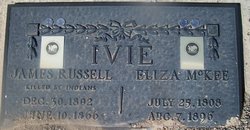
James Russell and Eliza McKee Faucett Ivie ~ Pioneers of the Month ~ April 2013


James Russell Ivie


CHILDREN
Richard Anderson Ivie
William Franklin Ivie
Sarah A Ivie
James Alexander Ivie
John Lehi Ivie
Polly Ann Ivie
Elizabeth Caroline Ivie
Joseph Orson Ivie   (11yrs)
Eliza Marie Ivie
Mari Betsy Ivie      (0yrs)
Isaac Thomas Ivie
Benjamin Martin Ivie
Hyrum Lewis Ivie
Heber Kimball Ivie
Martha Adeline Ivie (12yrs)
1825 - 1892
1826 - 1880
1829 - 1890
1830 - 1906
1833 - 1909
1835 - 1896
1837 - 1901
1840 - 1851
1842 - 1920
1842 - 1842
1844 - 1906
1846 - 1926
1849 - 1927
1852 - 1923
1855 - 1867
Eliza McKee Faucett Ivie


The Following Comes From Mount Pleasant History by Hilda Madsen Longsdorf:

After the burning of Hambleton Settlement, nothing was done so far as it is known towards re-establishing a settlement on Pleas­ant Creek, until about the middle of August, 1858, shortly after the arrival at Ephraim of the Big Move Caravan; James R. Ivie, Sr., Benjamin E. Clapp, Joseph R. Clement, Isaac Allred, Sr., Reuben W. Allred and Richard Ivie who were chosen at Fort Ephraim as an exploring committee to select a suitable location for a new settlement in the northern part of the valley, decided upon a site on

 Pleasant Creek. They returned to Fort Ephraim and stated their 

views to the immigrants and others, who had reached Fort Ephraim 

to remain over the winter.


A meeting was called and a petition was drafted, signed by sixty men who were desirous of locating farther north at the site selected. Not knowing just how to proceed or what to do, a meet­ing was called for the purpose of discussing necessary procedures. After some deliberations, James R. Ivie Sr., Joseph R. Clement, and Isaac Allred were chosen as a committee to wait upon Presi­dent Brigham Young in order to obtain his advice. Afterwards, however, it was deemed best for James Allred and James R. Ivie Sr. personally to present the petition. Leaving Fort Ephraim September 2nd, they arrived in Great Salt Lake City on September 6th. There they met Elder Orson Hyde on the street and at once stated the purpose of their visit. He kindly escorted them to Pres. Brigham Young's office. After considering the petition, President Young expressed himself as perfectly in favor of the new settle­ment. James R. Ivie stated that the petitioners were desirous that he, President Young, appoint men to take the lead. President Young, however, was not desirous of choosing their leaders or bishop at that time, and drafted the following letter which was sent back with the committee and presented to the petitioners: "Great Salt Lake City, Sept. 6, 1858.
"Brother John Reese and the rest of
the brethren whose names are on the list:
"In am perfectly willing that you should go there (Pleasant Creek) and make a settlement, but you must consider whether it will be safe or not. You wish to know my mind on the subject. It is this, that you must build you a good substantial fort and live in it, use every precaution that is necessary against the Indians. Your fort must be twelve feet high and four feet thick, built either of stone or adobe and laid in lime mortar. I also want you to select one of your number for president and one for bishop. You will have to be very careful of your stock or you will lose them. In choosing your farming land get it as nearly together as possible.

A meeting was called and a petition was drafted, signed by sixty men who were desirous of locating farther north at the site selected. Not knowing just how to proceed or what to do, a meet­ing was called for the purpose of discussing necessary procedures. After some deliberations, James R. Ivie Sr., Joseph R. Clement, and Isaac Allred were chosen as a committee to wait upon Presi­dent Brigham Young in order to obtain his advice. Afterwards, however, it was deemed best for James Allred and James R. Ivie Sr. personally to present the petition. Leaving Fort Ephraim September 2nd, they arrived in Great Salt Lake City on September 6th. There they met Elder Orson Hyde on the street and at once stated the purpose of their visit. He kindly escorted them to Pres. Brigham Young's office. After considering the petition, President Young expressed himself as perfectly in favor of the new settle­ment. James R. Ivie stated that the petitioners were desirous that he, President Young, appoint men to take the lead. President Young, however, was not desirous of choosing their leaders or bishop at that time, and drafted the following letter which was sent back with the committee and presented to the petitioners: "Great Salt Lake City, Sept. 6, 1858.
"Brother John Reese and the rest of
the brethren whose names are on the list:


"I am perfectly willing that you should go there (Pleasant Creek) and make a settlement, but you must consider whether it will be safe or not. You wish to know my mind on the subject. It is this, that you must build you a good substantial fort and live in it, use every precaution that is necessary against the Indians. Your fort must be twelve feet high and four feet thick, built either of stone or adobe and laid in lime mortar. I also want you to select one of your number for president and one for bishop. You will have to be very careful of your stock or you will lose them. In choosing your farming land get it as nearly together as possible."

June 20th, 1866, Indians under Chief Black Hawk made a raid on the stock of Scipio. During the skirmish Henry Wright and James R. Ivie, the father of Colonel J. L. Ivie, were killed. It will be remembered that in 1859 James R. Ivie had been chosen at Ephraim as leader for the company of pioneers who settled Mount Pleasant, and that he faithfully filled that position until W. S. Seeley was chosen bishop of the colony. A short time after the killing of Mr. Ivie, a son of Ivie, in retaliation for the killing of his father, killed a friendly Indian.  This enraged the Indians and they entered more vigorously in to the bloody work of massacre among the white settlers.


~~~~~~~~~~~~~~~~~~~~~~~~~~~~~~~~~~~~~~~~~~~~~~~~~~~~~~~~~~~~~~~~~~~~~~~~~


Submitted by: Sharon Allred Jessop 06/08/1999
JAMES RUSSELL IVIE & ; WIFE ELIZA MCKEE FAUCETT

Born: December 30, 1802 Born: July 5, 1808
Died: June 10, 1866 Died: August 7, 1861

Sketch of Their Lives By Hettie M. Robins

There is documentary evidence that Ivye, Ivie, Ivy, and Ivey are all of the same family. At the time there were no dictionaries, and the art of spelling was not highly developed. We find that most of the Ivies in the Southern and Eastern states have settled on spelling the name Ivey. We find the Ivey name in the United States as early as 1700. In the Revolutionary War the names of six soldiers are listed from Virginia and nine from North Carolina. In the Civil War there were hundreds, some of them in almost every Southern state and, perhaps, some listed in the Northern States.

Records show a Thomas Ivye or Ivie lived in Gloucestershire, England, about 1425, also of Ives coming to the United States from England as early as 1700, or even before. The above is sort of introductory of the Ivie family, the family tree of which our early grandparents are a branch of James Russell, the son of John Anderson Ivie, who was the sone of Anderson Ivey.

James Russell Ivie, son of John Anderson Ivie and Sarah Allred, daughter of William & Elizabeth Thresher, of North Carolina was born in Franklin County, Georgia, December 8, 1902. He was the second of nine children born to this union.

James Russell married Eliza McKee Faucett. She was born July 5, 1808, at West Columbia, Nuary County, Tennessee, to Richard Faucett and Mary McKee. There were married about June 1824. The location of their marriage is not definitely known, though the belief is that it may have been in Tennessee, since that is where they were living at the time, and their first three children were born, it is evident that they were moving from state to state - - going further west. The family spent from 1830 to 1844 in the State of Missouri, living in Paris, West Paris, and Caldwell Counties. They moved, then, to Council Bluffs, Pottowatamie County, Missouri, where their 11th child was born in 1846. From there they moved to Salt Lake City, where another child was born, and then to Provo, where the next child was born. Thirteen children in all were born to this union.

It was in the early 1830's in Missouri, that the Mormon Missionaries came to the areas in Missouri where the Ivies lived. Parley P. Pratt was one of the elders who came so often to their homes. It was he who brought the Book of Mormon to them and taught them the gospel, which converted them. He also helped to baptize them as members of the Church of Latter-Day Saints. Thereafter, their homes were always homes for the traveling missionaries.

I would like to relate an instance the Great Grandfather told us - - not just once, but many times.

I t happened some years after the Ivies had joined the Church. It was in November 1839, while the Elders were out preaching the Gospel that they were seized and put in prison without a hearing, or a trial. They were held prisoners from November 1839 to July 1940. Among them were Elder Parley P. Pratt, Elder Phelps, and others. The saints had planned a way of freeing the last three missionaries held prisoners. They had been changed from one prison to another during the seven months of confinement. At this time they were in Columbus, Missouri. The plan was worked out as Orson, brother of Parley P. Pratt, and others, had planned it, and happened on the eve of Independence day. The three prisoners, when their evening meal was served, crowded through the door and managed to evade bullets fired at them, and, upon reaching the three horses, brought for them by their brethren, were helped to mount and advised to separate, each going in a different direction, then, to hide themselves, in a deep cave until dark. One of the three was captured and taken back to prison for a short time. Elder Phelps managed to make his escape and reach Illinois, several days later. Elder Pratt was less fortunate and, apparently, headed off in another direction. Finally he made for a vast forest of trees, making his was some distance from his horse to await darkness. He climbed into a huge tree, laid his legs outstretched on top of the branches, locked his arms around two other limbs and, in this way, could not be so easily observed, had anyone come his way. After darkness, when he could no longer hear voices, he came down from his hiding place in the tree and went in search of his horse, which had broken loose and left him to make his way on foot.

On the third day of his escape he found himself in a neighborhood of settlers where he had had some acquaintances years previously, and where once there had been a small branch of the church; but, the saints had moved west, having been driven out of the state with other members of their faith. Elder Pratt remembered there were families of Ivies who had lived on the road, and in some clearing in the timber; so, he decided to make his way to them, and told us, in his own works as follows:

Quote: “ I was not sure if they were still friendly with the church, or if they had turned from it to avoid violence and being driven out. I hesitated, then decided to ask help from my Father in Heaven. I arose to my feet feeling much better. I asked in my prayers, that as I passed by the house, if they were still my friends, I would be recognized - - if not, that I might pass peaceably by. As I walked past their home that Sunday evening, about two hours before sundown, I got nearly by when the children playing in the front yard discovered me and cried out with surprise and much joy: “ There is Brother Pratt.” At this, a young man came running out to me who proved to be one of my acquaintances, still a member of the church, and who had been driven with others from the upper valley. Instead of going to Illinois, he had come back to his old neighborhood. I asked about Mr. Ivy and he said that he and his wife had gone to a neighbor’s home two or three miles away. He said “I am here on a visit.” He also advised that they had just received the news of my escape and were sending out warnings to be on the lookout. I told him of my plight. I was hungry and faint and my feet were covered with blisters. He told me of his brother’s wives and children who were also driven out of upper valley and were living in an obscure place in the woods, while the young man went in to see if it was all right. He came back with milk, cream, and bread. I ate of this and then went to the house. The wife said her husband would soon be home. I told her I was in constant fear of being found. She instructed the children not to say one word if anyone came, but to act like I was a total stranger. It was well she did, for just then a man came inquiring for her husband. She told him he was away and to come back but he said it was a matter of business he wanted to see her husband about and would wait. After an hour the dog barked and they knew her husband was returning. The children rushed out to see their father, and to tell him not to recognize me, as there was a strange young man there to see him. As he came in he gave me a cold look and a “howdy stranger, “ and turned to the other fellow. He was quite friendly with him. The young fellow told the man of the house he had some business with him and would he step out for awhile. He had come to borrow his saddle. As soon as he had gone the man of the house came in and threw his arms around my neck and welcomed me to his house. We ate supper and I asked if he would exchange hats with me as it had been winter when we were arrested. He gave me a hat that fully disguised me. The good wife made a lunch for me and Brother Ivie placed his wife’s saddle on her horse. After farewells to his wife and brother we were soon on our way. He went with me until I was safe - - way after midnight. He bade me God speed and returned to his family.” Unquote

This man and wife were James Russell Ivie and his wife, Eliza. I heard this story many times from Great Grandma and her son, Grandpa Ivie. Only, as I remember it, the side saddle and his horse got him well on his way, but the horse never found his way back.

I remember Grandmother telling: “I would go through the timber to a small spring for a pail of water. I was so frightened - - I could often hear the plaintiff cry of a panther or ‘panter’, as grandmother called it.

James Russell Ivie and Grandmother: Just where they met we don’t know. This is the tale she told, only it has lost its soft southern accent that was so pleasing in the way she would tell it: “I was milking my father’s cow one evening, the first time pop came a‘calling on me. He says, Eliza I’ve come a’ courting you. I looked up and there I saw a boy, plenty big enough to be wearing britches, and there he stood with a doe shirt on. I told him right out if I was to be his girl he better go home and ask his mother to make him some britches. The next time he came he wore britches.” (This was taken from Grandparents’ Martin and Martha Ivie’s family record.) His father John Anderson Ivie, owned a large tract of land, or plantation, and with 75 Negroes on it as slaves. When his son James Russell, and family left to join the saints to come west, his father gave him a little Negro boy. He was old enough to help Grandma with the smaller children. When they reached Omaha and near getting their outfits ready to start out, they were told not to burden themselves with extra mouths to feed, other than their families. So Grandpa, James Russell, gave the little boy his freedom and told him he could go to live with another family, or find his way back to his family. As they left, the little fellow cried and said, “Who will take of Missy, Betsy and Marie, I do love you Mama Ivie.” Both Grandmother and Grandfather loved the Negro boy and hated leaving him behind.

It was in the spring of 1848 in the month of May that the Ivies, James Russell, his wife and nine of their 11 children began plans for moving westward. Two of his sons were with the Mormon Battalion. Besides James Russell and family, two of his brothers, Thomas Isaac, or Kelton, and William Shelton, and families , got as far as Nerrion, Missouri, on their way to joint the wagon train which would have soon headed for the west (Utah). So they dropped out of the company. There was something about one of William’s girls marrying as a plural wife to a man by the name of Long. Both parents strongly opposed the marriage.

It was on the first of June 1948, that the Ivies left Elkhorn in the company of the saints - - 1,229 souls and 397 wagons, headed for the Great Salt Lake Valley. They were in Brigham Young’s second company. The Allred family, also, came at this time. Grandfather’s outfit was well equipped with a good wagon and teams. His son’s Richard’s wife, Elizabeth Dobson, was with them. The trip across the plains and mountains was made about the same as most of them in the company. Great Grandmother helped in cases of sickness and births in their company as well as others, where ever they were needed on their trip to Utah. The pioneers reached Great Salt Lake Valley about September 20, 1848. They must have spent the winter in Salt Lake City, for on February 25, 1849. Grandma gave birth to a son whom they called Hyrum Lewis Ivie. From Salt Lake City they went to what was then called Rhodes, or Roade Valley, and later called Provo Valley. Here another son was born, November 19, 1852. He was named Heber Charles Ivie. Their eighth child, a son, named Joseph Ivie died the year before in 1851. He was 11 years old at the time.

From Provo Valley some of the Ivie family went to Weber County to what is now Kamas. However, they weren’t satisfied with the outlook there, so they left and came to Mt. Pleasant. They had relatives there for a few years. During the time they were in Mt. Pleasant and the time they came to Round Valley (Scipio) in 1863, James Russell and some of his family and the Allred Family, made a trip to Rose Valley, Nevada, with the expectations of locating there. The Valley didn’t meet their expectations - - others having already located there. They came back to Scipio in the late spring of 1863. At that time the settlers were still in Graball or Robinville, where there was a branch of the church, the Ivies didn’t go there to make their home, but went a little further south, up the valley about two miles from Graball. This was where a little stream of water came from a small lake about seven or eight miles further south in the Valley. It separated into two streams. The west stream went by the settlers at Graball, the east stream just running to waste. It was on the east fork that James Russell and family stopped. It was known as Ivie Creek for years. Not long after this, President Young visited the people here, and advised them to locate closer together on a townsite in the Valley. It was called Rourl Valley, but later changed to Scipio.

The Ivies were the first to build homes on the new townsite. The first home built was a room put up of logs - - it was the old stable of the Joe Miller lot, built by William Franklin Ivie, a son of James Russell. His family lived there until he could get logs out to build a place for them to live in. This stable was used to keep a fine stallion in. He had it brought here with the livestock, horse and cattle. Grandfather James Russell built his home and they owned the old Joseph Stone lot - -it is on the northwest corner from the public square. In reading the record kept by the Branch Clerk, John Memmott, we find James Russell Ivie was interested both in his church and civil affairs. Both he and his son, William Franklin, were block teachers, and James Russell was President of the Field Committee, and Water Master. He was also very interested in education. He helped with the loan of his teams to move the log school house from Graball to the new homesite.

In the spring and summer of 1866 the Indians had become very hostile, and on the warpath; making raids on the stock owned by the settlers. A large band of Indians under Chief Black Hawk made a raid on a Sunday Morning, June 10, 1866, when Grandfather James Russell’s favorite milk cow was to freshen. Grandfather rose early and walked down to the pasture lands a little north and west of the settlement, in what was called the pond field. As he neared the spot where the cow was, he heard an Indian War Hoop and the people in town also heard it. They rushed out to look for Grandfather and found his body already pierced by several arrows. He was stripped of his clothing, all but his boots, as they were unable to get them off. The Indians made off with the cattle and horses owned by the families.

Both Grandparents had received their patriarchal blessings. I can remember so well, seeing dear little Grandma going to the old black box, or chest, as she called it. She would reach in, bring out her blessing, hand it to mother, and ask her to read it. It seemed such a source of strength and comfort to her in her last days. The one thing I remember in it, was that their posterity should be as Jacob’s of old, and as numerous as the sands of the sea. Of their 13 children, 12 grew to maturity, marrying, and are parents of large families. A host of grandchildren, some over 125 in number. I am happy to be counted among their great-grandchildren.

History obtained form Loya Moscon, 1888 E. Spring Creek Dr, Bountiful, Utah 84810

My records show that James Russell Ivie is the first born child of Anderson Ivie and Sarah Allred. James Anderson Ivie is the second child of James Russell and Sarah.

I have records of deeds and Anderson Ivie is the name shown on these. F.P.

Hettie M Robins gives us the following description of Eliza M Ivie’s last years.
“After the death of her husband, the care of Eliza fell on the shoulders of her son Martin and his wife, Martha Ivie. Her son moved a one-room log house onto his lot so his mother would be near them. When her son bought a larger home his mother was given a large sunny room to live in. I imagine I see it now with its fireplace and one or two pots hanging from hooks over the flames of coals. There was a very small cook stove in the corner. Her table was next to the fireplace. Just under the window was the large black box or chest that came across the plains with them. Next was the four-poster bed with rawhide stripes crisscrossed for slats or springs. The floor and hearth were scrubbed clean enough to eat on. White short curtains were at the windows The white cover on the black box and cover over the bed pillows all with knotted edging and made out of course white cotton yarn. I remember her telling everyone once that although she was dead and laid out of the cooling board, she said, "But I fooled them, I came back to life again because my mission on earth was not finished." She would sometimes get a little out-of-sorts at some of our pranks and say: "If you youngans  don't behave yourselves when I die I will come back and haunt ye."
"Both Grandparents had received their patriarchal blessings. I can remember so well, seeing dear little Grandma going to the old black box, or chest, as she called it. She would reach in, bring out her blessing, hand it to mother, and ask her to read it. It seemed such a source of strength and comfort to her in her last days. The one thing I remember in it, was that their posterity should be as Jacob's of old, and as numerous as the sands of the sea. Of their 13 children, 12 grew to maturity, marrying and are parents of large families. A host of grandchildren, some over 125 in number. I am happy to be counted among their great-grandchildren."


Thursday, October 4, 2012

THE PATTERN


Owen Sanders, age 92, passed away Dec. 24, 2001, at the Dixie Regional Medical Center in St. George.
Owen was a salesman for Scholzen Products for 25 years and serviced their accounts to many businesses in this area. He presented many programs in the area and loved to recite his poems.
Funeral services were held Dec. 28, 2001, in Hurricane, Utah.

Owen was a descendant of Moses Martin and Amanda Faucett Sanders, early pioneers to Mt. Pleasant, Utah, Fairview, Utah and Dixie Cotton Mission, St. George, Utah


THE PATTERN by Owen Sanders 

  • My father dug the ditches 
  • And tilled the stubborn soil; 
  • What have I, his son,to show 
  • For all his years of toil? 
  • My Mother gnarled her tender hands 
  • And suffered for my weal;
  • What have I, her son, to show 
  • For all her faith and zeal?
  • Their faith and love of God was strong 
  • their zest for life sincere 
  • What have I, their son, to show 
  • For what they held so dear? 
  • My folks have sketched a pattern 
  • And blazed a vivid trail; 
  • They have earned their Golden Goal 
  • Only, I, can fail!

Monday, December 20, 2010

Moses Martin Sanders and Amanda Armstrong Faucett Sanders (one of our most popular posts)

Moses Martin Sanders was born on the 17th of August 1803, the son of David Sanders and Mary Allred in Georgia.  He had two brothers and two sisters; William Hamilton,  David James, Sarah and Nancy Sanders.  Two of the children were born in Tennessee, where his parents moved sometime after they married in about 1802.  Moses Martin married Amanda Armstrong Faucett on the 12th of January 1826.  They were the parents of twelve children: 
     William Carl ------------4 Dec 1826 ------------Died 18 Aug 1827
     Richard Twiggs--------31 May 1828
     John Franklin----------- 5 Mar 1830
     Rebecca Ann ---------- 5 Mar 1832
     Martha Brown-------- 25 May 1834
     David Walker--------     1 Sep 1835
     Joseph Moroni -------  25 Dec 1836
     Sidney Rigdon--------- 10 Mar 1839
     Emma------------------  23 Jan 1841
     Eliza Jane--------------     4 Jun 1843 -------------Died in 1847
     Hyrum Smith----------    10 Jun 1845-------------Died in 1845
     Moses Martin Jr.------   21 Feb 1853

Moses Martin and Amanda were members of the L.D.S. Church in its early infancy and suffered inhuman treatment at the hands of mobs in Missouri along with the rest of the early Latter Day Saints.  During the Nauvoo Period, the Sanders family lived neighbors to the Prophet Joseph Smith and his family.  Moses received his patriarchal blessing in Nauvoo, given to him by Isaac Morley.

When the Prophet Joseph Smith called for members of the Church to bring in their deeds to their property in Missouri, Moses Martin Sanders was among the first to come.  The  Prophet said to him, "Brother Sanders, you have done this day that which will entitle you and your posterity to an everlasting inheritance in Jackson Co., Missouri."

Moses Martin Sanders received his endowments in the Nauvoo Temple on January 1, 1846.  while in Nauvoo, Moses Martin married a second wife before they were driven from there.  Her name was Mary Jane Sanderson.

In 1859, Moses Martin Sanders and some of his married children were called to Sanpete County.  They helped to build the fort in Mt. Pleasant, and then moved north to North Bend (Fairview).  While the men were busy building a fort and church in Fairview, the women resided in Mt. Pleasant.

In 1865, Moses Martin and his married sons were called to the Dixie Cotton Mission in Southern Utah.  Here again they shared the trials, hardships and toil that went into the conquering of a new frontier, as well as a new industry ----cotton.  They also worked on the building of the temple in St. George.  Moses Martin had quite a lot of land and cattle there.  Moses Martin Sanders died at St. George on November 8, 1878. 
the above is taken from the "Sanders Saga"  family newsletter
Filmore records show that Moses Martin Sanders and Amanda Faucett Sanders also helped to establish that area as well.

Lieutenant General, Joseph Smith on his horse "Joe Duncan"
given to him by Moses Martin Sanders.

While living in Nauvoo, Moses Martin Sanders and his wife Amanda Armstrong Faucett Sanders lived as neighbors to the Prophet, Joseph Smith, and they cherished their association with the Smith Family.  Moses owned a very beautiful, but unruly horse.  As Moses was often away from home, performing church duties, it fell to the lot of Amanda to lead this horse to water and she was really afraid of him.  He was very high spirited.

One day the Prophet Joseph said to his neighbor, Moses, "Brother Sanders, give the horse to me and I'll promise that you will never lose by it."  Moses Martin replied, "I would, but I am afraid that he may hurt you."  Then the Prophet said, "No, he would never hurt me."  So Moses tossed him the rope and said, "He is yours."  The horse was called "JOE DUNCAN", a very beautiful, intelligent animal.

The picture above shows the Prophet Joseph Smith dressed in his Lieutenant General uniform.  The Prophet rode this horse in maneuvers of the Nauvoo Legion and many other occasions.

AMANDA ARMSTRONG FAUCETT SANDERS

Amanda Armstrong Faucett was born May 6th 1810, the fifth child of Richard Faucett and Mary McKee.  Before she was sixteen years old, she married Moses Martin Sanders who was then twenty three.
She and Moses lived neighbors to  the Prophet Joseph Smith and family in Nauvoo.

Her life was one move after another and always to new frontiers where it was very difficult and often dangerous.  she was a helpmate and companion to her husband.  She gave birth to 12 children.

She was given a patriarchal blessing by the Patriarch, John Smith.  Her blessing told her that she not only shared in the priesthood of her husband but in the absence of Elders, she should have power to heal her children by the laying on of hands.

Amanda  helped pioneer Mt. Pleasant and also Fairview in 1859, then in 1865 they were called to the Dixie Mission near St. George.  There they built a sawmill and furnished lumber for the St. George Temple.  While living in St. George, she lost her husband and moved back to Fairview.

In 1881, she and some of her sons answered the call to help colonize Arizona.  They moved to Tonto Basin.  this move was about the twelfth move for Amanda.  She passed away on April 24, 1885.


Tuesday, September 14, 2010

Our Most Popular Posts

This past July we passed our Two-Year Anniversary of our blog. We are now approaching 15000 visits from people who care about the History of Mt. Pleasant, the Pioneers who gave up so much to come here. Pioneers who left their extended families in the old country, broke the ground, fought the indians and established a home for themselves and future generations. Google and Blogger now have a tool that graphs our most popular posts. During the next few weeks we will repeat those posts. Here is a listing: Pioneer of the Month: Peter Monsen (Peder Mogensen). Recipe: Danish EbelskeversTwenty Fourth of July by Talula Nelson. Victorian Scrapbooking. Hamilton Elementary ~ 1940s. Pioneers of the Month ~ Moses Martin Sanders and Amanda Armstrong Faucett Sanders. Hans Brotherson/Pete Nielsen Home by David Gunderson.  Justus Wellington Seely Family from Alice Hafen's Photos from the Past. Lee R. Christensen's Photos from His Book, "You Knew Me as Buddy". Rosenlof and Beckstrom Family From Sweden from Betty Gunderson Woodbury. Early Mt. Pleasant Main Street, from Elva Guyman Collection. Mt. Pleasant Female Relief Society ~ September 21, 2009Unknown Lady # 41. We thank you all for your interest and for your submissions. Keeping these histories alive will prove valuable to future generations to come. Thank You!!! ~~~Pass the Word On !

Tuesday, December 1, 2009

MOSES MARTIN SANDERS and AMANDA ARMSTRONG FAUCETT SANDERS Pioneers of the Month - December 2009

Moses Martin Sanders was born on the 17th of August 1803, the son of David Sanders and Mary Allred in Georgia.  He had two brothers and two sisters; William Hamilton,  David James, Sarah and Nancy Sanders.  Two of the children were born in Tennessee, where his parents moved sometime after they married in about 1802.  Moses Martin married Amanda Armstrong Faucett on the 12th of January 1826.  They were the parents of twelve children: 
     William Carl ------------4 Dec 1826 ------------Died 18 Aug 1827
     Richard Twiggs--------31 May 1828
     John Franklin----------- 5 Mar 1830
     Rebecca Ann ---------- 5 Mar 1832
     Martha Brown-------- 25 May 1834
     David Walker--------     1 Sep 1835
     Joseph Moroni -------  25 Dec 1836
     Sidney Rigdon--------- 10 Mar 1839
     Emma------------------  23 Jan 1841
     Eliza Jane--------------     4 Jun 1843 -------------Died in 1847
     Hyrum Smith----------    10 Jun 1845-------------Died in 1845
     Moses Martin Jr.------   21 Feb 1853

Moses Martin and Amanda were members of the L.D.S. Church in its early infancy and suffered inhuman treatment at the hands of mobs in Missouri along with the rest of the early Latter Day Saints.  During the Nauvoo Period, the Sanders family lived neighbors to the Prophet Joseph Smith and his family.  Moses received his patriarchal blessing in Nauvoo, given to him by Isaac Morley.

When the Prophet Joseph Smith called for members of the Church to bring in their deeds to their property in Missouri, Moses Martin Sanders was among the first to come.  The  Prophet said to him, "Brother Sanders, you have done this day that which will entitle you and your posterity to an everlasting inheritance in Jackson Co., Missouri."

Moses Martin Sanders received his endowments in the Nauvoo Temple on January 1, 1846.  while in Nauvoo, Moses Martin married a second wife before they were driven from there.  Her name was Mary Jane Sanderson.

In 1859, Moses Martin Sanders and some of his married children were called to Sanpete County.  They helped to build the fort in Mt. Pleasant, and then moved north to North Bend (Fairview).  While the men were busy building a fort and church in Fairview, the women resided in Mt. Pleasant.

In 1865, Moses Martin and his married sons were called to the Dixie Cotton Mission in Southern Utah.  Here again they shared the trials, hardships and toil that went into the conquering of a new frontier, as well as a new industry ----cotton.  They also worked on the building of the temple in St. George.  Moses Martin had quite a lot of land and cattle there.  Moses Martin Sanders died at St. George on November 8, 1878. 
the above is taken from the "Sanders Saga"  family newsletter
Filmore records show that Moses Martin Sanders and Amanda Faucett Sanders also helped to establish that area as well.

Lieutenant General, Joseph Smith on his horse "Joe Duncan"
given to him by Moses Martin Sanders.

While living in Nauvoo, Moses Martin Sanders and his wife Amanda Armstrong Faucett Sanders lived as neighbors to the Prophet, Joseph Smith, and they cherished their association with the Smith Family.  Moses owned a very beautiful, but unruly horse.  As Moses was often away from home, performing church duties, it fell to the lot of Amanda to lead this horse to water and she was really afraid of him.  He was very high spirited.

One day the Prophet Joseph said to his neighbor, Moses, "Brother Sanders, give the horse to me and I'll promise that you will never lose by it."  Moses Martin replied, "I would, but I am afraid that he may hurt you."  Then the Prophet said, "No, he would never hurt me."  So Moses tossed him the rope and said, "He is yours."  The horse was called "JOE DUNCAN", a very beautiful, intelligent animal.

The picture above shows the Prophet Joseph Smith dressed in his Lieutenant General uniform.  The Prophet rode this horse in maneuvers of the Nauvoo Legion and many other occasions.

AMANDA ARMSTRONG FAUCETT SANDERS

Amanda Armstrong Faucett was born May 6th 1810, the fifth child of Richard Faucett and Mary McKee.  Before she was sixteen years old, she married Moses Martin Sanders who was then twenty three.
She and Moses lived neighbors to  the Prophet Joseph Smith and family in Nauvoo.

Her life was one move after another and always to new frontiers where it was very difficult and often dangerous.  she was a helpmate and companion to her husband.  She gave birth to 12 children.

She was given a patriarchal blessing by the Patriarch, John Smith.  Her blessing told her that she not only shared in the priesthood of her husband but in the absence of Elders, she should have power to heal her children by the laying on of hands.

Amanda  helped pioneer Mt. Pleasant and also Fairview in 1859, then in 1865 they were called to the Dixie Mission near St. George.  There they built a sawmill and furnished lumber for the St. George Temple.  While living in St. George, she lost her husband and moved back to Fairview.

In 1881, she and some of her sons answered the call to help colonize Arizona.  They moved to Tonto Basin.  this move was about the twelfth move for Amanda.  She passed away on April 24, 1885.