Showing posts with label Duncan McMillan. Show all posts

Monday, August 5, 2019

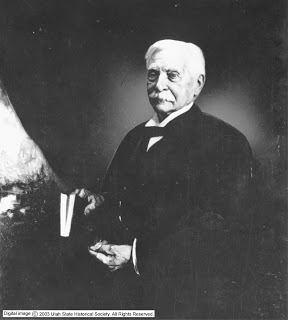
Reverend Duncan McMillan Acknowledged Gratefully The Unfailing Kindness of the People of Mt. Pleasant


 Reverend Duncan McMillan Acknowledged Gratefully, The Unfailing Kindness of the People of Mt. Pleasant 

Utah in general was a safe environment for denominational emissaries. There were no Presbyterian martyrs. All ministers and teachers who died in Utah did so of natural causes rather than at the hands of hostile Mormons.88* It is also apparent that a few Presbyterian ministers sensationalized their experiences in order to attract public attention to missionary activities in Utah. Indeed, in the case with Duncan McMillan, it is possible to trace how descriptions of encounters with Mormons increased in detail and intensity as they passed from oral tradition to printed word. Tellingly, McMillan’s Presbyterian colleagues in Salt Lake City were so alarmed at his inflammatory rhetoric that they purchased and burned copies of The Rocky Mountain Presbyterian in which one of his sensational articles appeared.89** It took nearly three decades before McMillan clarified details about his oft-repeated Bible-and-revolver episode. In 1903, en route to a meeting in Los Angeles, McMillan visited Salt Lake City and reprised his dramatic story at the Presbyterian-related Salt Lake Collegiate Institute. Confronted by local reporters with eyewitness accounts that contradicted his version of the event, McMillan finally acknowledged an element of exaggeration in his account. “That remark is a metaphor,” he admitted. “I did not go into the pulpit with a drawn pistol, but I went armed. One of the officials of the Mormon Church told me that my life was in danger, and advised me to go armed. I knew that I was in peril, and at the time this friend spoke to me, I had already taken the precaution to provide myself with a pistol. I was determined I would not bite the dust first.”90*** Shortly before he died, McMillan wrote a narrative of his years in Mt. Pleasant that presented a different scenario than the one he offered during the early days of his ministry. While affirming that he faced opposition to his educational ministry in Mt. Pleasant, McMillan offered this revealing statement. “I cannot close this letter without acknowledging most gratefully the unfailing kindness of all the people of Mt. Pleasant. The threats and attempts upon my life were from authority high up in the church. Some of the local preachers in duty bound uttered threats and used scurrilous language about me, but they were always personally kind and were most courteous in their treatment of me, so that I have most pleasant recollections for all who live there.”91****While this, too, might be deemed an exaggeration of an old man, it does provide a caveat to published accounts of his encounters with Mormons in Mt. Pleasant.The Journal of Mormon History +++ 86San Pete Stake, Tabernacle Meeting Minutes, October 2, 1892.91Duncan J. McMillan, Letter to Mrs. H. F. Wall, typescript, n.d., n.p., Wasatch Academy Archives ++++  

Tellingly, McMillan’s Presbyterian colleagues in Salt Lake City were so alarmed at his inflammatory rhetoric that they purchased and burned copies of The Rocky Mountain Presbyterian in which one of his sensational articles appeared.89**


90“Puts Blame on Brigham Young,” Salt Lake Herald, May 17, 1903, 8. See also “Who Was Attacked?” Deseret Evening News, June 8, 1903, 4.


All references  come from Journal of Mormon History Volume 37 ; Summer of 2011. 


Friday, March 1, 2013

John Waldemar ~ Pioneer of the Month March 2013


John Waldemar Family
COMING TOMORROW:
HISTORY OF ELIZA WALDERMAR
(ALESA)


Related Story:

This story is one of my favorites . 

James Hansen, my grandfather, a Danish convert to Mormonism, emigrated from Denmark to Utah.  Following church authorities decisions, he and his family were sent to help colonize Sanpete County.  They arrived in Mt. Pleasant in 1859.  James Hansen was a well-educated musician.  He played all the instruments including the organ.  The violin was his favorite. He taught music and dancing, but according to Brigham Young, he and his sons must till the soil.

It was the year 1880, Mt. Pleasant saints were having the greatest 24th of July celebrathion they had ever had.  It was to be held in the bowery with songs, recitation and orations.  But the crowning glory and most exciting part of the program was a contest between Mt. Pleasant's two musicians playing violins.  John Waldemar and James Hansen were the contestants.  John was also a well-trained and outstanding violinist.

John lived with his family on his farm several miles north of Mt. Pleasant city limits. James lived with his family in the large home on Main Street.  He was a very serious man, but he could be jolly.  This mood came to him only when he did the thing he loved best and which he could do best--his music, more especially his violin.  John made his brags to James.  He had new music that he was perfecting for the contest.  This was depressing to James.  New music for this frontier country was unheard of.  He had used all the music and melodies that he had brought with him from the old country.

Then an idea struck this Danish musician.  It was a long way to the Waldemar farm, but that would not stop him.  On the evening when James felt that John's farm work was finished and he would be practicing, he rode his horse to the Waldemar farm.  He crawled close to the open window where he could hear the beautiful violin music filling the air.  Intently he listened until he heard John close his violin case.

Upon returning to his own home, his remarkable ear and memory let him play John's beautiful new tune.

To make himself sure, he returned several nights.  Soon he knew he could play the melody better than John could.  He then went to work on John's music.  He used his Danish training until his piece was presentable.

With much excitement the great day arrived. Everyone in the hamlet attended.  Everyone was excited about the contest.  The audience's applause would declare the winner.  The violinist's drew cuts who should be first.  It was John.  Before the tense crowd, standing erect, John Waldemar began to play.  His beautiful new music filled the bowery.  Women used their handkerchiefs as the melody flowed on.  How could any music excel John's!

James Hansen stepped to the platform.  Silence filled the bowery.  He lifted the instrument to his shoulder.  With his right arm outstretched, he clutched the bow with his beautiful white hand.  deftly he let it slide over the strings while the long fingers of his left hand precisely pressed them.  What music! It was John's melody only in a haunting minor key enhanced by the vibrato of James' left hand.  Then the mood changed.  It was John's melody in a vivacious Danish polka, so rhythmical it was hard for the saints to keep their feet from stamping.  After retruning to John's theme, James turned the music into a scherzo, a waltz with a brilliant pizzicato, finishing with a Danish mazurka.

The bowery rang with applause. There were whoops and hollers, with hats flying in the air, to the very hills.  James had won the day!  His innate ability, coupled with the training acquired in Denmark, won for him the coveted prize- - - - the esteem of his fellow saints.

The friendship of the two musicians was not changed, but never again did John Waldemar make brags before James Hansen.
Sent in by Evelyn Ireland