Showing posts with label Petty. Show all posts

Sunday, March 3, 2024

DONKEY IN THE STRAW ~~~ Saga of the Sanpitch ~~~ 1974

  Git up here, you stubborn, lop-eared jackass, you,‖ a hoarse, half-whispered command forced its way out through clenched teeth as Will Arthur Cox tugged on the rope in an effort to get the donkey up on top of the straw stack. The object of this indignity was the property of a would-be suitor who had traveled from Nephi to court some young Manti girl. This night he had chosen to heap his attentions on one of the Cox sisters, but their mothers had decided that they would all be favored, and they had spent most of the afternoon trying to make themselves the most attractive. 

Ed‘s toes dragged along on the ground as he rode toward the younger sisters who stood watching him close the gap between them. Of course, the older ones busied themselves nonchalantly about the dooryard while Ed grinned broadly and waved vigorously toward them. The Indians had raided the settlement of Nephi a few nights before and had run all their livestock off. This donkey came wandering home the next day so, because it was the only transportation available, he rode it to Manti. He arrived in time to help with the evening chores before supper and had earned the wholehearted approval of the four wives of Father Cox.

 He planned to sleep with the Barn Crowd in the ―Old Cox Barn‖ for a couple of nights before returning experiences on his trip to Nephi, but now he was the center of a spellbound audience as he told of his experiences on his trip to the Missouri River for immigrants. The girls had to know what the latest fashions were. Did style call for hair piled on top of their heads or worn long? What were the latest dance steps? Could he remember the popular songs they were singing in St. Louis now? Ed told them what he had observed and then he added, ―Hell, they‘re just girls, the same as you are.‖ The girls giggled and Louisa replied, ―I‘ll wager their hands aren‘t as rough and calloused as ours are, anyway.‖ The boys had decided to play a trick on Ed because they were being to totally ignored. While he was receiving all the attention they were shoving and pulling, dragging and heaving his donkey up to the top of the straw stack by the barn. ―Black Hawk probably bribed this stupid, onery mule to return home‖ Hase Clark snorted. ―Wonder why they didn‘t kill it and be done with it.‖ 

When the donkey was up on the stack they tied it to a shed post and put and ox bow across its shoulder, then mounted a sack stuffed with straw on its back and left it for the night. Ed left the ―Big House‖ about nine o‘clock and walked quickly to the barn. He was thinking about Lavinia‘s brown eyes, Emmrette‘s tiny waist, Adelaide‘s beautiful long hair—and what a flirt Rosalia was. When he came to Manti again he would have to pay special attention to Louisa. She was quite stand-offish. Emily, Sarah Ann and Esther were really cute, but he guessed they were a little too young. As he walked into the barn a bullet was fired at a know in the rafters above him and he dropped to the floor instantly, whipping his gun out on his way down. 

Then he heard the snicker of the fellows and he moved forward to be introduced to them. There was Fred, Jr., and Will Arthur, John Hall, Ezra Shoemaker, Haslam Clark, Joe Snow, Elias DeMill, Alma Beal, William Richey, George Pectol, Titus Billings Heber Petty, Frank Beal, Gardner Snow, Luther T. Tuttle, and Andrew Van Buren. Marriage and death were the only acceptable reasons for getting out of the Barn Crowd. 

Winter and Summer they slept with their clothes on and their six-shooters strapped to their waists, ready for any emergency or duty. Will Arthur claimed he had slept in the barn for seven years.   Half past midnight they heard some cussing and swearing outside. Cautiously, Will Arthur made his way to a guard post and he saw Hebe Petty slipping and sliding up out of the creek. He had had a little too much whiskey and had slipped off the bridge into the icy water below. His clothes were frozen stiff, his teeth chattered, and he was shaking with cold. Will and Ed went after him and put him in bed between them to thaw him out. First, he was wet and miserable, then he was sick to his stomach, and then he was humble and penitent. No one got any sleep that night! 

Early in the morning, Ed went to get his donkey. No donkey! He knew it couldn‘t have gone very far because he had hobbled it when he turned it loose. He checked with the settlers close by. He looked inside the fort walls a block away. He searched through a sailor's glass (telescope), from the slate hill to the north, swinging it around slowly. Still no stray donkey! When he got back to the Cox home he asked, ―"Will, can you go with me and show me a few of the places that ornery cuss might be hid up?" Will pondered. ―"Well, I really can‘t afford the time to just go looking‘, but I‘ll tell you what I‘ll do. I‘ve got to bring a load of firewood out of the mountains today while the Indians are wintering down south. If you want to go with me, we‘ll keep a close vigil for that animal while we‘re gone."‖ ―"Well, I guess that‘s the way it‘ll have to be."
 Ed remarked. 

Late that afternoon as Will and Ed rode into the rear on top of the wood; Ed spotted the donkey up on the straw stack, silhouetted against the cold gray sky, bearing the oxbow and straw-stuffed sack valiantly. Ed turned to Will and said, ―"Will, have you known about this all day?" ―
"I can‘t honestly say I haven‘t," Will answered, ―
But I do know this, I sure got a good days work out of you while we were on the lookout for the ornery cuss , and I want to thank you".


 Ed jumped off the wood immediately and went to bring the donkey down. He found a partly filled tub of water so he knew the family was in on the trick too, or had learned about it during the day. He didn‘t stay to solicit the attention of the girls after supper, and he took the ribbing of the Barn Crowd good-naturedly, but he was gone in the morning before anyone stirred—without saying goodbye. Emily cried. She was the soft-hearted one of the family. ―"Well,  Will drawled,  
I guess we were a little rough on him. Next time I see Ed I‘ll have to apologize".

Source: Taken from an Auto-biography written by Will Arthur Cox

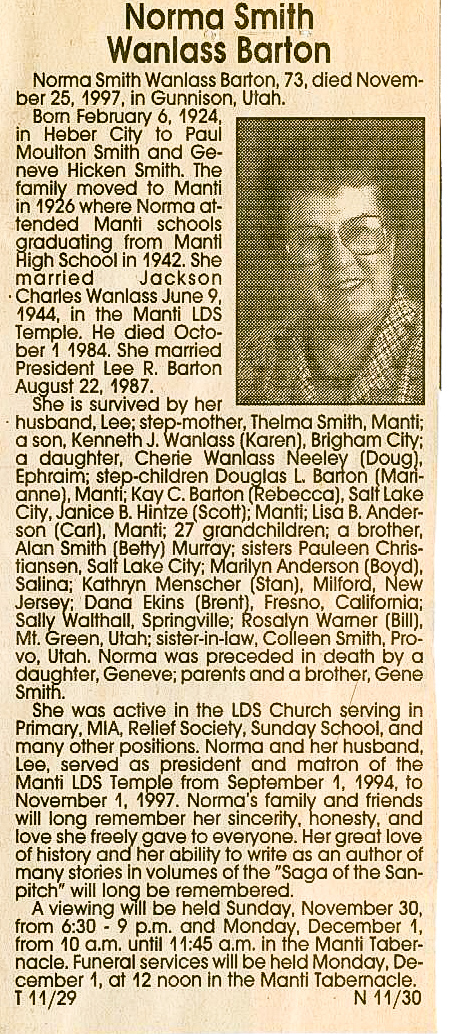
Norma S. Wanlass


Wednesday, May 22, 2013

Andrew Madsen's Journal Part IV

History of Andrew Madsen and the Early Settling of Sanpete County

Andrew Madsen Sr.
The following is an account written by Andrew Madsen concerning the settling of Sanpete Valley, the Indian Wars, Rattlesnakes in Manti, and Grasshopper Invasion.
David R. Gunderson  reproduced the original journal printed for private distribution several years ago and is currently working on a new edition to be published sometime in the future.

Mt. Pleasant as the name implies, is a city situated on a pleasant elevation in the north end of Sanpete County about one hundred miles south of Salt Lake City.  The site was selected by the early pioneers of Sanpete County as the most delightful and commending location for a rapid growing commercial and metropolitan city and its rapid growth and development fully demonstrate that the locators were not deceived.


After the Utah Pioneers had secured homes in Salt Lake Valley and were preparing to convert the desert into fruitful fields, a company of about fifty families from Salt Lake City and Centerville was organized and started late in the fall of 1849 for Sanpete Valley.

Among the original pioneers were the following ment, Seth Taft; Charles Shumway; D.B. Huntington; Barney Ward; John Lowry Sr.; Titus Billings; G. W. Bradley; Albert Petty; O.S. Cox; Albert Smith; Jesreel Shoemaker; Cyremus H. Taylor; Azariah Smith; Abraham Washburn; John D. Chase; Isaac Chase; Sylvester Hewlett; Wm. Potter; Gardner Potter; James Brown; Joseph Allen; Madison D. Hamilton; Wm. Richie; Harrison Fugate; Sylvester Wilcox; Gad Yale; J.Carter; Isaac Behunnin; Wm. Mendenhall; Edwin Whiting; Wm. Tubbs; John  Hart; John Baker; John Elmer; John Butterfield; Amos Gustin; John Cable; and W.K. Smith.

The pioneers cleared roads, built bridges and succeeded in passing through Salt Creek Canyon without a great deal of hardship.  They continued to move on southward in quest of a suitable location until the present site, Manti, was reached; thus being selected the frontier town of central and southern Utah.

The first camp was pitched on the stream now known as City Creek on the evening of November 22nd, 1849.  A few days later snow began falling and continued until the ground was covered to a depth of three feet.  The colony then changed quarters to the south side of Temple Hill where thy built dugouts which were occupied by some, while others remained in their wagons, on the hillside.

The Indians camped around the colony greedily devouring the dead animals which had died for want of food.  Th following Spring when the snow began melting and the days became warm, the peaceful colony were one day interrupted and startled by a continuous hissing and rattling of rattlesnakes which were found to exist almost everywhere throughout the homes of the settlers in boxes, cupboards, beds, etc.  A vigorous fight was at once inaugurated and hundreds were slaughtered in one night.

Of the two hundred and forty head of cattle brought in by the colonists less than one half were alive in the Spring, owing to the heavy winter.

The colonists were fortunate in having a fair supply of seed for planting.  The soil proved productive and crops began growing early, thereby giving some green vegetables for food within a short time after planting.  Ditches were made and water was easily taken out of the creek.  The crops grew and homes were erected until the settlers soon became comfortably situated.

About July 1st, of this year, Indian Chief Walker and a band of seven hundred warriors of the Sanpitch Indians with their squaws and papooses returned from a successful foraging expedition against the Shoshones and camped in a semi circle around the Colonists, remaining during the year.  They proudly exhibited their trophies of war, held frequent scalp dances and forced the squaws and children prisoners to dance with the scalp of their kindred attached to poles being significant of humbleness.  While thus being amused Indian Chief Walker and his leading men would tatalize the Colonists and threaten to treat them in a similar manner.  These fiendish actions would be kept up all night long, while occasionally a wild shriek or yell would burst forth from out of their camps.  The small Colony of Pioneers would lie in their beds not knowing whether or not their lives would be spared from the hands of the blood thirsty Indians until morning

President Brigham Young visited the Colony in August and christened the town Manti (in honor of one of the noted cities mentioned in the Book of Mormon).  The County he named Sanpete afte the Indian tribe then inhabiting this section, the chief of whom was Sanpitch.

A School house was erected of logs under the direction of Isaac Morley, Jessee w. Fox, and Mrs. Mary Whiting was installed as the pioneer teachers and the children were furnished the best opportunities of obtaining an education that the colonists could afforf.

A small grist mill was erected at the mouth of the Canyon by Phines W. Cook.  The only mill used previous to this was a large coffee grinder, which was passed from house to house as needed.

An act of Congress organizing Utah Territory was approved September 9th, 1850 and Brigham Young was appointed Governor.  A provisional form of government was instituted and Isaac Morley and Charles Shumway represented Sanpete County in the firs Legislative Assembly.  The Legislature met in Salt Lake City and passed an Act incorporating Manti which was approved February 5th, 1851.  Sanpete County was organized by authority of an act of the territorial legislature passed February 3rd, 1852 and Manti was made the County Seat.

In 1853 a Company of Veterans inaugurated under the direction of Madison D. Hambleton proceeded to move northward for the purpose of establishing a new colony and located on the stream just below where Mt. Pleasant is now situated.  The stream was named Hamilton (now Pleasant Creek) and the settlement was named Hamilton, giving honor to the name of their leader.  Early in March they built a sawmill at the mouth of the canyon and at once commenced cutting timber and sawing lumber for the purpose of building houses.  Work was at once commenced in clearing land, sowing and planting crops, building homes and they soon began to prosper.

During the summer the Indians were seen skirmishing about in a sulky, sullen manner, showing a spirit of dissatisfaction and the great Indian Chief Walker, continually gave indications of a desire to stir up trouble between the colonist and the redskins, notwithstanding his treacherous pleadings for white neighbors to settle among them and teach them the principals of a peaceful and happy government.  This bloodthirsty chieftan's purpose was only for more victims to slaughter.

An aged, diplomatic chief, named sowiatt, pleaded with his people to let the white men build homes and dwell with them in peace and his counsel generally prevailed, because he was reliable old Chief and desired peace, while Walker was very treacherous and could not even be trusted by his own tribe.  Walker desired the scalp of Charles Shumway and at last determined to make an effort to get someone to torture so that he could frighten his pale faced friends.

One day in the early summer, while most of the able-bodied men were at Hamilton assisting M.D. Hamilton, or in Salt Lake City after supplies, Walker and a band of painted redskins entered Manti and demanded the body of Shumway and others  against whom they had imaginary grievances, that they might be tortured and put to death.  This demand was not granted and an attack was threatened.

The old men and  women, also boys who were remaining at home, determined to resist the savages at once making preparations for battle, but the leader Sowiatt conquered and hostility ceased.  This vexed and humiliated Walker so much that he abandoned his tribe and went into the mountains alone, hoping that his actions would draw the warriors' affection from the Sowiatt to him.

July 18th, Alex Keel was killed at Payson, Utah by Arropine, a prominent Indian Leader.  This act caused the breaking out of the noted Walker Indian War and on July 19th, a band of blood-thirsty Indians fired upon guards at the Hambleton sawmill at the mouth of the canyon, but were forced back.

During the night a raid was made by the Indians upon the cattle that were corraled at Hambleton trying to frighten them away, but they were fired upon by the guards and tow of the Indians were killed.  The other Indians made their retreat, carrying with them their dead comrades and leaving behind them a gun and blanket which was covered with blood.  The following morning the veterans with their families, cattle and  provisions made a retreat to Spring Town for safety, where James Allred and about fifteen families had settled and built a fort in 1852.

While the settlers were rushing to Spring Town for shelter, their wagons, lumber and sawmill at the mouth of the canyon were burned and destroyed by the raging Indians.

The following day raids were made upon the herds of Manti and several horses and cattle were stolen and driven into the mountains.  A similar attack was made  on the range near Neph and Wm. Jolley was wounded by Indians at Springville.  The colonists became alarmed and at once organized for a defence of their homes and families.

A company of fifty militia men under Capt. P. W. Conover were sent out from Provo to assist the settlers at Hambleton, who were very few in proportion to the savages.

The troops met the savages on July 23rd, at Hambleton's Mill and engaged in a fierce bloody battle resulting in the death of six warriors and a complete routing of the Indians, who fled to the mountains.

By the aid of the militia, the settlers of Hambleton harvested their crops and returned to Spring Town, but the Indians were on the alert and did not wait long to recruit from the previous engagement.  One Sunday, Spring Town was attacked and all the horses and cattle were rounded up and started for the mountains; the the herders were fired upon and fled to the fort for protection, while the Indians rode away, yelling and waving their red blankets in defiance.  A posse was at once organized and soon on the trail of the Indians for the purpose of rescuing their cattle and horses.  When they neared the herd, some of the Indians broke back towards the Fort as if to attack their wives and children and thus the posse were compelled to return and protect their homes and families.  When they neared the Fort, the Indians fled to the mountains, joining those of their tribe who were rushing on with the cattle.  Two of the herding ponies escaped from being stolen by the Indians and returned to the Fort, thereby giving the settlers the means of communication with Manti, the only point from which relief could be expected.

A messenger was dispatched immediately and by riding west across the valley, then south, succeeded in evading the vigilant Indian scouts.  The express Messenger reached Manti at about three o'clock in the afternoon, making one of the quickest trips ever recorded.

When the news reached Manti, drums were sounded and their cattle was at once rounded up and sentries posted at all prominent points while hasy preparation was made for sending relief to Spring Town.

Twelve yoke of oxen and wagons, accompanied by teamsters and twelve mounted guards left as quickly as possible, arriving at Srping Town at daylight the following morning.  The colonists were taken to Manti and given quarters in a fort which had been erected that year.  The entire population of Sanpete at this time numberd only 765 men, women and children, who remained and fortified themselves in the Fort at Manti until the Spring of 1854.

Guards were kept at the little mill at the mouth of the canyon to prevent an attack from Indians until sufficient flour could be ground for the winter supply, but on October first, both Miller and Guard, John E. Warner, and Wm, Mills were killed by Indians who made their escape, leaving the mill undisturbed.  The indians, however, returned later and burned the mill, claiming that it was done in retaliation for the shooting of five Indians, who were convicted of stealing cattle and ordered executed by Major Higgins.

A few days previous to the killing of the Miller and the Guard, four ox teams loaded with grain started for Salt Lake City, being followed a few hours later by twelve horse teams hauling provisions, feed and a number of Saints enroute to the semi-annual Conference.  Arrangements were made for camping at Shumway Springs (now known as Duck Springs near Moroni) but the first teams kept going until they reached Uintah Springs (Now Fountain Green),

Before the rear team reached camp the Indians made an attack, killing all the drivers, Thomas Clark, Wm. E. Reed, Wm. Luke, and James Neilson driving away their oxen.  Having no use for the grain the savages cut open the sacks and scattered the wheat over the ground to complete their work of destruction and show their hatred for the white men.  The mangled bodies of those unfortunate freighters were picked up by the rear companhy and removed to Salt Creek (now Nephi) for interment.

Several Indians watched them from the  cover ofcedar and brushes on the mountain slopes, making frantic gestures of joy over their massacres.

A few days previous to this Capt. J. W. Gunnison a United States Topographical Engineer and a corps of seven men, including W. Potter of Manti, were killed by Indians while in camp on the Sevier River, near where the City of Gunnison is now situated.

During 1854, the Indians confined their depredations chiefly to southern Utah, but frequently invaded the herding grounds ofSanpete, stealing both cattle and horses and making good their escape.

On January 20th, 1855, Walker, the great Indian Chief died at Maddow Creek.  Arropine, who had begun the work of exterminating the white men became Chief of Walker'stribe and  made a treaty of peace.  Thus the Walker Indian War was ended.

On May 21st, 1855, A.N. Billings and a company of forty men were sent from Sanpete to settle the Elk Mountain country and make peace with the Indians.  They crossed the Grande River and erected the Mormon Fort, where Moab is now located.  In August some of the colonists returned to Manti and on September 3rd, the Indians made an attack, killing Wiseman Hunt, Edward Edwards, and Wm. Behunin and wounding Capt. A.N. Billings.  the colonists entered the Fort, which the Indians immediately surrrounded, giving notice of their intentions to kill all the inmates.

The next day some of the Chiefs interceded in behalf of the white men and the imprisoned colonists were permitted to return to their homes with the understanding that the settlement should be abandoned.  The request being complied with the colonists then returned to Manti.

In the Spring of 1854, R.N. Allred and R. W. Allred, together with fifteen families left the Manti Fort after remaining in the Fort over winter, where thy had stayed after being driven and forced away from Spring Town by the Indians the fall previous and located on Pine Creek seven miles north of Manti, the site afterwards being called Ephraim.  Isaac Behunnin had built a home on this creek as early as 1851, but had to return to Manti for protection from the Indians.  This settlement was really the first successful attempt towards forming a colony outside of Manti.  Several additions were made to their number during the fall of 1854 by families of Scandinavians from Salt Lake City.

The grasshoppers invade the farms in 1855 and 1856 and destroyed almost all crops, causing much hunger and starvation.  In December, 1857, a general jubilee prevailed through the colonies because of the abundant crops, which had been harvested, having overcome the two previous years of hardships.


To be continued ............