Showing posts with label Knudsen. Show all posts

Wednesday, May 27, 2026

LIFE SKETCH OF CHRISTIAN BROTHERSON AND HIS FAMILY ~~~ (From our archives)


The Life Sketch of Christian Brotherson  and  His Family

The life sketch of Christen Brothersen (Brodersen) is presented in two parts. The first part focuses on the family’s early life in Denmark and their emigration to America. The second part focuses on their life in their new homeland. 

Part 1: Focuses on Life in Denmark and the Family’s Emigration

Christian Brothersen was born, 14 June 1811 at Idrstrup, Maribo, Denmark. a son of Bohne Brothersen and Anne Margrette Rasmussen. At the age of thirty-five years, he married, Anne Mortensen on 13 February 1846. Anne was born 3 February 1824, a daughter of Martin Jensen Menboe and Dorthea Knudsen. Three children were born to Christian and Anne in Denmark: Dorthea was born 19 Dec. 1847; Hans on 15 Feb 1849; Bohne on 4 April 1851.   

A sorrowful event occurred in this family when Bone was an infant of only a few weeks of age. The mother, Anne Mortensen Brothersen. passed away on 26 May 1851. Mainly out of symphony for her sister’s children; Elsie Mortensen went into the Brothersen home, married Christian and cared for the children. It seems that Christian was a wealthy man. When missionaries of the Church of Jesus Christ of Latter-Day Saints visited his home and brought the message of the restored gospel, the father embraced it with all his heart, as did Elsie.  Quick preparations were made and this family planned on going to Zion. Two children were born to Christian and Elsie; Martin, who was born 30 May 1853, at (Faister?) and Ane who born on 8 Jan. 1856.


Map showing the location of
IdestrupDenmark, the home of
Christian Brotherson


The following year, 1857, this family joined a company of emigrants and sailed to America. Hans was Seven and Martin was only three years of age at the time. (Reference -pp 401- 403  Vol. 6. "Heart Throbs of the West" a History of the Daughters of Utah Pioneers.) The company journeyed westward immediately. At Iowa City, Iowa, they became a part of an Overland Emigration Company and were outfitted there and were bound for Utah, beyond the plains.

There were 330 people, 3 wagons, and 68 handcarts with which to make the journey. The journey was hazardous and eventful. The leader also walked and tried to keep up the spirits of his people. On13 September 1857, the company arrived in Utah, with a division of the United States Army hot on its heels.  They with many others, moved southward from the Salt Lake Valley into Sanpete


           Brothersens on the Passenger List of the Westmoreland (1857)
                        (Family Members are Indicated by Arrows)


Christian Brothersen settled his family at Fort Ephraim where the settlers from Springtown, or the Allred Settlement, had fled for protection from the Indians. They remained there until early in 1859, when

Christian went to Mount Pleasant to assist in the building of the fort. This was completed in July of 1859. Like many others, the family lived in dugouts, until log or adobe houses could be built.

After moving to Mt.  Pleasant, the Brotherson family went through a period when they had only a small bit of wheat for food which they kept in one corner of the room.  Each day, Christian would prey that they could make the food last until they could get more.  The Lord did bless them and the food did last so that the family did have something to eat.


Martin moved to Indianola to plant and cultivate crops. They also had cattle and sheep. Those were the days that tried their soul, Hans, Martin, and Christian Brotherson and other members of the family stood guard against Indians led by Chief Black Hawk from April 1865 until a treaty of peace was signed in Mt.  Pleasant at Bishop Seeley’s home in 1872.

A close up map of the location of Idestrup, Denmark


Part 2: Focuses on their Life in Utah


BIOGRAPHY OF CHRISTIAN BROTHERSEN (BRODERSEN)
by Ila Brotherson Tidwell

My great grandfather, Christian Brotherson, was one of the noble pioneers who entered the Salt Lake Valley in 1857. He it was, who gave to our family our pioneer heritage, a gift for which should be forever grateful and thankful. It is a great challenge to us as his posterity to achieve through our own efforts. We must improve and build upon the faith, standards and ideals he so valiantly preserved for us. It was he who looked beyond his own time; he had the foresight and vision. He saw the necessity of freedom. He accepted the restored gospel of Jesus Christ when missionaries came to his door. It was his soul who first accepted the principles and truths that has been a guiding star for us to follow. It was he who had the faith and courage to want to establish a new home and new way of life for his family and posterity.
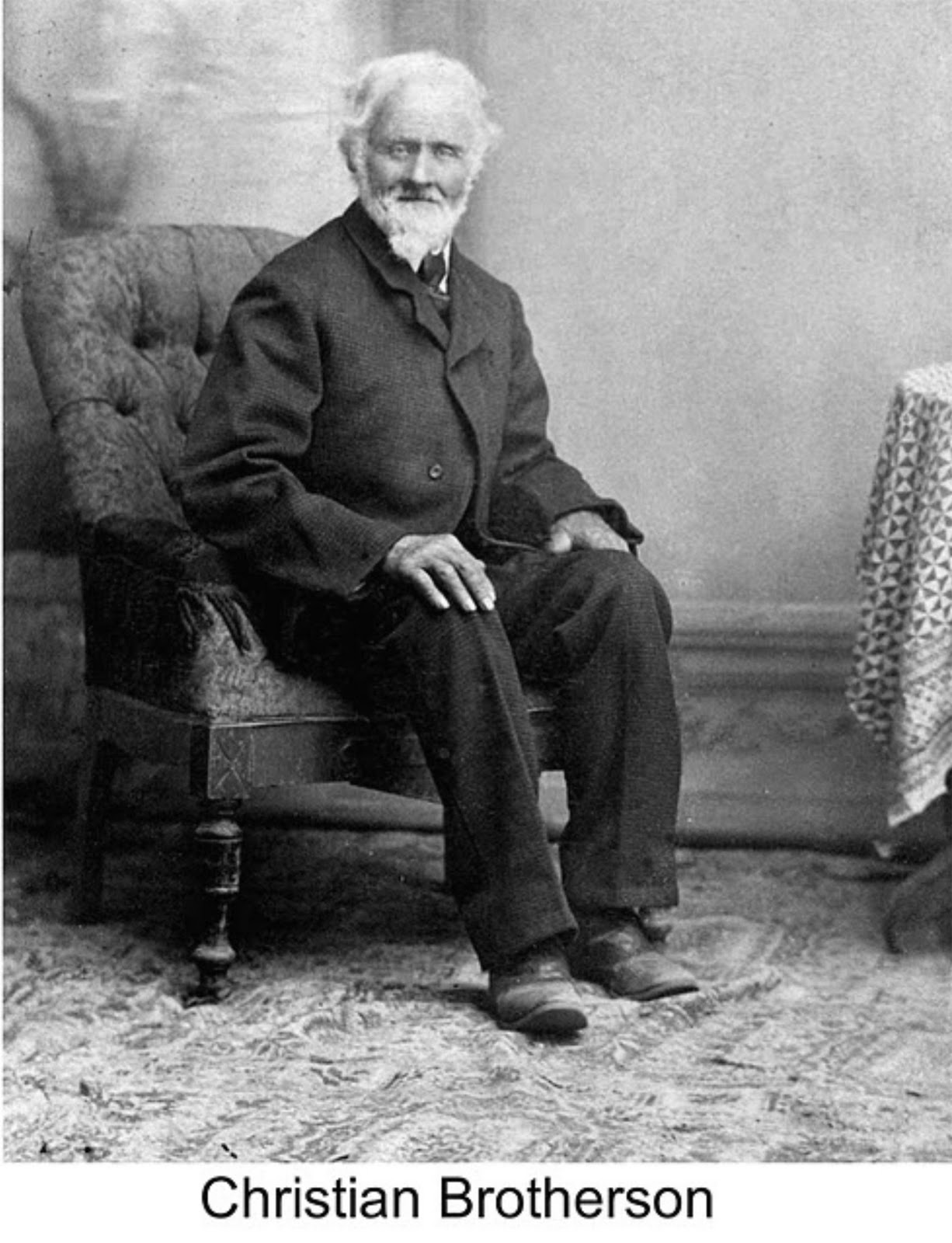


Christian Brotherson was not only a pioneer, he also helped to conquer this western land and make it a frontier civilization. In doing this, he gave us a land of freedom in which to live. He gave us the opportunity to live under the protection of the Stars and Stripes of America. It is a glorious privilege and blessing to live in a land, where by our own choice, selection and work, determine our progress and status in life. He also represented the vision, faith, culture and strength of our ancestors in the Old Country of Idestrup, Maribo, Denmark.


He was born 14 June 1811. One record says Idestrup the other says Veggerlose, Maribo, Denmark. His father's name was Bohne Broderson Magnesson. He came from Germany as a German Soldier to Denmark. He married Ann Margrethe Rasmussen. They had a family of ten children. The first four were boys and the last six were girls. Christian was the second son. This is all we know of his childhood.


Grandfather married Ann Mortensen in Denmark on 13 February 1846, he, being thirty-five years old and Ann only twenty-two. There were three children born to this couple. Dorthes Brotherson, born 18 December 1846; Hans Brotherson, born 15 February 1849; Bohne Brotherson, born 3 April 1851. From what we can get from memories handed down---the young mother had complications from the last childbirth. When the little son, Bohne, was only six weeks old, his mother, Ann, died. This was 26 May 1851. She left three small children under four years of age to the care of her husband, Christian. The family was very fortunate in having Ann's younger sister, Elsie. She came into their home and cared for this new baby, a little girl four, and a small boy of two. This was a handful for Elsie, but she loved and wanted to care for her sister's children.


This presents a sad beginning in the life of Christian Brotherson. He did not loose the desire to care for his babies even though his heart was broken at the loss of his sweetheart in the beautiful years of their youth. Those who know grandfather, lived with him, those who lived near him and those who remember him now, tell us he was a devoted and kind father from the very beginning. He was now forty years old and had always had responsibilities on his shoulders. It hadn't been too easy living in a family of twelve children. Each one must take his share of the load. Great grandfather, being old when he was married, had accumulated much. He was prepared to stand on his own two feet. We have a tithing receipt given him in Denmark in 1857 for 349.00. That was a big tithing to be paid in the Old Country at one time. This tithing receipt is really very valuable. There aren't many in keeping. It was issued before they counted money in Krones. Money was then rigs dollars. I took this tithing receipt to Johanna Madsen, who is from Denmark.

She said we should have it put in a museum so people could see it. It was among the first tithing receipts given in Denmark.


Maybe it was the feeling of loyalty and responsibility for the children of her sister; we hope it was love for both the children and their father that prompted Elsie to become a mother to Christian’s three small children. They were married on March 19, 1852 in Denmark.

These children were very fortunate in having a second mother come into their home to help care for them. But as the story unfolds, Great Grandfather Christian had more dark clouds on the horizon as well as sunshine.

During the time, or shortly after he married Elsie, while they were still on their honeymoon, missionaries from America, representing the Church of Jesus Christ of Later-Day Saints, (Mormons as they were called) knocked at their door. Christian said in his own words, "I know from the first, their message was true." Erastus Snow brought the gospel to these Scandinavian people. Maybe it was he who knocked at Great Grandfather's door. However, he and his wife, Elsie, soon become loyal converts to the Mormon faith. There were two children born to this union.

Their first, a baby boy, was born 14 May 1853. They named him Martin after his Maternal Grandfather. On January 8, 1856, a little girl came to bless their home. They named her Ann. (Her home was where the Pioneer Relic Hall now stands in Mt. Pleasant, Utah).

After the Restored Gospel had come into their lives, their ideals and ambitions were to come to America. When their little boy, Martin, was only five; their baby girl only eighteen months old, they decided to come to America.

This was a big sacrifice in those days, as well as a blessing. They had to part with friends and relatives, home and it's comforts, worldly possessions, all for the Gospel of Jesus Christ and the desire to worship God in a new world. Their ideals as parents were high education, culture, patriotism, and freedom was the pattern of their lives, the desire for their children.

They were patriotic and loyal to the Church they loved so much. Great Grandfather was a well to do man in Denmark. He had servants who helped care for household and did much of his work. When he was almost ready to come to America, he hired a man by the name of Hyrum Arnoldsen to help him and his family to America. He paid his way to this new land.

They sailed on the Westmoreland, from Liverpool, 25 April 1857. The leader of their company was Matrthias Cowley. There were some 544 souls who come to America on this ship.

They landed in Philadelphia. It was only two months since they had left their home in the Old Country. On 15 June 1857 they were prepared to begin their trek across the plains to the Great Salt Lake Valley.

They joined the 7th Handcart Company under the leadership of Christian Christiansen. (Interesting to me was this notation. He was the first Elder ordained in Scandinavia. This was done by Erastis Snow in 1851.)

There was much to be done in preparation for the journey to Zion. The conditions they had left in their homeland were heart rendering---friendly relationships and family ties were often broken. Fathers, Mothers, sisters and brothers became almost strangers. Many showed enmity towards their loved ones, who had embraced Mormonism. With sad and broken hearts, but with the testimony burning in their soul, they faced another new experience different than crossing the water. Now they must pull a handcart across the plains. These activities were carried out with joy and anticipation.

There were 330 souls in this company, three wagons, and 68 handcarts. Rightly, it was named the "Christian Christiansen Handcart Company". In one these handcarts were all their possessions. Christian had a family of five children, his wife, himself and a hired man. He had a baby of two who had to ride or be carried and a little boy almost five. I have heard him (Martin) tell many times how he walked all the way, or most of the way, barefoot. His feet were so callused that he could step on prickly pares and not even flinch. He told how happy he was when his mother would pull the handcart and his daddy would carry him a little way. He also told of how his father would hold him at night until he went to sleep. He also told how he liked to see the campfire at night, hear them sing, climb on his daddy's lap and go to sleep.

They built fires only once in a while because the Indians were beginning to attack the Saints. In fact the first attack they had by Indians was in 1857.


The weary travelers moved slowly every day, stopping only long enough to eat and sleep. Behind them was the Johnson Army. They preferred to keep out of their way. But one afternoon some supply wagons that were ahead of the army caught up with the handcart company. They moved slowly pulling the handcarts and so many walking. The army had a lame oxen. They told the pioneers they could have half if they would dress it by the next evening. During the night a heavy rainstorm made the roads so muddy the army wagons mired deep in the mud and moved very slowly. The Saints pulled their light carts out of the ruts and moved on, soon leaving the army wagons far behind. The Saints had all the oxen. That night they camped near a large stream of water. The Indians helped the women and children across the stream. The Saints didn't ever see Johnson's Army again.

They had many hardships but I feel my Great Grandfather was really blessed. He and all his family reached their destination.

Here is one experience Grandpa told that happened while coming across the plains. A little girl that was the same age as baby Ann died. They had nothing to bury her in, so they wrapped her little body in a blanket, put her head in a brass kettle to keep the dirt from her face and placed her in a lonely grave. These were the heart-rending experiences that tested their faith. Sometimes they felt they couldn't carry on.

One of the abilities that God gave us when he created us was the ability to see ahead, the vision to do today what will be best for us tomorrow. Great Grandfather's faith was really tested.

Besides the hardships they endured crossing the plains, he could see every day he was loosing his wife's love. For reasons we do not know, she became the object of another man's desire to covet a lovely woman. Great Grandfather was very kind and understanding with her. He loved her very much. He needed her to help rear their children. His oldest girl was only nine years old. He had a baby only two and three other children. They all needed a mother's love and tender care. Christian told her this, "If you are dissatisfied, I will not prevent your leaving." He must have been a good man with an understanding heart. The man who took his wife was none other than the man whom Great Grandfather had hired to help him while crossing the plains. He had paid his way and in return Mr. Arnoldsen took his wife. We can't find if Great Grandfather took his wife with him into the settlement at Ephraim or if when they reached the Great Salt Lake Valley she went with this other man.

They reached the valley on Sunday, 13 September 1857. They lacked two days of being three months crossing the plains. When they had finished their journey over, in fear of Johnson's Army, most of the company was sent by the church leaders to Ephraim. The tired souls struggled on to Fort Ephraim. There Christian housed his family in a cellar or dug-out until the spring of 1859.

I have read from history that trail of the Saints, who went to Ephraim, could be followed by blood on the snow. The first winter they almost starved. Grandfather Martin tells of the winter of 1858 when they only had a little mound of wheat, in a corner to last until the next harvest. His father would raise his hands, close his eyes and pray to the Father in Heaven to bless this little bit of food that it would last them. Martin, only a boy, testified that it seemed to not diminish very fast and it lasted so that these faithful pioneers could subsist until the weeds began to grow in the spring and they could dig roots to eat.

My heart aches for Great Grandfather Christian with the sadness that he must carry in his heart alone. He had five children under ten years of age whom he must love, instruct, feed and care for. He must be a mother and father to them. What his faith and courage must have been. We owe him so much.

In the spring of 1859 he came among the first settlers to what they called Hamilton Settlement. He helped to build the stone fort. His name appears on the Pioneer Monument erected in honor of the first settlers. He took up land and built his first home in America. It was on the corner just south of where Alton Brotherson now lives. He lived in a cellar or dug-out until he and his boys finished their first home in Hamilton Settlement which later became Mt. Pleasant.

They lived here until the children all married. Then Christian moved to the north part of town. This was in his declining years. They say even then Great Grandfather's home was the play ground for all the neighborhood children. He always had lump sugar, raisins, or candy to give to them. Sometimes when he didn't have these, he would give them an egg and let them take it to the store and get what they would like. Many people of Mt. Pleasant have told me Christian always wore a long beard, and it was white as long as they could remember. If the children loved to play around his door, I think the story of his life and what he was has been pictured.

After his wife, Elsie, had gone with the hired man, they settled in Ft. Green. Later, they moved to Moroni where they made their home. Great Grandmother Elsie regretted what she had done before very long. She wanted her children but her new husband did not. She would come and get the children and have them one or two days. She still loved them and realized she had made a mistake. When they were with her, her new husband was mean to them.

One time, when Martin, my grandfather, was only seven, he was going from Mt. Pleasant with Arnoldsen to see his mother. They got to what we all know as Fiddler's Green. Later it was known as Riverside  Park. (It was a dance hall, race track, and swimming pool). A nice place at one time but it was rather wild and was disbanded. They said they called it "A place between Heaven and Hell".

Arnoldsen stopped the wagon and told Martin to get out. He said he was going to stop and water and rest the horses. So the little fellow climbed down from the wagon. The man hurriedly whipped the horses to a run and drove away. The child was astounded when he realized he was left alone and it was getting dark. He was all alone, the Indians were real ferocious. He might get lost or even perish in the darkness of the night. He sadly thought, "What shall I do, go home to Dad or go on to see Mother?" He quickly made up his mind and began to run after the wagon. He thought, "If I can just stay far enough behind so he doesn't see me but I can see the dust of the wagon, I wont' be afraid."

After separating from his step-father, he fairly flew. He began to tire after he had followed a trail out through the fields and over the hill for a long way. It was a shorter way. He said, "I prayed in my heart as I ran faster and faster that the Lord would help me get to my mother first. I did get to Mother before he did and told her what he had done." Grandfather tells of how his mother took him in her arms and cried like her heart would break. "You must go back and live always with your father. He is a good man and will always be good to you." When Arnoldsen arrived, he was surprised to see the boy and also angry. He made Martin go to bed without any super. Great Grandmother sent him home the next day with a friend as I remember. I do remember what his father said to him when he returned, "My little Mart, I felt I should never have let you go after you had gone."

On another occasion when Martin was helping Arnoldsen haul hay, he was pitching the hay on the wagon and I felt impressed to move. He looked up just in time to dodge a pitch fork. The man had aimed it at his head.

Martin tells this story about his boyhood also. "I went for a walk up in the hills. I was sitting on a big rock, I felt the presence of someone, I knew not whom. I knew I was being watched, likely by Indians. What should I do? Suddenly, I began singing loudly, so I could be heard by anyone nearby. The fear left me; I was not molested or harmed, for which I was thankful."

Great Grandfather Christian probably loved or had a great deal of respect for Elsie. He always knew how she was and when she needed help. Grandfather said, "My father often took her flour, meat, fruit and other foods and clothing for her and her children." She had a real hard life and many times didn't know which way to turn. Her husband lived in polygamy. He had four wives. It was hard for him to care for all in those days.

Great Grandmother was a beautiful woman. She had light brown hair with beautiful dark blue eyes. She was slender and average height; had a pleasing disposition but was quiet. Sometime in her life she hurt her shoulder. Some say it was from her helping pull the handcart across the plains. We don't know. But we do know her one shoulder drooped and hurt all her life.

She was sealed to Arnoldsen in the old endowment house in Salt Lake City on 16 August 1862. She told Christian many times she wished she could break that sealing.

She didn't want Arnoldsen. Christian[1] evidently wanted his first wife because he went and had her sealed to him 19 September 1889. His children were married at this time and so they made the choice of who they would be sealed to. My Grandfather, Martin Brotherson said, "I want my father." He was sealed to his father and his mother's sister, Ann, Christian's first wife. Christian died on 9 August 1893. He was buried in Mt. Pleasant City  Cemetery. Christian was 82 years old when he died. Elsie was 67 years old when she died. He lived a year and four months after she passed away.


A picture of the Hans Brotherson family circa 1901

Soon after the Death of Hans Brotherson
Background:  Hans Brotherson .(In Picture Frame)

Back Row (Left to right)t: Parley [Parley Pratt], Tina [Clementine], Francis [Francis], Boone [Bohney], Lora [Lorenza Christine], Hans [Hans}, Chris [Christian],


Middle Row (Left to right)Orsen [Orson Hyde], Rakkie, [Fredrickka], Rhea [Maria], Maggie [Annie Margaret], Grandma Frederikka [Frederickka Andrea], Nels [Nels Douglas]


Front Row: Floyd [Ferdnand Floyd] on the left, Vernon [Vernon Hamlet] and Heneretta [Heneritta] on the right.


A Portrait Picture of Hans Brotherson 


[1] Christian Brothersen (Brodersen) was endowed in the Salt Lake Endowment House on 8 July 1865.


Friday, March 1, 2024

NIELS JOHANSEN, ANE ANDERSON JOHANSEN, ANDERSINE (SENA) ANDERSON JOHANSEN ~~~ PIONEERS OF THE MONTH ~~~ MARCH 2024

Niels, Annie, and Andrew 


Andersina Andersen Johansen


~~~~~~~~~~~~~~~~~~~~~~~

1851: Ane Andersdatter declares the truth: 


"I had seen an Angel....  and I would not deny it!!!"


The gospel was first preached in Denmark the summer of 1850. The organization of the first branch of the church there occurred on September 15, 1850. Niels heard the gospel message from two Mormon missionaries who came to his home. When he was nineteen, he joined the Church of Jesus Christ of Latter-Day Saints, on February 9, 1853. He became an active member. He met a young lady named Ane Andersen who had accepted baptism into the church on November 6, 1851. Ane was born March 16, 1839, in Rojle Mose, Vejlby, Odense, Denmark. Her father was Anders Larsen, born April 9, 1806, at Strib, Vejlby, Odense, Denmark. He was the son of Maren Pedersen and Lars Svendsen. Ane’s mother was Ane Cathrine Hansen, born December 2, 1801, at Aulby, Vejlby, Odense, Denmark. She was the daughter of Anne Hansen and Hans Madsen. Ane was the fourth child, with two older brothers, Lars and Hans, an older sister, Maren, and a younger sister, Andersine. Many did not listen to the missionaries and would not receive their message. Oftentimes they would ridicule and persecute those who did. Ane Andersen was the first member of her family to join the church and was turned away from her home because of her affiliation. She was twelve years old. She went to live with an uncle named Peder. At school, she was looked down upon and punished by having to hold a book in the air for a certain length of time. If her hand dropped, she received a good hit with a ruler. In telling her children about this later Ane would say, “I had seen an angel and he had made known unto me that the church was true, and I would not deny it.” A year after Ane joined, her older sister, Maren, joined the church, and then her eldest brother, Lars Strib, was baptized into the church the day before Niels was baptized. (Written by Louise B. Johansen, Effonia J. Burns, Beth J. Brasher, and Gayle H. Bailey)

#######################################


ANDERSINE ANDERSEN JOHANSEN
 Andersine Andersen, or Sena as she was always called, was born August 2, 1842 in Rojle Mose, Vejlby, Odense, Denmark. Her mother was Ane Cathrine Hansen, who was born December 2, 1801 in Aulby, Vejlby, Odense, Denmark. Ane Cathrine’s parents were Hans Madsen and Anne Hansen. Sena’s father was Anders Larsen, who was born April 9, 1806 in Strib, Vejlby, Odense, Denmark. Ander’s parents were Lars Svendsen and Maren Pedersen. Sena joined the Mormon Church on October 20, 1858 and came to Utah in 1862 to join her sister Ane and be taken as the second wife to her husband, Niels Johansen. 
They were all sealed in the Endowment House in Salt Lake City on November 12, 1864. 
Sena had nine children:


          Nielsena (Sena) born in December 
21, 1865, 


Ester Fredricka born April 30, 1868, 

Kimball born September 24, 1870, 
Elizabeth (Eliza) born May 15, 1873,
 Moroni born June 19, 1876, Lucinda born May 4, 1879, Wilford born June 4, 1882, Marie born April 4, 1885, and        Anna Cathrine (Katie) was born June 16, 1888. 
Sena lost one child who contracted diphtheria and another child who fell down a cellar and was killed. 
Another heartbreaking experience was when Sena’s daughter, Ester Fredricka, gave birth to a baby, Fredrick Mathiasen, on January 26, 1891 and died from complications of childbirth. This was on February 5, 1891, just the day after her husband, Jacob Mathiasen, was killed in a farming accident. The baby lived just ten months and died on October 26, 1891. Sena was treasurer of the Relief Society for many years. 
In those days there was no welfare or social security. When visiting teachers went on their monthly rounds the members donated eggs, fruit, beans, or anything they had, and this in turn was distributed to the poor. As one can guess, these good ladies didn’t collect very much. Few people had anything to spare. But Sena’s grandchildren recall being at her home many times when a needy person would come for some food and they were never turned away empty-handed. Most of what they were given was from the limited food supply of their own personal stock. This, however, was not common knowledge.
 The Johansens were always charitable people, nothing could equal the goodness of their hearts. Just before Christmas the family assembled at their house and the food preparation went on for days. Beef, pork, and lambs were killed and dressed, and finker, head cheese, rolly pulse, cakes, and puddings were prepared. When it was all ready and assembled into packages, Wilford would hitch the horses to the bob sleigh and away they all went, singing and delivering goodies to the needy. 
The true spirit of Christmas was taught in the Johansen home, and the children enjoyed the spirit of sharing what they had with others. What family fun they had! 
They were temple workers for many years, working year in and year out. The “Temple Hack” as it was called, stopped on scheduled days to pick them up. 
Niels died August 16, 1921 in Mt. Pleasant, Utah. He was eighty eight years old. 
After Niels died Sena spent most of her time at either Marie’s or Eliza’s home. She became ill while at Eliza’s home and was taken to Delta, Utah. She died six days later at Marie’s home on October 11, 1921. She was seventy nine years old. Niels and his two wives are buried in the Mt. Pleasant City Cemetery. 

TRIBUTE TO ANDERSINE JOHANSEN By the Mt. Pleasant, Utah Relief Society 
We have met today my dear sisters to do honor to our beloved Sister Johansen, our retiring officer, after the terrible siege of sickness she has been of late called to pass through. The Lord has surely heard her prayers and our prayers as well as the prayers of the Priesthood in her behalf and has been pleased to restore her to health so much that she is able to meet with us again. Sister Johansen is one of the few remaining that has come here from a distant land for the Gospel. She has been tested and tried and proven herself worthy to be thus honored. Only for her failing health is she now being released of the office of treasurer of the South Ward Relief Society which has been held by her since April 16, 1904. Prior to that she was a teacher in the district and was later appointed head teacher in which position she worked zealously. She is still favored of the Lord to remain with us longer. In reading the poem it brought to my mind many scenes of early days, as we have lived neighbors for many years. Yes, since my childhood I have seen her and many of the hardships she has had to pass through. She has lived in a small home with a large family and endured all the inconveniences of pioneer life. She has struggled day by day, working at home and in the fields, and has taken care of the products raised for the benefit of her family. She has spent time weaving, cording, spinning, knitting, and other industries which were engaged in at that time. Never did we hear any complaining or trouble, everything seemed to be peaceful and quiet, with perfect harmony prevailing in her home. She has many times been called to pass through very trying scenes, burying loved ones, being nearly burned out of her home, and many other adversities. She is the mother of nine children, four of whom have gone to the Great Beyond to await her coming. The five remaining are an honor to her name. She and her husband have strived to live honorable and upright lives and have instilled in the hearts of their children the Gospel and its principles. They have set an example worthy of emulation. She has not only cared for her own but has been a mother to the motherless and has watched over and supplied the necessities of life to many of the aged in distress. She has been an ardent worker in her calling in the Relief Society and has taken on the responsibility to help others who were growing aged in the work they were unable to perform. Cheese making was one of the industries of this organization. The milk was gathered from those who could spare it and was carried to her home. She was the one who made the cheese and gave it to those in need. This was of great value to many in those days. Sena had a large family and not much room but she was patient and long-suffering with her circumstances. Many today might take a lesson from those like her who have labored and toiled under such trying circumstances and have been willing to take up the good work and faithfully perform it. While we do not want to recall the past too vividly, we must remember the many blessings of the Lord which have been bestowed upon us and be grateful to Him and try to do honor to the works of righteousness in love and charity to those less fortunate than we. We must remember we are living in a time when we little know what awaits us, and we must ever be ready to do what may be required of us by those in authority over us. 3 Sister Johansen’s life has been a strenuous one for many years. She has answered the beckoned call of children, grandchildren, nieces, and nephews. “Aunt Sena,” as she has been known among her friends, has given willingly heart and hand to aid and give comfort to those who are sick. She has administered that love and sympathy so much needed in times of death and sorrow. In her family, among her friends, and in public, she has ever proved true and faithful in this cause and the Sisters have much appreciated her good works. We would have liked to acknowledge our appreciation before now, would she have accepted it. We are now sorry to have to accept Sister Johansen’s resignation, but for her sake and her family’s we willingly do. We feel to thank her for her long and untiring efforts in this cause. While we regret to give you up as a worker, we rejoice to have you still with us and hope the Lord will bless you with health and sufficient strength to enable you to continue in your own family and be a strength and stay to them. We realize you need to care for your aged husband who is still with you. May you live long and enjoy the blessings you have rightfully earned, and the blessings of Heaven, which are ever in store for you because of your faithfulness. May this occasion be remembered by you as an appreciation, and may this rocking chair we present to you, for your comfort in your declining years, be accepted as a token of the love and esteem we hold for your good and faithful duties these many years. May we enjoy your presence at our meetings and your good words of counsel and advice for many years. May you be given health and strength sufficient to enjoy to live and see many of the eventful things transpiring in this wonderful age of the world, as you have witnessed much in the past. 


Sunday, July 9, 2023

The COPENHAGEN DISTRICT Of Mt. Pleasant (From our Archives) taken from Knudsen Chronicles page 59

COPENHAGEN DISTRICT

The Knudsen family lived in the southwest quarter of town, called the
"Copenhagen District" 
 because so many Danes made their homes there.
 An interesting culture developed.  Because there 
were so many Sorensens, Madsens, Olsens, Hansens,
 Rasmussens, Jensens, etc.,
 nicknames based on former hometown,
 physical characteristics, or a humorous happening 
became common.  For instance, 
James Christensen, 
who came from the town of Hobro, was commonly called
James Christensen Harbro.  
Ole Sorensen, who said the word 'absolutely' often, 
was called Ole Absolutely
 Examples of other amusing names were
Olaf Coffee Pot
Chris Golddigger
Stinkbug Anderson
Fat Lars
Dirty Mart
Alphabet Hansen, 
Bert Fiddlesticks,
Otto By-Yingo Anderson
Pete Woodenhead, 
Long Peter
Little Peter,
Salt Peter,
Shimmy Soren
and Shingle Pete.

The Word of Wisdom was not stressed so much at the time, 
so they followed the customs of their homeland and
 continued to drink coffee and homemade brew called 
Danish Beer. 
 Symbols of hospitality were the coffee pot simmering
 at the back of the stove and freshly-made cinnamon buns
 or cookies covered with a colorful cloth waiting to be shared.  
If anyone chided them, they commonly replied with a smile,
 "Brother Joseph never meant the Word of Wisdom
 for the Danes."

One Dane explained, "Not all the goot tings should 
be left to the yentiles."

Preaching at a funeral of a friend, a Dane said, 
"He has gone to Heaven where there is no sorrow, or pain, 
or Word of Wisdom."

The Danes had a great ability to laugh at themselves: 
"The Danes of Mount Pleasant, it was said, 
had pretty wives, 
while the Swedes had homely wives. 
 The reason:  
the Swedes were hard workers, while the Danes
 loafed around and picked out the 
pretty girls when they came to town."

At times, old prejudices from Europe caused
 problems, but laughing about it seemed to help 
defuse anger:  "A Dane and a Swede were arguing 
about the virtues and vices of the two nations.  
As the argument reached its peak, the furious
 Swede demanded, 'What could be dirtier than 
a dirty Dane?' To which the Dane triumphantly 
responded, 'A clean Swede."'