Showing posts with label Wanlass. Show all posts

Sunday, May 12, 2024

UTAH BECAME A STATE


45 Star Flag ~~ Utah Became A State 
STATEHOOD

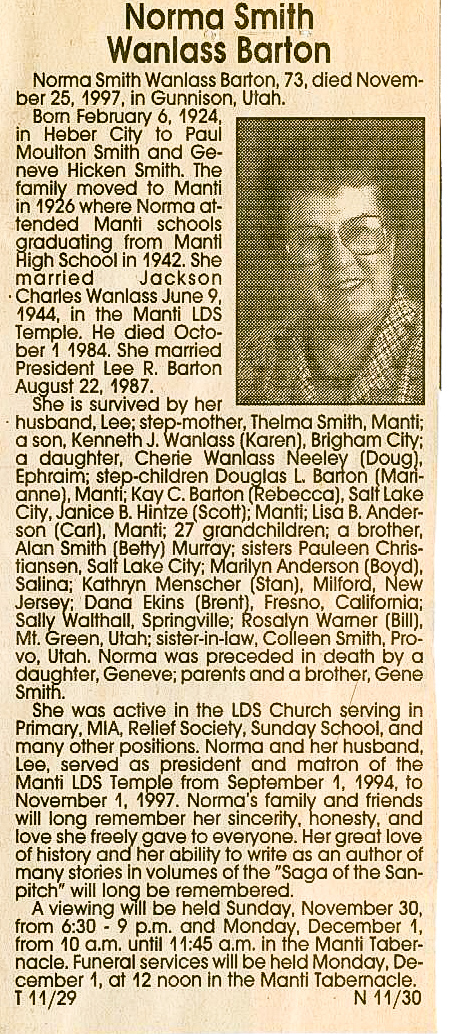
Norma Smith Wanlass Manti, UT 84642

Before admitting Utah to the Union, the United States Congress turned down six statehood petitions from the territory, and the six petitions are only the efforts that got as far as Washington. For 45 years Mormons deliberated, petitioned, politicked and intrigued almost constantly to achieve it. Why should statehood be successful in 1895 and a failure in 1849, 1856, 1862, 1872, and 1887? The answer, Polygamy.

If Congress had admitted the State as in the original petition almost all of Utah and Nevada, as well as large parts of Idaho, Wyoming, Colorado, New Mexico, Arizona, California and Oregon, were within the boundaries of Deseret. It took Congress two years to decide what to do. When it finally acted, it rejected the petition for statehood, instead creating the Territory of Utah.

As a Territory, the Mormon settlers were less able to control their own affairs than they would have been as a state. When the Mormons came to Utah it was still in Mexico, yet part of the problem was that the Mormons had settled the land without authority of the United States government. They granted tracts to their members to farm, and gave vast water and timber rights to their leaders to administer to the community. Because they held their land without title from the United States, some gentiles claimed the property of their Mormon neighbors. This resulted in court battles and street fights.

Women were given the right to vote in Utah in l870, the first in the nation to exercise that right. The first votes cast by women in municipal elections in the United States were in Salt Lake City. In the EdmundsTucker Act of 1887, Congress revoked the right of women to vote—to reduce the political power of the Mormons. Stiff new penalties were prescribed for polygamy by the Edmunds Act, and co-habitation with more than one wife was defined as a separate criminal offense.

Over 1200 persons were convicted and served time in the territorial penitentiary. The common law rule that a wife may not testify against her husband was declared inoperative in the case of polygamous wives. Many went to jail for contempt when they refused to give evidence against their husbands.

In 1887 Congress struck the final legislative blow with the Edmunds-Tucker Act. That law: —Disincorporated the Mormon Church and the perpetual Emigration Company. —Declared all church property in excess of $50,000 forfeit to the government, and gave the courts power to ferret out actual holdings of the church, setting aside devices such as the "trustee in trust." —Abolished woman suffrage in Utah, disinherited children of polygamous marriages, and required al] marriages be certified by the courts. —Required an expurgatory oath of all prospective voters swearing they did not belong to or support an organization which advocated polygamy. Thus, any Mormon would have to forswear himself to vote.6

After passage of this Act, the Mormons surrendered over $1 Million in property to the federal government to facilitate a court test of the constitutionality of the legislation. Temple Square in Salt Lake City was one of those forfeited properties. The church continued to occupy the block, but paid rent to the government.

7 The Edmunds-Tucker Act was morally wrong when it took the franchise from women. Unjust as it was, the provisions of the Constitutional Convention defining the qualifications for voting could not go into effect until Utah became a state. This legislation was violently in opposition to the Constitution of the United States. This act illegally confiscated the real estate property belonging to the church. Nine years passed before the enormity of the crime was realized. "Resolved, that all of the real estate now in the hands of the receiver of the 'late' Corporation of the Church of Jesus Christ of Latter-Day Saints, and all the rents, issues and profits arising there from, are hereby granted and conveyed to the Church of Jesus Christ of Latter-Day Saints." This resolution was approved by the House, March 24, 1896, and signed by President Cleveland, March 28, 1896.8

For 42 years Utah had been called wicked. Now they were vindicated. 33 "Utah is a State" The click of the telegraph instrument conveyed the news that the people had long been waiting for. At 9:03 A.M. in Utah, on Saturday, January 4, 1896, Utah assumed the robes of State sovereignty. To other states, statehood came as a matter of course; to Utah it came as a sacred deed of trust put in the hands of the people. The joy was too deep for any outward violent demonstration; but that did not disguise from any looker-on the truth that the people were immensely, intensely moved.9

MANTI, HOW WE CELEBRATED

 January 6, 1896 Early on Monday morning the booming of cannons, ringing of cow bells and blowing of whistles gratified the ear, or otherwise, with the noise. In every direction flags and bunting met the eye. Uncle Sam paraded the street accompanied by as many noise-makers as could be raked together. At 11 A.M. the citizens met at the Tabernacle and crowded it to its limits. The meeting was well warmed up by the stove brought from the SPV round house. —Call to order at 12 P.M. by Master of Ceremonies, Mayor Alder. —Music - Double Mixed Quartette —Invocation - Anthony W. Bessey —Music - "America ", by school children. —Address - Honorable C. P. Larsen —Music - Guitar and Mandolin Club. —Speech - Bishop Win. T. Reid. —Song - by the Schools. —Speech - Pres. J. B. Maiben —Speech - Mrs. A. L. Cox —Song - Misses Billings —Speech - Mrs. Adelia Sidwell —Speech - Bishop Hans Jensen —Male Quartette. —Speech - "Pioneers" , George P. Billings —Speech - Daniel Henrie M.W.V. —Music - Orchestra. —Speech - Pres. J. D. T. McAllister. —Music - Choir, Schools and Audience. —Benediction - Rev. G. W. Martin.

The Program was carried out in a splendid manner. The speeches were good particularly that of President Maiben. The singing was excellent and the double quartette was all right. There were too many speeches which made the meeting too long, but we scarcely see how it could be shortened. In the evening the dances were well attended, and a good time was spent by the participants. Altogether the whole affair was a genuine success.

Eddie, son of Judge Cochran had his eyes filled with burnt powder and it was feared that his eyesight would be permanently injured, but he is doing all right under Dr. Morrey's care.

 One thing lacking about the decorations was a picture of President Cleveland. The committee secured the services of Oliver Christiansen, to make one, but the work was not considered good enough and it was reluctantly laid aside. The Sentinel—January 8, 1896 34

 GUNNISON

Inaugural Day at Gunnison was celebrated in a manner which will never be forgotten. The citizens seemed to be out in masses to show their appreciation of the boon of Statehood. Just before 11 o'clock on the morning of January 6, 1896, commenced the firing of artillery and ringing of the bell while the brass band paraded the streets. The people gathered at the R.S. Hall and soon filled the building to overflow. The hall was beautifully decorated and the stores, as well as many residences were bedecked with bunting and flags. Large flags were displayed over the R.S. Hall, Co-op, Presbyterian chapel, and premises of W.H. Gribble, Mrs. Julius Christensen and Edmund Sandersen.

The city tendered free to the public, three dances that night. Each hall was thronged and merriment reigned supreme. Last night the smaller children danced at Johnson's. Gunnison is elated over the prospect of one of her citizens being entitled to the Salt Lake Herald's gold and silver cup, as well as the honor attached if decided, that she has the first born son in the State of Utah.

Anton Jensen will send in a claim for the cup in behalf of a son, GROVER JAMES JENSEN, born on Saturday morning, January 4, 1896, at 8 o'clock and ten minutes local standard time, just seven minutes after President Cleveland signed a proclamation of statehood. Mr. Jensen is a Democrat and it is hoped he will be the winner.

Sentinel—January 8, 1896
It is noted that in the regular session of Manti Council Meeting held January 7, 1896, a bill was submitted by Marshal Billings amounting to 25c for flags for decorating on State Day. Bill was allowed. Council adjourned. Signed—Ferdinand Alder Mayor

 JESSIE WINTCH JENSEN, of Manti, Utah, was nine years old when Utah was admitted to the sisterhood of States. She remembers the gunners and their 45 salutes, the noise, the flag and bunting decorating the Tabernacle and Main Street, the band, the choruses, and the speeches. One speaker explained what statehood meant and this impressed her. It was a somber, joyful occasion. Mrs. Jensen was the only person I found who remembered this historic day first hand. There were several others whom I contacted—all in their nineties, but they had no remembrance of it. Mrs. Jensen will be 96 years old on September 24, 1982. She has lived a good productive life, highly esteemed by everyone. Her sense of humor is wonderful, and she considers it a great privilege to vote in all elections. Just think, if you can, of all the changes during her life span. Sources: 7Deseret, p. 198. 1History of Utah, Vol. I, p. 490, by Wayne Stout. 8 & 9 History of Utah, Vol. 2, p. 8 and Vol. 1, p. 519. By Wayne Stout. 2Deseret, p. 189. 3Deseret, pp. 189-191. 4Deseret, p. 191. 5Deseret, p. 196. 6Deseret, p. 197.

Sunday, March 3, 2024

DONKEY IN THE STRAW ~~~ Saga of the Sanpitch ~~~ 1974

  Git up here, you stubborn, lop-eared jackass, you,‖ a hoarse, half-whispered command forced its way out through clenched teeth as Will Arthur Cox tugged on the rope in an effort to get the donkey up on top of the straw stack. The object of this indignity was the property of a would-be suitor who had traveled from Nephi to court some young Manti girl. This night he had chosen to heap his attentions on one of the Cox sisters, but their mothers had decided that they would all be favored, and they had spent most of the afternoon trying to make themselves the most attractive. 

Ed‘s toes dragged along on the ground as he rode toward the younger sisters who stood watching him close the gap between them. Of course, the older ones busied themselves nonchalantly about the dooryard while Ed grinned broadly and waved vigorously toward them. The Indians had raided the settlement of Nephi a few nights before and had run all their livestock off. This donkey came wandering home the next day so, because it was the only transportation available, he rode it to Manti. He arrived in time to help with the evening chores before supper and had earned the wholehearted approval of the four wives of Father Cox.

 He planned to sleep with the Barn Crowd in the ―Old Cox Barn‖ for a couple of nights before returning experiences on his trip to Nephi, but now he was the center of a spellbound audience as he told of his experiences on his trip to the Missouri River for immigrants. The girls had to know what the latest fashions were. Did style call for hair piled on top of their heads or worn long? What were the latest dance steps? Could he remember the popular songs they were singing in St. Louis now? Ed told them what he had observed and then he added, ―Hell, they‘re just girls, the same as you are.‖ The girls giggled and Louisa replied, ―I‘ll wager their hands aren‘t as rough and calloused as ours are, anyway.‖ The boys had decided to play a trick on Ed because they were being to totally ignored. While he was receiving all the attention they were shoving and pulling, dragging and heaving his donkey up to the top of the straw stack by the barn. ―Black Hawk probably bribed this stupid, onery mule to return home‖ Hase Clark snorted. ―Wonder why they didn‘t kill it and be done with it.‖ 

When the donkey was up on the stack they tied it to a shed post and put and ox bow across its shoulder, then mounted a sack stuffed with straw on its back and left it for the night. Ed left the ―Big House‖ about nine o‘clock and walked quickly to the barn. He was thinking about Lavinia‘s brown eyes, Emmrette‘s tiny waist, Adelaide‘s beautiful long hair—and what a flirt Rosalia was. When he came to Manti again he would have to pay special attention to Louisa. She was quite stand-offish. Emily, Sarah Ann and Esther were really cute, but he guessed they were a little too young. As he walked into the barn a bullet was fired at a know in the rafters above him and he dropped to the floor instantly, whipping his gun out on his way down. 

Then he heard the snicker of the fellows and he moved forward to be introduced to them. There was Fred, Jr., and Will Arthur, John Hall, Ezra Shoemaker, Haslam Clark, Joe Snow, Elias DeMill, Alma Beal, William Richey, George Pectol, Titus Billings Heber Petty, Frank Beal, Gardner Snow, Luther T. Tuttle, and Andrew Van Buren. Marriage and death were the only acceptable reasons for getting out of the Barn Crowd. 

Winter and Summer they slept with their clothes on and their six-shooters strapped to their waists, ready for any emergency or duty. Will Arthur claimed he had slept in the barn for seven years.   Half past midnight they heard some cussing and swearing outside. Cautiously, Will Arthur made his way to a guard post and he saw Hebe Petty slipping and sliding up out of the creek. He had had a little too much whiskey and had slipped off the bridge into the icy water below. His clothes were frozen stiff, his teeth chattered, and he was shaking with cold. Will and Ed went after him and put him in bed between them to thaw him out. First, he was wet and miserable, then he was sick to his stomach, and then he was humble and penitent. No one got any sleep that night! 

Early in the morning, Ed went to get his donkey. No donkey! He knew it couldn‘t have gone very far because he had hobbled it when he turned it loose. He checked with the settlers close by. He looked inside the fort walls a block away. He searched through a sailor's glass (telescope), from the slate hill to the north, swinging it around slowly. Still no stray donkey! When he got back to the Cox home he asked, ―"Will, can you go with me and show me a few of the places that ornery cuss might be hid up?" Will pondered. ―"Well, I really can‘t afford the time to just go looking‘, but I‘ll tell you what I‘ll do. I‘ve got to bring a load of firewood out of the mountains today while the Indians are wintering down south. If you want to go with me, we‘ll keep a close vigil for that animal while we‘re gone."‖ ―"Well, I guess that‘s the way it‘ll have to be."
 Ed remarked. 

Late that afternoon as Will and Ed rode into the rear on top of the wood; Ed spotted the donkey up on the straw stack, silhouetted against the cold gray sky, bearing the oxbow and straw-stuffed sack valiantly. Ed turned to Will and said, ―"Will, have you known about this all day?" ―
"I can‘t honestly say I haven‘t," Will answered, ―
But I do know this, I sure got a good days work out of you while we were on the lookout for the ornery cuss , and I want to thank you".


 Ed jumped off the wood immediately and went to bring the donkey down. He found a partly filled tub of water so he knew the family was in on the trick too, or had learned about it during the day. He didn‘t stay to solicit the attention of the girls after supper, and he took the ribbing of the Barn Crowd good-naturedly, but he was gone in the morning before anyone stirred—without saying goodbye. Emily cried. She was the soft-hearted one of the family. ―"Well,  Will drawled,  
I guess we were a little rough on him. Next time I see Ed I‘ll have to apologize".

Source: Taken from an Auto-biography written by Will Arthur Cox

Norma S. Wanlass


Tuesday, August 27, 2019

UTAH REACHES STATEHOOD


45 Star Flag ~~ Utah Became A State 
STATEHOOD

Norma Smith Wanlass Manti, UT 84642

Before admitting Utah to the Union, the United States Congress turned down six statehood petitions from the territory, and the six petitions are only the efforts that got as far as Washington. For 45 years Mormons deliberated, petitioned, politicked and intrigued almost constantly to achieve it. Why should statehood be successful in 1895 and a failure in 1849, 1856, 1862, 1872, and 1887? The answer, Polygamy. 1

If Congress had admitted the State as in the original petition almost all of Utah and Nevada, as well as large parts of Idaho, Wyoming, Colorado, New Mexico, Arizona, California and Oregon, were within the boundaries of Deseret. It took Congress two years to decide what to do. When it finally acted, it rejected the petition for statehood, instead creating the Territory of Utah.

As a Territory, the Mormon settlers were less able to control their own affairs than they would have been as a state.2 When the Mormons came to Utah it was still in Mexico, yet part of the problem was that the Mormons had settled the land without authority of the United States government. They granted tracts to their members to farm, and gave vast water and timber rights to their leaders to administer to the community. Because they held their land without title from the United States, some gentiles claimed the property of their Mormon neighbors. This resulted in court battles and street fights.

Women were given the right to vote in Utah in l870, the first in the nation to exercise that right. The first votes cast by women in municipal elections in the United States were in Salt Lake City. In the EdmundsTucker Act of 1887, Congress revoked the right of women to vote—to reduce the political power of the Mormons.4 Stiff new penalties were prescribed for polygamy by the Edmunds Act, and co-habitation with more than one wife was defined as a separate criminal offense.

Over 1200 persons were convicted and served time in the territorial penitentiary. The common law rule that a wife may not testify against her husband was declared inoperative in the case of polygamous wives. Many went to jail for contempt when they refused to give evidence against their husbands.5

In 1887 Congress struck the final legislative blow with the Edmunds-Tucker Act. That law: —Disincorporated the Mormon Church and the perpetual Emigration Company. —Declared all church property in excess of $50,000 forfeit to the government, and gave the courts power to ferret out actual holdings of the church, setting aside devices such as the "trustee in trust." —Abolished woman suffrage in Utah, disinherited children of polygamous marriages, and required al] marriages be certified by the courts. —Required an expurgatory oath of all prospective voters swearing they did not belong to or support an organization which advocated polygamy. Thus, any Mormon would have to forswear himself to vote.6

After passage of this Act, the Mormons surrendered over $1 Million in property to the federal government to facilitate a court test of the constitutionality of the legislation. Temple Square in Salt Lake City was one of those forfeited properties. The church continued to occupy the block, but paid rent to the government.

7 The Edmunds-Tucker Act was morally wrong when it took the franchise from women. Unjust as it was, the provisions of the Constitutional Convention defining the qualifications for voting could not go into effect until Utah became a state. This legislation was violently in opposition to the Constitution of the United States. This act illegally confiscated the real estate property belonging to the church. Nine years passed before the enormity of the crime was realized. "Resolved, that all of the real estate now in the hands of the receiver of the 'late' Corporation of the Church of Jesus Christ of Latter-Day Saints, and all the rents, issues and profits arising there from, are hereby granted and conveyed to the Church of Jesus Christ of Latter-Day Saints." This resolution was approved by the House, March 24, 1896, and signed by President Cleveland, March 28, 1896.

For 42 years Utah had been called wicked. Now they were vindicated. 33 "Utah is a State" The click of the telegraph instrument conveyed the news that the people had long been waiting for. At 9:03 A.M. in Utah, on Saturday, January 4, 1896, Utah assumed the robes of State sovereignty. To other states, statehood came as a matter of course; to Utah it came as a sacred deed of trust put in the hands of the people. The joy was too deep for any outward violent demonstration; but that did not disguise from any looker-on the truth that the people were immensely, intensely moved.9

MANTI, HOW WE CELEBRATED

 January 6, 1896 Early on Monday morning the booming of cannons, ringing of cow bells and blowing of whistles gratified the ear, or otherwise, with the noise. In every direction flags and bunting met the eye. Uncle Sam paraded the street accompanied by as many noise-makers as could be raked together. At 11 A.M. the citizens met at the Tabernacle and crowded it to its limits. The meeting was well warmed up by the stove brought from the SPV round house. —Call to order at 12 P.M. by Master of Ceremonies, Mayor Alder. —Music - Double Mixed Quartette —Invocation - Anthony W. Bessey —Music - "America ", by school children. —Address - Honorable C. P. Larsen —Music - Guitar and Mandolin Club. —Speech - Bishop Win. T. Reid. —Song - by the Schools. —Speech - Pres. J. B. Maiben —Speech - Mrs. A. L. Cox —Song - Misses Billings —Speech - Mrs. Adelia Sidwell —Speech - Bishop Hans Jensen —Male Quartette. —Speech - "Pioneers" , George P. Billings —Speech - Daniel Henrie M.W.V. —Music - Orchestra. —Speech - Pres. J. D. T. McAllister. —Music - Choir, Schools and Audience. —Benediction - Rev. G. W. Martin.

The Program was carried out in a splendid manner. The speeches were good particularly that of President Maiben. The singing was excellent and the double quartette was all right. There were too many speeches which made the meeting too long, but we scarcely see how it could be shortened. In the evening the dances were well attended, and a good time was spent by the participants. Altogether the whole affair was a genuine success.

Eddie, son of Judge Cochran had his eyes filled with burnt powder and it was feared that his eyesight would be permanently injured, but he is doing all right under Dr. Morrey's care.

 One thing lacking about the decorations was a picture of President Cleveland. The committee secured the services of Oliver Christiansen, to make one, but the work was not considered good enough and it was reluctantly laid aside. The Sentinel—January 8, 1896 34

 GUNNISON

Inaugural Day at Gunnison was celebrated in a manner which will never be forgotten. The citizens seemed to be out in masses to show their appreciation of the boon of Statehood. Just before 11 o'clock on the morning of January 6, 1896, commenced the firing of artillery and ringing of the bell while the brass band paraded the streets. The people gathered at the R.S. Hall and soon filled the building to overflow. The hall was beautifully decorated and the stores, as well as many residences were bedecked with bunting and flags. Large flags were displayed over the R.S. Hall, Co-op, Presbyterian chapel, and premises of W.H. Gribble, Mrs. Julius Christensen and Edmund Sandersen.

The city tendered free to the public, three dances that night. Each hall was thronged and merriment reigned supreme. Last night the smaller children danced at Johnson's. Gunnison is elated over the prospect of one of her citizens being entitled to the Salt Lake Herald's gold and silver cup, as well as the honor attached if decided, that she has the first born son in the State of Utah.

Anton Jensen will send in a claim for the cup in behalf of a son, GROVER JAMES JENSEN, born on Saturday morning, January 4, 1896, at 8 o'clock and ten minutes local standard time, just seven minutes after President Cleveland signed a proclamation of statehood. Mr. Jensen is a Democrat and it is hoped he will be the winner.

Sentinel—January 8, 1896
It is noted that in the regular session of Manti Council Meeting held January 7, 1896, a bill was submitted by Marshal Billings amounting to 25c for flags for decorating on State Day. Bill was allowed. Council adjourned. Signed—Ferdinand Alder Mayor

 JESSIE WINTCH JENSEN, of Manti, Utah, was nine years old when Utah was admitted to the sisterhood of States. She remembers the gunners and their 45 salutes, the noise, the flag and bunting decorating the Tabernacle and Main Street, the band, the choruses, and the speeches. One speaker explained what statehood meant and this impressed her. It was a somber, joyful occasion. Mrs. Jensen was the only person I found who remembered this historic day first hand. There were several others whom I contacted—all in their nineties, but they had no remembrance of it. Mrs. Jensen will be 96 years old on September 24, 1982. She has lived a good productive life, highly esteemed by everyone. Her sense of humor is wonderful, and she considers it a great privilege to vote in all elections. Just think, if you can, of all the changes during her life span. Sources: 7Deseret, p. 198. 1History of Utah, Vol. I, p. 490, by Wayne Stout. 8 & 9 History of Utah, Vol. 2, p. 8 and Vol. 1, p. 519. By Wayne Stout. 2Deseret, p. 189. 3Deseret, pp. 189-191. 4Deseret, p. 191. 5Deseret, p. 196. 6Deseret, p. 197.

Saturday, July 25, 2009

Between Scofield and Colton - - - sent in by David R. Gunderson

Pictured left to right: Bent Rolfson, Anthon Madsen, Hilda Madsen Longsdorf, Showman Longsdorf, ...Wanlass, (Betsy the Car),