Showing posts with label Devil's Gate. Show all posts

Wednesday, July 1, 2026

HISTORY OF NIELS PETER MADSEN AND LARS MADSEN, Bodel Frandsen and Marie Wilhelmina Catherine Kraus ~~~ Pioneers of the Month ~~~July 2026


Niels Peter Madsen


 HISTORY OF NIELS PETER MADSEN AND LARS MADSEN

 Written by Anna Mina Louise Madsen Remund (Daughter of Niels Peter Madsen) December 1958 Typed from the original by Linda Cox Retyped by Richard Cox, Sept. 2011 Niels Peter Madsen was born September 17, 1832, the son of Lars Madsen and Bodel Nielsen. He was born in Svinnige, Osherred, Denmark. He had two sisters and five brothers. They belonged to the Lutheran Church and used to walk two miles to their meetings.

 Two Mormon missionaries, Hans Lund and Lars Ericksen from Mt. Pleasant, Utah, converted all the family to Mormonism. In 1854 the entire family was baptized and became members of the Mormon Church. In 1854 they decided to sell their estate which had been in the family for generations and go to Utah (Zion) in the United States. Then the family separated; three sons and two daughters went to America. The parents and youngest son, 8 years old, should go the next year, and the oldest son should remain to take care of their business and come to America the following year. Their father, Lars Madsen, went with the sons and daughters to Copenhagen, Denmark, arriving there in November. He [Lars] bid them goodbye, not knowing it would be the last time he would see them. Fate of Lars Madsen He [Lars] died one year later in November 1856, at Devils Gate, Wyoming, while coming to Utah. The Hodgetts and Willie Handcart Company were near Devils Gate, traveling through a terrible blizzard and deep snow. They were half starved and frozen. My grandfather Lars Madsen and my mother, Wilhelmina Krause, age 8 years, were walking together. He turned to go back. Mother [age 8] followed him, but he pushed her with his cane to go back. She cried and thought he was mean to her. They soon missed him, and found him dead in the deep snow. They made a shallow grave and buried him, then made a fire on his grave so the coyotes couldn’t smell the corpse. 

Back to the Lars and Bodel Madsen Children; On November 29, 1855, Canute Petersen (later of Ephraim) was chosen president over the Mormon emigrants on their ship which sailed from Keil, Germany. [this included three sons and two daughters of Lars Madsen, one of which was Niels Peter Madsen] They landed there at midnight, and from there they took a train to Gluckstart, Germany, arriving there the next day. Then they sailed for England. They were four days on the North Sea and then went by train to Liverpool. 

On December 6, 1855, they [three sons and two daughters of Lars Madsen] boarded a ship called John J. Boyd. There were 508 persons aboard. Apostle Franklin Richards who was there on a mission came on the ship and bade them farewell. They set sail and were soon out of sight of land. Many became seasick. The ship was overloaded. They had to sit on boxes, and also to eat. It wasn’t a very pleasant voyage. On December 19th [1855], a terrible storm came up. The ship 2 rocked and knocked over boxes and everything. Christmas Day the storm continued. One of the masts split and was wrapped with chains, and the sails were taken down. The captain was very discouraged over conditions. He forbade them to sing or pray, but that didn’t prevent the Saints from fasting and praying as their leader told them to do. The lord answered their prayers, and they go better weather. Then they came upon a ship drifting in the ocean with broken masts and sails. They lowered their life boats and rescued forty men and their valuable belongings. These sailors were of great assistance to them. A day later a fire broke out under the Captain’s cabinet and smoke poured out on the emigrants in the lower deck, almost suffocating them before the fire was put out. The Saints knew God would answer their prayers, and they would arrive safely in Utah from any such terrible deaths on the ocean. Their food was very coarse, and it had to be rationed. There were six grown people and fifty children died and were buried in watery grave. After a long tiresome voyage of eleven weeks and three days, they arrived in New York. They stayed at Castle Gate two days, then took a train for St. Louis, crossing the Mississippi on ferry boats. They arrived in St. Louis March 1st, 1856. They couldn’t speak English, and it was hard for them to get along. On June 1st, 1856, President Petersen gathered a company and they sailed on a steamboat to Winter Quarters, where they began to make preparations to go to Utah. 

President Petersen was made Captain. He appointed a captain for each ten wagons. On June 26th, 1856, they started on their journey across the plains for Salt Lake City [Lars, Bodel, and Wilhelmina Krause would start their ill fated crossing with the Hodgetts Company later in the summer]. It was a hard trip. Some of the oxen were wild and they didn’t know how to handle them. The next day was hot. The oxen were very tired, traveling with their tongues out. They had heavy loads and were compelled to unload some of their supplies and leave them by the roadside. One day they had a stampede. Their oxen became frightened, rushed together, and some wagons were broken and one man killed. A few more were injured. Indians were roaming from one side of the valley to the other. Sometimes they would visit the Saints and they gave them food and supplies, but they had to watch them and guard their oxen so they were not stolen. Every morning they were called together by the sound of bugle to receive instructions. Sundays they had meetings and rested. During the week on some days they would walk along, laughing and singing the songs of Zion. After three months of a tiresome trip, they arrived in Salt Lake City on September 20, 1856. They stayed there a few days, then sold their oxen and bought provisions. They traded a cook stove for a yoke of young steers. While in Salt Lake City, they met President Brigham Young and the leaders of the Church who impressed them very much. Plight of Lars Madsen, Bodel (Nielsen) Madsen, and Wilhelmina Krause Then the Madsen sons and daughters went to Kaysville, Weber County and lived. Their parents and young son, eight years old, and my mother, Wilhelmina Krause, 8 years , came with the William B. Hodgetts Company. They had to assist the company of Captain James D. Willies and Edwards Handcart Company. These people endured many hardships. It was late in the season,the Indians had run off with their cattle, and handcarts were breaking down, it was getting late in the fall, beginning to snow, even blizzards. It was a pathetic sight as weary old men and women, and little children drew their handcarts alongside the pioneers’ wagons for protection from the cold. Their shoes were wearing out, and the men had to wrap burlap around their feet. It would freeze on them and they had to sleep with the frozen burlap on their feet at night. 

Brigham Young heard of the Hodgetts and the Handcart Company. It was conference time. Apostle Franklin D. Richards and some missionaries were traveling with horses and teams, returning to Salt Lake City when they passed these companies. The ground was then covered with snow, and the next morning it was so deep it almost prevented the companies from traveling. It was so cold that many oxen died and the others were weak and poor. They had to discard some of their bedding and leave it by the side of the road. Conditions were terrible. They had only one week’s supply of food. Their clothing was in rags, and some had bruised and bleeding feet. Old men were tugging and pulling their carts which sometimes carried a sick wife of child, or a wife would be pulling a cart carrying a sick husband. Even though it was Conference time, President Young and others arranged for some men and wagons to go back and rescue them, or they would all have perished. 


At Devils Gate, Wyoming, the Hodgetts Company was snowed in, and Mrs. Madsen’s husband, and our grandfather, Lars Madsen, died of exposure and was buried there. This relief company came and helped them, and when they arrived in Salt Lake, Peter came with an ox team from Weber. The Madsen children had not heard from their parents since they left Denmark, and they didn’t know their father was dead. Peter took them to Kaysville to their home which consisted of a dugout and wagon box room of food. It was a sad meeting of mother and children, all feeling the loss of their father and husband. The mother was very tired and weary from the effects of exposure and the trials of the long journey they had endured. She had left a good home and had suffered much during the trip. In addition, she had to leave all of her possessions on the plains. Nevertheless, she was glad to again be with her children, and even though she had sacrificed so much and endured so many hardships on this journey, her faith in God and the religion she believed in was unshaken. She felt it was the will of the Lord. She told this [the following] story to her children. They sailed across the ocean in the ship Torton. They landed in New York, then took the train for Iowa City, remaining there for six weeks. Late in August they joined the William B. Hodgetts Company for the long and tiresome journey to Salt Lake. 

As soon as the Madsen boys got material, they built a house in Kaysville where they where they remained until President Brigham Young called a number of families to go to settle Sanpete. The Madsen’s of Mt. Pleasant First they went to Ft. Ephraim, but the Madsen boys were not satisfied there. They wanted to go to the northern part of the valley. President Young said if they went where Mt. Pleasant now is they should build a fort as the Indians were very unfriendly and had burned down Hamleton, a city west of Mt. Pleasant. All the Madsen boys came to Mt. Pleasant and helped build the fort. The people lived in the fort until they thought it was safe enough to move out and build cabins, but when the drums beat, they would all run back to the fort for safety. 

 The pioneers were a sturdy ambitious class of people. They were all given twenty-acre lots and farming land. People came from the east and west, from land and sea. They came in many companies and handcarts, horses, and ox teams. There were different nationalities – some Scots, Norwegians, Germans, Danes, English, Canadians, etc. They endured many hardships but all were good workers and soon cleared the land, making ditches to irrigate their lots and land. They planted grain, potatoes, etc., and built large nice homes where they planted lawns and trees, made fences, and eventually got electricity. This is how the beautiful city of Mt. Pleasant was built. 

 These Madsen brothers were among the rest of the pioneers, doing their part in building the city which they all felt was so near [dear] to them. The Indians were very unfriendly. They killed a number of families who were in the fields working. Brother Kuhre’s parents, brothers and sisters were all killed. They thought he was killed, but he lay by his mother’s body. My sister-in-law’s grandmother and children were all killed. The father had to stand and see them killed. The Black Hawk Indian War lasted three years. It was heart rending to read about the many white men who were killed leaving large families. Horses and cattle were stolen from the pioneers. When the men went after their horses the Indians would lay in ambush and kill the men. Minute men were ready to be called and fight them when the Indians came.

Caroline Frandsen Madsen 


 It was in this terrible Indian War the five Madsen men fought. Father [Peter Niels Madsen] was in many of the Indian battles. In 1864 he with 60 men were called to go to Salina Canyon where they fought the Indians. Later he was called with the Sanpete Military. Another time he and others were sent to get the cattle from the Indians after they had been stolen. Father had the best horses, and the Indians were always trying to steal them. These Madsens were very prominent men. They all held big responsibilities and all did their part in building Mt. Pleasant. They all had large families, and their children went on missions and held high offices in Church and city offices. 

Father and Mother [Peter Niels Madsen & Anna Mina Louise Krause] were married January 2, 1864 in the Endowment House in Salt Lake City [Anna Mina Krause was the 9 year old girl who traveled across the plains with Lars and Bodel Madsen]. He was bishop for many years. Mother was president of the Relief Society, and President Young and the leaders of the Church stayed at her home when they were in Mt. Pleasant. They had a family of ten children. Joseph, the oldest son, died when he was fourteen years old, and Freddie died at three months. Father held many prominent positions including city councilman and school trustee. He had an interest in the branch of ZCMI store and was part owner in the first saw mill and threshing machine that came to Mt. Pleasant. The Madsen boys all married and had large families. Their descendants are among the most prominent people in the West. 

On July 6, 1909, a monument was erected in Mt. Pleasant in honor of the pioneers, and father’s name was on the right plate. He enjoyed good health until just before he died, on September 30th , 1909 at the age of 77 years. He had one of the largest funerals ever held in Mt. Pleasant, and was buried in the cemetery at Mt. Pleasant, Utah.


~~~~~~~~~~~~~~~~~~~~~~~~~~~~~~~~~~~~~~~~~~~~~~~~~~~~~~~~~~~~~~~~~~~~~~~~~~~~~


MARIE WILHELMINA CATHERINE KRAUSE
Born: 27 April 1847 Svenborg, Fuenert (Fynn), Denmark Age: 9 Hodgett Wagon Company Wilhelmina was reportedly a very “comely” and beautiful girl. Her parents were both from Germany. Her mother, Anna Lucia Simonsen Abel, had been widowed previously. When Anna’s first husband died, she inherited a wheelwright nail factory. Anna advertised in the Danish Star News for a manager to take care of the business and Johan H. F. A. Krause answered that advertisement, was hired, and proved to be very capable. He and Anna married and became the parents of six children. 

Wilhelmina went to her father’s nail factory one day and picked up a red-hot nail that had dropped on the floor, thinking it very beautiful. It left a terrible scar the rest of her life. Another incident at the nail factory would also influence the course of Wilhelmina’s life. A crowd had gathered outside the factory where two “Mormon” missionaries were passing out literature and announcing a meeting they would hold in the woods that night. Wilhelmina’s mother and her friend, Marie Frandsen, attended and participated in the singing. A mob of persecutors soon came with ropes and clubs, but the missionaries were able to escape and find shelter in the woods. Anna and Marie learned where the Elders were hiding, took food to them, and invited them to Anna’s home to hold another meeting. 

At this meeting, the same mob came, broke the door to the Krause home, and told the missionaries to leave the country. Before leaving, the missionaries gave each of those present some literature and hymnals.Wilhelmina received one of those song books and cherished it throughout her life. She loved to sing and had a beautiful singing voice. Other missionaries soon came and taught the gospel to the Krause family. Johan was not interested, but Anna requested baptism. She did not tell her husband. She secretly attended meetings for about two years and finally revealed her actions to her husband, requesting that he take her to “Zion” to gather with the Saints. Johan did not wish to leave his successful business, but he was also a kind man who didn’t like to see his wife unhappy. She would often sing from her little book this hymn: “Oh, Zion, when I think of thee, I long for pinions like the dove, And mourn to think that I should be so distant from the land I love. A captive exile, far from home, for Zion’s sacred walls I sigh, With ransomed kindred there to come and see Messiah eye to eye. While here I walk on hostile ground, the few that I can call my friends, are, like myself, in fetters bound, and weariness our steps attends. But yet we hope to see the day, When Zion’s children shall return, When all our grief shall flee away, and we again no more shall mourn. The thought that such a day will come, makes e’en the exiles portion sweet. Though now we wander far from home, in Zion soon we all shall meet. Johann finally decided to sell the business and go to America. It was decided to let one child remain in Denmark with friends and go to America the following year with those friends. The children drew lots to see who would stay and the lot fell to Wilhelmina. The rest of the family left from Liverpool in 1855 with a company of four hundred Saints aboard the ship Charles Buck. The Krause family traveled as far as Mormon Grove, Kansas, where Anna and two daughters died of cholera in July 1855.

 From Wilhelmina’s biography we read: Thus, Anna’s hope and cherished dream of gathering to Zion with the Saints was not to become a reality, but her great faith paved the way for her daughter, Wilhelmina, to be among those whose names were to be carved in Utah’s history. Meanwhile, in Denmark, Wilhelmina was unaware of the tragedy in her family and was preparing to sail with the Frandsens when Marie Frandsen’s brother tried to prevent Marie from going to Utah by telling the officials that Marie was stealing a child to take with her. The police officers took Wilhelmina’s clothes and precious song book and placed her in an orphanage with little but a gray uniform. The missionaries were finally able to make the truth known and obtain her Niels Peter and Wilhelmina Krause Madsen 349 Hodgett Company 

This biographical sketch comes from the 8th edition of the book Tell My Story, Too: A collection of biographical sketches of Mormon pioneers and rescuers of the Willie handcart, Martin handcart, Hodgett wagon, and Hunt wagon companies of 1856, by Jolene S. Allphin. This pdf edition (2017) has been edited, with some stories updated, and some corrections made. See also www.tellmystorytoo.com. Individual sketches may be used for family, pioneer trek, Church, and other non-commercial purposes.

.  The Elders arranged for Wilhelmina to travel with the Lars and Bodel Madsen family in the next emigrant group. Wilhelmina became very close to Brother and Sister Madsen. One morning while waiting out the bad weather and unloading the wagons at Devil’s Gate, Wilhelmina went with Brother Madsen a distance from the camp. When he collapsed in the snow, Wilhelmina cried and wanted to stay with him, but he took his cane and pushed her away, telling her she couldn’t stay or she would freeze. By the time she returned with help, Lars had died. 

 Wilhelmina stayed with the widow Madsen and eventually married her son, Niels Peter. They settled in Mt. Pleasant, Utah, where they had a home in town and also homesteaded a 160-acre piece of property. Bodel Mad Niels Peter served on the City Council and also as a Bishop for 13 years. Wilhelmina developed an infection in one eye, causing her to go blind in that eye, but she continued to read to her children from the Book of Mormon every night. Her children said that many times they saw her crying as though her heart would break. She would then go to her bedroom to pray and come out smiling, feeling God had given her the strength to bear her troubles. 

Eventually, Wilhelmina placed an ad in a St. Louis, Missouri, newspaper to advertise for her family. Her father was notified and soon he and his daughter, Augusta, arrived in Salt Lake City. They stood on the steps of the Deseret News Building each day for a week, inquiring of passers-by for information. They were about to give up when they met a man from Sanpete County and asked him if he knew a George Frandsen. The man knew the Frandsens and Wilhelmina and after 32 years this family was reunited. Wilhelmina’s father stayed in Utah for a month. Although Johan Krause does not seem to have made any efforts to locate his daughter prior to this, he maintained that the Mormons had stolen her. He returned to Missouri where he and his step-son, Frederick Abel, had become wealthy in St. Louis, pioneering in the plumbing business. They were both reputed to be millionaires and bought one of the first Pierce-Arrow automobiles in that area. 

Frederick visited Wilhelmina at one time and offered her anything to renounce her faith and return with her children to St. Louis where he would see that they had every advantage, but she refused. She did keep up communication with her sisters, Augusta and Caroline. Caroline sent her a gold band ring and told her if she didn’t see her in this life she would know her by her ring in the next world. After Wilhelmina’s very full and happy life, she was buried with the ring on her finger. “Sister Mina” served as a Relief Society President and was beloved by all. She played her accordion and sang to her neighbors. 

Her children wrote a tribute to her: “By her teachings and her good example she instilled into our hearts the good things of life, and taught us to live the Gospel which was so dear to her. She has been a beacon light to us all our lives and made an impression on us that will always be with us. She had a testimony of the Gospel. She knew it was true and that there is a God who answers prayers. She paid a full tithing and kept the Word of Wisdom and we never heard her swear or even use slang.” Sources:“The Life Story of Wilhelmina Krause Madsen” by Pearle M. Olsen and Aleen M. Summers; “Mt Pleasant,” by Hilda Madsen Longsdorf; email from David R. Gunderson, June 30, 2012.

 See also Lars Madsen story in Tell My Story, Too; familysearch.org. (See painting representing Wilhelmina entitled, “Trust in God,” by Julie Rogers, at tellmystorytoo.com.)

Wednesday, January 15, 2025

IMMIGRATION EXPERIENCES (Taken from History of Mt. Pleasant by Hilda Madsen Longsdorf)


The following Mount Pleasant pioneers came with President Canute Petersen's company: William Morrison, Margaret Morrison, Rasmus Frandsen,  George Frandsen Sr., Karen Neilson, Erick Gunderson Sr., Christian Jensen, Karen Marie Petersen, Niels Johansen, Annie Anderson, Jens C. Jensen, Marian Anderson, Peter Mogensen (Monsen), Jeppe Iverson, Caroline Christine Iverson, Annie Christensen Mortensen Scowgaard, Caroline Frandsen, Niels Christian Neilson, Mary Larsen Neilsen, Rasmus Hansen, Annie Marie Jorgensen Frandsen, and others.  Also a number who located in Ephraim.

Among those who came with the ill-fated Martin and Willie handcart companies, and later pioneered Mount Pleasant were John Oldham, Sarah Hotgkinson, Joseph Burton (Reynolds), Mrs. Eliza Cusworth Burton (Staker), Martha Burton (Reynolds), Andrew Madsen (Harbro) and his sisters, Mrs Hannah Madsen (Aldrich), Mrs. Maria Madsen (Ericksen), Mrs, Christina Madsen (Harbro), and their mother Ane Jensen Madsen, Mrs. Ellen Jackson and son John Carter, (Willie's Company)

Among those who came with the William Hodgett'd Company were: Mrs. Bodel Madsen (fifty), her son, Larsen Christian (eight), Wilhelmina Kraus (eight), Lars Jorgensen (forty one), his wife Karen Jorgensen (thirty), their daughter Karen Jorgensen (three); although the name is not listed just the same, it is claimed that Lars Jorgensen and his wife were the same people who were killed by Indians in Salt Creek Canyon, in 1858.
 
In Hunt's Company came Lars Peter Fredericksen, Adolph Fredericksen, Karen Petersen Fredericksen.


Tuesday, August 1, 2017

History Of Caroline Miller Olsen and her emigration to Zion ~ by Sybyl Hansen


Olsen, Caroline Miller 1Olsen, Caroline Miller 2Olsen, Caroline Miller 3Olsen, Caroline Miller 4Olsen, Caroline Miller 5
Olsen, Caroline Miller 6
Olsen, Caroline Miller 7
Olsen, Caroline Miller 8Olsen, Caroline Miller 9

Birth: Jan. 22, 1841, Denmark
Death: Apr. 2, 1921
Mount Pleasant
Sanpete County
Utah, USA

Family records show her full name is Margaret Christine Caroline "Selena" Miller. Cemetery records (which can be of dubious accuracy) show her name as Carlena M. Olsen. I have changed it here to the family record name. If anyone has other information that would be great.
Born in Vester Marie, Bornholm, Denmark.


Family links:
 Parents:
  Jorgen Hansen Miller (1807 - 1891)
  Margarethe Catherine Jensdatter Miller (1817 - 1883)

 Spouse:
  Jens (James) Peter Olsen (1839 - 1921)

 Children:
  Margaret Sophia Olsen Pearson (1864 - 1940)*
  James David Olsen (1868 - 1913)*
  George Martin Olsen (1871 - 1950)*
  John William Olsen (1871 - 1950)*
  Henry Peter Olsen (1876 - 1943)*
  Hannah Kolstrom (1880 - 1910)*

 Siblings:
  Margaret Christina Caroline Miller Olsen (1841 - 1921)
  Martin Michael Miller (1843 - 1912)*
  Peter James Miller (1846 - 1879)*

*Calculated relationship
Burial:
Mount Pleasant City Cemetery
Mount Pleasant
Sanpete County
Utah, USA
Plot: A_214_1_5

Monday, February 4, 2013

ANDREW MADSEN'S JOURNAL PART II


This is a continuation of Andrew Madsen's account of his conversion to the L.D.S. Faith and his trip across the Atlantic Ocean and the plains of North America.  His father, mother and brother, Christian  were among the William B. Hodgett's Company.  He gives their account of the very serious conditions, death and suffering of  the Hodgett's, Martin's and Hunt's Companies at Devil's Gate  and Martin's Cove.  His father, Lars Madsen, died there at the age of 61, due to the harsh conditions that he and others  had suffered . Lars Madsen  was buried at Devil's Gate, at the head of the Sweet Water and  near Martin's Ravine.

We stopped a few days at Salt Lake City and went to a meeting.  We met President Brigham Young and the leaders of the church, but could not understand much of their language.  Myself, two brothers and two sisters moved from Salt Lake City to Kaysville and there we arrived with but one dollar among us.  We were not able to get but very little work there and consequently sold one yoke of our cattle, bought provisions.  We also had a cookstove with us and this we traded for a yoke of young steers.  This I received for my portion of the outfit and I then left and went to Brigham City, December 1st and secured work with a carpenter for the winter and received for my services twelve bushels of wheat and my board.  This was very small pay but it was the best I could do.  Early in the spring my brothers and sisters moved from Kaysville to Brigham City.  Neils Peter was now married to Lena Frandsen and my sisters had both married Rasmus Frandsen, April 1857.  My father, mother and brother, Christian, who had remained in Denmark emigrated to the United States to join us in Utah.  They landed in Philadelphia and took the train to Iowa City, Iowa and remained there six weeks for some unknown cause before they could get fitted out.  They started out in July with ox teams, together with a large company under the command of Captain Wm. B. Hodgetts.  They traveled on into the wild and unsettled west, enduring many hardships.  October 9th they passed Captain Martin's hand cart company just as they were ready to start from Deer Creek after having stopped for dinner.

Many of them pulled their carts alongside of the wagons of Hodgetts  Company and it was enough to draw forth one's sympathy for them.  Seeing the aged men, women and children dragging carts and so many with haggard countenances.  They passed the Ft. Bridge  Plat and camped at the fording  place on the Plat River.


Hodgetts Company forded the river just before Captain Martins' hand cart company arrived and was further on ahead.  October 19th, the dark clouds were hovering  over the mountains and every indication was that winter would set in and on the morning of October 20th the ground was covered with snow, which continued to fall during the day and prevented their moving.  The morning of the 21st, the snow was about one foot deep, which almost prevented them from traveling.  It became very  cold and frosty.  Their oxen were getting so poor that many of them died.  As Captain Edward Martin left the soldiers' camp at Laramie, Wyoming, where they had obtained some provisions and Rogers, one of the last to leave after the Company, had gone on about a quarter of a mile, he espied Father Jonathan Stone (I think from the London Conference, a man of about 55 or 60 years of age) in the log cabin.  He was sitting on the floor by the side of a fire, the cook handing him bread and  meat, which he was devouring with relish.  Mr Rogers went and called him and begged him to come, as it was getting late in the day and he could see their company a mile or so off,  preparing to cross the river and the storm clouds were gathering quite low.  The only promise that he was able to get was that he would be along soon.  It was then between three and four o-clock and Rogers made all haste to catch the company before they commenced to cross the river.  Some of the Hodgetts teams had crossed, taking with them some of the aged men, women and children.  The remaining then began to ford the river, a distance of six or eight rods, slipping sometimes off the smooth stones, shoulders deep into the water.  Some of them were so weak and timid , but getting into the rope harness they were soon in the ice cold water, men and elder sisters, wading waist deep in several places, by keeping up courage, made the crossing without accident.  After all had crossed the river they camped for an hour or so, close by the river and after a tin cup or so of hot tea had been drunk and a bite to eat for supper, they traveled up the river a mile or two.


Father Stone did not reach the camp that night, but it was learned that he had become lost and wandered on to Captain Hunt's company, with a young girl by the hands about ten years old.  Being advised where they were, they then turned and started in the darkness in a direction of Martin's Company.  This was the last seen of Father Stone and the girl alive.  The following morning when Captain Edward Martin had missed him, he returned across the river to Hunt's camp and hearing about the last they knew of him, he turned east on our back track and within a mile learned from Peter Fredericksen, one of Hunt's guards of their death, Mr. Fredericksen having found some of the remains of both bodies and clothing upon which the Plat wolves had feasted on the night before.  The name of the girl I have never been able to learn.


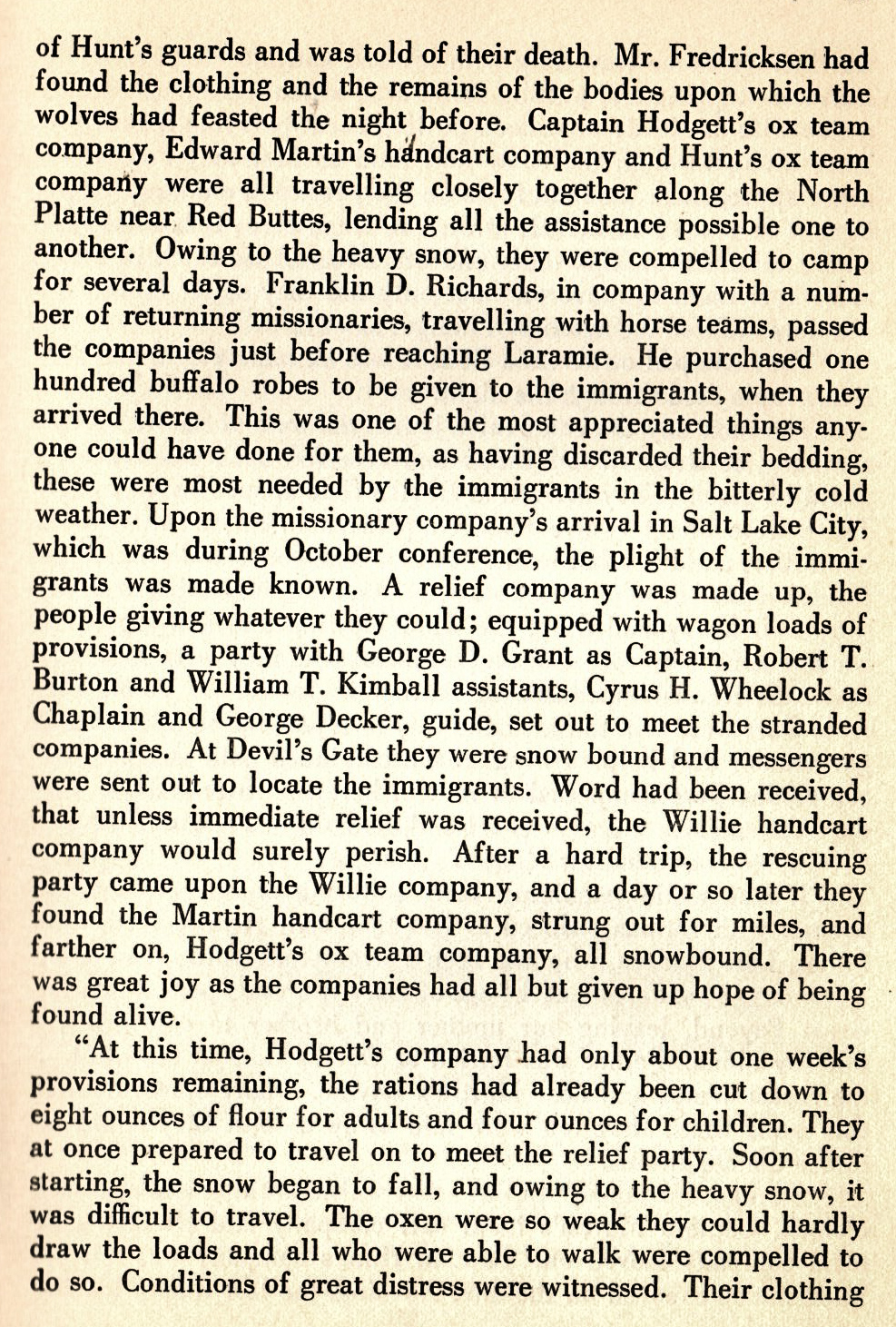
On the morning of October 19th when Captain Martin's Hand Cart Company forded the crossing of the North Plat River they had to dodge while wading, the lage cakes of mush snow and ice.  The water was cold, indeed, and to many of the young women and middle aged mothers it proved a fatal crossing, resulting in the death of many and the ruining of the health of as many more, where from some of them never recovered.  The Hodgett;s Company rendered them all the assistance that was their power, but owing to their heavy loads and poor conditions of their oxen, they were barely able to handle their own luggage.  Captain Hodgetts Company, together with Willis Martin's Had Cart Company and Hunt's Company were all camped close together along North Plat River, near Red Buttes.  Owing to the heavy snow they were compelled to remain there for several days.  Franklin D. Richards in company with a number of returning missionaries, traveling with horse teams, passed the Company just before reaching Laramie and when he was at Laramie he purchased one hundred buffalo robes to be given to the emigrants when the arrived, as he knew that the cold would be severe and cause them much suffering.  This was one of the most appreciated things ever done for them as it was certainly cold and these were what the emigrants needed.  Mr. Richards arrived in Salt Lake City, October fourth and Conference was held on October 6-7-8.


When Richards arrived there, he at once made known the conditions of the emigrants and when conference was opened, President Brigham Young took up this important question and soon a relief party was fitted out and all gave what they could spare.  Equipped with wagon loads of provisions, a party set out with George D. Grant, Captain Robert T. Burton and Wm. T. Kimball, Assistant; Cyrus H. Wheelock, Chaplain; Charles Decker, Guide.  They journeyed on reaching Devil's Gate where they were snowbound.  This being the same storm which the reader will understand all the Company and Emigrants were snowbound in at the North Plat River, a short distance away, which you have just previously read about.


While the relief party were there snowbound, they sent out express men not to return until they found the Emigrants and to hasten on towards the relief company.  They traveled all day and camped in the snow that night.  The following day their horses followed a herd of buffaloes for several miles but the express men finally overtook them.  They then started back and soon were on their way in search of the companies.  After traveling on about fifteen miles, they saw a foot print of a white man in the snow.  This at once cheered the searching party and they cried out "We have found them."  They then rushed on for a short distance and came in sight of their camps.  They found Captain Martin's Hand Cart Company and Captain Hodgett's Ox Team Company and a little further down was Captain Hunt's Company, all snow boud.  There was no time lost in reaching them.


When they reached the Companies there was great rush of great joy and hand shaking, as they had nearly given up all hope of ever reaching Utah alive.  At this time they only had about a week's supply of provisions and the rations were then cut down to one half pound of flour to adults and one fourth to children.  They were at once requested to pack up and journey on to meet the Relief Party and on October 28tth, Hodgett's Company and the Had Cart Company started on toward's Devil's Gate.  The clouds began to gather together thickly for more storm and after they started the snow began to fall.  As they journeyed on it was very difficult, owing to the snow and mud.  All the men, women and children were compelled to walk as the oxen were as poor and many of them had died and they were barely able to bear the loads while ascending the muddy hills.


Conditions of great distress were witnessed.  The Companies were strung along for miles.  There were old men pulling and tugging their carts, sometimes loaded with a sick wife or child.  Women pulling along a sick husband.  Little children from six to eight years old were seen tugging along through the mud and snow.


As night came on, the mud froze on their clothes and feet.  That night they camped on Avenue Hill.  It was bitter cold and several persons died.  Next morning they started for the Relief Camp at Devil's Gate and the Relief Company moved on east meeting the emigrants at Grass Wood Creek.  Such assistance was rendered, as could be given, until they finally arrived at Devil's Gate Fort about November 1st.  There were some twelve hundred in all, one half with hand carts and the other half with ox teams.  The goods were all unloaded and they started again Sunday, November 2nd.  The snow fell very deep, the wind blowing ad drifting.  It became exceedingly cold and  on November 3rd Monday, they remained at the same place.  It was so cold that the Companies could not move during the day.  Joseph A. Young and Abe Garr were sent as an express to Salt Lake City to report our situation to get council and help.  Owing to the continued cold weather and snow the Companies were compelled to remain here several days, suffering much cold and exposure, it at times being as much as eleven degrees below zero.  ad for days the sun was not seen at all .  Charley Decker was here with General Burton and stated that he, with all his trips across the plains to Utah since 1847, had never seen the snow as deep or the cold so intense.


While remaining here suffering these many exposures and hardships, being reduced in rations to less than one half of the amount required and needed to eat, my father took sick, and after a few days of illness and suffering worn out from exposure and hardships, passed to the Great Beyond and died at the age of 61 years .  He was buried at the Devil's Gate at the head of the Sweet Water and near Martin's Ravine.  He was laid away as best that could be done under the conditions, as was many others, leaving my mother and youngest brother, Christian to move alone with the Companies.


Sunday, November 9th was a fine warm morning.  Captain Martin's had cart company and Hodgett's team company moved on at 11 o'clock.  Hunt's Company had not yet been fitted out and came on a little later.  Dan Jones, F.M. Alexander and Benjamin Hampton with several other brethren were left to reain and take charge of the goods left by Hodgett's Companies.  November 10th Monday, was a very fine morning, Captain Hunt's company moved out and the last wagons pulled out at about 2 o'clock p.m.  Captain George D. Grant, Cyrus H. Wheelock, Steve Taylor and R.J. Burton moved at 3 o'clock p.m. and camped that night with Captain Hodgett's Company.  As soon and as fast as relief teams arrived from Salt Lake, the hand carts were left and the emigrants taken in wagon load after wagon load with the goods left at the gate and soon after Captain George Grant and Company followed.  The  entire relief consisted of 350 horses and mules, 104 wagons and 16 yoke of oxen, together with all the provisions.  At Green River all the wagons were left  and most of the oxen were dead, others killed and eaten.  My mother, brother, together with others were placed in one of the relief wagons which reached there from Salt Lake and started with the companies to Utah.


When they reached the Weber River the two young men driving the team preferred to go down the Weber River and left the Company and started off alone.  They had to cross the River many times and at places the ice was broken and the horses could not pull the load up the bank and many times they were compelled to load and unload.


They were two weeks in getting through Weber Canyon on account of snow and  rough roads.  They arrived at East Weber December 21st 1855, while the other Companies arrived at Salt Lake City fully ten days earlier.  My brother, Peter, and family were living at Kaysville and learned of the arrival of mother and brother, which was a great surprise to us as we had not heard from them since we left Denmark.  My brother went to Heber with an ox team and brought them to his home which consisted of a dug out and a wagon bed.  There they remained over the winter, mother being nearly worn out from the exposure of so long a journey.  She left a good home and suffered much losing her husband and leaving all they had upon the plains.  She was glad to again be with her children and although she had sacrificed the loss of her husband and endured the hardships of the journey her faith in God and the religion she believed in caused her to rejoice and she felt that it was the will of the Lord.


to be continued


Sunday, May 8, 2011

Parley Christian Madsen and Family

The Parley Christian Madsen Family 
              ~ shared by  Ardith Madsen Renning Milner

Large group photo is the Parley Madsen family in the mid-fifties.  Middle row is all of Parley and Rosina's children and center is Parley and Rosina.
Left to right:  Thelma Madsen Hair, Ardith Madsen Renning, Olive Madsen Bray, Rosina and Parley, Jay Madsen, Margaret Madsen, Myrl Madsen and Clark Madsen.  Standing behind each family member is their spouse and in front Parley and Rosina's grandchildren at that point.


The following note has been added May 9, 2011:Middle row, second person from right, looking at the photo, should be listed as Myrl Madsen Rasband.
 Middle row, third person from right, looking at the photo, should be listed as Margaret Madsen Jensen. 


The Lars Madsen family  - wife, Bodil/Bodel Nielsen Madsen, and children - Mads, Niels Peter, Anders (Andrew), Ann Margarethe, Jacobine, Niels and Lars Christian, came to the United States from their home in Holbaek, Denmark as members of the Latter Day Saints.


The family came in two groups - most of the children first, followed by Lars, Bodil and their youngest son, 
Lars Christian in 1856.  The oldest son, Mads, followed the others after collecting payments for the sale of the family’s farm in Denmark.


Unfortunately, Lars Madsen, husband and father, lost his life north of  Devil’s Gate Wyoming during November of 1856 and did not reach Utah.  Lars, Bodil, and Lars Christian were members of the William B. Hodgett  Company in 1856.  After the death of Lars, Bodil and young Christian, who was about eight years old, continued on to Utah.


After reuniting with her children, Bodil and most of the others eventually settled in Mt. Pleasant, Utah.  Members of the family married, had families and prospered.  Lars Christian married Hannah Poulson Lindstrom.  Born to them in Mt. Pleasant in 1881 was Parley Christian Madsen.  Hilda Electa Madsen Longsdorf born in 1877 in Mt. Pleasant to Andrew and Joanne E. Widergreen Andersen Madsen was, of course, Parley Christian’s cousin.  Hilda wrote, “The History of Mt. Pleasant.”


In 1909, Parley married Rosina Abigail Clark of Mt. Pleasant.  She was born in 1880.  Rosina (Sina) was the daughter of Ferdinand Clark (Klerk) and Hannah Christena Christensen also settlers of Mt. Pleasant.  Parley and Rosina’s family consisted of:  Jay, Olive, Clark, Ardith, Thelma, Margaret and Myrl. The children were raised for the most part in Springville. 


Parley was employed by the U.S. Forrest Service in 1906 and worked in Wyoming and Utah,  He retired after thirty-five years of service.  Rosina was an organist and soloist and while living in Mt. Pleasant, she and her father sang at gatherings and funerals.   In her later years in Springville, she enjoyed  church, handiwork, TV, and visiting with friends and family.


The fourth child, Ardith Bodel Madsen Renning, born in 1914, was my mother.  She graduated from Springville High School in 1931 and entered the LDS School of Nursing in Salt Lake.  After receiving her RN, she was employed by United Air Lines, flying from Salt Lake City to Oakland, California.  (Having an RN was a requirement of the airlines in the 30’s.)  In California Ardith  met and married, October 22, 1937, my father, Albert Weldon Renning of Collingswood, New Jersey.  He had been sent to San Francisco by the insurance company he was employed by in Philadelphia, Pennsylvania.  Ardith had to retire after marrying as this was a regulation of United Airlines then.  It was determined that she had flown some 500, 000 miles for United.  


The Rennings relocated to Collingswood, New Jersey, residing in South Jersey until their deaths, Albert in 1970 and Ardith in 1991.  Two daughters were born to this union and reside in Southern New Jersey near their families and grandchildren.


Parley Christian Madsen died in Provo, Utah in October 1957.  Rosina Abigail Clark Madsen died in April,  1979 in Heber, Utah.  Parley and Rosina have one living daughter as of this date in 2011.  The family is survived by many members who reside in Utah, California, Colorado and New Jersey.

Ardith Madsen Renning Milner


Parley and Rosina as a very young couple


Ardith B. Madsen in her United Airlines uniform


also see:http://mtpleasantpioneer.blogspot.com/2011/04/ardeth-madsen-shared-by-ardith-madsen.html


  Parley Christian Madsen (son of Christian Madsen and Hannah Poulson Lindstrom) .


Parley Christian, Rosina Abigail Clark Madsen, Olive Madsen Bray.  Back row:   Clark Christian Madsen and Jay Madsen.


 Rosina Abigail Clark Madsen was born on Oct. 24, 1880 in Mt. Pleasant,  Utah.


She was the daughter of Ferdinand Clark (or Klerk) born in 1859 in Jutland,  Denmark and his wife, Hannah Christena Christensen.  Hannah was born in Mt.  Pleasant on April 27, 1862.  Her father was James Christian Christensen.   Hannah married Ferdinand Clark on October 1, 1879 in Mt. Pleasant, Utah.


Rosina Abigail Clark married Parley Christian Madsen (son of Lars Christian  Madsen  and Hannah Poulson Lindstrom and great grandson of Lars Madsen and Bodil  Nielsen Madsen).  Rosina and Parley were married in Mt. Pleasant on June 30,  1909. 


Lars and Bodil  Madsen were  "Pioneers of the Month, Sept. 2010."


Parley and Rosina raised their children:  Jay, Olive, Clark, Ardith,  Thelma, Margaret and Myrle for the most part, that I know of, in Springville,  Utah.  Myrle is the only surviving child and resides in St. George, Utah.   Parley was a forest ranger and Rosina (Sina) a homemaker.

It appears to me that the Clark Furniture and Hardware Company of Mt.  Pleasant was managed (and perhaps owned by Ferdinand Clark). This information  comes to me from a paper written by Ruth Louise Clark Reynolds.


Ardith Madsen Renning Milner
Publish Post