 |
| Photo by Savage and Ottinger |

Showing posts with label Kimball. Show all posts
Showing posts with label Kimball. Show all posts
Thursday, May 14, 2026
BRIGHAM YOUNG AND TWELVE APOSTLES 1870 ~~~CITY AND VALLEY OF GREAT SALT LAKE 1870

Friday, December 12, 2025

Tuesday, July 8, 2025
THE PROPHET MORONI DEDICATED THE SITE OF THE MANTI TEMPLE ~~~Gerald Henrie, Provo, Utah~~~ First Honorable Mention Essay ~~~Saga of the Sanpitch Vol. 2
Father Isaac Morley and others were trying to decide in the spring of 1850 on a suitable place to recommend to President Brigham Young as a site for a Latter-day Saint Temple, when my great grandmother, Betsy Bradley, and her three-year-old son, Hyrum, saw a personage in white on a white horse mysteriously appear on the hill to the north east of Manti and then just as mysteriously disappear.
Others may have seen this same manifestation. Great Grandma Bradley told about this mysterious appearance to everyone who desired to listen and one of the Sagas of the Sanpitch was born: Everyone said, “This personage dressed in white on the white horse is the same personage that constrained Father Morley to point with a prophetic finger to an eminence rising in the distance and say, “There is the termination of our journey; in close proximity to that hill, God Willing, we will build our city,’ and that person is the Prophet Moroni! And he wants a Latter-day Saint Temple built on the Manti Stone quarry!”
The settlers of the Sanpitch had shown how the power of the Lord is manifested to a people and had seen the fruitation of their Saga fulfilled in the summer of 1850 in the words on page 436 of Orson F. Whitney’s “Life of Heber C. Kimball”: “One of the Elders laboring in the Manti Temple writes: ‘In an early day when President Young and party were making the location of the settlement here, President Heber C. Kimball, prophesied that the day would come when a temple would be built on this hill. Some disbelieved and doubted the possibility of even making a settlement here. Brother Kimball said, “Well, it will be so, and more than that the rock will be quarried from that hill to build it with, and some of the stone from that quarry will be taken to help complete the Salt Lake Temple.” On July 28, 1878, two large stones, weighing respectively 5,600 and 5,020 pounds, were taken from Manti stone quarry, hauled by team to York, the U.C.R.R. terminus then, and shipped to Salt Lake City to be used for tablets in the east and west ends of the salt Lake City Temple.’”
Why did the General Authorities of the L.D.S. Church and President Brigham Young hold so tenaciously to insisting that a Latter-day Saint Temple be built on the Manti stone quarry if they didn’t have the assurance that the Prophet Moroni had dedicated that site for a temple?
This test of President Heber C. Kimball’s prophecy took place June 25, 1875 at a conference held at Ephraim, Utah. Before the above mentioned conference was held in Ephraim, the resident of the city of Ephraim had quarried enough stone that was suitable to build the foundation for a temple and this stone had been taken from the Ephraim stone quarry and had been deposited on the spot where the Noyes Building of Snow College now stands. The residents of Ephraim had hoped to have the temple built on the ground where Snow College now stands in the center of Ephraim. This same stone is at the present time still in good condition in the foundation of the Noyes Building at Snow College.
Whitney’s “Life of Heber C. Kimball” states on page 435, “At the conference held in Ephraim, Sanpete County, June 25, 1875, nearly all the speakers expressed their feelings to have a temple built in Sanpete County, and gave their views as to what point and where to build it, and to show the union that existed, Elder Daniel H. Wells said, ‘Manti,’ George Q. Cannon, Brigham Young, Jr., John Taylor, Orson Hyde, Erastus Snow, Franklin D. Richard, Lorenzo Young, and A.M. Musser, said, ‘Manti stone quarry.’ I have given the names in the order in which they spoke.
At 4 p.m. that day, President Brigham Young said, ‘The Temple should be built on Manti stone quarry.’” I testify from what I have read and have had handed down to me through family tradition and otherwise that Brother Warren S. Snow was an honest man and I believe wholeheartedly his following statement. Whitney’s “Life of Heber C. Kimball” says on page 436, “Early on the morning of April 25, 1877, President Brigham Young asked Brother Warren S. Snow to go with him to Temple hill. Brother Snow says, ‘We two were alone, President Young took me to the spot where the Temple was to stand. We went to the southeast corner, and President Young said, “Here is the spot where the Prophet Moroni stood and dedicated this piece of land for a Temple site and that is the reason why the location is made here, and we can’t move it from this spot, and if you and I are the only persons that come here at high noon today, we will dedicate this ground.’” I am predicting that the sage of the Prophet Moroni dedicating the site for the Manti Temple is a saga that will live a long time in the hearts and memories of the people who live in Sanpete County or in the Valley of the Sanpitch!
1. Additional reference to great grandma, Betsy Bradley, (Mentioned in para. 1) can be read on page 60, para. 2, in the book, Descendants of William Henrie, by Manetta Prince Henrie, Chapter Five: Myra Elizabeth Henrie Oldson: Quote: “Grandma Betsy also told Myra of how she and her three-year-old son, Hyrum, had seen a personage in white, on a white horse, mysteriously appear on the brow of the stone quarry when President Isaac Morley and others were trying to decide on a suitable place to recommend to President Brigham Young for a site for the Latter-day Saint Temple. It disappeared just as mysteriously. Everyone said they thought it was the Angel Moroni, but little Hyrum said, “It was the Lord.”
2. Additional reference to Father Morley pointing a prophetic finger (mentioned in para.2) is mentioned in history of “Early Manti” in the story of Mrs. A.B. Sidwell, “Reminisences of Early Days in Manti,” para 3, para. 2: Quote: “On the arrival of the last detachments, Father Morley being among that number, (He having been unavoidably detained) – a council was held relative to the advisability of remaining where they were then encamped. Father Morley felt constrained to proceed about three miles southward and pointing with a prophetic finger to an eminence rising in the distance, said, ‘There is the termination of our journey; in close proximity to that hill, God willing, we will build our city.’”
Tuesday, February 18, 2020
J. GOLDEN KIMBALL STORIES ~~~ From our archives

Stories of J. Golden told by his grand nephew, Jim Kimball.
Things went so far that she told the bishop whether or not someone should be called to the Sunday School because they failed to return borrowed items. Apparently, the bishop did enough of her bidding that people’s complaints alerted Church headquarters.
After talking with the bishop and Relief Society president, Kimball took care of things in sacrament meeting. At the close of the meeting Golden was called to speak. “I want to ask you all a question. Would you please show by the raise of hands: How many of you have ever had a sliver in your ass? One little girl who’d recently gotten one going down a slippery slide raised her hand. Slowly other people started raising theirs. Good—you know you need somebody else to help you take it out. You can’t do it by yourself. Well, that’s why I’m here.
You have a sliver in your ass, brothers and sisters, and I’m here to help you take it out. Now, all who can release Sister Brown as the Relief Society president, would you do so by the usual sign?
Are there any opposed? Good. Thank you.
Another J. Golden Kimball Story
from Sanpete
In a church welfare meeting Golden was assigned to check on a piece of property in Manti for a possible welfare farm. He was headed that way for a Stake Conference. In the next meeting President Grant asked if he'd had the opportunity to visit the parcel. Golden answered that he had.
"How was it?" asked President Grant.
"Well now, it was a nice piece of ground, about 180 acres, with a nice slope to it and a good stream of water at the head." responded Golden.
"How big was the stream?" queried the prophet.
"I could piss about half way acrossed it." answered Golden.
To which Rudger Clawson huffed, "Bro-ther Kimball, you're out of order!"
"Of course I am," said Golden matter of factly, "if I wasn't I could've pissed all the way across."

Tuesday, December 3, 2019


Wednesday, August 14, 2019
Utah State Penitentiary, Sugarhouse, Salt Lake City, Utah
Utah State Penitentiary
The following photographs and paintings show the Utah State Penitentiary, a Federal prison that was located at the present Sugar House Park in Salt Lake City.
The actual prisoner photos have been collected over the years from various sources. Some from the Utah Historical Society files, others from private sources. Some are new to the Historical Society and they have been shared with the LDS Church Historical Department and the Historical Society. Some of the pictures are duplicates with names written on them.
George Q. Cannon writes in his journal: On Tuesday November 13, 1888 and November 15, 1888 my portrait with the brethren. They formed different groups and each group desired me to sit with them. Thursday was a chilly day and I was kept out most of the time with my head uncovered, for about two hours, sitting before the camera. The result was I took a very heavy cold. Br. C. R. Savage accompanied by May Wells the first day and Br. Ottingerr, Jr. the second day was the photographer.
Journal of Abraham Alonzo Kimball – C. R. Savage was in the yard taking striped groups, As I was coming down the stairs, I met brother Cannon going up. I hardly knew him as he had colored his beard and eyebrows - - Louis Farr came for me to come down and have my picture taken in a group of 14 bishops and Br. Cannon. I was the only one not in stripes I had my overcoat on.
 |
| Early painting of Utah Pen showing adobe brick walls |
 |
| Left to right F.A. Brown, Moroni Brown, A Milton Musser, Parley P. Pratt Jr. Rugger Clawson and Job Pingree taken August or September 1885. |
 |
| Cannon center with flowers: to his left, Joseph Stacy Murdock from Heber, Ut; Alonzo Kimball on lower step in black, Andrew Wood Cooley – Bishop of Brighton Ward, Right of Cannon: David M. Stuart.. James Campbell Hamilton, top left (highest). 3rd from right: John Jardine; Winslow Farr, Jr., with mutton chop sideburns, right of Cannon: Thomas Harper, Bishop of Harper Ward. |
 |
| John Walton Price, James C. Hamilton, Guard, George Q. Cannon, Guard, Charles Nookes and A. J. Hansen The above photos and history is taken from "The Stay Family History"http://www.stayfamily.org/showmedia.php?mediaID=247 More photos can be found there. |
Friday, September 7, 2018
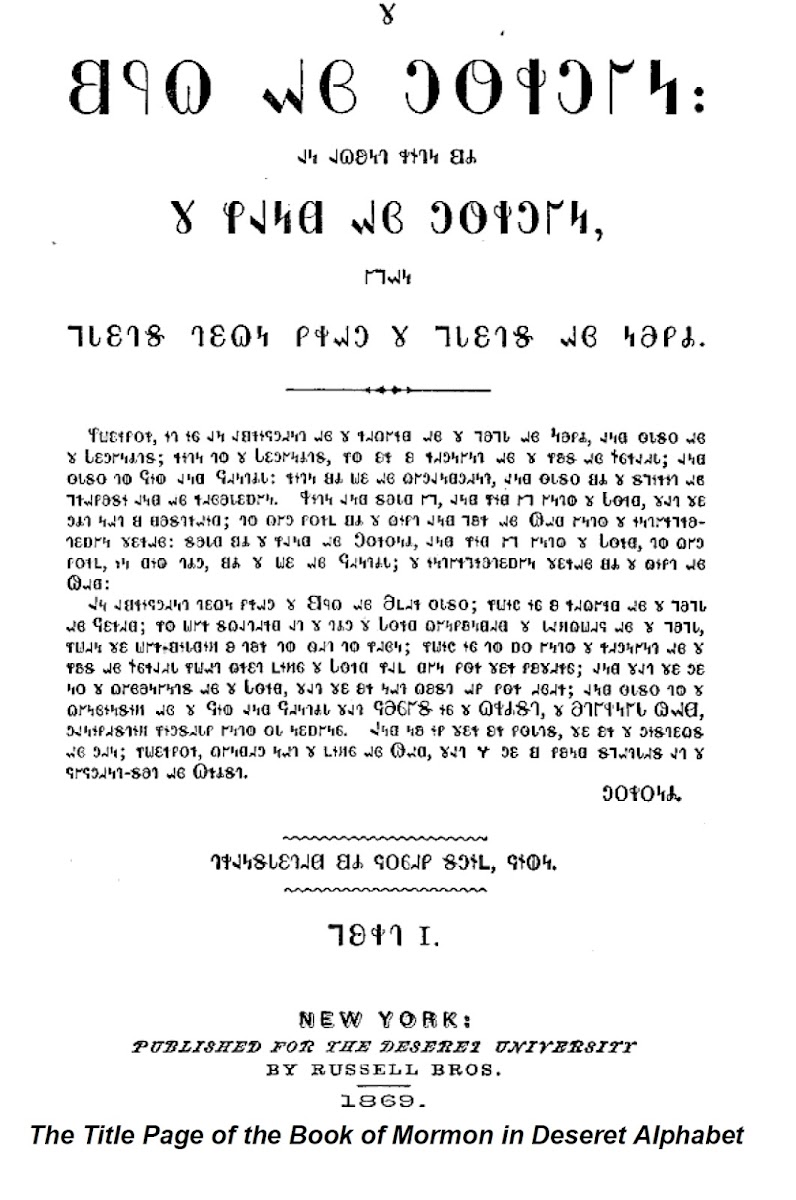
The Deseret Alphabet ~~~ Taken from Journey of Faith by David R. Gunderson
With permission of David R. Gunderson, we include the following book to our blog. I will do a few increments at a time, as I have done with the Andrew Madsen and James Monsen histories. I will also paste the pages over to David's own blog page: http://davidrgunderson.blogspot.com/
This book will be of interest to not only the Gunderson Family but also to the Brotherson, Ericksen, Peel, Madsen, Larsen and more.


Saturday, April 2, 2016
J. Golden Kimball Story ~~~ It Happened In Spring City

Stories of J. Golden told by his grand nephew, Jim Kimball.
Things went so far that she told the bishop whether or not someone should be called to the Sunday School because they failed to return borrowed items. Apparently, the bishop did enough of her bidding that people’s complaints alerted Church headquarters.
After talking with the bishop and Relief Society president, Kimball took care of things in sacrament meeting. At the close of the meeting Golden was called to speak. “I want to ask you all a question. Would you please show by the raise of hands: How many of you have ever had a sliver in your ass? One little girl who’d recently gotten one going down a slippery slide raised her hand. Slowly other people started raising theirs. Good—you know you need somebody else to help you take it out. You can’t do it by yourself. Well, that’s why I’m here.
You have a sliver in your ass, brothers and sisters, and I’m here to help you take it out. Now, all who can release Sister Brown as the Relief Society president, would you do so by the usual sign?
Are there any opposed? Good. Thank you.
Another J. Golden Kimball Story
from Sanpete
In a church welfare meeting Golden was assigned to check on a piece of property in Manti for a possible welfare farm. He was headed that way for a Stake Conference. In the next meeting President Grant asked if he'd had the opportunity to visit the parcel. Golden answered that he had.
"How was it?" asked President Grant.
"Well now, it was a nice piece of ground, about 180 acres, with a nice slope to it and a good stream of water at the head." responded Golden.
"How big was the stream?" queried the prophet.
"I could piss about half way acrossed it." answered Golden.
To which Rudger Clawson huffed, "Bro-ther Kimball, you're out of order!"
"Of course I am," said Golden matter of factly, "if I wasn't I could've pissed all the way across."
Monday, October 6, 2014
Andrew Madsen's Journal ~ Indian Trouble ~ 1866

In the Spring of 1866, another call was made by the Church for men to go to the east for Emigrants and this year Hans Brotherson, Charley Hampshire, George Tuft, Christian Peterson (Peel), Neils Jensen, Hans Scholf, Frederick Peterson, Neils Lund and August Manier, with Laman Pete as Night Guard. They were fitted out by us and at once went to Salt Lake City and


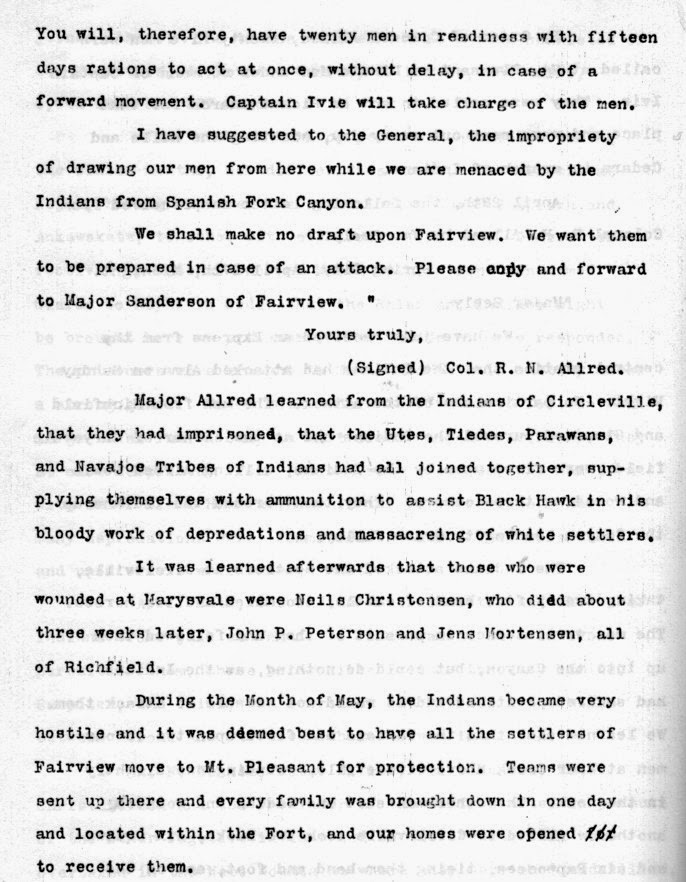


They managed to keep at a safe distance from the troops and enjoyed the
fruit of their many exploits during the winter months and made their
calculations for the Spring.
July 15th, 1866 my wife gave birth to a girl. We gave her the name of Emma.
She, however, only lived a few hours and died the same day and was buried
in our City Cemetery.
Monday, February 4, 2013
ANDREW MADSEN'S JOURNAL PART II

This is a continuation of Andrew Madsen's account of his conversion to the L.D.S. Faith and his trip across the Atlantic Ocean and the plains of North America. His father, mother and brother, Christian were among the William B. Hodgett's Company. He gives their account of the very serious conditions, death and suffering of the Hodgett's, Martin's and Hunt's Companies at Devil's Gate and Martin's Cove. His father, Lars Madsen, died there at the age of 61, due to the harsh conditions that he and others had suffered . Lars Madsen was buried at Devil's Gate, at the head of the Sweet Water and near Martin's Ravine.
We stopped a few days at Salt Lake City and went to a meeting. We met President Brigham Young and the leaders of the church, but could not understand much of their language. Myself, two brothers and two sisters moved from Salt Lake City to Kaysville and there we arrived with but one dollar among us. We were not able to get but very little work there and consequently sold one yoke of our cattle, bought provisions. We also had a cookstove with us and this we traded for a yoke of young steers. This I received for my portion of the outfit and I then left and went to Brigham City, December 1st and secured work with a carpenter for the winter and received for my services twelve bushels of wheat and my board. This was very small pay but it was the best I could do. Early in the spring my brothers and sisters moved from Kaysville to Brigham City. Neils Peter was now married to Lena Frandsen and my sisters had both married Rasmus Frandsen, April 1857. My father, mother and brother, Christian, who had remained in Denmark emigrated to the United States to join us in Utah. They landed in Philadelphia and took the train to Iowa City, Iowa and remained there six weeks for some unknown cause before they could get fitted out. They started out in July with ox teams, together with a large company under the command of Captain Wm. B. Hodgetts. They traveled on into the wild and unsettled west, enduring many hardships. October 9th they passed Captain Martin's hand cart company just as they were ready to start from Deer Creek after having stopped for dinner.
Many of them pulled their carts alongside of the wagons of Hodgetts Company and it was enough to draw forth one's sympathy for them. Seeing the aged men, women and children dragging carts and so many with haggard countenances. They passed the Ft. Bridge Plat and camped at the fording place on the Plat River.
Hodgetts Company forded the river just before Captain Martins' hand cart company arrived and was further on ahead. October 19th, the dark clouds were hovering over the mountains and every indication was that winter would set in and on the morning of October 20th the ground was covered with snow, which continued to fall during the day and prevented their moving. The morning of the 21st, the snow was about one foot deep, which almost prevented them from traveling. It became very cold and frosty. Their oxen were getting so poor that many of them died. As Captain Edward Martin left the soldiers' camp at Laramie, Wyoming, where they had obtained some provisions and Rogers, one of the last to leave after the Company, had gone on about a quarter of a mile, he espied Father Jonathan Stone (I think from the London Conference, a man of about 55 or 60 years of age) in the log cabin. He was sitting on the floor by the side of a fire, the cook handing him bread and meat, which he was devouring with relish. Mr Rogers went and called him and begged him to come, as it was getting late in the day and he could see their company a mile or so off, preparing to cross the river and the storm clouds were gathering quite low. The only promise that he was able to get was that he would be along soon. It was then between three and four o-clock and Rogers made all haste to catch the company before they commenced to cross the river. Some of the Hodgetts teams had crossed, taking with them some of the aged men, women and children. The remaining then began to ford the river, a distance of six or eight rods, slipping sometimes off the smooth stones, shoulders deep into the water. Some of them were so weak and timid , but getting into the rope harness they were soon in the ice cold water, men and elder sisters, wading waist deep in several places, by keeping up courage, made the crossing without accident. After all had crossed the river they camped for an hour or so, close by the river and after a tin cup or so of hot tea had been drunk and a bite to eat for supper, they traveled up the river a mile or two.
Father Stone did not reach the camp that night, but it was learned that he had become lost and wandered on to Captain Hunt's company, with a young girl by the hands about ten years old. Being advised where they were, they then turned and started in the darkness in a direction of Martin's Company. This was the last seen of Father Stone and the girl alive. The following morning when Captain Edward Martin had missed him, he returned across the river to Hunt's camp and hearing about the last they knew of him, he turned east on our back track and within a mile learned from Peter Fredericksen, one of Hunt's guards of their death, Mr. Fredericksen having found some of the remains of both bodies and clothing upon which the Plat wolves had feasted on the night before. The name of the girl I have never been able to learn.
On the morning of October 19th when Captain Martin's Hand Cart Company forded the crossing of the North Plat River they had to dodge while wading, the lage cakes of mush snow and ice. The water was cold, indeed, and to many of the young women and middle aged mothers it proved a fatal crossing, resulting in the death of many and the ruining of the health of as many more, where from some of them never recovered. The Hodgett;s Company rendered them all the assistance that was their power, but owing to their heavy loads and poor conditions of their oxen, they were barely able to handle their own luggage. Captain Hodgetts Company, together with Willis Martin's Had Cart Company and Hunt's Company were all camped close together along North Plat River, near Red Buttes. Owing to the heavy snow they were compelled to remain there for several days. Franklin D. Richards in company with a number of returning missionaries, traveling with horse teams, passed the Company just before reaching Laramie and when he was at Laramie he purchased one hundred buffalo robes to be given to the emigrants when the arrived, as he knew that the cold would be severe and cause them much suffering. This was one of the most appreciated things ever done for them as it was certainly cold and these were what the emigrants needed. Mr. Richards arrived in Salt Lake City, October fourth and Conference was held on October 6-7-8.
When Richards arrived there, he at once made known the conditions of the emigrants and when conference was opened, President Brigham Young took up this important question and soon a relief party was fitted out and all gave what they could spare. Equipped with wagon loads of provisions, a party set out with George D. Grant, Captain Robert T. Burton and Wm. T. Kimball, Assistant; Cyrus H. Wheelock, Chaplain; Charles Decker, Guide. They journeyed on reaching Devil's Gate where they were snowbound. This being the same storm which the reader will understand all the Company and Emigrants were snowbound in at the North Plat River, a short distance away, which you have just previously read about.
While the relief party were there snowbound, they sent out express men not to return until they found the Emigrants and to hasten on towards the relief company. They traveled all day and camped in the snow that night. The following day their horses followed a herd of buffaloes for several miles but the express men finally overtook them. They then started back and soon were on their way in search of the companies. After traveling on about fifteen miles, they saw a foot print of a white man in the snow. This at once cheered the searching party and they cried out "We have found them." They then rushed on for a short distance and came in sight of their camps. They found Captain Martin's Hand Cart Company and Captain Hodgett's Ox Team Company and a little further down was Captain Hunt's Company, all snow boud. There was no time lost in reaching them.
When they reached the Companies there was great rush of great joy and hand shaking, as they had nearly given up all hope of ever reaching Utah alive. At this time they only had about a week's supply of provisions and the rations were then cut down to one half pound of flour to adults and one fourth to children. They were at once requested to pack up and journey on to meet the Relief Party and on October 28tth, Hodgett's Company and the Had Cart Company started on toward's Devil's Gate. The clouds began to gather together thickly for more storm and after they started the snow began to fall. As they journeyed on it was very difficult, owing to the snow and mud. All the men, women and children were compelled to walk as the oxen were as poor and many of them had died and they were barely able to bear the loads while ascending the muddy hills.
Conditions of great distress were witnessed. The Companies were strung along for miles. There were old men pulling and tugging their carts, sometimes loaded with a sick wife or child. Women pulling along a sick husband. Little children from six to eight years old were seen tugging along through the mud and snow.
As night came on, the mud froze on their clothes and feet. That night they camped on Avenue Hill. It was bitter cold and several persons died. Next morning they started for the Relief Camp at Devil's Gate and the Relief Company moved on east meeting the emigrants at Grass Wood Creek. Such assistance was rendered, as could be given, until they finally arrived at Devil's Gate Fort about November 1st. There were some twelve hundred in all, one half with hand carts and the other half with ox teams. The goods were all unloaded and they started again Sunday, November 2nd. The snow fell very deep, the wind blowing ad drifting. It became exceedingly cold and on November 3rd Monday, they remained at the same place. It was so cold that the Companies could not move during the day. Joseph A. Young and Abe Garr were sent as an express to Salt Lake City to report our situation to get council and help. Owing to the continued cold weather and snow the Companies were compelled to remain here several days, suffering much cold and exposure, it at times being as much as eleven degrees below zero. ad for days the sun was not seen at all . Charley Decker was here with General Burton and stated that he, with all his trips across the plains to Utah since 1847, had never seen the snow as deep or the cold so intense.
While remaining here suffering these many exposures and hardships, being reduced in rations to less than one half of the amount required and needed to eat, my father took sick, and after a few days of illness and suffering worn out from exposure and hardships, passed to the Great Beyond and died at the age of 61 years . He was buried at the Devil's Gate at the head of the Sweet Water and near Martin's Ravine. He was laid away as best that could be done under the conditions, as was many others, leaving my mother and youngest brother, Christian to move alone with the Companies.
Sunday, November 9th was a fine warm morning. Captain Martin's had cart company and Hodgett's team company moved on at 11 o'clock. Hunt's Company had not yet been fitted out and came on a little later. Dan Jones, F.M. Alexander and Benjamin Hampton with several other brethren were left to reain and take charge of the goods left by Hodgett's Companies. November 10th Monday, was a very fine morning, Captain Hunt's company moved out and the last wagons pulled out at about 2 o'clock p.m. Captain George D. Grant, Cyrus H. Wheelock, Steve Taylor and R.J. Burton moved at 3 o'clock p.m. and camped that night with Captain Hodgett's Company. As soon and as fast as relief teams arrived from Salt Lake, the hand carts were left and the emigrants taken in wagon load after wagon load with the goods left at the gate and soon after Captain George Grant and Company followed. The entire relief consisted of 350 horses and mules, 104 wagons and 16 yoke of oxen, together with all the provisions. At Green River all the wagons were left and most of the oxen were dead, others killed and eaten. My mother, brother, together with others were placed in one of the relief wagons which reached there from Salt Lake and started with the companies to Utah.
When they reached the Weber River the two young men driving the team preferred to go down the Weber River and left the Company and started off alone. They had to cross the River many times and at places the ice was broken and the horses could not pull the load up the bank and many times they were compelled to load and unload.
They were two weeks in getting through Weber Canyon on account of snow and rough roads. They arrived at East Weber December 21st 1855, while the other Companies arrived at Salt Lake City fully ten days earlier. My brother, Peter, and family were living at Kaysville and learned of the arrival of mother and brother, which was a great surprise to us as we had not heard from them since we left Denmark. My brother went to Heber with an ox team and brought them to his home which consisted of a dug out and a wagon bed. There they remained over the winter, mother being nearly worn out from the exposure of so long a journey. She left a good home and suffered much losing her husband and leaving all they had upon the plains. She was glad to again be with her children and although she had sacrificed the loss of her husband and endured the hardships of the journey her faith in God and the religion she believed in caused her to rejoice and she felt that it was the will of the Lord.
to be continued
Wednesday, November 10, 2010
Indian Troubles 1866
On May 4th, 1866, President Orson Hyde visited Mount Pleasant and read to the people a proclamation from the First Presidency, addressed to the people of Sanpete, Sevier, Piute and other settle ments which were not safe from the Indians. The Presidency begged the people to be of good cheer, and advised that all settle ments that had not over 150 families should move to larger settlements.
They should arm themselves. The stock should be guarded so that the Indians would not be able to steal any more. If the Indians desired peace and came into the settlements, they should be treated with kindness, for if a peaceable Indian was killed it was just as much murder as if it had been a white man.
Quoting R. N. Bennett: "David Candland was sent with the epistle for the people of Fairview to move to Mount Pleasant, the people of Fountain Green to Moroni, and the people of Spring City to move to Ephraim. John L. Ivie and myself were sent as Candland's body guards. After these families had moved, the minute men of Mount Pleasant and other settlements had to go as guards for the men while they did their work."
Soon after President Hyde's visit, the people of Mount Pleasant sent teams to Fairview to help the people move. The move of the people to Mount Pleasant took place in one day. They were lo cated within the fort, and with families outside the fort. During the time they were living at Mount Pleasant, men went to Fairview to build a fort for their protection and in August, when the work was completed, they were prepared to return. President Hyde came to Mount Pleasant and held a meeting with the citizens of Fairview, and released Andrew Petersen, the acting bishop, and ordained Amasa Tucker, of Mount Pleasant, to act in his stead.
In Mount Pleasant, it was now found necessary, in order to protect the cattle, to erect a fort. Some, today, claim this was never completed, yet we find recorded in Andrew Madsen's Journal, "On June 4th the wall was commenced, and the fort, the same size as the one erected in 1859, was completed on June 19th, 1866."
The walls enclosed the block consisting of a little more than five acres, lying directly north of the old fort. (This block is now known as the North Sanpete High School Block.) Andrew Rolph states that the east, north and west walls were the same height as those of the old fort, but that the south wall was only about half as high, and there was a gate in the center of it. In due time four herders, who were paid so much a head for herding the cattle had been appointed. The tingling of the many cowbells was a familiar sound as the herd was taken out at seven o'clock every morning. One man was assigned as gate keeper, and after the cattle were accounted for and claimed by the owners, the gate was locked.
Horses for the guards were always on hand. He further states that the first break in this fort wall was made near the northeast corner by Thomas Fuller, who used the rocks to wall up a ditch which passed in front of his mother, Mrs. Sarah Scoville's, place, which was opposite on the north side of the street.
General Daniel H. Wells and escort visited Mount Pleasant June 19th, and gave the people timely advice in regards to protecting themselves against the Indians.
The minute men were often called to scout about without finding the enemies. The country was sparsely settled, the raids day and night of so frequent occurrence, the scanty crops must be harvested, the wood must be hauled, and other preparations for winter be made, so that it was impossible for men to attend to their farms and stock and other duties, and fight the Indians day and night without some assistance.
Previous to this, Colonel O. H. Irish had called on General Doty asking Military assistance from Fort Douglas, but bad been informed by the commander at the fort that the settlers must take care of themselves.
The people of Salt Lake and Utah Counties, learning the real condition with their friends in the south, made preparations for the re-enforcing of the military power. A little later Captain P. W. Conover, with fifty men from Utah County, reported to Gen eral Snow for orders. Colonel Heber P. Kimball, having a com pany of fifty men from Salt Lake County, reached Manti. Colonel E. B. Page took command of the forces under Captain" Conover, and with such an additional force, the citizens felt secure and proceeded to their daily duties in comparative safety. The Indians kept away from the troops but managed to continue their depredations.
June 20th, 1866, Indians under Chief Black Hawk made a raid on the stock of Scipio. During the skirmish Henry Wright and James R. Ivie, the father of Colonel J. L. Ivie, were killed. It will be remembered that in 1859 James R. Ivie had been chosen at Ephraim as leader for the company of pioneers who settled Mount Pleasant, and that he faithfully filled that position until W. S. Seeley was chosen bishop of the colony. A short time after the killing of Mr. Ivie, a son of Ivie, in retaliation for the killing of his father, killed a friendly Indian. This enraged the Indians and they entered more vigorously in to the bloody work of massacre among the white settlers.his father, killed a friendly Indian. This enraged the Indians and they entered more vigorously in the bloody work of massacre among the white settlers.
Captain Kimball's company, under command of Captain A. P. Dewey, was stationed at Thistle Valley. Sunday, June 24th, Captain Dewey sent out two companies of scouts, four in each company, one company going north and the other south. Two of those who were going south had stopped at the warm springs on the west side of the valley. The members of the camp were not aware that Indians were at that time scattered through the cedars and ravines surrounding the camp. However, Horner Roberts and John Hambleton, being at the spring, saw them. Roberts succeeded in evading the Indians and took the report to Mount Pleasant and Fairview. Charles Brown, of Draper, and a companion who were in the cedars, also seeing the Indians, made their way towards camp. Brown was shot in the back and, upon falling, the Indians shot him with arrows. Some of the company at camp, seeing him fall, rushed out and brought him to camp where he expired. The Indians immediately surrounded the camp, which consisted of six baggage wagons that had been placed along with a wall of wood built around the camp for their protection. This enabled the company to keep out of sight of the Indians. However, the Indians shot into the camp, wounding Thomas Snaar of Salt Lake City. When the news of the attack reached Mount Pleasant, Colonel John L. Ivie and his company were in Pleasant Creek Canyon. At about 2 p. m., upon hearing three shots fired followed by five more, which they knew to be a signal, immediately left the stock they were helping to gather and rode down to the mouth of the canyon about four miles east of Mount Pleasant, where the message was delivered to them. They were ordered to get to the scene as quickly as their horses could carry them.
A cavalry consisting of about eighteen or twenty men, includ ing Colonel Ivie, George Tucker, Orange Seely, R. N. Bennett (Dolph), Martin Aldrich, Aaron Oman, Niels Madsen, and Peter Fredricksen started with great speed for Dewey's camp, at Fairview, others joined them.
They arrived in Thistle Valley about one hour before sundown, just in time to save the whole camp from being massacred. After a hard skirmish, the company succeeded in routing the Indians. Some Indians were killed and many wounded as they fled into the mountains; the Indians, as was their custom, taking their dead and wounded with them. A chase was taken up; after following them to Soldiers Summit at the head of Spanish Fork Canyon, the Indians resorted to their old tactics, that of separating and going in all directions, and the men were compelled to return. During the skirmish in Thistle Valley, Orange Seely and Dolph Bennett, seeing an Indian leave his horse and sneak into the wash towards camp, captured the horse, saddle, bridle, a buckskin jacket and a long lasso rope. Seely kept the horse for some time as a trophy of war. All horses, excepting five or six head of saddle horses were missing. These were hitched by the rescuing party to the wagons and the camp was moved to a more protected loca tion, where Indianola now stands. The body of Charles Brown was taken to Mount Pleasant for burial.
R. N. Bennett made the following statement concerning the attack: "June 24, 1866, Black Hawk warriors attacked Captain Peter Dewey's company at Thistle Valley, killing one man, Charles Brown, of Draper, and wounding Thomas Snaar, and driving off twenty or more head of horses. John L. Ivie, Orange Seely, George Tucker, myself and others went to recover the horses. We followed Black Hawk and his band nearly to the head of Spanish Fork River, going a distance of about forty or fifty miles, then follow ing down the Spanish Fork River, to about where Thistle Junction now is. During this engagement three or four Indians were killed, and a number wounded."
Three days after the attack on Captain Dewey's camp, the red skins raided Spanish Fork and killed John Edmonston, of Manti, and wounded another man, and drove away the stock. Settlers of Spanish Fork and Springville combined their forces and pur sued the Indians up the canyon as far as they dared, securing most of the cattle. The Indians continued on into Sanpete, then into Sevier County, and caught the unprotected points as places for attacks. They kept on the mountain when near Manti, or in the vicinity of the troops, thus avoiding engagements. About July 1st, 1866, General Y. Kimball Wells, obeying the instructions or President Brigham Young, issued an order for the abandonment of the settlements in Piute County, and the colonists moved to Sanpete County, most of them locating at Ephraim.
July 12th, Captain Bigler, with sixty men from Davis County, reached Manti, relieving the troops from Salt Lake County. Though new men soon had an opportunity for a conflict with the savages, for on the 27th, the Indians made a night raid on the cattle of Ephraim and Manti, driving away about 150 head of cattle. General Snow and Captain Bigler, with their commands, pursued the thieves into Castle Valley, but did not succeed in recovering the cattle, nor were they able to capture any Indians. This successful raid no doubt gave the Red Men enough beef for the winter. Few people had trouble with the Indians until the following spring. They managed to keep at a safe distance from the troops, enjoying the fruit of their many raids during the summer, and making their plans for the spring.
R. N. Bennett states: "About September 1866, the Black Hawk Indians drove off a herd of cattle, John L. Ivie, Orange Seely, myself and others, were with the company that followed them over the mountains east of Ephraim, via Joe's Valley, from there down Cotton Wood Canyon, on to Huntington River, where the town of Lawrence now stands, a distance of about seventy five miles. Then we came back to the Cotton Wood River, and then, camped and patrolled the valley two days, searching for Indians. We were gone from home about ten days."
They should arm themselves. The stock should be guarded so that the Indians would not be able to steal any more. If the Indians desired peace and came into the settlements, they should be treated with kindness, for if a peaceable Indian was killed it was just as much murder as if it had been a white man.
Quoting R. N. Bennett: "David Candland was sent with the epistle for the people of Fairview to move to Mount Pleasant, the people of Fountain Green to Moroni, and the people of Spring City to move to Ephraim. John L. Ivie and myself were sent as Candland's body guards. After these families had moved, the minute men of Mount Pleasant and other settlements had to go as guards for the men while they did their work."
Soon after President Hyde's visit, the people of Mount Pleasant sent teams to Fairview to help the people move. The move of the people to Mount Pleasant took place in one day. They were lo cated within the fort, and with families outside the fort. During the time they were living at Mount Pleasant, men went to Fairview to build a fort for their protection and in August, when the work was completed, they were prepared to return. President Hyde came to Mount Pleasant and held a meeting with the citizens of Fairview, and released Andrew Petersen, the acting bishop, and ordained Amasa Tucker, of Mount Pleasant, to act in his stead.
In Mount Pleasant, it was now found necessary, in order to protect the cattle, to erect a fort. Some, today, claim this was never completed, yet we find recorded in Andrew Madsen's Journal, "On June 4th the wall was commenced, and the fort, the same size as the one erected in 1859, was completed on June 19th, 1866."
The walls enclosed the block consisting of a little more than five acres, lying directly north of the old fort. (This block is now known as the North Sanpete High School Block.) Andrew Rolph states that the east, north and west walls were the same height as those of the old fort, but that the south wall was only about half as high, and there was a gate in the center of it. In due time four herders, who were paid so much a head for herding the cattle had been appointed. The tingling of the many cowbells was a familiar sound as the herd was taken out at seven o'clock every morning. One man was assigned as gate keeper, and after the cattle were accounted for and claimed by the owners, the gate was locked.
Horses for the guards were always on hand. He further states that the first break in this fort wall was made near the northeast corner by Thomas Fuller, who used the rocks to wall up a ditch which passed in front of his mother, Mrs. Sarah Scoville's, place, which was opposite on the north side of the street.
General Daniel H. Wells and escort visited Mount Pleasant June 19th, and gave the people timely advice in regards to protecting themselves against the Indians.
The minute men were often called to scout about without finding the enemies. The country was sparsely settled, the raids day and night of so frequent occurrence, the scanty crops must be harvested, the wood must be hauled, and other preparations for winter be made, so that it was impossible for men to attend to their farms and stock and other duties, and fight the Indians day and night without some assistance.
Previous to this, Colonel O. H. Irish had called on General Doty asking Military assistance from Fort Douglas, but bad been informed by the commander at the fort that the settlers must take care of themselves.
The people of Salt Lake and Utah Counties, learning the real condition with their friends in the south, made preparations for the re-enforcing of the military power. A little later Captain P. W. Conover, with fifty men from Utah County, reported to Gen eral Snow for orders. Colonel Heber P. Kimball, having a com pany of fifty men from Salt Lake County, reached Manti. Colonel E. B. Page took command of the forces under Captain" Conover, and with such an additional force, the citizens felt secure and proceeded to their daily duties in comparative safety. The Indians kept away from the troops but managed to continue their depredations.
June 20th, 1866, Indians under Chief Black Hawk made a raid on the stock of Scipio. During the skirmish Henry Wright and James R. Ivie, the father of Colonel J. L. Ivie, were killed. It will be remembered that in 1859 James R. Ivie had been chosen at Ephraim as leader for the company of pioneers who settled Mount Pleasant, and that he faithfully filled that position until W. S. Seeley was chosen bishop of the colony. A short time after the killing of Mr. Ivie, a son of Ivie, in retaliation for the killing of his father, killed a friendly Indian. This enraged the Indians and they entered more vigorously in to the bloody work of massacre among the white settlers.his father, killed a friendly Indian. This enraged the Indians and they entered more vigorously in the bloody work of massacre among the white settlers.
Captain Kimball's company, under command of Captain A. P. Dewey, was stationed at Thistle Valley. Sunday, June 24th, Captain Dewey sent out two companies of scouts, four in each company, one company going north and the other south. Two of those who were going south had stopped at the warm springs on the west side of the valley. The members of the camp were not aware that Indians were at that time scattered through the cedars and ravines surrounding the camp. However, Horner Roberts and John Hambleton, being at the spring, saw them. Roberts succeeded in evading the Indians and took the report to Mount Pleasant and Fairview. Charles Brown, of Draper, and a companion who were in the cedars, also seeing the Indians, made their way towards camp. Brown was shot in the back and, upon falling, the Indians shot him with arrows. Some of the company at camp, seeing him fall, rushed out and brought him to camp where he expired. The Indians immediately surrounded the camp, which consisted of six baggage wagons that had been placed along with a wall of wood built around the camp for their protection. This enabled the company to keep out of sight of the Indians. However, the Indians shot into the camp, wounding Thomas Snaar of Salt Lake City. When the news of the attack reached Mount Pleasant, Colonel John L. Ivie and his company were in Pleasant Creek Canyon. At about 2 p. m., upon hearing three shots fired followed by five more, which they knew to be a signal, immediately left the stock they were helping to gather and rode down to the mouth of the canyon about four miles east of Mount Pleasant, where the message was delivered to them. They were ordered to get to the scene as quickly as their horses could carry them.
A cavalry consisting of about eighteen or twenty men, includ ing Colonel Ivie, George Tucker, Orange Seely, R. N. Bennett (Dolph), Martin Aldrich, Aaron Oman, Niels Madsen, and Peter Fredricksen started with great speed for Dewey's camp, at Fairview, others joined them.
They arrived in Thistle Valley about one hour before sundown, just in time to save the whole camp from being massacred. After a hard skirmish, the company succeeded in routing the Indians. Some Indians were killed and many wounded as they fled into the mountains; the Indians, as was their custom, taking their dead and wounded with them. A chase was taken up; after following them to Soldiers Summit at the head of Spanish Fork Canyon, the Indians resorted to their old tactics, that of separating and going in all directions, and the men were compelled to return. During the skirmish in Thistle Valley, Orange Seely and Dolph Bennett, seeing an Indian leave his horse and sneak into the wash towards camp, captured the horse, saddle, bridle, a buckskin jacket and a long lasso rope. Seely kept the horse for some time as a trophy of war. All horses, excepting five or six head of saddle horses were missing. These were hitched by the rescuing party to the wagons and the camp was moved to a more protected loca tion, where Indianola now stands. The body of Charles Brown was taken to Mount Pleasant for burial.
R. N. Bennett made the following statement concerning the attack: "June 24, 1866, Black Hawk warriors attacked Captain Peter Dewey's company at Thistle Valley, killing one man, Charles Brown, of Draper, and wounding Thomas Snaar, and driving off twenty or more head of horses. John L. Ivie, Orange Seely, George Tucker, myself and others went to recover the horses. We followed Black Hawk and his band nearly to the head of Spanish Fork River, going a distance of about forty or fifty miles, then follow ing down the Spanish Fork River, to about where Thistle Junction now is. During this engagement three or four Indians were killed, and a number wounded."
Three days after the attack on Captain Dewey's camp, the red skins raided Spanish Fork and killed John Edmonston, of Manti, and wounded another man, and drove away the stock. Settlers of Spanish Fork and Springville combined their forces and pur sued the Indians up the canyon as far as they dared, securing most of the cattle. The Indians continued on into Sanpete, then into Sevier County, and caught the unprotected points as places for attacks. They kept on the mountain when near Manti, or in the vicinity of the troops, thus avoiding engagements. About July 1st, 1866, General Y. Kimball Wells, obeying the instructions or President Brigham Young, issued an order for the abandonment of the settlements in Piute County, and the colonists moved to Sanpete County, most of them locating at Ephraim.
July 12th, Captain Bigler, with sixty men from Davis County, reached Manti, relieving the troops from Salt Lake County. Though new men soon had an opportunity for a conflict with the savages, for on the 27th, the Indians made a night raid on the cattle of Ephraim and Manti, driving away about 150 head of cattle. General Snow and Captain Bigler, with their commands, pursued the thieves into Castle Valley, but did not succeed in recovering the cattle, nor were they able to capture any Indians. This successful raid no doubt gave the Red Men enough beef for the winter. Few people had trouble with the Indians until the following spring. They managed to keep at a safe distance from the troops, enjoying the fruit of their many raids during the summer, and making their plans for the spring.
R. N. Bennett states: "About September 1866, the Black Hawk Indians drove off a herd of cattle, John L. Ivie, Orange Seely, myself and others, were with the company that followed them over the mountains east of Ephraim, via Joe's Valley, from there down Cotton Wood Canyon, on to Huntington River, where the town of Lawrence now stands, a distance of about seventy five miles. Then we came back to the Cotton Wood River, and then, camped and patrolled the valley two days, searching for Indians. We were gone from home about ten days."
Taken from History of Mt. Pleasant by Hilda Madsen Longsdorf pp 110-115
Subscribe to:
Posts (Atom)