Showing posts with label Johns. Show all posts

Friday, November 11, 2022

History Of Wasatch Academy ~~ Written by W. K. Throndson in 1939


HISTORY OF WASATCH ACADEMY
written by W. K. Throndson in 1939
and taken from "History of Mt. Pleasant" by Hilda Madsen Longsdorf

"In the spring of 1875, a young minister, Duncan J. McMillan. came to Mt. "Pleasant in search of health and with a longing to be of some service to his fellows. Learning from some of the local citizens that they desired educational advantages for their children, and having had several years experience in the teaching field, he entered into an agreement with them to purchase what was known as the Liberal Dance Hall, a building which still is standing on Main Street and which is now occupied by the Masonic Order. The first session was held on April 19th of that year, and before the term ended that spring, the attendance had reached well over the hundred mark. The Academy went through the usual vicissitudes of the "growing up" process. At one time it appeared that the school was doomed to cease operations because of lack of funds, but through a providential gift from a missionary society in Cedar Rapids, Iowa, the work was enabled to go on.

In 1880, the school was taken over by the Board of Home Missions .of the Presbyterian church and has been under the control of that body since that date.
Of course in the beginning years, the scholastic offerings were restricted to the lower grades. The first high school class was graduated in 1887 and consisted of two members. There were no further graduates until 1895, when one student was graduated. Classes have been graduated each succeeding year, with the exception of 1900 and 1919. It was in this latter year that the local influenza epidemic made it impossible to continue after the first few weeks in the fall.

In 1888, the building on Main Street proved to be too small for efficient work, so a group of Mt. Pleasant business men subscribed the sum of $2,000.00 to help complete a new structure which was located on the site of the present Administration Hall. The old Sanpete County Co-op was the largest single subscriber to this fund.
Popular demand soon brought about the establishment of the boarding department and by 1896, we find that there were twenty four boarding pupils enrolled. The boys lived in the school building and the girls resided in a home a block distant, their home occupying the corner where the Conoco service station is now located southeast corner Main and First West.
In 1901, the music department was added to the curriculum and has continued to be one of the most popular departments up to the present time.

Mr. Ernest Patterson, formerly principal of the Henry Kendall CoIlege of Muskogee, Oklahoma, became principal in 1905, and remained in that position until 1908, when he was succeeded by Walter McKirahan, who later became Dean of Westminster CoIlege in Salt Lake City. During the latter's administration, the Academy Administration Hall was enlarged and remodeled.
Charles Lee Johns was appointed to the principal-ship in 1911. During his tenure, much of the present property was secured, a number of new buildings were erected, and the Administration Hall was again enlarged. The brick schoolhouse and grounds, east of Simpson's, the Albert Peterson residence, and. "Lincoln Hall" were purchased during this period, making the school pro¬perty equivalent to almost a city block.
In 1912, a similar school in Springville, Utah, known as "Hungerford Academy" was closed and consolidated with Wasatch. Much of the equipment from that institution was brought to the Mt. Pleasant plant.
The first important dormitory, "Finks Memorial Hall" for girls, was erected in 1913 by volunteer gifts from all parts of the nation. During the same year, the commercial and home economics departments were added. The next year, the manual training courses were offered for the first time.
Mrs. Charles F. Darlington, of New York City, long a friend of the school, gave funds in 1916, for the first boys' dormitory. The building was named "Charles F. Darlington, Jr. Dormitory" in honor of her young grandson. In 1917, the gymnasium corner was purchased, as well as a small cottage from a Mr. Johansen. By these purchases, the holdings now included one and one-half city blocks of valuable property in the heart of the city.
The "Frances Thompson Memorial Infirmary" was built in 1921, by church friends of Passaic, New Jersey. A year later, the "Johns Gymnasium" was erected, being named for the principal who was so active in its construction. The following year, the "Olivia Sage Memorial Hall" was built, funds being provided from the estate of the wife of the internationally famous philanthropist.
Mr. Johns resigned in 1924, and his position was assumed by W. K. Throndson, who is still superintendent at the time of this writing.


In 1929, the "Duncan J. McMillan Memorial Hall" was built to house a number of the teachers and to serve as a home for the superintendent.
On April 4, 1933, the Administration Hall was destroyed by fire. Classes were housed temporarily for the remainder of the year, and as no building funds were available at the time, the enrollment was restricted during the following year, and Darlington Hall was converted into temporary classrooms. During that period of financial depression, it was even thought in some quar¬ters that it might be necessary to close the Academy, but in the spring of 1934, it was learned that building funds had been made available through the estate of Miss Alice Craighead, of Washington, D. C. Miss Craighead's father was a friend of Dr. McMillan and she had listened as a girl to his tales of his work in Utah. Her will therefore listed the Academy as one of the schools where the Board of National Missions might spend the gift which she left to it. During the summer of 1934, the Craighead Industrial Hall was built to house the manual arts and homemaking de¬partments, and late that summer, excavation was begun on the Craighead Administration Hall. The Industrial Hall was occupied at the opening of school in 1934, and the Administration Hall in February of 1935.
In the spring of 1934, the Board decided to close its boarding and day school for girls at Logan, Utah, and consolidated that institution with Wasatch. Technically, the local school is now called Wasatch-Logan. Miss Margery E. Frink, for many years principal of Logan Academy, was brought to Mt. Pleasant as Dean of Girls, a position which she still holds.

Seeing the need of additional space, the school purchased the Clemensen home, north of the Administration Hall, in 1928, and the Barnett home in 1935. During the summer of 1938, both of these buildings were razed to make possible the erection of a fine new dormitory for girls. Funds for this building were also pro¬vided from the Craighead estate.
The last addition to the Academy property was the home of Mr. and Mrs. Chesley Seely, which was purchased in 1938 to serve as a residence for the principal. The Academy now owns approximately two city blocks in the heart of Mt. Pleasant. (1939)
The Administration building of the Wasatch Academy was destroyed by fire in April 1933.


At the present time, the school has a staff of twenty-four members and a student body gathered from ten of the intermountain states. There are accommodations in the boarding department for slightly over 160 pupils equally divided as to boys and girls. The day enrollment exceeds eighty students, making a total enrol¬ment of approximately 250. In line with the policy of the Boar; controlling the Academy, the enrollment will be held at that level unless the Board sees fit to make a special ruling and provide for an increased capacity."

In the Year 2009, Wasatch Academy now owns 43 private residences and has acquired much more property.

Thursday, March 31, 2022

World War One ~~~ 1914-1918 (from our archives)


World War I and Utah

Allan Kent Powell
Utah History Encyclopedia, 1994

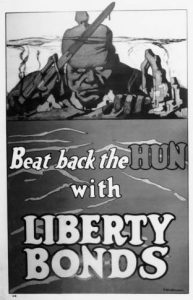
WORLD WAR I POSTER ENCOURAGING THE PURCHASING OF LIBERTY BONDS

Known as “The Great War” until the outbreak of World War II, World War I began on 1 August 1914 and ended with armistice on 11 November 1918. The two warring sides were the Allies—comprised of Russia, France, Great Britain, Italy, United States, Japan, Romania, Belgium, Serbia, Greece, Portugal, and Montenegro; and the Central Powers which included Germany, Austria-Hungary, Turkey, and Bulgaria. During the course of the war, Utahns were affected by the events in many ways. Immigrants followed events in their warring homelands, sent aid, volunteered to return to fight, and encouraged other Utahns to sympathize with the side they favored. Utah’s economy prospered because of the war. New coal mines were opened, metal and copper mining expanded, smelters ran at or near full capacity, and farmers and ranchers received more for their crops and animals than any other time in recent decades.


After the United States entered the war on 6 April 1917, many Utahns were directly affected as relatives and friends joined the armed services or were drafted. Approximately 21,000 Utahns saw military service; of these, 665 died and 864 were wounded. Of the 665 deaths, 219 were killed on the battlefield or died from wounds received in action; 32 died of accidental causes; the remaining 414 died from disease and illness. Approximately 10 percent (2,156) of the Utahns who served were of foreign birth or were members of U. S. ethnic or racial minorities. A number of Utah women, including eighty registered nurses, served during the war as nurses, ambulance drivers, and clerical and canteen workers.

In the summer of 1914, most Utahns were little concerned with the rumblings of war in Europe. Most felt that the fight had little to do with United States interests, advocated a strict policy of neutrality, and insisted that the United States not become embroiled in a European conflict. There were exceptions, of course, primarily among the Utah immigrant groups including the South Slavs, Germans, Greeks, and Italians whose homelands had been caught up in the Great War. Utah German-Americans openly demonstrated their sympathy for Germany, held rallies, collected money for the German Red Cross, complained of the virulent anti-German propaganda in most English-language newspapers, and, in some cases returned to Germany to fight.

As the war continued, America’s position as a neutral became continually more difficult, especially with the loss of 124 American lives when the passenger ship Lusitania was sunk off the coast of Ireland in May 1915. After the outcry against Germany over the sinking of the Lusitania, Germany complied with American demands that ships carrying neutral passengers and cargo be allowed to sail without attack. By 1917, German strategists concluded that their best hope for victory was to resume unrestricted submarine warfare to keep essential war material from reaching the French and English, launch an offensive along the Western Front designed to end the nearly three years of stalemate, and to seek a secret alliance with Mexico which would restore to that nation the territory (including Utah, Arizona, New Mexico, and California) lost to the United States in 1848. Faced with these events, President Woodrow Wilson saw no other option than to ask Congress for a declaration of war against Germany, which was passed on 6 April 1917.

Even before war was officially declared, Governor Simon Bamberger issued a proclamation on 24 March 1917 calling for Utahns to enlist in the Utah National Guard. Four months after war was declared, the Utah National Guard was drafted into Federal Service on 5 August 1917, sent to California, and then on to Europe where Utahns saw action along in the Argonne Forest, and at Chateau Thierry, Champagne, Soissons, St. Mihiel, Verdun, and other locations on the Western Front.

World War I helped bring Utah into the mainstream of American life as much as anything during the first two decades of the twentieth century. As part of the national war effort, Utahns planted “victory gardens,” preserved food, volunteered for work in the beet fields and on Utah’s fruit farms, purchased Liberty Bonds, gave “Four Minute” patriotic speeches, collected money for the Red Cross, used meat and sugar substitutes, observed meatless days, knitted socks, afghans, and shoulder wraps, wove rugs for soldiers’ hospitals, made posters, prohibited the teaching of the German language in some schools, and cultivated patriotism at every opportunity.

Utah’s economy prospered as wartime demands for farm and orchard produce, sugar, beef, coal, and copper placed a demand on production far beyond peacetime conditions.

Fort Douglas was an important military facility during the War. Thousands of recruits were trained at the fort and a prison was set up at the fort to house 870 enemy aliens, who had expressed pro-German sentiments or were considered dangerous, and as well as draft resisters from all states west of the Mississippi. An adjacent but separate part of the prison housed 686 German naval prisoners of war, who were sent to Utah after their ships were seized by American forces in Guam and Hawaii.

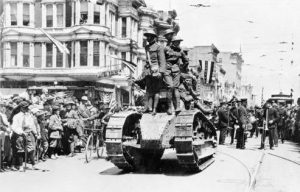
VETERANS’ PARADE IN OGDEN, 1919

Most Utah servicemen returned home early in 1919 to cheering crowds, impressive parades, enthusiastic celebrations, and generous parties even though the influenza epidemic necessitated some precautions. Many joined the American Legion as posts were established in most Utah cities and towns. They were honored when the nation proclaimed 11 November as Armistice Day, a national holiday, and were moved when “Memory Grove,” located along City Creek at the mouth of City Creek Canyon just north of the downtown Salt Lake City, was dedicated on 27 June 1924, as a permanent memorial to the soldiers killed during the war.

Like many other Americans, Utahns became disillusioned with the formal peace treaty ending the war. They were also divided over Woodrow Wilson’s primary objective, the establishment of the League of Nations. Heber J. Grant, who became President of the LDS church in 1918, was an advocate of the League of Nations while Reed Smoot, an LDS apostle and Utah’s senior senator in Washington D. C. was an outspoken critic of the League. The war was something that many seemed to never really understand, a situation that hampered international cooperation and understanding and led to increased tensions and another war within a generation.

See: “Utah and World War I,” Utah Historical Quarterly, (fall 1990); and Noble Warrum, Utah in the World War (1924). John Sillito, “Drawing the Sword Against the War: B.H. Roberts, World War I, and the Quest For Peace,” Utah Historical Quarterly 87, no. 2, 2019Tammy M. Proctor, “The Great War and The Making of a Modern World,” Utah Historical Quarterly 86, no. 3 (2018)Allan Kent Powell, “Utah and World War I,” Utah Historical Quarterly 86, no. 3 (2018)Robert S. Means, “Try To Be As Brave Cross-Continental Comparisons of Great War Poetry,” Utah Historical Quarterly 86, no. 3 (2018)


People Respond to Every Call During World War I


 When the United States entered the World War, the people of Mt. Pleasant loyally responded to every call, and made a record of which it may well be proud. One hundred and eighteen boys enlisted from Mt. Pleasant, and a number of Mt. Pleasant's sons enlisted from other communities. As the boys, one by one or in groups, boarded the train, great crowds, although sad at heart, cheered them as they left for the front. 

Three of the number died in service. Ralph Braby, while in California, was drowned, Jacob Hafen died of disease, and Henry Merville Zabriskie was killed in action, over seas. The Sanpete County Council of Defense was organized as follows: J. W. Cherry, chairman; Burke McArthur, secretary; Ed. Johnston, treasurer; Committee chairmen, Finance, N. S. Nielsen; Publicity, ,Burke McArthur; Legal, J. W. Cherry; Sanitation and Medicine, Ed. Johnston; Food supply and conservation, L. R. Anderson; Industrial survey, Orlando Bradley; Labor, Christian Willardsen; Military affairs, J. Morgan Johnson; State protection, H. R. Thomas; Survey of man power, L. P. Brady; Woman's work, Mrs. G. W. Martin. In June 1918, there were deposited in the Mt. Pleasant Com-mercial and Savings Bank, by Mr. N. S. Nielsen, county chairman of finance, to the credit of W. G. McAdoo, treasurer of the National American Red Cross, seven thousand five hundred dollars. 200 The citizens went over the top in the various other drives conducted. 

Liberty bonds, postal savings, Soldier's Welfare Relief, Christmas boxes, tobacco, conservation of food, etc. Local committees were organized, among them the local Red Cross. The officers of this organization visited the neighboring cities, Fairview, Fountain Green, Moroni, Wales, Chester and Spring City, and in cooperation with them, purchased material and sewed articles called for. There were checked out something over $3000, which had been obtained by weekly canvasses made by wo¬men and girls, and by other volunteer donations other than the National drives. Mt. Pleasant headquarters were established at about 122 West Main, where the women, some representing differ¬ent organizations, met and did sewing, etc., required. Many ship¬ments of goods were made. The officers at this time were: C. L. Johns, president; Mrs. Grace Madsen and Miss Irene Nielsen, vice presidents; Miss Hilda Madsen, secretary and treasurer. History of Mt. Pleasant HML pp 199-200

Tuesday, January 16, 2018

Johns Gym ~ Wasatch Academy

 In 1922   "John's Gymnasium" was built and named for the school principal Charles Johns.

Charles Johns served as principal of Wasatch Academy from 1912 to 1916 and then again from 1918 to 1924.

Ground was broken for the new Gym on May 16 1921. The total cost of the Gymnasium was $40,000 (equipment excluded).

Sunday, May 17, 2015

History of Our Dough Boy


"Doughboy"is an informal term for a member of the United States Army or Marine Corps. Today it is especially used to refer to members of the American Expeditionary Forces in World War I. (A popular mass-produced sculpture of the 1920s, the Spirit of the American Doughboy,   
Courtesy of Wikipedia 


~~~~~~~~~~~~~~~~~
The following comes from History of Mt. Pleasant.


World War

When the United States entered the World War, the people of Mt. Pleasant loyally responded to every call, and made a record of which it may well be proud. One hundred and eighteen boys enlisted from Mt. Pleasant, and a number of Mt. Pleasant's sons enlisted from other communities. As the boys, one by one or in groups, boarded the train, great crowds, although sad at heart, cheered them as they left for the front. Three of the number died in service. Ralph Braby, while in California, was drowned, Jacob Hafen died of disease, and Henry Merville Zabriskie was killed in action, over seas.

The Sanpete County Council of Defense was organized as follows: J. W. Cherry, chairman; Burke McArthur, secretary; Ed. Johnston, treasurer; Committee chairmen, Finance, N. S. Niel­sen; Publicity, ,Burke McArthur; Legal, J. W. Cherry; Sanitation and Medicine, Ed. Johnston; Food supply and conservation, L. R. Anderson; Industrial survey, Orlando Bradley; Labor, Christian Willardsen; Military affairs, J. Morgan Johnson; State protection, H. R. Thomas; Survey of man power, L. P. Brady; Woman's work, Mrs. G. W. Martin.

In June 1918, there were deposited in the Mt. Pleasant Com­mercial and Savings Bank, by Mr. N. S. Nielsen, county chairman of finance, to the credit of W. G. McAdoo, treasurer of the Nation­al American Red Cross, seven thousand five hundred dollars.


The citizens went over the top in the various other drives conducted. Liberty bonds, postal savings, Soldier's Welfare Re­lief, Christmas boxes, tobacco, conservation of food, etc.

Local committees were organized, among them the local Red Cross. The officers of this organization visited the neighboring cities, Fairview, Fountain Green, Moroni, Wales, Chester and Spring City, and in cooperation with them, purchased material and sewed articles called for. There were checked out something over $3.000, which had been obtained by weekly canvasses made by wo­men and girls, and by other volunteer donations other than the National drives. Mt. Pleasant headquarters were established at about 122 West Main, where the women, some representing differ­ent organizations, met and did sewing, etc., required. Many ship­ments of goods were made. The officers at this time were: C. L. Johns, president; Mrs. Grace Madsen and Miss Irene Nielsen, vice presidents; Miss Hilda Madsen, secretary and treasurer.


Mt. Pleasant History (1939) pp 199-200 by Hilda Madsen Longsdorf


~~~

The original location of the Dough Boy was right in the center of the intersection of State Street and Main Street.


~~~~~~~~~~~~~~~~~~~


~~~~~~~~~~~~~~~~~~~~~~~~~~~~~~~~~~~~~~~~~~~~

 Honoring all soldiers in all wars .

"To Honor Those Who Left Our Midst To Fight For Freedom" 

In 2008 the "old armory" now recreation center  was given the artist touch with Soldiers from all wars painted on the south exterior wall. 

https://www.blogger.com/blogger.g?blogID=823365018368490611#editor/target=post;postID=3738460868035955231;onPublishedMenu=allposts;onClosedMenu=allposts;postNum=32;src=postname

Wednesday, February 3, 2010

Wearers of the W - Wasatch Academy Football 1920

Lee adds: Kathy: Wasatch's football team 1925, Ernest G Brunger ,coach and Gordon Brunger, ball boy. Three Mt Pleasant players for sure, John Keusseff, Earl Beck and Jimmie Meyrick. I don't remember any Becks at Wasatch so Coach Brunger may have borrowed Earl from North Sanpete to make a team.

Saturday, September 19, 2009

History of Wasatch Academy


HISTORY OF WASATCH ACADEMY
written by W. K. Throndson in 1939
and taken from "History of Mt. Pleasant" by Hilda Madsen Longsdorf

"In the spring of 1875, a young minister, Duncan J. McMillan. came to Mt. "Pleasant in search of health and with a longing to be of some service to his fellows. Learning from some of the local citizens that they desired educational advantages for their children, and having had several years experience in the teaching field, he entered into an agreement with them to purchase what was known as the Liberal Dance Hall, a building which still is standing on Main Street and which is now occupied by the Masonic Order. The first session was held on April 19th of that year, and before the term ended that spring, the attendance had reached well over the hundred mark. The Academy went through the usual vicissitudes of the "growing up" process. At one time it appeared that the school was doomed to cease operations because of lack of funds, but through a providential gift from a missionary society in Cedar Rapids, Iowa, the work was enabled to go on.

In 1880, the school was taken over by the Board of Home Missions .of the Presbyterian church and has been under the control of that body since that date.
Of course in the beginning years, the scholastic offerings were restricted to the lower grades. The first high school class was graduated in 1887 and consisted of two members. There were no further graduates until 1895, when one student was graduated. Classes have been graduated each succeeding year, with the exception of 1900 and 1919. It was in this latter year that the local influenza epidemic made it impossible to continue after the first few weeks in the fall.

In 1888, the building on Main Street proved to be too small for efficient work, so a group of Mt. Pleasant business men subscribed the sum of $2,000.00 to help complete a new structure which was located on the site of the present Administration Hall. The old Sanpete County Co-op was the largest single subscriber to this fund.
Popular demand soon brought about the establishment of the boarding department and by 1896, we find that there were twenty four boarding pupils enrolled. The boys lived in the school building and the girls resided in a home a block distant, their home occupying the corner where the Conoco service station is now located southeast corner Main and First West.
In 1901, the music department was added to the curriculum and has continued to be one of the most popular departments up to the present time.

Mr. Ernest Patterson, formerly principal of the Henry Kendall CoIlege of Muskogee, Oklahoma, became principal in 1905, and remained in that position until 1908, when he was succeeded by Walter McKirahan, who later became Dean of Westminster CoIlege in Salt Lake City. During the latter's administration, the Academy Administration Hall was enlarged and remodeled.
Charles Lee Johns was appointed to the principal-ship in 1911. During his tenure, much of the present property was secured, a number of new buildings were erected, and the Administration Hall was again enlarged. The brick schoolhouse and grounds, east of Simpson's, the Albert Peterson residence, and. "Lincoln Hall" were purchased during this period, making the school pro¬perty equivalent to almost a city block.
In 1912, a similar school in Springville, Utah, known as "Hungerford Academy" was closed and consolidated with Wasatch. Much of the equipment from that institution was brought to the Mt. Pleasant plant.
The first important dormitory, "Finks Memorial Hall" for girls, was erected in 1913 by volunteer gifts from all parts of the nation. During the same year, the commercial and home economics departments were added. The next year, the manual training courses were offered for the first time.
Mrs. Charles F. Darlington, of New York City, long a friend of the school, gave funds in 1916, for the first boys' dormitory. The building was named "Charles F. Darlington, Jr. Dormitory" in honor of her young grandson. In 1917, the gymnasium corner was purchased, as well as a small cottage from a Mr. Johansen. By these purchases, the holdings now included one and one-half city blocks of valuable property in the heart of the city.
The "Frances Thompson Memorial Infirmary" was built in 1921, by church friends of Passaic, New Jersey. A year later, the "Johns Gymnasium" was erected, being named for the principal who was so active in its construction. The following year, the "Olivia Sage Memorial Hall" was built, funds being provided from the estate of the wife of the internationally famous philanthropist.
Mr. Johns resigned in 1924, and his position was assumed by W. K. Throndson, who is still superintendent at the time of this writing.


In 1929, the "Duncan J. McMillan Memorial Hall" was built to house a number of the teachers and to serve as a home for the superintendent.
On April 4, 1933, the Administration Hall was destroyed by fire. Classes were housed temporarily for the remainder of the year, and as no building funds were available at the time, the enrollment was restricted during the following year, and Darlington Hall was converted into temporary classrooms. During that period of financial depression, it was even thought in some quar¬ters that it might be necessary to close the Academy, but in the spring of 1934, it was learned that building funds had been made available through the estate of Miss Alice Craighead, of Washington, D. C. Miss Craighead's father was a friend of Dr. McMillan and she had listened as a girl to his tales of his work in Utah. Her will therefore listed the Academy as one of the schools where the Board of National Missions might spend the gift which she left to it. During the summer of 1934, the Craighead Industrial Hall was built to house the manual arts and homemaking de¬partments, and late that summer, excavation was begun on the Craighead Administration Hall. The Industrial Hall was occupied at the opening of school in 1934, and the Administration Hall in February of 1935.
In the spring of 1934, the Board decided to close its boarding and day school for girls at Logan, Utah, and consolidated that institution with Wasatch. Technically, the local school is now called Wasatch-Logan. Miss Margery E. Frink, for many years principal of Logan Academy, was brought to Mt. Pleasant as Dean of Girls, a position which she still holds.

Seeing the need of additional space, the school purchased the Clemensen home, north of the Administration Hall, in 1928, and the Barnett home in 1935. During the summer of 1938, both of these buildings were razed to make possible the erection of a fine new dormitory for girls. Funds for this building were also pro¬vided from the Craighead estate.
The last addition to the Academy property was the home of Mr. and Mrs. Chesley Seely, which was purchased in 1938 to serve as a residence for the principal. The Academy now owns approximately two city blocks in the heart of Mt. Pleasant. (1939)
The Administration building of the Wasatch Academy was destroyed by fire in April 1933.


At the present time, the school has a staff of twenty-four members and a student body gathered from ten of the intermountain states. There are accommodations in the boarding department for slightly over 160 pupils equally divided as to boys and girls. The day enrollment exceeds eighty students, making a total enrol¬ment of approximately 250. In line with the policy of the Boar; controlling the Academy, the enrollment will be held at that level unless the Board sees fit to make a special ruling and provide for an increased capacity."

In the Year 2009, Wasatch Academy now owns 43 private residences and has acquired much more property.