Showing posts with label Graham. Show all posts

Sunday, May 26, 2024

The Soldier


Lee R. Christensen's  Photos and Stories From Mt. Pleasant


Kathy:  Inspired by Rupert Brooke’s poem “The Soldier” and paraphrasing a line from it I’ve crafted this tribute.

     They never came Home but there is a spot in a Foreign Land that is forever North Sanpete.


Glen Brady

ID: 39835618
Entered the Service From: Utah
Rank: Staff Sergeant

Service: U.S. Army Air Forces, 527th Bomber Squadron, 379th Bomber Group, Heavy

Died: Monday, December 20, 1943
Buried at: Netherlands American Cemetery
Location: Margraten, Netherlands
Plot: M Row: 3 Grave: 6

Awards: Air Medal, Purple Heart


~~~~~~~~~~~~

Clyde W. Rigby                              

ID: O-743208
Entered the Service From: Utah
Rank: Second Lieutenant

Service: U.S. Army Air Forces, 577th Bomber Squadron, 392nd Bomber Group, Heavy

Died: Tuesday, January 04, 1944
Memorialized at: Cambridge American Cemetery
Location: Cambridge, England

Awards: Air Medal, Purple Heart


~~~~~~~~~~~~

Russell S. Jensen

ID: 39675224
Entered the Service From: Utah   
Rank: Private

Service: U.S. Army Air Forces, Headquarters Squadron, 5th Air Base Group

Died: Thursday, September 07, 1944
Memorialized at: Manila American Cemetery
Location: Fort Bonifacio, Manila, Philippines

Awards: Purple Heart

From Moroni


~~~~~~~~~~~~~~~


Charles Rutishauser


ID: 39835671
Entered the Service From: Utah
Rank: Technical Sergeant

Service: U.S. Army Air Forces, 526th Bomber Squadron, 379th Bomber Group, Heavy

Died: Sunday, June 18, 1944
Buried at: Ardennes American Cemetery
Location: Neupre (Neuville-en-Condroz), Belgium
Plot: D Row: 16 Grave: 4

Awards: Air Medal with 2 Oak Leaf Clusters, Purple Heart


~~~~~~~~~~~~


Wallace W. Candland

ID: 39918059
Entered the Service From: Utah
Rank: Corporal

Service: U.S. Army Air Forces, Army Air Corps

Died: Thursday, January 04, 1945
Memorialized at: East Coast Memorial
Location: New York, NY, USA


~~~~~~~~~~~~~~


Dee A. Johnson

ID: O-730509
Entered the Service From: Utah
Rank: First Lieutenant

Service: U.S. Army Air Forces, 94th Fighter Squadron, 1st Fighter Group

Died: Sunday, July 11, 1943
Memorialized at: Sicily-Rome American Cemetery
Location: Nettuno, Italy

Awards: Distinguished Flying Cross, Air Medal with 6 Oak Leaf Clusters, Purple Heart

Wasatch Academy


~~~~~~~~~~~~~


James K. Sorensen

ID: 03684611
Entered the Service From: Utah
Rank: Ship's Cook, Third Class

Service: U.S. Navy, United States Navy

Died: Friday, December 11, 1942
Memorialized at: Manila American Cemetery
Location: Fort Bonifacio, Manila, Philippines

Awards: Purple Heart


~~~~~~~~~~~~~~~


Harold Q. Graham


ID: 39914895
Entered the Service From: Utah
Rank: Private First Class

Service: U.S. Army, 275th Infantry Regiment, 70th Infantry Division

Died: Saturday, May 12, 1945
Buried at: Netherlands American Cemetery
Location: Margraten, Netherlands
Plot: K Row: 17 Grave: 3


~~~~~~~~~~~~~

Ferris Ivory

ID: 06604538
Entered the Service From: Utah
Rank: Aviation Radioman, Second Class

Service: U.S. Navy, United States Naval Reserve

Died: Saturday, February 23, 1946
Memorialized at: Honolulu Memorial
Location: Honolulu, HI, USA

Awards: Distinguished Flying Cross, Air Medal with 4 Gold Stars

Wasatch Academy


The Soldier
If I should die, think only this of me:
That there's some corner of a foreign field
That is for ever England. There shall be
In that rich earth a richer dust concealed;
A dust whom England bore, shaped, made aware,
Gave, once, her flowers to love, her ways to roam,
A body of England's, breathing English air,
Washed by the rivers, blest by suns of home.


And think, this heart, all evil shed away,

A pulse in the eternal mind, no less

Gives somewhere back the thoughts by England given;

Her sights and sounds; dreams happy as her day;
And laughter, learnt of friends; and gentleness,
In hearts at peace, under an English heaven.

Monday, December 5, 2022

Donna Graham Brunger


Donna Graham Brunger was born in Mt. Pleasant, Utah to Loyal and Ellen Vida Seeley Graham April 12, 1929. She left this life peacefully on February 26, 2016. She spent most of her life in Milburn then in Mt. Pleasant the last few years of her life.

She graduated from North Sanpete High School, Snow College and Brigham Young University. She earned a degree in social work and psychology when she was 47 years old. She worked at the sewing plant in Mount Pleasant and the turkey plant in Moroni to earn money for her tuition. She was a counselor at Central Utah Counseling Center for twenty years. She married Norman (Tommy) Brunger, January 1948. They were later divorced.

Reading, sewing, gardening, farming, and church service were some of her interests and hobbies. She had a driving ambition to write a history book about the north end of Sanpete County titled “Milburn and Its World.” In 2000, she developed health problems but continued to see it completed. She was an active member of the LDS Church and gave service two different times as a Relief Society President as well as served in many other ward and stake auxiliaries.

She is survived by four children: Paulette (Michael) Park, West Jordan, UT; Tom L (Mary) Brunger, Orem, UT; Randy Ray Brunger, Mount Pleasant, UT; Annette (Steven) Muir, Solon Ohio; 10 grandchildren and 18 great grandchildren. Brother, Grant E. (Shirley) Graham, West Jordan, UT; and sister-in-law Darlene Steusher Graham Bullough, West Valley, UT.
She was preceded in death by her parents, Loyal and Ellen Vida Seeley, brother Berkley and four sisters, Baby, Alice, Marie, and Vida Loy Graham.

Viewing will be at the LDS Church, 1465 West Bristol Ridge Drive (8420 South) in West Jordan, UT at 9:30 a.m. The funeral service will be 10:30 a.m. on Saturday, March 5, 2016 at the same location. Interment at Fairview City Cemetery at 3:00 p.m. under the direction of Broomhead Funeral Home.
In lieu of flowers, Donna requested donations given to a worthy charity in her name.SERVICES
Visitation

Saturday, March 05, 2016
9:30 AM

LDS Church
1465 West Bristol Ridge Dr. (8420 South)
West Jordan, Utah


Funeral Service

Saturday, March 05, 2016
10:30 AM

LDS Church
1465 West Bristol Ridge Dr. (8420 South)
West Jordan, Utah

 Brunger
MT. PLEASANT-- The Mt. Pleasant Pioneer Association has chosen to spotlight Donna Brunger for her hours of faithful volunteer work she performs at the Mt. Pleasant Relic Home.
Brunger was born in Mt. Pleasant on April 12, 1929, to Vida and Loyal Graham. She attended Fairview schools, and was valedictorian at Fairview Junior High School, and again at North Sanpete High School. The honor earned her a scholarship to Brigham Young University (BYU). She graduated from Snow College in 1971 and from BYU in 1974 in social work and psychology.


She raised her family of four children, Paulette, Tom, Randy, and Annette, in Milburn. Brunger worked for Central Utah Counseling Center for 20 years, taught at Snow College, served as chair for March of Dimes and cancer fundraisers, is a member of the Daughters of the Utah Pioneers and served twice as Relief Society and LDS Stake Primary president.

Brunger has written short stories published in the Ensign and Sanpete Saga. At the present time, she is writing a history of Milburn in northern Sanpete. She has been a faithful volunteer at the Relic Home since about 1999 and is currently there on Fridays, assisting in going through old local newspapers and making copies of obituaries to go in a file.
 

Monday, November 8, 2021

MILBURN SCHOOL by Harold Vance, Saga of the Sanpitch


Someone, please send us a picture! 
Request Granted

Herald Vance

Fairview, Utah   1988

I hear the laughter of children. I hear the sometimes jovial, sometimes serious, and concerned conversations of adults. I hear music. I hear mischievous pranks giddily planned by energetic young people. I hear the solemn silence of reverence. Other sounds also drift through my century-old memory: the creak and clatter of wagon wheels over a rutted, rocky road; the heavy clop-clop of horse hooves; rhythmic sounds of a carpenter’s saw and hammer; the high-pitched ping of a rock mason’s chisel; sighs of fatigue; and proud comments of accomplishment. There are also the thousands of identifying odors that pleasantly linger, springtime and the changing seasons, the turning of the soil, fresh-sawn lumber, storm, new-mown hay, dust, rain, sweat, paint, food in various form, perfume, animals, and coal-oil lamps. Who am I? I’m a proud old building. I’ve served various purposes and seen many changes. In fact, my very own structure and location has been changed. In reality I’m not even the same building I started out to be. But I am very proud of my ancestral roots, and clung to those roots with every fiber of my stately structure. It all started about 1894, when the old pink-red brick, two-room Milburn school house, located below the mouth of Dry Creek Canyon was built. Its design was most prominently expressed by two large, arched entryways, above which appeared on one the word “Boys” and the other, “Girls” these entryways contained coat hooks around the walls and steps leading up into the two large rooms, one somewhat larger than the other.


The rooms were divided by massive folding doors which could be opened all the way to create an unrestricted hall for social events. There was also a teacher’ room near the front between the arches. The children of Milburn attended school in this building through the eighth grade, first through fourth in the “little room,” and fifth through eighth in the “big room.” A milestone in life had, indeed, been reached when one ‘graduated’ into the Big Room. Reading ‘Riting, and ‘Rithmetic were pounded into the young heads by able teachers like Rhoda Davis, Irene Edmunds, Maitland Graham, Marcella Graham, Coquella Jones, Mary Jones, Elva Madsen, Leah Nielsen, Leland Nielsen, Adriel Norman, Hilda Sanders, Mae Sanderson, Hannah Stewart, Otis L. Stewart, and Verga Ray Stewart. While the main purpose of the school was education, there were also the lighter, more carefree moments. The fun times participating in school plays, operettas, Christmas parties, May Day celebrations, dances, and scores of other events, should not be overlooked. But it should also be remembered that, even though these activities did provide untold satisfaction, pleasure, and entertainment, they did not take place without a price. It was not a monetary one, but one paid through inconvenience, determination, and sacrifice. In the early 1900’s people didn’t hop in a car and motor on down to the schoolhouse.


Transportation was either horseback or horse-drawn wagon, buggy, or sleigh. Upon returning home cold or wet, in the middle of the ngi9ht, the team still had to be cared for. The building did not light by the flick of a switch. Lighting was provided by candles, “coal oil” lamps, and later, gasoline lamps, usually brought in by some of those attending. If a youngster had to go to the bathroom, it was a long, cold, dark, and possibly snowy trek to the little house out back. Ahh, for the “good old days.” This building served the Milburn community as both school and I hear the laughter of children. I hear the sometimes jovial, sometimes serious and concerned conversations of adults. I hear music. I hear mischievous pranks giddily planned by energetic young people. I hear the solemn silence of reverence.


Other sounds also drift through my century-old memory: the creak and clatter of wagon wheels over a rutted, rocky road; the heavy clop-clop of horse hooves; rhythmic sounds of a carpenter’s saw and hammer; the high-pitched ping of a rock mason’s chisel; sighs of fatigue; and proud comments of accomplishment. There are also the thousands of identifying odors that pleasantly linger, springtime and the changing seasons, the turning of the soil, fresh-sawn lumber, storm, new-mown hay, dust, rain, sweat, paint, food in various form, perfume, animals, and coal-oil lamps.


Who am I? I’m a proud old building. I’ve served various purposes and seen many changes. In fact, my very own structure and location has been changed. In reality, I’m not even the same building I started out to be. But I am very proud of my ancestral roots, and clung to those roots with every fiber of my stately structure. It all started about 1894, when the old pink-red brick, two-room Milburn schoolhouse, located below the mouth of Dry Creek Canyon was built. Its design was most prominently expressed by two large, arched entryways, above which appeared on one the word “Boys” and the other, “Girls” these entryways contained coat hooks around the walls and steps leading up into the two large rooms, one somewhat larger than the other. The rooms were divided by massive folding doors which could be opened all the way to create an unrestricted hall for social events. There was also a teacher’s room near the front between the arches. The children of Milburn attended school in this building through the eighth grade, first through fourth in the “little room,” and fifth through eighth in the “big room.” A milestone in life had, indeed, been reached when one ‘graduated’ into the Big Room. Reading ‘Riting, and ‘Rithmetic were pounded into the young heads by able teachers like Rhoda Davis, Irene Edmunds, Maitland Graham, Marcella Graham, Coquella Jones, Mary Jones, Elva Madsen, Leah Nielsen, Leland Nielsen, Adriel Norman, Hilda Sanders, Mae Sanderson, Hannah Stewart, Otis L. Stewart, and Verga Ray Stewart.


While the main purpose of the school was education, there were also the lighter, more carefree moments. The fun times participating in school plays, operettas, Christmas parties, May Day celebrations, dances, and scores of other events, should not be overlooked. But it should also be remembered that, even though these activities did provide untold satisfaction, pleasure, and entertainment, they did not take place without a price. It was not a monetary one, but one paid through inconvenience, determination, and sacrifice. In the early 1900s people didn’t hop in a car and motor on down to the schoolhouse. Transportation was either horseback or horse-drawn wagon, buggy, or sleigh. Upon returning home cold or wet, in the middle of the ngi9ht, the team still had to be cared for. The building did not light by the flick of a switch. Lighting was provided by candles, “coal oil” lamps, and later, gasoline lamps, usually brought in by some of those attending. If a youngster had to go to the bathroom, it was a long, cold, dark, and possibly snowy trek to the little house outback. Ahh, for the “good old days.”


This building served the Milburn community as both school and Today this building still serves a dual purpose. While it houses a successful small business, it is also a lovely home with all the charm, character, and comfort that one could ever hope for. Friends and relatives bask in its warmth whenever they come to call, especially the grandchildren. They think it’s about the greatest thing this side of heaven. So you see, my rough-sawn native pine rafters and floor joists, though nearly 100 years old, still hear music, the conversations of oldsters, and the laughter of children. My Milburn stone quarry foundation rocks still hear an occasional sigh of fatigue. And my native pink adobe bricks still absorb the many sweet aromas of the changing seasons and most of the other smells that crowd my memory bank, as well as the tantalizing odors that drift from the kitchen.


While many changes have taken place during the past century, some things change very little. The couple who have called me “home” for the past sixteen years love me very much and cherish my heritage as they do their own. They are descendants of those hardy founding fathers who helped plant my roots. Mr. Vance has been associated with me since he drew his first breath nearly sixty-five years ago. His early teachings, both academic and spiritual, began within my walls as the old Milburn School and as the Milburn Ward Chapel. Even though my history goes back a century and holds many memories, I think I kind of like being a part of this modern age!


Sources: 3 Author’s recollection. 4 These Our Fathers, 1947, p. 120. 5 Ibid 6 These Our Fathers, 1947, p. 121 and Fairview North Ward LDS Church records. 7 Personal diary of Donna Brunger, Milburn, Utah.

Wednesday, February 19, 2020

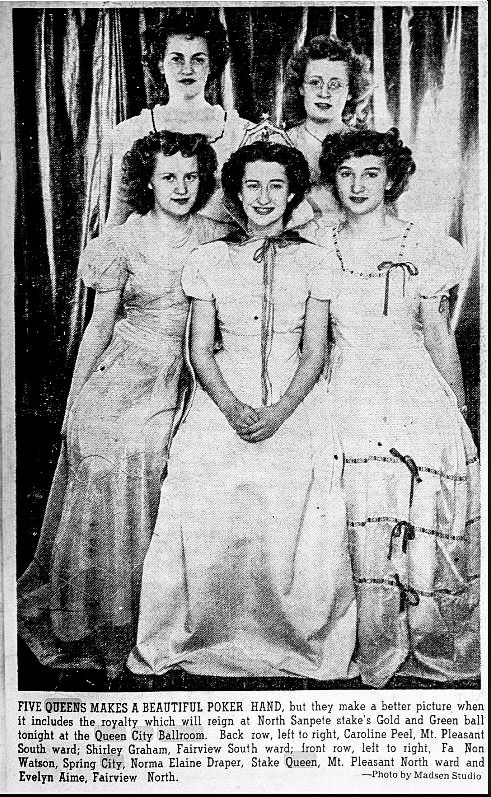
Queen City Ballroom

November 14, 1947

~~~~~~~~~~~~~~~~~~~~~~~~~~~~~~~

Mt. Pleasant Pyramid
December 12, 1947


Mt. Pleasant Pyramid
March 26, 1948
~~~~~~~~~~~~~~~~~~~~~~~~~~~~~~
Mt. Pleasant Pyramid
November 26, 1948

Queen City Ballroom Fire 
February 1990

Sunday, February 12, 2017

DONNA GRAHAM BRUNGER BOOK TO BE PUBLISHED

SEELY DESCENDANT PUBLISHES LOCAL HISTORY BOOK

 Milburn Utah and Its World, a new history book in two volumes, will soon be available. The book was written by Donna Graham Brunger, a JASFO descendant who passed away in 2016. Milburn is a small agricultural community located about five miles north of Fairview, Utah. An unincorporated village settled by Mormon pioneers in about 1876, Milburn once boasted a school, a Church building, a Co-op Store/dance hall, and a mill. This history has 2088 pages of text and photos and costs $93. To purchase, contact the author’s daughter, Paulette Park, at (801) 255- 0562 or paulettepark49@hotmail.com.


Donna Graham Brunger was born in Mt. Pleasant, Utah to Loyal and Ellen Vida Seeley Graham April 12, 1929. She left this life peacefully on February 26, 2016. She spent most of her life in Milburn then in Mt. Pleasant the last few years of her life.


She graduated from North Sanpete High School, Snow College and Brigham Young University. She earned a degree in social work and psychology when she was 47 years old. She worked at the sewing plant in Mount Pleasant and the turkey plant in Moroni to earn money for her tuition. She was a counselor at Central Utah Counseling Center for twenty years. She married Norman (Tommy) Brunger, January 1948. They were later divorced.


Reading, sewing, gardening, farming, and church service were some of her interests and hobbies. She had a driving ambition to write a history book about the north end of Sanpete County titled “Milburn and Its World.” In 2000, she developed health problems but continued to see it completed. She was an active member of the LDS Church and gave service two different times as a Relief Society President as well as served in many other ward and stake auxiliaries.

She is survived by four children: Paulette (Michael) Park, West Jordan, UT; Tom L (Mary) Brunger, Orem, UT; Randy Ray Brunger, Mount Pleasant, UT; Annette (Steven) Muir, Solon Ohio; 10 grandchildren and 18 great grandchildren. Brother, Grant E. (Shirley) Graham, West Jordan, UT; and sister-in-law Darlene Steusher Graham Bullough, West Valley, UT.


She was preceded in death by her parents, Loyal and Ellen Vida Seeley, brother Berkley and four sisters, Baby, Alice, Marie, and Vida Loy Graham.

Thursday, February 12, 2015

A BUILDING REMINISCES by Herald Vance ~ Saga of the Sanpitch 1988

Someone, please send us a picture! 
Request Granted

Herald Vance

Fairview, Utah   1988

I hear the laughter of children. I hear the sometimes jovial, sometimes serious, and concerned conversations of adults. I hear music. I hear mischievous pranks giddily planned by energetic young people. I hear the solemn silence of reverence. Other sounds also drift through my century-old memory: the creak and clatter of wagon wheels over a rutted, rocky road; the heavy clop-clop of horse hooves; rhythmic sounds of a carpenter’s saw and hammer; the high-pitched ping of a rock mason’s chisel; sighs of fatigue; and proud comments of accomplishment. There are also the thousands of identifying odors that pleasantly linger, springtime and the changing seasons, the turning of the soil, fresh-sawn lumber, storm, new-mown hay, dust, rain, sweat, paint, food in various form, perfume, animals, and coal-oil lamps. Who am I? I’m a proud old building. I’ve served various purposes and seen many changes. In fact, my very own structure and location has been changed. In reality I’m not even the same building I started out to be. But I am very proud of my ancestral roots, and clung to those roots with every fiber of my stately structure. It all started about 1894, when the old pink-red brick, two-room Milburn school house, located below the mouth of Dry Creek Canyon was built. Its design was most prominently expressed by two large, arched entryways, above which appeared on one the word “Boys” and the other, “Girls” these entryways contained coat hooks around the walls and steps leading up into the two large rooms, one somewhat larger than the other. 

The rooms were divided by massive folding doors which could be opened all the way to create an unrestricted hall for social events. There was also a teacher’ room near the front between the arches. The children of Milburn attended school in this building through the eighth grade, first through fourth in the “little room,” and fifth through eighth in the “big room.” A milestone in life had, indeed, been reached when one ‘graduated’ into the Big Room. Reading ‘Riting, and ‘Rithmetic were pounded into the young heads by able teachers like Rhoda Davis, Irene Edmunds, Maitland Graham, Marcella Graham, Coquella Jones, Mary Jones, Elva Madsen, Leah Nielsen, Leland Nielsen, Adriel Norman, Hilda Sanders, Mae Sanderson, Hannah Stewart, Otis L. Stewart, and Verga Ray Stewart. While the main purpose of the school was education, there were also the lighter, more carefree moments. The fun times participating in school plays, operettas, Christmas parties, May Day celebrations, dances, and scores of other events, should not be overlooked. But it should also be remembered that, even though these activities did provide untold satisfaction, pleasure, and entertainment, they did not take place without a price. It was not a monetary one, but one paid through inconvenience, determination, and sacrifice. In the early 1900’s people didn’t hop in a car and motor on down to the schoolhouse. 

Transportation was either horseback or horse-drawn wagon, buggy, or sleigh. Upon returning home cold or wet, in the middle of the ngi9ht, the team still had to be cared for. The building did not light by the flick of a switch. Lighting was provided by candles, “coal oil” lamps, and later, gasoline lamps, usually brought in by some of those attending. If a youngster had to go to the bathroom, it was a long, cold, dark, and possibly snowy trek to the little house out back. Ahh, for the “good old days.” This building served the Milburn community as both school and  I hear the laughter of children. I hear the sometimes jovial, sometimes serious and concerned conversations of adults. I hear music. I hear mischievous pranks giddily planned by energetic young people. I hear the solemn silence of reverence. 

Other sounds also drift through my century-old memory: the creak and clatter of wagon wheels over a rutted, rocky road; the heavy clop-clop of horse hooves; rhythmic sounds of a carpenter’s saw and hammer; the high-pitched ping of a rock mason’s chisel; sighs of fatigue; and proud comments of accomplishment. There are also the thousands of identifying odors that pleasantly linger, springtime and the changing seasons, the turning of the soil, fresh-sawn lumber, storm, new-mown hay, dust, rain, sweat, paint, food in various form, perfume, animals, and coal-oil lamps. 

Who am I? I’m a proud old building. I’ve served various purposes and seen many changes. In fact, my very own structure and location has been changed. In reality, I’m not even the same building I started out to be. But I am very proud of my ancestral roots, and clung to those roots with every fiber of my stately structure. It all started about 1894, when the old pink-red brick, two-room Milburn schoolhouse, located below the mouth of Dry Creek Canyon was built. Its design was most prominently expressed by two large, arched entryways, above which appeared on one the word “Boys” and the other, “Girls” these entryways contained coat hooks around the walls and steps leading up into the two large rooms, one somewhat larger than the other. The rooms were divided by massive folding doors which could be opened all the way to create an unrestricted hall for social events. There was also a teacher’s room near the front between the arches. The children of Milburn attended school in this building through the eighth grade, first through fourth in the “little room,” and fifth through eighth in the “big room.” A milestone in life had, indeed, been reached when one ‘graduated’ into the Big Room. Reading ‘Riting, and ‘Rithmetic were pounded into the young heads by able teachers like Rhoda Davis, Irene Edmunds, Maitland Graham, Marcella Graham, Coquella Jones, Mary Jones, Elva Madsen, Leah Nielsen, Leland Nielsen, Adriel Norman, Hilda Sanders, Mae Sanderson, Hannah Stewart, Otis L. Stewart, and Verga Ray Stewart. 

While the main purpose of the school was education, there were also the lighter, more carefree moments. The fun times participating in school plays, operettas, Christmas parties, May Day celebrations, dances, and scores of other events, should not be overlooked. But it should also be remembered that, even though these activities did provide untold satisfaction, pleasure, and entertainment, they did not take place without a price. It was not a monetary one, but one paid through inconvenience, determination, and sacrifice. In the early 1900s people didn’t hop in a car and motor on down to the schoolhouse. Transportation was either horseback or horse-drawn wagon, buggy, or sleigh. Upon returning home cold or wet, in the middle of the ngi9ht, the team still had to be cared for. The building did not light by the flick of a switch. Lighting was provided by candles, “coal oil” lamps, and later, gasoline lamps, usually brought in by some of those attending. If a youngster had to go to the bathroom, it was a long, cold, dark, and possibly snowy trek to the little house outback. Ahh, for the “good old days.” 

 This building served the Milburn community as both school and Today this building still serves a dual purpose. While it houses a successful small business, it is also a lovely home with all the charm, character, and comfort that one could ever hope for. Friends and relatives bask in its warmth whenever they come to call, especially the grandchildren. They think it’s about the greatest thing this side of heaven. So you see, my rough-sawn native pine rafters and floor joists, though nearly 100 years old, still hear music, the conversations of oldsters, and the laughter of children. My Milburn stone quarry foundation rocks still hear an occasional sigh of fatigue. And my native pink adobe bricks still absorb the many sweet aromas of the changing seasons and most of the other smells that crowd my memory bank, as well as the tantalizing odors that drift from the kitchen. 

 While many changes have taken place during the past century, some things change very little. The couple who have called me “home” for the past sixteen years love me very much and cherish my heritage as they do their own. They are descendants of those hardy founding fathers who helped plant my roots. Mr. Vance has been associated with me since he drew his first breath nearly sixty-five years ago. His early teachings, both academic and spiritual, began within my walls as the old Milburn School and as the Milburn Ward Chapel. Even though my history goes back a century and holds many memories, I think I kind of like being a part of this modern age! 

Sources: 3 Author’s recollection. 4 These Our Fathers, 1947, p. 120. 5 Ibid 6 These Our Fathers, 1947, p. 121 and Fairview North Ward LDS Church records. 7 Personal diary of Donna Brunger, Milburn, Utah.

Wednesday, January 7, 2015

Fairview's 73 Year Old White Hearse Restored


The following story comes from "Scandinavia To Sanpete", Edited by Christian Peel.   Andreas Olsen, builder of the hearse, was Christian's ancestor.  Photos of the hearse are unavailable but a likeness of what it might have looked like is below.
courtesy of http://www.chateauhorsedrawnhearse.com/
mention of photos are not available


Saturday, September 6, 2014

"THE SOLDIER"


Lee R. Christensen's  Photos and Stories From Mt. Pleasant


Kathy:  Inspired by Rupert Brooke’s poem “The Soldier” and paraphrasing a line from it I’ve crafted this tribute.

     They never came Home but there is a spot in a Foreign Land that is forever North Sanpete.


Glen Brady

ID: 39835618
Entered the Service From: Utah
Rank: Staff Sergeant

Service: U.S. Army Air Forces, 527th Bomber Squadron, 379th Bomber Group, Heavy

Died: Monday, December 20, 1943
Buried at: Netherlands American Cemetery
Location: Margraten, Netherlands
Plot: M Row: 3 Grave: 6

Awards: Air Medal, Purple Heart


~~~~~~~~~~~~

Clyde W. Rigby                              

ID: O-743208
Entered the Service From: Utah
Rank: Second Lieutenant

Service: U.S. Army Air Forces, 577th Bomber Squadron, 392nd Bomber Group, Heavy

Died: Tuesday, January 04, 1944
Memorialized at: Cambridge American Cemetery
Location: Cambridge, England

Awards: Air Medal, Purple Heart


~~~~~~~~~~~~

Russell S. Jensen

ID: 39675224
Entered the Service From: Utah   
Rank: Private

Service: U.S. Army Air Forces, Headquarters Squadron, 5th Air Base Group

Died: Thursday, September 07, 1944
Memorialized at: Manila American Cemetery
Location: Fort Bonifacio, Manila, Philippines

Awards: Purple Heart

From Moroni


~~~~~~~~~~~~~~~


Charles Rutishauser


ID: 39835671
Entered the Service From: Utah
Rank: Technical Sergeant

Service: U.S. Army Air Forces, 526th Bomber Squadron, 379th Bomber Group, Heavy

Died: Sunday, June 18, 1944
Buried at: Ardennes American Cemetery
Location: Neupre (Neuville-en-Condroz), Belgium
Plot: D Row: 16 Grave: 4

Awards: Air Medal with 2 Oak Leaf Clusters, Purple Heart


~~~~~~~~~~~~


Wallace W. Candland

ID: 39918059
Entered the Service From: Utah
Rank: Corporal

Service: U.S. Army Air Forces, Army Air Corps

Died: Thursday, January 04, 1945
Memorialized at: East Coast Memorial
Location: New York, NY, USA


~~~~~~~~~~~~~~


Dee A. Johnson

ID: O-730509
Entered the Service From: Utah
Rank: First Lieutenant

Service: U.S. Army Air Forces, 94th Fighter Squadron, 1st Fighter Group

Died: Sunday, July 11, 1943
Memorialized at: Sicily-Rome American Cemetery
Location: Nettuno, Italy

Awards: Distinguished Flying Cross, Air Medal with 6 Oak Leaf Clusters, Purple Heart

Wasatch Academy


~~~~~~~~~~~~~


James K. Sorensen

ID: 03684611
Entered the Service From: Utah
Rank: Ship's Cook, Third Class

Service: U.S. Navy, United States Navy

Died: Friday, December 11, 1942
Memorialized at: Manila American Cemetery
Location: Fort Bonifacio, Manila, Philippines

Awards: Purple Heart


~~~~~~~~~~~~~~~


Harold Q. Graham


ID: 39914895
Entered the Service From: Utah
Rank: Private First Class

Service: U.S. Army, 275th Infantry Regiment, 70th Infantry Division

Died: Saturday, May 12, 1945
Buried at: Netherlands American Cemetery
Location: Margraten, Netherlands
Plot: K Row: 17 Grave: 3


~~~~~~~~~~~~~

Ferris Ivory

ID: 06604538
Entered the Service From: Utah
Rank: Aviation Radioman, Second Class

Service: U.S. Navy, United States Naval Reserve

Died: Saturday, February 23, 1946
Memorialized at: Honolulu Memorial
Location: Honolulu, HI, USA

Awards: Distinguished Flying Cross, Air Medal with 4 Gold Stars

Wasatch Academy


The Soldier
If I should die, think only this of me:
That there's some corner of a foreign field
That is for ever England. There shall be
In that rich earth a richer dust concealed;
A dust whom England bore, shaped, made aware,
Gave, once, her flowers to love, her ways to roam,
A body of England's, breathing English air,
Washed by the rivers, blest by suns of home.


And think, this heart, all evil shed away,

A pulse in the eternal mind, no less

Gives somewhere back the thoughts by England given;

Her sights and sounds; dreams happy as her day;
And laughter, learnt of friends; and gentleness,
In hearts at peace, under an English heaven.