

Showing posts with label Morrison. Show all posts
Showing posts with label Morrison. Show all posts
Monday, October 5, 2026

Wednesday, September 23, 2026
BON ACCORD COTTAGE

BON ACCORD COTTAGE was the name William and Margaret Morrison named their home. Bon Accord meaning "unity or good feelings". Later, Wilhelmina, their daughter ran a telegraph office here. Those in the picture are Mary Margaret Ericksen, Margaret Farquahar Cruickshank Morrison, Sterling Ericksen, Florence Ericksen, Gladys Ericksen, Mother Wilhemina Ericksen.
Bon Accord Cottage was located back in the lot at about 150 West 300 South behind the Henry Ericksen Home and Ferdinand Ericksen home. Both the wives of Henry and Ferdinand were daughters of William and Margaret Morrison. This block is now owned by Wasatch Academy and Bon Accord was east of the "Old Gymn" at Wasatch Academy.
Wednesday, August 26, 2026

Thursday, July 2, 2026
BOOK OF MT. PLEASANT ~~~ INDEPENDENCE DAY ~~~ Black Smiths, Leather Tanning, Wooden Shoes, Dispute of the Water ~~~HILDA MADSEN LONGSDORF


be wanted. We propose hauling as many blocks as possible this fall and in the winter.
Yours in the Gospel, (Signed) Brigham Young
Wednesday, June 3, 2026


Sunday, May 31, 2026
MINUTES OF FEMALE RELIEF SOCIETY (From our archves)

The Relief Society President was Mary Margaret Forquhar Cruickshank Morrison. Her Counselor was Christiana Folkman Peel. There were several Secretaries during this time period beginning with an E. Wallis. Later, Hilda Dehlin becomes the Secretary.
The meetings back then, were held at Social Hall.
Mount Pleasant
Mount Pleasant
Female Relief Society
Minute Book

Meeting held in Social Hall February 9th 1874. Opened with singing and prayer by Sister Hemmet.
Sister Morrison exhorted the sisters to be diligent and especially themthat has young girls to try and teach them to be virtuous and wise; said a little amusement is good, too much is dangerous, instill into their minds true principles, let them dress becomingly. The Visiting Committee that went around gave satisfactory reports.
Several of the Danish Sisters bore their testimony in thier own tongue, good spirit prevailed. Sister Morrison made some lengthey (sp) remarks on different subjects to cooperation and polygamy. She hoped the sisters will teach these principles as they visit the houses, but don't cram it as it is were; treat everybody kind. Have the spirit of God with you and that will teach you what to do and say.
Wants that the old and feeble hould be taken care of. It was moved and carried that Sister Poulson's children should have some schooling. Pay Flower. Sister Merrick should have a petticoat and Mother Walker have what we can get for her.
Sisters Peel and Johnson, (Albine) were received as teacher of the Visiting Committee, also Sophia Stanfill as a member of the same.
Sister Tregore wants to have her child, 12 years of age to this place through the assistance of the F.R. Society.
Sister Peel explained to the Danish Sisters what had been said by Sister Morrison. Sister Simpson bore her testimony. She feels thankful for the privelege we have and said we ought to treasure up all the good things we hear from time to time and let us be wise mothers in Israel.
Closed by singing and prayer by Sister C. Jensen.
M.F. Morrison, President
E. Wallis, Secretary
Saturday, March 21, 2026
HAMILTON ELEMENTARY BEGINNING ~~~ History by Janice Nielsen
 |
| HAMILTON ELEMENTARY SCHOOL |
The settlement of Mt. Pleasant began like the settlement of most colonies in Sanpete. Although the first settlers labored diligently, their efforts were often demolished. But with much determination a group of sixty from Fort Ephraim surveyed a Fort site and planned a colony on Pleasant Creek and finally succeeded. The Fort was very well planned and organized. Because these sturdy pioneers had been schooled in crafts and many professions in their native lands, a log one-roomed schoolhouse was included in the fort. A.B. Strickland, (it has been said he was also very strict) and Mrs. Oscar Winters served as the first school teachers in the fort. The schoolhouse was also used as a chapel, theater, dance hall, and meeting place. At one end was a huge fireplace which provided heat, and light. Even though the floor was dirt, young and old liked to dance to the music of violins; the bishop's stand was often converted to a stage for a Shakespearean drama. The school was a center of community activity. Because they had been taught well the fundamentals of living and survival, they used the environment to work at their command. Regardless of Indian aggression, homes sprang up and schools soon dotted the town site in various homes. "Aunty Hyde"s school was the first built outside of the fort. "Aunty Hyde" was a very interesting person who was most often attired in a dark-colored bonnet and smoked a pipe. She did not use a bell but brought her children to school by calling "to books, to books, to books." She often prepared her evening meal at school in the fireplace, making it very difficult to study with all the aroma. The schoolroom was situated one half block west of the present High School. (This was in 1980, the present high school is 500 East and 700 South.) There became other classes held throughout the town and tuitions were paid by the parents. the few books that were available were also paid for by the parents. At this time classes were not graded as they are now but went by readers first; the primer reader, next; first primer reader, second, third, fourth and fifth. (If one completed the fifth reader, he was considered educated as the material was very hard.) Practice writing was done on slates. Children rarely got to school before Christmas as school was a secondary consideration. It was the same in the springtime as soon as the ground was bare, work on the farm began and had preference over school. So most school seasons did not exceed four months. Methods and practices started changing as teachers were getting degrees from college and universities. During this time Sister Margaret F.C. Morrison was able to place an organ in her school and music became to be an important part of the curriculum. Schools and ward houses were still used in conjunction with one another. Educational advancement was always in the uppermost mind of the people of Mt. Pleasant. The old houses used as school buildings located in different districts of the town were abandoned and a central school was established in 1896. It was a beautiful three story school building, erected on the corner of Main and First East Street at a cost of about $20,000. The new school was called Hamilton Elementary, probably getting it's name from one of the first attempted settlements led by Madison D. Hambleton. (This name was later changed to Hamilton.) It was indeed a happy day for the settlers to have such a fine, large modern building in their city. This school sometimes housed grades up to the 8th grade and had anywhere from 350 to 600 students at one time. (This building was not used as a church either.) The outside walls were made of blocks of rock and red brick with four regular classrooms and a few smaller rooms on each floor. One of the smaller rooms on the 3rd floor was used as the library and housed the ladder to get up to the belfry. One of the walls seperating the library from one of the other rooms could be rolled up like a roll top desk to make an assembly room. Later, this wall was nailed down. It seemed the 3rd floor was a poor place for an assembly room. This new school had blackboards which were easy to write on and easily cleaned. Until about 1942 the restrooms were out in a separate building to the south of the main building. Later the supply room on the 2nd floor was converted into the restrooms. At that time they were called "toiletrooms." In this same separate building, the meals were prepared and brought to the school on a big cart pulled by the cooks. School lunch program was introduced during the 1930's. One hot dish of soup or chowder was served for a penny a bowl. Every student donated a bowl and spoon to the school for this purpose. Students usually brought a sandwich or something else to go with it. When in Kindergarten each child brought his own milk. The belfry housed the bell which was heard all over town because of it's remarkable tone. People often set their watches or clocks to the sound of the bell from the elementary school. It was used as 9:00 p.m. curfew, warning of fire, flood, other special occasions because it could even be heard beyond the city limits. It rang with much force. In fact, if you were on the 3rd floor when fire drill was called, the building actually swayed. It was rung on a pull on a big rope that hung from it to the teacher's entrance on the first floor. A smal gong attached to the side of the stairs was rung by a little jerk on a small chain. Sixth grade students felt it an honor and an important position to be assigned to answer the telephone in the Principal's office and to ring the gong for class change and to ring it other scheduled times. The little bell became used for the fire drills. Fortunately there was never a fire in the school building even though the students loved the fire drill especially if they were on the third floor because they had the privilege of sliding down the three story high fire escape with it's spiraling curves. Often in the summer or after school hours a favorite pastime was climbing up the slide and going down. It was worn very shiny and the metal was actually worn thin. It would appear that a million students had escaped fires in the Hamilton School. This bell has been preserved by the Daughters of Utah Pioneers and put on display on the top of the Pioneer marker on the north side of the Pioneer Relic Hall in Mt. Pleasant.
 A piano was placed on the 2nd floor. With a gong from the bell, the students were called from their play on the school ground and lined up by their assigned door. Each class lined up in threes and to the rhythm of the piano marched to their classrooms. If anyone got off step or goofed up they were to put in time after school in the awkward squad. Thus it was necessary for everyone to learn how to march left, right, and how to keep time. All were expected to do this. Again, when every one was marching to the beat, the sway of the building could be felt. Children were excused with about the same procedure.
Those who lived on farms outside of Mt. Pleasant, would wak to the county road where they would be picked up by a canvas covered wagon. The wagon was pulled by two beautiful big, well mannered horses owned and driven by Lawrence Barton who guided them with love, not whips. About twenty students rode in the school wagon and were among the first to be at school. Later, school buses replaced the horses.
Another incident which most of the senior citizens remember about their days in school was the double tragedy of death of the Principal and Janitor. On the morning of March 24, 1922, Principle Elmer Johansen and Janitor Kanute Terkelson were both accidentally electrocuted on the landing at the top of the steps to the furnace room. (more details in a future post.)
Through Japan's sneak attack on Pearl Harbor on December 7, 1941, our nation was plunged into a bitter struggle that lasted until 1943. The teachers and students loyally supported drives to buy thrift stamps and war bonds were purchased by the teachers and students. Tons of scrap metal were hauled to a spot out by the furnace room. In one of the rooms that was a restroo, was piled up end to end with bundles of old newspapers and other papers in the paper drive to help the war effort.
Many special events can be remembered such as the annual "May Day" held outside so the May Pole could be braided and all grades danced a special dance. A spring dance festival is still held where all children participate. Hamilton had a well groomed band which often played for some of the town special events and were often invited to march in various parades through the state.
After serving as the public schoolhouse for Mt. Pleasant for over sixty years, it became necessary to get a new schoolhouse for Mt. Pleasant. It was built on the same block as the Hamilton School on the south side; so the old one could be used until completion of the new one. This new building was completed in 1962.
A piano was placed on the 2nd floor. With a gong from the bell, the students were called from their play on the school ground and lined up by their assigned door. Each class lined up in threes and to the rhythm of the piano marched to their classrooms. If anyone got off step or goofed up they were to put in time after school in the awkward squad. Thus it was necessary for everyone to learn how to march left, right, and how to keep time. All were expected to do this. Again, when every one was marching to the beat, the sway of the building could be felt. Children were excused with about the same procedure.
Those who lived on farms outside of Mt. Pleasant, would wak to the county road where they would be picked up by a canvas covered wagon. The wagon was pulled by two beautiful big, well mannered horses owned and driven by Lawrence Barton who guided them with love, not whips. About twenty students rode in the school wagon and were among the first to be at school. Later, school buses replaced the horses.
Another incident which most of the senior citizens remember about their days in school was the double tragedy of death of the Principal and Janitor. On the morning of March 24, 1922, Principle Elmer Johansen and Janitor Kanute Terkelson were both accidentally electrocuted on the landing at the top of the steps to the furnace room. (more details in a future post.)
Through Japan's sneak attack on Pearl Harbor on December 7, 1941, our nation was plunged into a bitter struggle that lasted until 1943. The teachers and students loyally supported drives to buy thrift stamps and war bonds were purchased by the teachers and students. Tons of scrap metal were hauled to a spot out by the furnace room. In one of the rooms that was a restroo, was piled up end to end with bundles of old newspapers and other papers in the paper drive to help the war effort.
Many special events can be remembered such as the annual "May Day" held outside so the May Pole could be braided and all grades danced a special dance. A spring dance festival is still held where all children participate. Hamilton had a well groomed band which often played for some of the town special events and were often invited to march in various parades through the state.
After serving as the public schoolhouse for Mt. Pleasant for over sixty years, it became necessary to get a new schoolhouse for Mt. Pleasant. It was built on the same block as the Hamilton School on the south side; so the old one could be used until completion of the new one. This new building was completed in 1962. (Each era has its own memories of Hamilton Elementary School. Those memories listed in the above history are not the same as mine. However, we thank Janis Nielsen and others for preserving this history. We would like to hear your memories. Please share with us your thoughts and remembrances.)
Sunday, February 1, 2026
FERDINAND ERICKSEN AND CLEMENTINA MARION MORRISON ERICKSEN ~~~~PIONEERS OF THE MONTH ~~~FEBRUARY 2026

Ferdinand Ericksen, son of Lars and Stena, was born in Mt. Pleasant, September 30, 1863. He attended the district schools and took a two year course at B.Y. Academy at Provo.
He taught school for four years in Mt. Pleasant and then entered the Ann Arbor Law College, studying one year. He was admitted to the bar of Michigan, June 5, 1890 and opened an office in Mt. Pleasant.
He was elected County Prosecuting Attorney in August, 1890 and County Collector in 1892. In 1897 he was elected mayorl. He was cashier of the Mt. Pleasant Bank from January 1893 to July 1895, and was a member of the board of directors. He also had an interest in the Ericksen Meat and Grocery Company.
In 1894, he was elected Major of the National Guard of Utah, and in 1896 was appointed Judge Advocate, with the rank of Major, on Brigadier-General Willard Young's staff. He was appointed a school trustee in 1896, to fill a vacancy, and in 1897 was elected to that position.
"In 1898, during the time Ferdinand Ericksen was mayor of the city, the city purchased the north brick schoolhouse, (the now mortuary) corner First North and First West, and in due time, after remodeling it, placing in a heating plant, vaults and cells, suitable furniture, etc.,it became an up-to-date and creditable city hall, and was the first real home the Mt. Pleasant city council had ever known.
The north Public Square was cleared of the brush and burrs, and trees and grass were planted for a city park". from Mt. Pleasant History pp 179-180 by Hilda Madsen Longsdorf

Picture taken at the dedication of the Mt. Pleasant Pioneer Monument


 |
| Bon Accorde Cottage Where Clementina Grew Up |


Thursday, December 18, 2025


Thursday, December 4, 2025
1877 RELIEF SOCIETY MEETING HELD AT SOCIAL HALL (from our archves)

 Meeting held in Social Hall July 8, 1877
Opened with singing and prayer by Sister Johansen. Minutes of former meeting was read and accepted.
Sister Morrison talked considerably about the privileges we as a people enjoyed here in these mountains and have greatly blessed we were in being able to live here in peace and tranquility and worship God according to the dictates of our own consciences without fear of molestation.
While many of the nations of the earth there was nothing but tumult and strife failing them with fear. But hear we had it in our power to enjoy the Spirit of the Lord, and do the will of God and keep his commandments as we desire so to do. This was our privilege and the fault would be ours if we did not hold onto it. Sister Morrison also talked about the Sisters voting to sustain and supply the Mt. Pleasant Home in Manti with Sisters to cook for the men and hoped they would consider that vote as binding as any other covenant that they made, and do their best to sustain the same, that we ought not to forget the blessings to be derived from having our temple right in our own county and do all that lay in our power to help it along in our humble way. And she said that those that did so in honesty of heart would receive blessings more than they would be able to contain.
Bro. Jacob said he had been to Manti and heard the teachings of President Young and with great satisfaction; that he urged the necessity of us being a self-sustaining people and that the time was not distant when we would realize it to its fullest extent, and the sooner we could get machinery in our midst and have all kinds of Home Industry carried on amongst us the better it would be for this people.
President Young also said Polygamy was one of the greatest principles in this church and that we ought to strive to enjoy peace and good will one towards another and live unitedly, pray with each other and for each other and by so doing we would gain power over the power of darkness and live in full enjoyment of every principle of the Gospel.
Sister Peel also spoke in her own language and said she felt well
The meeting closed with singing and prayer by Jacob Christensen.
MFC Morrison, Pres.
and Sec. Pro Tem
Wednesday, November 12, 2025
CHARLOTTE STAUNTON QUINDLAN JOHNSON HYDE ~~~OBITUARY and History

One of the most popular pioneers of Mt. Pleasant is Charlotte Staunton Quindlan Johnson Hyde.
We found this obituary recently and posted it here yesterday, which has given us some additional facts about "Aunty Hyde".
Aunty Hyde died at the home of Mrs. M.M.F.G. Morrison.
(Mary Margaret Folkwar Cruickshank Morrison)
was the Relief Society President at that time.
Aunty Hyde taught for 21 years.
Aunty Hyde taught the following students:
Emaline Seely Barton, Oscar Anderson, William Morrison Jr., Sylvester Barton, Joseph Nephi Seeley, Annie Porter Nelson, Melvina Clemensen Crane, Peter Johansen, Chastie Neilsen, Benta Neilsen, Peter Jensen, Allen Rowe, Henry Ericksen, Miranda Seeley Oman, Wilhemina Morrison Ericksen, Hans Neilsen, William D. Candland, Charlotte Reynolds Seeley, Sarah Wilcox Bills, Celestial McArthur Barton, William A. Averett, Amasa Aldrich, James B. Staker, Maria Tidwell Larsen, Libby Barton Averett, Morgan A. Winters, Eli A. Day, W.W. Brandon, Sarah Davidsen Wilcox, Maggie Peel Seely, Samuel H. Allen, Harry Candland, Albert Candland, Charles Averett, Hazard Wilcox and Hans Neilsen.
Charlotte Staunton Quindlan Johnson Hyde
You would think that a wife of Orson Hyde would be buried in Spring City next to him. You would think that she would have a very distinctive, monolithic marker of granite and stand very tall. Not so for Charlotte Staunton Quindlan Johnson Hyde. Of those many names by which she was called, we can only verify that her name was Charlotte Quindlan Hyde. She lived in Mt. Pleasant, taught school in Mt. Pleasant and died in Mt. Pleasant. Her grave marker is about 18 inches tall made of marble. You literally have to kneel down to read her epitaph there.
Charlotte Quindlen was born 22 of August 1802 at Lower Pensnock, Salem, New Jersey. Charlotte Quindlan was the name used at the Endowment House in Salt Lake City when she was sealed to Orson Hyde in 1852. The marble marker lists her as Charlotte Staunton Hyde as does the Mt. Pleasant History Book. Perhaps the name Staunton came from another marriage. From the dates we find that she was fifty years old when she married Orson Hyde.
The following is taken from the book “Orson Hyde Olive Branch of Israel”
“Orson Hyde was chosen as an original member of the Council of the Twelve in 1835, when the Mormon Church first organized this governing body. Orson's most well-known accomplishment was as a Mormon missionary to Jerusalem (1840-1842) to dedicate the land for the return of the Jews. Because his words have proven prophetic in the many decades since his entreaty, a peaceful garden on the Mount now honors him and his supplication. In 1979 civil authorities in Jerusalem invited the development of a five-acre hillside garden in honor of Orson Hyde.
“Orson Hyde was a remarkable individual. He received esteem in many roles, among them apostle, teacher, missionary, orator, scriptorian, journalist, editor, lawyer, judge, statesman, colonizer, and administrator; also as the husband of eight wives, the father of thirty-three children, a friend of mankind, and a servant of God.” MYRTLE STEVENS HYDE,
During the years 1850-1852 Charlotte Quindlin Johnson lived in Kanesville, Iowa at the home of Orson Hyde as a domestic assistant to his first wife Marinda. She was already a member of the L.D.S. Faith. She had been divorced from a man named Johnson. She was described as a seamstress who also liked children. She helped Marinda with her children Alonzo, Frank and baby Delila. She was with the Hyde Family at Winter Quarters and as they traveled across the plains to Salt Lake, arriving in 1852. Marinda and Charlotte got along very well.
Orson and Marinda discussed the possibility of inviting Charlotte to become a wife rather than a domestic. Orson had also married Mary Ann Price who for a time was a domestic in his household. Orson and Mary Ann were married in Nauvoo in 1843. Orson talked with Brigham Young about taking Charlotte as another wife and Brigham Young approved. Orson proposed to Charlotte, she accepted and they were sealed as husband and wife in the Endowment House 22nd of November, 1852. She was the fourth wife of Orson. Besides Marinda and Mary Ann, Orson had married Martha Rebecca Browett, who he later divorced in 1850. Martha went on to become the wife of Thomas McKenzie who also divorced her.
In the spring of 1853 we find Marinda, Mary Ann and Charlotte all living together under one roof in Salt Lake. Charlotte, however, was having a hard time adjusting to being a plural wife and departed the family, a mutual decision between she and Orson. They were separated, but never divorced. Brigham Young granted official separation for Charlotte and Orson Hyde in 1859.
Charlotte came to the Sanpete Valley long before Orson shows his influence here. It was during the “big move” with the earliest Saints first to Fort Ephraim, then north to resettle Mt. Pleasant. The first pioneers had been driven out of Camp Hambleton, located one mile west of the current city of Mt. Pleasant. She first made her living as a seamstress then as a school teacher while the settlers still lived inside the fort. A schoolhouse was then built outside the fort. She was fondly called "Aunty Hyde" by her students. She inspired many of her students to become teachers themselves.
In Mt. Pleasant History by Hilda Longsdorf the following description of Aunty Hyde school: “In a little log house about 12x15 feet, on the south side of the street on First North, about midway between State and First West, (in the area where Mary Ursenbach now lives-2008) Charlotte Staunton Hyde taught school. The building was also known and later used for Lesser Priesthood meetings and similar Church gatherings. Mrs. Hyde was a woman who no doubt had earlier in life received quite a liberal education, and although described as “a little old woman who smoked a pipe and was quite deaf,” she was affectionately called "Aunty Hyde". Many amusing stories were told of her school, but with all her students there remained pleasant memories. There being no handbell, as in later years, the children were always called from their play to the schoolroom with her familiar call, “To Books. To Books. To Books.””
“Mrs. Hyde lived in a little log house west of the school. She often brought her bread to the schoolhouse to bake. She had a skillet with a tight-fitting lid and in this, by heaping on it coals from the fireplace, which was in one end of the building, she baked the bread during school hours. She was paid for her services as a teacher with any produce or garden stuff available.
Mrs. Hyde taught for some time in the log meeting house in the fort. Many attended school. A number of the pioneers were polygamist families and usually were large families. In some cases the entire family had attended her school as was the case in Abraham Day’s family, Joseph, Abraham Jr., Eli A., Ezra, and Ephraim, children of the second wife, all attended; among others who also in later days became prominent citizens were her students Emaline Seely Barton, Oscar Anderson, William Morrison Jr., Sylvester Barton, Joseph Nephi Seeley, Annie Porter Nelson, Melvina Clemensen Crane, Peter Johansen, Chastie Neilsen, Benta Neilsen, Peter Jensen, Allen Rowe, Henry Ericksen, Miranda Seeley Oman, Wilhemina Morrison Ericksen, Hans Neilsen, William D. Candland, Charlotte Reynolds Seeley, Sarah Wilcox Bills, Celestial McArthur Barton, William A. Averett, Amasa Aldrich, James B. Staker, Maria Tidwell Larsen, Libby Barton Averett, Morgan A. Winters, Eli A. Day, W.W. Brandon, Sarah Davidsen Wilcox, Maggie Peel Seely, Samuel H. Allen, Harry Candland, Albert Candland, Charles Averett, Hazard Wilcox, and Hans Neilsen.
Although records show that Mrs. Hyde was not the first teacher in the community, in the Mt. Pleasant Cemetery on the south side of the center driveway, is a little marble slab now yellowing with age, upon which is engraved: “Charlotte Staunton Hyde, wife of Apostle Orson Hyde, born in Penn., Died in Mount Pleasant, December 3, 1881, age 78. At rest now---Through the kindness of pupils of early days, this stone is erected to her memory, she is the first school teacher in Mt. Pleasant.” M.M.F.C.M.”
Many, many children benefited from her talents, from her love, and from her example.

Thursday, July 17, 2025


Wednesday, July 16, 2025


Friday, June 6, 2025


Tuesday, April 29, 2025
MT. PLEASANT RELIEF SOCIETY MEETING HELD MARCH 9, 1874 AT SOCIAL HALL

Old Social Hall was built before any churches in Mt. Pleasant. It stood just south of where the red church stands today; at about 85 South State street.

Opened by singing and prayer by Sister Peel. Minutes of a former meeting were read to accept.
Sister Morrison wished to hear the sisters speak freely and appreciated the opportunity. Said the Lord will help them that help themselves. Sister Jensen gave her report in Danish. Sister C. Jensen and Sister E. Seely bore their testimony - - - felt glad they were connected with this work. Several of the Danish sisters spoke in their own tongue - - - all felt well.
Sister Christena Christensen thanked the Society in behalf of her father for the garments. He received his on his 77th year of age and is sick.
Sister Morrison made a few remarks concerning the wants of the people. She wants the teachers to have the spirit of their calling, so that they may really know and understand the needs assistance; for as a people we are getting numerous. We must keep up with the times. Sister Peel made a few edifying remarks. Sister S. Peterson bore her testimony - - - felt glad she had a standing in the church. She said God is merciful unto her and her children....said that He helps them that help themselves.
Sister Peel felt well....said it is good for us to meet together in the name of our Father. Said no one has any need to suffer . . . wants that the visiting teachers should see into the wants of the people, poor and aged. Sister Fetcher bore her testimony....felt glad to meet with the sisters. She has been deprived from the meetings through her daughters's sickness.
It was moved and carried that Sisters Ann and Sena Johansen were admitted as members of the Relief Society.
The meeting was closed by singing and prayer by Sister Simpson.
MF Morrison, President
Elizabeth Wallis, Secretary

Sunday, March 9, 2025
HENRY ERICKSEN AND WILHELMINA MORRISON ERICKSEN (from our archives)

Henry Ericksen was born July 28, 1856 in Lehi, Utah; the son of Henrik and Ingeborg Gunderson Ericksen. Henrik and Ingeborg were Norwegian immigrants and converts to the Church of Latter Day Saints. They first settled in Lehi and then moved south to Mt. Pleasant on the date of August 13, 1864. Not much is known of Henry's childhood. We know he fell in love with Miss Wilhemina Morrison, the daughter of William and Mary Margaret Farquhar Cruickshank Morrison. They were married October 24, 1878 in the Endowment House, Salt Lake City.

In about 1885, Henry Ericksen and his brother Allif started a meat and grocery store in Mt. Pleasant. Henry managed the store while Alif ran the farm and livestock; buying, feeding and slaughtering for the store. They would notify the townspeople that on a certain day they were going to kill a beef in the evening and bring it to the store the next morning, so that people could get a "hunk" of meat.

There were steaks, roasts, boils, stews or hamburger - just a chunk of meat. They would start cutting just back of the ears and end at the hind shank. all the cuts sold for the same price per pound; whether it was the neck or the porter house. Then, to carry it home, the customer whittled a sharp stick, jabbed it in the piece of meat and went home to mama, to have it prepared for the family dinner. There was no paper, twine or plastic to wrap the piece of meat in.
In 1893, they built their store on Main Street and took in another partner; brother-in-law, Judge Ferdinand Ericksen. The store was incorporated as the Ericksen Meat and Grocery Co. Their store was in a two story brick building with a full basement. It was considered one of the finest institutions in the community.
Ferdinand Ericksen was a lawyer and occupied three rooms on the second floor for his law practice. The town doctor, Dr. W.W. Woodring, occupied the other two rooms on the second floor.
In 1920, Soren M. Nielson and Harry, Henry's son, bought the store.
Henry was also a Black Hawk War Veteran and a member of the Mt. Pleasant Pioneer Association.

Wilhemina Morrison Ericksen
Wilhemina was born in Ephraim, Sanpete County March 13, 1959. She was the daughter of William Morrison and Mary Margaret Farquhar Cruickshank Morrison, immigrants from Aberdeen Scotland. When she was three months old the family moved to Mt. Pleasant, where they lived in a tent for three months. Then a one-room adobe house was built just inside the south gate of the Mt. Pleasant Fort, where the family lived until the Spring of 1863. In those days chances for advancement were limited and what little education she obtained was from her father and mother.
In 1865 her father, William Morrison was called to help settle Sevier Valley. Being unable to dispose of their property in Mt. Pleasant, (which proved to be a blessing later on) her mother Mary Margaret Morrison was obliged to remain with her family here in Mt. Pleasant.
Wilhemina began needlework, and all kinds of handwork, suc as embroidery, millinery, drawing and straw-braiding for hats. She used to go to the field to glean wheat for the chickens.
She was not quite twelve years old when she made her first temple apron to aid her mother. At this particular time her mother had a very painful felon on her thumb and was unable to make the temple apron for a Brother McClenehan who had died. So Wilhemina spent all of that Christmas Day 1871, making her first temple apron without assistance.
Wilhemina received instructions in telegraphy at Ephraim from Miss Helen Armstrong, after which time she was employed in the Mt. Pleasant Telegraph Office which position she held for 18 years. During that time the telephone system was installed for use between Mt. Pleasant and Fairview. She being the first to operate the telephone system in Mt. Pleasant.
She married Henry Ericksen in the Endowment House in Salt Lake City on October 24, 1878, by Daniel H. Wells. They made their journey by team and wagon which took them eight days. To this union ten children have been born.
In 1892 on account of the dath of her sister Tina, Wilhemina was obliged to give up her office work and take up the responsiblilty of caring for her brother-in-law's two children as well as her aged mother, who was ill at the time. This continued for six years. During this time she gave birth to three children and buried two of them at the age of one year each.
Just before her sister's death, she was requested to accept the position of President of the Young Women's Mutual Improvement Association in the Mt. Pleasant Ward.
With all the added responsibility, she continued the M.I.A. work for nine years, when she was called to be the President of the North Sanpete Stake Relief Society. This new work began in the Fall of 1900 and she held that position for twenty years; being honorably released and retained as an honorary member.
She was a member of the Mt. Pleasant Historical Association from the time of its first organization. She was also a member of the Genealogical Association of Utah. In 1921, she was called to act as a member of the genealogy committe of the Mt. Pleasant South Ward and in that same year she was made chairman of the burial clothes committee of the same ward.
She prepared and laid out for burial hundreds of people for as long as she could. She always endeavored to fulfill any duty required of her with a willing heart and to her best understanding and always felt blessed by doing so. She was forever grateful for the sacrifices her parents had made in accepting the Gospel of Jesus Christ, leaving their homeland and all that was dear to them there, coming to the wilds of the west, the chosen land for God's people, where they faced the red men and helped pioneer the country and make it "blossom as the rose".
In 1920 she was appointed genealogist of the Morrison Family Organization when she gathered many records and helped others with their genealogy as well as did the temple work for their dead.
There is no limit to the work of the faithful in whatever capacity their calling may be. Much is required. Sacrifice brings for the the blessings of Heaven. Do your might with a willing heart and God will Bless you.
Wilhemina was born in Ephraim, Sanpete County March 13, 1959. She was the daughter of William Morrison and Mary Margaret Farquhar Cruickshank Morrison, immigrants from Aberdeen Scotland. When she was three months old the family moved to Mt. Pleasant, where they lived in a tent for three months. Then a one-room adobe house was built just inside the south gate of the Mt. Pleasant Fort, where the family lived until the Spring of 1863. In those days chances for advancement were limited and what little education she obtained was from her father and mother.
In 1865 her father, William Morrison was called to help settle Sevier Valley. Being unable to dispose of their property in Mt. Pleasant, (which proved to be a blessing later on) her mother Mary Margaret Morrison was obliged to remain with her family here in Mt. Pleasant.
Wilhemina began needlework, and all kinds of handwork, suc as embroidery, millinery, drawing and straw-braiding for hats. She used to go to the field to glean wheat for the chickens.
She was not quite twelve years old when she made her first temple apron to aid her mother. At this particular time her mother had a very painful felon on her thumb and was unable to make the temple apron for a Brother McClenehan who had died. So Wilhemina spent all of that Christmas Day 1871, making her first temple apron without assistance.
Wilhemina received instructions in telegraphy at Ephraim from Miss Helen Armstrong, after which time she was employed in the Mt. Pleasant Telegraph Office which position she held for 18 years. During that time the telephone system was installed for use between Mt. Pleasant and Fairview. She being the first to operate the telephone system in Mt. Pleasant.
She married Henry Ericksen in the Endowment House in Salt Lake City on October 24, 1878, by Daniel H. Wells. They made their journey by team and wagon which took them eight days. To this union ten children have been born.
In 1892 on account of the dath of her sister Tina, Wilhemina was obliged to give up her office work and take up the responsiblilty of caring for her brother-in-law's two children as well as her aged mother, who was ill at the time. This continued for six years. During this time she gave birth to three children and buried two of them at the age of one year each.
Just before her sister's death, she was requested to accept the position of President of the Young Women's Mutual Improvement Association in the Mt. Pleasant Ward.
With all the added responsibility, she continued the M.I.A. work for nine years, when she was called to be the President of the North Sanpete Stake Relief Society. This new work began in the Fall of 1900 and she held that position for twenty years; being honorably released and retained as an honorary member.
She was a member of the Mt. Pleasant Historical Association from the time of its first organization. She was also a member of the Genealogical Association of Utah. In 1921, she was called to act as a member of the genealogy committe of the Mt. Pleasant South Ward and in that same year she was made chairman of the burial clothes committee of the same ward.
She prepared and laid out for burial hundreds of people for as long as she could. She always endeavored to fulfill any duty required of her with a willing heart and to her best understanding and always felt blessed by doing so. She was forever grateful for the sacrifices her parents had made in accepting the Gospel of Jesus Christ, leaving their homeland and all that was dear to them there, coming to the wilds of the west, the chosen land for God's people, where they faced the red men and helped pioneer the country and make it "blossom as the rose".
In 1920 she was appointed genealogist of the Morrison Family Organization when she gathered many records and helped others with their genealogy as well as did the temple work for their dead.
There is no limit to the work of the faithful in whatever capacity their calling may be. Much is required. Sacrifice brings for the the blessings of Heaven. Do your might with a willing heart and God will Bless you.
Wednesday, January 15, 2025
IMMIGRATION EXPERIENCES (Taken from History of Mt. Pleasant by Hilda Madsen Longsdorf)


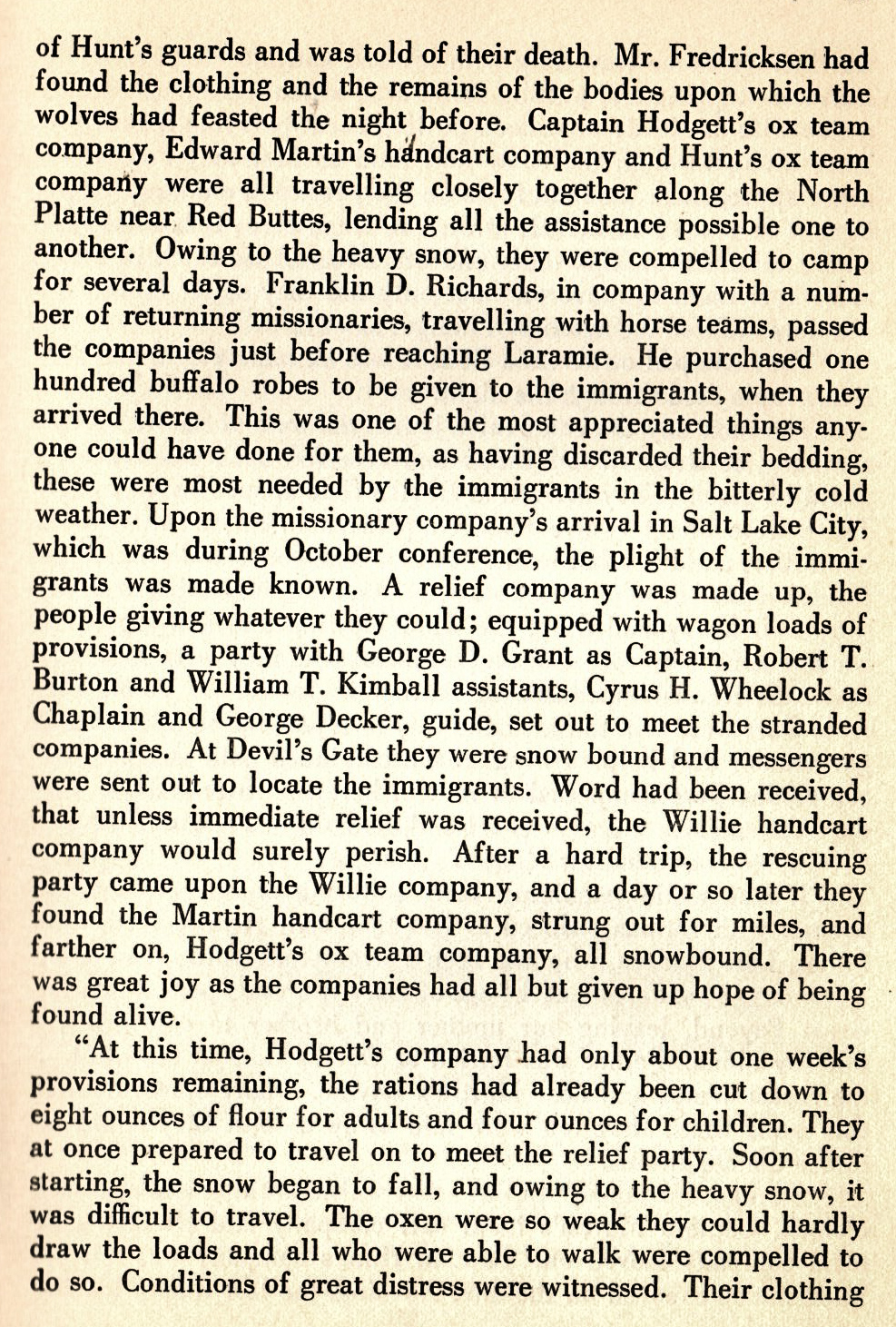


Among those who came with the ill-fated Martin and Willie handcart companies, and later pioneered Mount Pleasant were John Oldham, Sarah Hotgkinson, Joseph Burton (Reynolds), Mrs. Eliza Cusworth Burton (Staker), Martha Burton (Reynolds), Andrew Madsen (Harbro) and his sisters, Mrs Hannah Madsen (Aldrich), Mrs. Maria Madsen (Ericksen), Mrs, Christina Madsen (Harbro), and their mother Ane Jensen Madsen, Mrs. Ellen Jackson and son John Carter, (Willie's Company)
Among those who came with the William Hodgett'd Company were: Mrs. Bodel Madsen (fifty), her son, Larsen Christian (eight), Wilhelmina Kraus (eight), Lars Jorgensen (forty one), his wife Karen Jorgensen (thirty), their daughter Karen Jorgensen (three); although the name is not listed just the same, it is claimed that Lars Jorgensen and his wife were the same people who were killed by Indians in Salt Creek Canyon, in 1858.
In Hunt's Company came Lars Peter Fredericksen, Adolph Fredericksen, Karen Petersen Fredericksen.
Subscribe to:
Posts (Atom)