Showing posts sorted by date for query hat making. Sort by relevance Show all posts

Saturday, August 1, 2026

JOHN MEYRICK AND JAMIMA JOHANSSEN JENSEN MEYRICK ~~~ PIONEERS OF THE MONTH AUGUST 2026


John Meyrick 

Jamima Jensen Meyrick is a 


AUTOBIOGRAPHY: (From handwritten ledger by John Meyrick and also a typewritten copy by Jamima Johannsen Jensen. I, Ione Merrick Bush retyped his diary and added some changes or differences from a history written by my grandmother Hattie Henry Merrick from interviews she had with John & Jamima H Meyrick. She titled it 'A Short Sketch of John Meyrick's Life.' I have included differences and/or corrections in [ ] in the following text: 'LIFE OF JOHN AND JAMIMA HUTCHENSON MEYRICK - TAKEN FROM A DIARY WRITTEN WHILE PIONEERING - BY JOHN MEYRICK 'My name is John Meyrick, I was born Tuesday, May 17th, 3 p.m. 1831 at Talgath (sic) Broctonshire (sic) Wales. [Internet research: http://archives.powys.gov.uk/images/bre_map.html gives spelling as Talgarth, Breconshire or Brecknockshire.] 'My father's name was James Meyrick born at Darnell Cottage, Warchestersire (sic) [should be Worcestershire] England on January 15, 1798, and died at Mt. Pleasant, Sanpete County, Utah. My mother's name was Elizabeth Mumford, [Ibush note: Copy of James' & Elizabeth's marriage license shows her maiden name as 'Bumford' and her father as 'Edward Bumford' md. Third of August 1817, per Parish register, Bettws Cedewain, Montgomeryshire, Wales. Copy in my poss. and James' history at www.boydhouse.com/alice/Green/green10jamesmeyrick.htm] 'born January 16, 1799 Wales, died Mt. Pleasant, Sanpete County, Utah. My grandfather was Thomas Meyrick and my grandmother was Lord Foley's daughter. When she died she left a great sum of money in the bank in England for her three children when they became of age. But it is still there. The children did not get it because their mother had married out of the ranks and we cannot get it because we cannot find the place and date of her death except in England. 'My father and mother had 9 children [Ibush Note:Family Group Sheets list: John I, b. 1829; John II (himself) b. 1831; Mary Ann; Thomas; George; No names or info on other 4. He names himself & other 3 as being baptized into LDS Church 1849, later in this history.] 'Father was a hard working man and had not the means to send me to school although I learned to read and write by going to Sunday School at the church of England. I had to work when very small frightening birds off from the grain. I had to be at the field two miles from home by daylight for if the birds beat me there they raised "Ned" and I got it from the Master. His name was James Porter a kind man and I liked him very much. ['The name of the farm was called the Nunnery Farm two miles from Worcester, Worchestershire, England.' per Hattie Merrick's history] 'At this time my father was called away and was gone 2 years. [Hattie M's history: 'My father's work called him away to another place called Boarson (Borson)] After that we moved many times as father's work did not last long in one place. He drained land and made pools and coach roads for the Lords of the land. At Kembery (sic) [Hattie M: 'Trembury,' but I,Ione Bush, think it's 'Tenbury' parish, because that is where Darnal Cottage is.] we stayed long enough for me to get 3 months of schooling, ['six months' per Hattie M.] which helped me very much. I had lost the sight of one eye caused from a cold. This handicapped me some. From there we went to Ludlow to drain land for Lord Clive at Oakley Park. My brother and I got a good job there also, but our boss was very harsh. We watched for a chance for something better and it soon came. Father got the job of hireing (sic) the men to drain land for Lord Dereton ['Lord Darton' per Hattie M.] Here we had very good work. 'Then the Mormon Elders came along preaching glad tidings of joy to all men. ['So father and mother were baptized in August, 1849, and my sister Mary Ann, me, and brothers Thomas and George were baptized on the 13th of September, 1849' per Hattie M.] We heard and received it and were baptized Sept. 13, 1849, me, father, mother, Mary Ann, Thomas, George, and I were baptized in the river Thame ['River Teme, Ludlow, Shropshire, England' per Hattie M.] at Ludlow by Elder Edward Jones. I was also ordained a deacon. Then father asked me if I wanted to go to the Valleys. I did very much so he borrowed 8 pounds and gave to Elder Wm. Finch to bring me to the Mts. They did not have enough money for all the family to come, but father thought if I'd go first and board with Elder Finch, we could all get thru alright (sic). 'So on February 23, 1853 we started on the International. There were 319 people on board. David Brown was captain; Alfred Horse, sailing master ['House, 1st mate' per Hattie M.]; James Campbell, 1st mate; John Marson, 3rd mate; the cook, I forget his name, he was an Irishman. The Carpenters name Westline answered the first of the ship's company to embrace our holy creed. Then came a scramble - crew, called sailors or shipriggers - amounting to about eighteen, Swedes, Dutch and Norwegians. We baptized them all but two days on sea. I have forgotten the names of the rest, but we baptized them all except the cook and some went on to the valleys. We were 8 weeks except 2 days on sea and only one death. We landed in New Orleans in May with not a penny in my pocket. I had had my over coat stolen and the one who took it knew to whom it belonged because my hymn book was in the pocket. I sold my stove pipe hat and got a little money and started up the river. ['for Keokuk, ten miles from Nauvoo. We stayed there three weeks waiting for a pilot.' per Hattie M.] We stopped 10 miles from NaVan three weeks where I worked a little and the money I got I gave to Elder Finch. I became very lonely for the first time in my life so I went into the woods and wrote a letter home. When I got back to camp I saw oxen yoked up for the first time. 'Finch got 2 oxen and an old wagon and we started for Council Bluffs but broke down. Some of the Saints said we would never make it with that outfit, but Elder Finch said he had to get back to Salt Lake so we fixed it and went ahead. 'We saw Nauvoo, the place the saints were driven from, at a distance. We got to Indian Creek that night. It was raining hard so we slept under the wagon. I shall never forget that night, we were wet through. When morning came we went on making bridges and wading creeks to Council Bluffs. Here they coaxed for us to stay, but to no purpose. Means were short so Finch got a job for me driving a team for Davison to the Valley. So I joined Brother Cyrus Wheelocks Co. [Ibush note: Verified on Mormon Pioneer Overland Travel, 1847-1868: 'Cyrus H. Wheelock Company; Departure: 1-3 June 1853; Arrival in Salt Lake Valley: 6-16 October 1853; Co. Info: About 400 individuals and 52 wagons were in the company when it began its journey from the outfitting post at Keokuk, Iowa. This company included a California company. They crossed the Missouri River on July 11. John Meyrick is listed as 'Male, Age 22. Birthdate Unknown.'] 'Brother Rogers and wife went with us to the river. It was raining toads and frogs. They were all over the road. We crossed allright and the Rogers went back. 'Davison was a cross old Chap. I had a mind to leave him several times. 'The Indians bothered a great deal. Once they stopped us and prepared to fight, but we passed it off by giving them sugar and flour and treating them kindly. 'There were many buffalo. I killed one at Chimney rock. It was good meat. The oxen's necks were sore from the bad yoke. One of the sisters was washing one's neck when an Indian chief saw her. He offered us six horses for her. 'At noon one day we got word the Indians were driving the cattle down the river. I started to cross after them on one of Captain Wheelock's horses, not knowing how to swim him, I came nie drowning. John Taylor from Manchester, England came to help me. I got safely ashore "Thank God." But Jack was drowned. There was such a wind, hail and rain we could not find his body. It was found six weeks later by immigrants two miles down the river. 'This made all of our camp feel very badly. I was on guard with him a few nights before and heard him say he believed he would never die a natural death. 'There were a great many wolves all the way from Independence rock on. We had meetings every Sunday while crossing. 'We ferried over Sweet Water and Green River. Louis Robinson kept the boat. ['Met Jim Ferguson and Captain Wheelock's wife, Mary Ann Broomhead, a fine woman to look at.' per Hattie M.] We reached Salt Lake October 6, 1853, being 7 months and 13 days since I left home. I was now 22 years old. ['In Salt Lake City at meeting Jedediah Grant preached on the destruction of the wicked. Saw John Smith, the Patriarch. Knew him at sight. I had seen him in a dream. . .' per Hattie M.] 'I went and slept in a haystack with no supper. It rained and was bad weather for several days. I would dry myself in the daytime. I was ashamed to ask for food and I had no job. Now I prayed for work so I would get bread. Wm. Vernory (sic) ['Verney' per Hattie M.] came at last and offered me work. I accepted gladly and was thankful to him. He took me home and gave me a good dinner of bread, milk, and squash. I had never tasted squash before and it tasted very good. I was ashamed when I came to look at the bowl I had emptied, but I never told them I had gone without eating for so long. 'I went to work for $12 a month, but when the first month was over he gave me a pigeon tail coat for pay. 'Then Richard Merderth (sic) ['Meredith' per Hattie M.] took me to his house. I worked most of that winter on the city mud wall for $1 a day. ['Worked most of the winter. Went to Tooele to build wall like the other.' per Hattie M.] I gave my money to Mr. Merderth (sic) to help keep his family. 'In 1854 Elder Finch came and wished me to go to Battle Creek, ['Utah County' per Hattie M.] now Pleasant Grove, Utah to dig wells. I dug three 60 feet deep and one 40 feet. I was now making pretty good. McCarte (sic) [Bro. MacArthur' per Hattie M.] gave me a cow for pay. 'In the meantime we were training as soldiers and guarding the place by night. The Indians were very bad. I saw Chief Walker here. 'In 1855 I went to Provo to Conference and heard Parley P. Pratt preach on marriage. 'Brother McCarthe ['Father MacArthur' per Hattie M.] brought me a Desert (sic) News telling of the arrival of the Milton Anderson Company. [Ibush note: It may have been the Milo Andrus Co. since no company is listed as Milton Anderson Co. on website: www.familysearch.org] 'In this were the names of those who had just arrived in Salt Lake. My father and mother were there, also brother George, and nephew James Pemlow (sic) and Susannah Wishaw. I road (sic) a wild horse to the City to see them. ['Their names are James Meyrick, Elizabeth Mumford Meyrick, George Meyrick, James Wishaw, Pemlow Wishaw, and Susannah Wishaw.' per Hattie M.] 'Father was sick and had been most of the way. Pemlow had mountain fever. ['Pemlow has been very sick with the mountain fever. Most of the hair has come out of her head.' per Hattie M.] 'It was hard times then for both man and beast, the grasshoppers having destroyed most of the grain. I had 17 bushels of wheat, a house and lot in Battle Creek. ['gave it to my folks also and started for San Bernadino, California, in 1856, with Tom Robens and family. James MacArthur and family, Philip June, and 50 head of cattle.' per Hattie M.] They lived in Battle Creek until 1859 then moved to Mt. Pleasant. 'Just at this time a group of people came thru on their way to California. I got a job driving 50 head of their cattle. I walked all the way herding both night and day, but we got there alright. 'I found California to be a good country for most everything. At Los Angeles I saw a Spanish bull fight but I didn't care for that kind of sport. On New Year's Day I went to the St. Gaberal (sic) ['St. Gabriel' per Hattie M.] races. I bet $7 against a mare and won then sold the mare for $20. I went and heard Sparks and Benson spout about the Mormons. They tried to excite the people against them, but they did not. ['This was about the time of the Mountain Meadow Massacre.' per Hattie M.] I stayed until I was called home. I bought a horse, saddle, and pistol and came back with some of the people I went with. ['but poor Philip June. He stayed. We got back all right, and very glad I was to find my folks all well. 1858.' per Hattie H.] 'Arriving home I was glad to find my folks well, but poor Samuel Merderth (sic) ['Meredith' per Hattie M.] was dead. He had told his mother to give me his dog. She did and I kept him until he died which was several years. 'The United States soldiers were after us now and we were ready for them, not to fight, but to teach the gospel to them if they would hear it. They had lots of gold and silver, clothing, horses, oxen, mules and wagons. This was fulfilling the words of the prophets that they should come to beautify the place of the Lord.' ['George Meyrick and I bought a white ox from one of the teamsters that was given out. This is the first they ever owned. I went to work.' per Hattie M.] 'In 1859 I and my brother George went to Sanpete County. First to Moroni thru to Hamelton (sic) ['Hampton' per Hattie M.] now called Mt. Pleasant, where we worked on the wall 23 days, we thought Sanpete was a grand place. George took up some land and we had to join teams to plow the ground was so hard. ['George Coates and I had to join teams to plow the ground it was so hard. 'One day one of George's oxen was found dead. Soon after the black one was missing. We found it dead, but we tugged along with one team and got in some wheat, and made a ditch to water it. This ditch runs through the lot I own at 1st West and 4th North Mt. P. We worked canyon roads until we each got a lot inside the walls. We took up four lots in the city site. ['Father Ivie is the President. Tom Ivie is a mad patient. He hurt Father Andrew on the head with a large stick and broke his skull. He died in the night. Neilson Tidwell and myself took Tom into custody, then we guarded him all night. W. S. Seely took him to Ephraim and delivered him up to the Justice of the Peace. Sad time of mourning.' per Hattie M.] 'We raised a good crop of wheat and moved father and mother and all to Sanpete. ['In 1860 we moved our parents from Pleasant Grove to San Pete.' per Hattie M.] We built a house, but we didn't know much about building, the chimney fell down twice in a single day, but we put it up until it would stand. This house still stands in Mt. Pleasant only there was an addition of two more rooms some years later. I gave up my land to the authorities four times. 'I was now called to go back to meet the companies of emergants (sic). In 1861 I went back to the Missouri River to meet John Murdock's company. On this trip I was gone 7 months and only lost 4 nights without food. I saved a boy from drowning in the Platt river. His name was Christensen ['Christian' per Hattie M.] and his mother wanted to give him to me because I saved his life. 'When I met them some of the younger ones were walking. One girl especially attracted my attention because she was so pretty. I let her ride with me every time I could. This was our courtship. We were married as soon as we reached the valleys, on her 18th birthday October 28, 1861 by Bishop Harrington ['Cretington' per Hattie M.] at the house of her father at American Fork. 'My wife Jamima Hutchensen (sic) [usually spelled 'Hutchison' by family members] was born October 28, 1843 at Mt. Pleasant, Fifshire Scotland. Her father was David Hutchensen, her mother Janette Corkston (sic) [usually spelled 'Crookston'] both born in Scotland. They were hardworking people. Jamima worked in the linen mills when she was very small. Here she got her first two fingers on her right hand cut off at the second joint. Her parents were among the first to receive the Gospel so she was born in the faith. She was baptized by her father when she was 8 years old. She was twelve years younger than myself, but we were happy. 'In November 1861 we were notified we could get our endowments if we cared to. We were very happy for the privilege so on Nov. 24 we went to Salt Lake and were sealed together for time and all eternity, by one who had the power, W. W. Woodruff. Brigham Young was present. 'In 1862 I went to Carson to help the saints as the Indians were very bad burning houses and killing people. I was caught and held 4 days by them. Our first child Jeanette was born in Aug. of this year. We had 15 children, 7 girls and 8 boys. During this time we had to work very hard. My wife was strong. She worked when her baby was only a few days old doing her washings and other hard work. 'The Indians were bad all of this time. In 1871 I had 2 mares and colts stolen by them. In this same year my dear father died. He had always been on hand to protect the Saints and he did a great deal of watching by night and guarding stock by day and doing whatever he could to benefit the community at large. He was 73 years old. He left all of his property in Pleasant Grove to the Church of Jesus Christ of Latter-day Saints. ['He signed off his property to the Church of Jesus Christ of Latter-day Saints in the year 1857 at Pleasant Grove, Utah County.' per Hattie M.] 'I worked in the order part of the time doing street work and herding cattle. 'I was the first man from Mt. Pleasant to work on the Manti Temple. I commenced work Jan 8, 1878. Warren Snow was boss. Wm. Hinkley was there. I and my son J.D. hauled the first rock with my team. ['James D. Meyrick and George Meyrick hauled the first rocks for the building of the Manti Temple, I believe, with my team.' per Hattie M.] We hauled lumber for the temple in June 1881. I donated money many times. 'In 1884 I was ordained a Seventy of the 66 Quorum. 'In November 1887 I was called by Bishop Seeley and the temple committee to take lead and preside over the boarding house in Manti. The temple was dedicated May 22, 1888. I, my wife and daughter Jeanette and granchild attended. Brother Snow opened meeting by singing, prayer by F. Richards. Brother Snow then asked us all to stand on our feet and give an angelic shout to God and the lamb so they could hear us in the Eternal worlds. So we shouted three times "Hosanna Hosannah to God and the Lamb forever and ever amen and amen and amen." And it seemed to me the spirits came and joined us in rejoycing (sic). 'On May 25th three days later I took five of my children thru the temple, Elizabeth Jane, Mary, Christina, Hyrum and Joseph the youngest I had by the hand all the way. In one of the rooms it seemed all of my dead friends were around me. The joy I felt I cannot tell, with my little boy often looking up at me. I would like to know what he felt at that time.' Added Note by Jamima Johannsen Jensen: 'John Meyrick died April 22, 1899, at Mt. Pleasant, Utah. His wife Jamima Hutchensen Meyrick lived a widow 23 years. I remember her to be a very good woman. She always paid her tithing and prayed night and morning. She was an ideal grandmother. I lived with her a lot in the summer. She never complained of anything. Every morning she would go to the door or window and say, 'Another beautiful day, we must be thankful for it.' She died Sept. 21, 1922, at Mt. Pleasant, Utah. 'ADDED IN THE HISTORY BY HATTIE MERRICK: 'What I Saw' by John Meyrick: 'On the evening of the 14th of October 1887 about 5 o'clock, as I was coming from feeding the pigs, a dreadful bright star in the house. I stood and looked at it some time. Then I went toward it, but before I got close to it, it passed away to the East. My son, George and daughter Christina were in the room at the same time the star was shining. I asked them if they had seem a light in the room. They said no.' (This also included in life sketch sent me by Dee Sparks, another grt grnd dau.) 'John Meyrick lost his reason and was sent to the State Insane Asylum at Provo, Utah, October 1892 (age 72). A cancerous growth developed on his lower lip which finally caused his death, April 21, 1899. His body was brought to Mt. Pleasant for interment where he was laid to rest beside his children who had gone before, on the afternoon of April 24, 1899. 'The funeral services were held in the L.D.S. meeting house, the speakers being Elder Cliff, Bishop Lund, and Bishop Candland of Chester. 'He is where the wicked cease from troubling; and the weary are laid to rest. May he rest in peace.' ---Hattie Henry Merrick 'JOHN MEYRICK - A Young Convert of Courage - 1831 -- 1899' by Dee Sparks, (copy in possession of Ione Merrick Bush) She basically summarized his life by using his diary, but in third person: 'he. . .' Ione preferred to use his diary in his own words as in above with additional info by Hattie Merrick she got from him. But Dee added the story of the bright light he saw as Hattie Merrick also recorded. Dee's sketch included the following that she indicates was also in his journal that I don't have. I felt it is important to add to show his great faith and belief in the truthfulness of the Gospel: 'MORMONISM -- It contains More Truth, More Light, More Intelligence, More Wisdom, More Knowledge, More Unity, More Power, More Energy, More Courage, More Love, More Liberty, More Virtue, More Happiness, More Godliness, More revelation, More Scripture, More Common Sense than all the world because it comprehends all truth that ever was, is or ever will be.' Dee Sparks ends his story with this paragraph: 'John Meyrick died eventually from an injury received when a rock fell on him while he was digging a well. Next to the entry of his death in the Mt. Pleasant War Records is recorded (insane). It may also be that he spent his last years at the State Mental Hospital in Provo. He died April 22, 1899 and was buried in Mt. Pleasant, Utah.' WRITINGS FROM LEDGER BOOK OF JOHN MEYRICK OF MT. PLEASANT, UTAH: (Copied 28 Aug 2004 by Ione Merrick Bush from Xerox copies of John's ledger book that I received from JoEll Meyrick Swensen in July 1978) [I used same spelling & punctuation he used. Some I indicate with (sic). Some not.] 'Pg. 3 'Jennett (sic) Myrick, (sic) married April the First 1880 to W. S. Seely, son of W. S. Seely, sener (sic). Married by Bishop W. S. Seely at Mount Pleasant City Sanpet (sic) County, Utah. 'W. S. Seely Juner (sic) was born in . . .[can't read] night at 8 oclock (sic) January the 14st (sic) 1881. 'Blessed the same night by John Meyrick, W S Seely and Bishop Seely, Mountpleasent (sic) city Sanpet (sic) Co. Uath (sic). '[Handwriting change - written by someone else.] 'Jammia (sic) Seely born Nov. 18 1889 at Mt Pleasant Sanpete Co Utah. 'Justin Lehi Seely born June 9 1884 at Mt. Pleasant Sanpete Co. Utah. 'John Thomas born Oct 13 1886 at Mt Pleasant Sanpete Co Utah. 'Gabrila (sic) Seely born Dec 6 1888 at Mt Pleasant Sanpete Co Utah. 'Ercell Seely born July 24 1893 at Mt Pleasant Sanpete Co Utah. 'George Ernest Seely born July 21 1896 at Mt Pleasant Sanpete Co. Utah 'Jemie [or Jennie] Constance Seely Born Dec 2 19...[01 ?-- can't read] 'Elizbeth (sic) Constance Seely Born Dec 2 1901 [Twins?] 'Pg. 4 -- (John's writing) 'Deaths. John and Jemmia Meyrick children and father and mother and brother: 'Daughter Anna Meyrick died December 22, 1886 at Mt Pleasant Sanpet (sic) Co Utah 'Daughter Jimmia (sic) Meyrick died June 1, 1870 Mt Pleasant Sanpet (sic) Co Utah 'Son Cyrus Amon (sic) [should be Ammon] Meyrick died March 4, 1882 [or 1880?] 'Father James Meyrick died May 11, 1871 at Mt Pleasant Sanpet (sic) Co Utah. 'Mother Elizbeth (sic) Meyrick died January 10, 1883 at Mt Pleasant Sanpet (sic) Co Utah. 'Brother George Meyrick Died November 20, 1886 at Mt Pleasant Sanpet (sic) Co Utah. 'Daughter Eliza Meyrick died May 15 1887 'Son Brigham Meyrick died Sep 3, 1887 Blessed by John Meyrick and W S Seely Sep 3, 1887 [change of handwriting - rest of this page 'Christena Meyrick died Januery (sic) 1892 'Donel (sic) Meyrick Died 16 1892 febry (sic) 'Father John Merrick (sic) died April 22 1899 'Son Doneld (sic) Merrick (sic) died Febery (sic) 16, 1892 'Daughter Christena Merrick (sic) died Januery (sic) 22 1892 'Son John Thomas Meyrick (sic) died June 9 1909. [another change of handwriting - this page - maybe Jenette M Seeley] 'Pg. 17 'Deaths of W.S. Seeley Family 'Daughter Ercelle Seeley died December 12, 1893 at Mt Pleasant Utah. Daughter of W.S. and Jennette Seely. 'Father William S. Seeley died at Mt Pleasant Utah Oct 7, 1923 'Son Justice Lehi Seely died at Mt Pleasant Utah March 17, 1902 'Son George Ernest Seely died at Mt Pleasant Utah 'Daughter In Law Ada Lee Seeley died at Mt. Pleasant May [April written above May.] 30 1926 'Pg. 18 [John Meyrick's handwriting - this page] 'Married John Meyrick vs Jemmia Hutchisen 'When married October 28 in 186...[1, I believe.] 'By Bishop Erentington (sic) Amercanfork (sic) Utah County Utah. 'And sealed to gether according to the order of Celestial Law of Marriage for Time and Ertenety (sic) by W. W. Woodruff In November 24 in 1861 at Salt Lake City Salt County Utah. 'Brigham Young and others presant (sic). /s/ John Meyrick 'John Meyrick was Baptized on the 13 of September 1849 By Edward Jones, Ludlow Shropshire england (sic) 'Jammia (sic) Hutchison Meyrick was Baptized By Her Father David Hutchison when 8 years old. Scotland. [Change of handwriting at bottom of page] 'June (sic) 'Elizbeth (sic) Jane Meyrick was blessed by father. Daniel Page. Mt Pleasant Sanpet Co Utah 'Brigham Meyrick was blessed by his father ... W. W. Seely Junor (sic) Mount Pleasant Sanpet (sic) Co. Utah. [John's handwriting again - this page] 'Pg 19 'When Blessed and By Whom 'Mary Meyrick Blessed April 3. 1889 By Elders Christon (sic) Lun (sic), Mads (sic) Andersen, P. M Peel and Hans Polson, Mountpleasant Sanpet (sic) county Utah 'Cyrus Amon (sic) [should be Ammon] Meyrick blessed March 31 1879 by James M Worker [or Workes] and John Meyrick Mountpleasant Sanpet (sic) County. Utah. 'Eliza Meyrick blessed by James M. Worker [or Workes] January 20 1887 Mountpleasant Sanpet Co. Utah 'Hyrum Meyrick Blessed June 2, 1881 By Edward Clift Mountpleasant Sanpet Co. Utah. 'Jimmia (sic) Meyrick Blessed by Edward Clift and John Meyrick June 1, 1870 Mtpleasant Sanpet County Utah. 'Elizbeth (sic) Jane Meyrick Blessed August 2, 1877 Daniel Page MtPleasant Sanpet Co Utah 'Christena Meyrick Blessed By William Presnish (sic) and John Meyrick Moroni [?] Sanpet Co Utah 'Joseph Meyrick Blessed March 1, 1883 By Bishop Peter Madsen Mtpleasant Sanpet Co. Utah 'W.S. Seely Junior Blessed January 14, 1881 By Bishop W. S. Seely and John Meyrick Mt Pleasant Sanpet Co Utah 'Eliza Meyrick Blest (sic) by James M. Workes [?] and John Meyrick Januery (sic) 20, 1887 Mount Pleasant Sanpet Co Utah 'Pg 20 'When Blessed 'John Meyrick and W. S. Seely Blessed Brigham Meyrick September 3. 1887 Mount Pleasant. Arona (sic) Harday, Richard Jenkins [?] 'David Hutchison and John Meyrick Blessed Donel [should be Donald] Meyrick the 12 of July 1891 Mt. Pleasant Sanpet Co. Utah 'pg 21 'When Baptized and Whom 1 Jennett (sic) Meyrick Baptized June 3, 1873 by John Tidwell Senor (sic) Confirmed by William Ranrants (sic) Mt. Pleasant Sanpet Co Utah 2 Jemes (sic) Daived (sic) Meyrick Baptized July 2, 1876 By C C Reow (sic) Confirmed By Elder Peterson and Elder Jensen Mtpleasant Sanpet Co Utah 3 John Thomas Meyrick Baptized July 16 1877 By C C Reow (sic) Confirmed By Mads (sic) Anderson (sic) and Neils Jonhansen (sic) Mt pleasant Sanpete Co Utah 4 Anna Meyrick Baptized by C C Reow (sic) [July ? - hard to read] the 16 Confirmed Jacob Christen and Ebe Jensen 1877 Mount pleasant Sanpet Co Utah 5 George Fredrick Louis Meyrick Baptized September 19 By Christon (sic) Madsen [?? I Bush] Confirmed By William Ranruals (sic) Same Day 1880 Mt pleasant Sanpet Co Utah 6 Elizbeth (sic) Jane Meyrick Baptized July 7 1883 By Christian Lun (sic) Confirmed By Edward Clift Mtpleasant Sanpet Co Utah 7 Mary Meyrick Baptized July 6, 1884 by Christian Anderson Mtpleasant Sanpete Utah 8 Christena Meyrick Baptized April the 29, 1888 by Jacob ... [can't read] Confirmed by Thomas ... [can't read] Same day. Mt. Pleasant Sanpet Co Utah' 'pg 28 'John Meyrick was born on the 17 of May 1831 Talgath (sic) Brecktonshire (sic) Wales and was Baptized on the 13 of Sepember (sic) 1849 by Edward Jones, Ludlow Shropshire England. Ordained a deacon. 'Emergreated (sic) to America Febery (sic) 23st (sic) 1853 [hard to read]. Saled (sic) on bord (sic) the Internaett (sic) Laned (sic) New Orlines (sic) in May1853. 'Daived (sic) Brown Capten (sic) of the ship. Crossed the plains in C. H. We... [can't read. Should be Wheelock] Company. Arived (sic) in Salt Lake City October the 6st (sic) 1853 Moved to Plesant (sic) Grove. 1852 [ ? hard to read] My father and mother, brother George and Pemlow Wisham , Sushannah (sic) Wisham, James Wisham came in to the valley 1855 in Milton Anderson Company. Myself and brother George went to Sanpet (sic) to find a place to sell so we could get some land. Found a good place nowr called Mountpleasent (sic) City 1859. 'In 1860 we moved our parents from Pleasantgrove to Sanpet (sic). '1861 went back to the Missouri river a night gard (sic) in John Murdock Company. Gon (sic) 3 [??can't read] mounths only lost and missed 4 nights in the time. Saved a boy from being drowned in the Plat (sic) by the name of Christian. His mother said she give him to me becase (sic) I had saved is (sic) life. On this trip I got my wife but was not married untill (sic) we came home. Then we was married at her father and mother (sic) in Ameri [can]fork by Bishop Cretington (sic) October the 28 1861.' 'pg 32 'Family Record of Birth 'Eliza Meyrick born Wenday (sic) Ten minets (sic) past 12 oclock (sic) 'Eliza Meyrick born Januery (sic) 27, 1885 at Mt. Pleasant Sanpet Co Utah 'Joseph Meyrick Born Wenday (sic) night Ten minets (sic) 12 oclock (sic) Januery (sic) the 10, 1883 at Mt. Pleasant Sanpet co Utah 'Brigham Meyrick born September 2, 1887 at Mt. Pleasant, Sanpet Co. Utah.' Pg 35 'John and Jammia (sic) Merrick's (sic) Family. [Don't believe this is John's handwriting] 'John Merrick (sic) was born on the 17 of May 1831 Sunday afternoon 3 o'clock. Talgat (sic) Brechonshire (sic) Wales 'Jammia (sic) Hutchison was born October the 28th [I believe. Can't read] 1843 at Mountpleasant (sic) Fiefshire (sic) Scotland 1 Jennetta (sic) Merrick (sic) was born Aug. 4 on Monday morning at 1 o'clock 1862 at Mt. Plesant ... 2 James David Merrick (sic) was born Nov 10th Tuesday at half ... 2 o'clock 1864 at Mt. Pleasant Sanpete Co. Utah 3 John Thomas Merrick (sic) was born Sep 11th at 3 o'clock 1866 at Mt. Pleasant Sanpete Co Utah 4 Annie (sic) Merrick (sic) was born Sep 30th at sunrise 1868 at Mt Pleasant, Utah 5 Jammia (sic) Merrick (sic) born June 1st 1870 at Mount Pleasant Sanpet Co Utah 6 George Fredrick Louis Merrick (sic) was born Oct 31th (sic) Tuesday at 20 min to 6 o'clock in the evening 1871 at Mt Pleasant Utah. Married Hattie Henry June 8 1897 7 Elizbeth (sic) Jane Merrick (sic) was born Feb 14 Sunday 10 min. to one in the morning 1873 at Mount Pleasant Utah 8 Mary Merrick (sic) was born Dec 14th 1875 at Mt Pleasant Utah 9 Christena Merrick (sic) was born Aug 13 Monday morning at 5 o'clock 1877 at Mt. Pleasant Utah. 10 Cyrus Ammon Merrick (sic) born March ... [can't read. Should be 21st] Friday morning at 2 o'clock 1879 at Mt. Pleasant Utah. 11 Hyrum Merrick (sic) was born April 24 ... [can't read] day night 10 o'clock 1881 at Mt Pleasant Sanpete Co Utah. 12 Joseph Merrick (sic) was born Jan 10 ... [can't read] day night 10 min past 12 o'clock 1883 at Mt Pleasant Utah 13 Eliza R. Merrick (sic) was born Jan 27 1885 at Mt. Pleasant Utah. 15 (sic) Donald Merrick (sic) was born May 11th Tuesday morning 25 min past 1 o'clock 1885 at Mt Pleasant Utah 14 (sic) Brigham Merrick (sic) was born Sep 2, 1887 at Mt Pleasant Utah.' [Don't believe this is John's handwriting, either] 'Pg 39 'Jammia (sic) Seely was married to W. E. Bemus Nov 13, 1897 at Moroni Utah Baby born Sept 27 1898 died same day.' 'Pg 41 [John's handwriting, I believe] 1) John Meyrick born the 17 of May 1831 Tuesday afternoon 3 o'clock at Talgat (sic) Brechonshire North Wales 2) Jamima Meyrick born the 28 of October 1843 at Mountpleasant Fiefshire (sic) Scotland' [Not John's handwriting] 'Pg 45 '... [can't read - probably Niels] Johansen was married to Mary Meyrick Apr 19 1899 at Mt Pleasant Sanpete Co Utah Pres. C. N. Lund officiating. 'Niels Johansen Born Dec 22 1878 at Mt Pleasant Sanpete Co Utah. 'Mary Meyrick Johansen born Dec 14 1875 at Mt Pleasant Sanpete Co. Utah 'Daughter Carmen Olena Johansen born Apr 6 1900 at Mt Pleasant Sanpete Co Utah 'Daughter Ruby Indy Johansen born Nov 8 1901 at Mt Pleasant Utah Sanpete Co 'Daughter Crystal Beatrice Johansen born Apr 13 1904 at Mt Pleasant Utah Sanpete Co. 'Daughter Elinora Blanch Johansen born Oct 8 1905 at Mt Pleasant Sanpete Co Utah 'Daughter Jamima Irene Johansen born June 4 1907 at Mt Pleasant Sanpete Co Utah 'Daughter Rhoda Christena Johansen born Mar 28 1909 at Mt Pleasant Utah (Sanpete Co.) 'Daughter Mary June Johansen born June 5 1916 at Moroni Utah Sanpete Co.' [Not John's handwriting] 'Pg 47 'Deaths John and Jammia (sic) Meyrick's Childrean (sic) 'Daughter Anna Meyrick died December 22st (sic) 1886 at Mt. Pleasant Sanpete Co Utah 'Daughter Jammia (sic) Meyrick died June 1st 1870 at Mt. Pleasant Sanpete Co Utah 'Son Cyrus [hard to read] Amon (sic) [should be Cyrus Ammon] died March 4th 1880. At Mt. Pleasnt (sic) Sanpete Co Utah. 'Daughter ...[can't read - should be Eliza] Meyrick died January 10, [above Jan 10 is written May 15] 1887. at Mt. Pleasant Sanpete Co Utah 'Son Brigham Meyrick died September 3rd 1887 at Mt. Pleasant Sanpete Co Utah 'Daughter Christena Meyrick died January 22nd 1892 at Mt. Pleasant Sanpete Co Utah. 'Son Donald Meyrick died Febuary (sic) 16 1892. At Mt Pleasant Sanpete Co Utah. 'Son John Thomas Meyrick died June 9 1909 [change of handwriting] 'Father John Meyrick died Apr 21st 1899 'Mother Jamima Hutchinsen Meyrick died Sept 21, 1922 Mt Pleasant Utah' [Not John's handwriting] 'Pg 53 'Hyrum Meyrick married Dora Matilda King Mar 3d 1908 at Manti Utah Dau. Crystal Madora Meyrick born Dec 31 1908 at Mt Pleasant Utah. Son Verl Hyrum Meyrick born Nov 18 1910 at Mt Pleasant Sanpete Co Utah. Son John Frank Meyrick born Feb 26 1913 at Mt Pleasnt Utah. Son Ronald Dean Meyrick born Apr 24 1914 at Mt Pleasant Sanpete Co. Utah Daughter Neva Luciel Meyrick born at April 3 1918 Mt Pleasant Sanpete Co Utah Son John Frank died at Mt. Pleasant Sanpete Co Utah Son Ronald Dean died at Mt Pleasant Sanpete Co Ut. Daughter Paula JoEll Meyrick born at Mt. Plesant. Sanpete Co. Utah June 22 1933 [change of handriting] 'Hyrum Meyrick died November 29, 1951 at Springville, Utah County, Utah. Buried at Mount Pleasant. Snpt. Ut.' 'pg 54 'Chrystal Madora Meyrick married James Shirley Poulson Jan 2 [hard to read] 1926 at Manti Court House 'James Shirley Poulson was born at Mt. Plesant, Utah 1903 [??] 'Dau Frances Shirline Poulson was born May 28, 1929 at Mt Pleasant Utah 'Son James Douglas Poulson was born June 14, 1936 at Springville, Utah.' 'Pg 55 'Joseph Meyrick married Zella Beatrice Allred Oct. 19 1910 at Manti, Sanpete Co., Utah 'Dau Marjorie Beatrice Meyrick born July 27 1911 at Mt Pleasant Sanpete Co Utah. Jos. [hard to read] Vernon Meyrick born Feb [??] 21st 1915 at Mt. Pleasnt (sic) Sanpete County Utah. 'Dau. Beth Meyrick born Aug 23rd 1916 Farnum Idaho 'Dau. Loa May Meyrick born Dec 22nd 1917 at Farnum Idaho Zella Meyrick died Jan 23rd 1930 at Rexberg(sic) Idaho Joseph Meyrick died Dec 22nd 1956 at Burley Idaho.' 'Pg 57 'Elizbet (sic) Jane Meyrick married to Frank C. Christensen Sep 4 1901 at Manti Utah 'Dau. Jamima Christena Christensen born Apr 4 1903 at Mt Pleasant Sanpete Co Utah. 'Dau. Anna Lara Christensen born Oct 27, 1904 at Mt Pleasant Sanpete Co. Utah 'Father Frank C. Christensen born May 1, 1875 at Mt Pleasant Utah died Nov 5 at ... [Salt] Lake City Ut, 1935' [This pg very faint writing & very hard to read] 'Pg 61 'Religion '... [James ?] David Meyrick -- Presbyterian '... [?] Nov ...[?] 1864. [James David's birthdate, I think. I Bush] Mt. Pleasant, Utah '... [?] March [I think] ... 1941 -- Mt. Pleasant, Utah [His death date, I think. I Bush] '... [Annie] Jensen Meyrick -- Presbyterian [wife ? of J D] '... March 19, 1871 at Mt. Pleasant, Utah. [her birthdate?] '... May 7, 1948 at Mt. Pleasant, Utah [her death date?] 'daughter ... ... Meyrick Apr. 30 1894 [who?] 'daughter ... ... ... [who? ] Mar 21, 1897 'Dau. ...nnie Adele Meyrick Aug 27 1898 [who?] 'Dau. Lola Jean Meyrick July 14 1902 'son James David Meyrick Jr. June 17 1909 Died in Salt Lake City, Utah June 1956 'Marriages 'Drusella married Charles A. Poulson '...enita married ...ancis Michael ...a...eties Dec. 5, 1921 Presbyterian marriage service by Reverend Boand (sic) 'Jean Married ... W. Gibbs Presbyterian marriage service by Reverend Boand (sic) 'James Jr. married Bernadean Hardy.' ----End of John Meyrick's Ledger [Some parts were difficult to read from the Xerox copies I made. /s/Ione Merrick Bush]


Also see:  https://www.blogger.com/blogger.g?blogID=823365018368490611#editor/target=post;postID=3978426052600115609;onPublishedMenu=allposts;onClosedMenu=allposts;postNum=2;src=postname

Friday, May 1, 2026

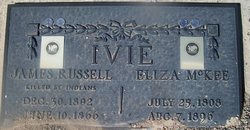
JAMES RUSSELL IVIE AND Eliza McKee Fausett ~~~ Pioneers of the Month ~~~ May 2026


James Russell Ivie


CHILDREN
Richard Anderson Ivie
William Franklin Ivie
Sarah A Ivie
James Alexander Ivie
John Lehi Ivie
Polly Ann Ivie
Elizabeth Caroline Ivie
Joseph Orson Ivie   (11yrs)
Eliza Marie Ivie
Mari Betsy Ivie      (0yrs)
Isaac Thomas Ivie
Benjamin Martin Ivie
Hyrum Lewis Ivie
Heber Kimball Ivie
Martha Adeline Ivie (12yrs)
1825 - 1892
1826 - 1880
1829 - 1890
1830 - 1906
1833 - 1909
1835 - 1896
1837 - 1901
1840 - 1851
1842 - 1920
1842 - 1842
1844 - 1906
1846 - 1926
1849 - 1927
1852 - 1923
1855 - 1867


Eliza McKee Faucett Ivie


The Following Comes From Mount Plea
sant History by Hilda Madsen Longsdorf:

After the burning of Hambleton Settlement, nothing was done so far as it is known towards re-establishing a settlement on Pleas­ant Creek, until about the middle of August, 1858, shortly after the arrival at Ephraim of the Big Move Caravan; James R. Ivie, Sr., Benjamin E. Clapp, Joseph R. Clement, Isaac Allred, Sr., Reuben W. Allred and Richard Ivie who were chosen at Fort Ephraim as an exploring committee to select a suitable location for a new settlement in the northern part of the valley, decided upon a site on

 Pleasant Creek. They returned to Fort Ephraim and stated their 

views to the immigrants and others, who had reached Fort Ephraim 

to remain over the winter.


A meeting was called and a petition was drafted, signed by sixty men who were desirous of locating farther north at the site selected. Not knowing just how to proceed or what to do, a meet­ing was called for the purpose of discussing necessary procedures. After some deliberations, James R. Ivie Sr., Joseph R. Clement, and Isaac Allred were chosen as a committee to wait upon Presi­dent Brigham Young in order to obtain his advice. Afterwards, however, it was deemed best for James Allred and James R. Ivie Sr. personally to present the petition. Leaving Fort Ephraim September 2nd, they arrived in Great Salt Lake City on September 6th. There they met Elder Orson Hyde on the street and at once stated the purpose of their visit. He kindly escorted them to Pres. Brigham Young's office. After considering the petition, President Young expressed himself as perfectly in favor of the new settle­ment. James R. Ivie stated that the petitioners were desirous that he, President Young, appoint men to take the lead. President Young, however, was not desirous of choosing their leaders or bishop at that time, and drafted the following letter which was sent back with the committee and presented to the petitioners: "Great Salt Lake City, Sept. 6, 1858.
"Brother John Reese and the rest of
the brethren whose names are on the list:
"In am perfectly willing that you should go there (Pleasant Creek) and make a settlement, but you must consider whether it will be safe or not. You wish to know my mind on the subject. It is this, that you must build you a good substantial fort and live in it, use every precaution that is necessary against the Indians. Your fort must be twelve feet high and four feet thick, built either of stone or adobe and laid in lime mortar. I also want you to select one of your number for president and one for bishop. You will have to be very careful of your stock or you will lose them. In choosing your farming land get it as nearly together as possible.

A meeting was called and a petition was drafted, signed by sixty men who were desirous of locating farther north at the site selected. Not knowing just how to proceed or what to do, a meet­ing was called for the purpose of discussing necessary procedures. After some deliberations, James R. Ivie Sr., Joseph R. Clement, and Isaac Allred were chosen as a committee to wait upon Presi­dent Brigham Young in order to obtain his advice. Afterwards, however, it was deemed best for James Allred and James R. Ivie Sr. personally to present the petition. Leaving Fort Ephraim September 2nd, they arrived in Great Salt Lake City on September 6th. There they met Elder Orson Hyde on the street and at once stated the purpose of their visit. He kindly escorted them to Pres. Brigham Young's office. After considering the petition, President Young expressed himself as perfectly in favor of the new settle­ment. James R. Ivie stated that the petitioners were desirous that he, President Young, appoint men to take the lead. President Young, however, was not desirous of choosing their leaders or bishop at that time, and drafted the following letter which was sent back with the committee and presented to the petitioners: "Great Salt Lake City, Sept. 6, 1858.
"Brother John Reese and the rest of
the brethren whose names are on the list:


"I am perfectly willing that you should go there (Pleasant Creek) and make a settlement, but you must consider whether it will be safe or not. You wish to know my mind on the subject. It is this, that you must build you a good substantial fort and live in it, use every precaution that is necessary against the Indians. Your fort must be twelve feet high and four feet thick, built either of stone or adobe and laid in lime mortar. I also want you to select one of your number for president and one for bishop. You will have to be very careful of your stock or you will lose them. In choosing your farming land get it as nearly together as possible."

June 20th, 1866, Indians under Chief Black Hawk made a raid on the stock of Scipio. During the skirmish Henry Wright and James R. Ivie, the father of Colonel J. L. Ivie, were killed. It will be remembered that in 1859 James R. Ivie had been chosen at Ephraim as leader for the company of pioneers who settled Mount Pleasant, and that he faithfully filled that position until W. S. Seeley was chosen bishop of the colony. A short time after the killing of Mr. Ivie, a son of Ivie, in retaliation for the killing of his father, killed a friendly Indian.  This enraged the Indians and they entered more vigorously in to the bloody work of massacre among the white settlers.

~~~~~~~~~~~~~~~~~~~~~~~~~~~~~~~~~~~~~~~~~~~~~~~~~

Eliza McKee Faucett Ivie


Submitted by: Sharon Allred Jessop 06/08/1999
JAMES RUSSELL IVIE & ; WIFE ELIZA MCKEE FAUCETT

Born: December 30, 1802 Born: July 5, 1808
Died: June 10, 1866 Died: August 7, 1861

Sketch of Their Lives By Hettie M. Robins

There is documentary evidence that Ivye, Ivie, Ivy, and Ivey are all of the same family. At the time there were no dictionaries, and the art of spelling was not highly developed. We find that most of the Ivies in the Southern and Eastern states have settled on spelling the name Ivey. We find the Ivey name in the United States as early as 1700. In the Revolutionary War the names of six soldiers are listed from Virginia and nine from North Carolina. In the Civil War there were hundreds, some of them in almost every Southern state and, perhaps, some listed in the Northern States.

Records show a Thomas Ivye or Ivie lived in Gloucestershire, England, about 1425, also of Ives coming to the United States from England as early as 1700, or even before. The above is sort of introductory of the Ivie family, the family tree of which our early grandparents are a branch of James Russell, the son of John Anderson Ivie, who was the sone of Anderson Ivey.

James Russell Ivie, son of John Anderson Ivie and Sarah Allred, daughter of William & Elizabeth Thresher, of North Carolina was born in Franklin County, Georgia, December 8, 1902. He was the second of nine children born to this union.

James Russell married Eliza McKee Faucett. She was born July 5, 1808, at West Columbia, Nuary County, Tennessee, to Richard Faucett and Mary McKee. There were married about June 1824. The location of their marriage is not definitely known, though the belief is that it may have been in Tennessee, since that is where they were living at the time, and their first three children were born, it is evident that they were moving from state to state - - going further west. The family spent from 1830 to 1844 in the State of Missouri, living in Paris, West Paris, and Caldwell Counties. They moved, then, to Council Bluffs, Pottowatamie County, Missouri, where their 11th child was born in 1846. From there they moved to Salt Lake City, where another child was born, and then to Provo, where the next child was born. Thirteen children in all were born to this union.

It was in the early 1830's in Missouri, that the Mormon Missionaries came to the areas in Missouri where the Ivies lived. Parley P. Pratt was one of the elders who came so often to their homes. It was he who brought the Book of Mormon to them and taught them the gospel, which converted them. He also helped to baptize them as members of the Church of Latter-Day Saints. Thereafter, their homes were always homes for the traveling missionaries.

I would like to relate an instance the Great Grandfather told us - - not just once, but many times.

I t happened some years after the Ivies had joined the Church. It was in November 1839, while the Elders were out preaching the Gospel that they were seized and put in prison without a hearing, or a trial. They were held prisoners from November 1839 to July 1940. Among them were Elder Parley P. Pratt, Elder Phelps, and others. The saints had planned a way of freeing the last three missionaries held prisoners. They had been changed from one prison to another during the seven months of confinement. At this time they were in Columbus, Missouri. The plan was worked out as Orson, brother of Parley P. Pratt, and others, had planned it, and happened on the eve of Independence day. The three prisoners, when their evening meal was served, crowded through the door and managed to evade bullets fired at them, and, upon reaching the three horses, brought for them by their brethren, were helped to mount and advised to separate, each going in a different direction, then, to hide themselves, in a deep cave until dark. One of the three was captured and taken back to prison for a short time. Elder Phelps managed to make his escape and reach Illinois, several days later. Elder Pratt was less fortunate and, apparently, headed off in another direction. Finally he made for a vast forest of trees, making his was some distance from his horse to await darkness. He climbed into a huge tree, laid his legs outstretched on top of the branches, locked his arms around two other limbs and, in this way, could not be so easily observed, had anyone come his way. After darkness, when he could no longer hear voices, he came down from his hiding place in the tree and went in search of his horse, which had broken loose and left him to make his way on foot.

On the third day of his escape he found himself in a neighborhood of settlers where he had had some acquaintances years previously, and where once there had been a small branch of the church; but, the saints had moved west, having been driven out of the state with other members of their faith. Elder Pratt remembered there were families of Ivies who had lived on the road, and in some clearing in the timber; so, he decided to make his way to them, and told us, in his own works as follows:

Quote: “ I was not sure if they were still friendly with the church, or if they had turned from it to avoid violence and being driven out. I hesitated, then decided to ask help from my Father in Heaven. I arose to my feet feeling much better. I asked in my prayers, that as I passed by the house, if they were still my friends, I would be recognized - - if not, that I might pass peaceably by. As I walked past their home that Sunday evening, about two hours before sundown, I got nearly by when the children playing in the front yard discovered me and cried out with surprise and much joy: “ There is Brother Pratt.” At this, a young man came running out to me who proved to be one of my acquaintances, still a member of the church, and who had been driven with others from the upper valley. Instead of going to Illinois, he had come back to his old neighborhood. I asked about Mr. Ivy and he said that he and his wife had gone to a neighbor’s home two or three miles away. He said “I am here on a visit.” He also advised that they had just received the news of my escape and were sending out warnings to be on the lookout. I told him of my plight. I was hungry and faint and my feet were covered with blisters. He told me of his brother’s wives and children who were also driven out of upper valley and were living in an obscure place in the woods, while the young man went in to see if it was all right. He came back with milk, cream, and bread. I ate of this and then went to the house. The wife said her husband would soon be home. I told her I was in constant fear of being found. She instructed the children not to say one word if anyone came, but to act like I was a total stranger. It was well she did, for just then a man came inquiring for her husband. She told him he was away and to come back but he said it was a matter of business he wanted to see her husband about and would wait. After an hour the dog barked and they knew her husband was returning. The children rushed out to see their father, and to tell him not to recognize me, as there was a strange young man there to see him. As he came in he gave me a cold look and a “howdy stranger, “ and turned to the other fellow. He was quite friendly with him. The young fellow told the man of the house he had some business with him and would he step out for awhile. He had come to borrow his saddle. As soon as he had gone the man of the house came in and threw his arms around my neck and welcomed me to his house. We ate supper and I asked if he would exchange hats with me as it had been winter when we were arrested. He gave me a hat that fully disguised me. The good wife made a lunch for me and Brother Ivie placed his wife’s saddle on her horse. After farewells to his wife and brother we were soon on our way. He went with me until I was safe - - way after midnight. He bade me God speed and returned to his family.” Unquote

This man and wife were James Russell Ivie and his wife, Eliza. I heard this story many times from Great Grandma and her son, Grandpa Ivie. Only, as I remember it, the side saddle and his horse got him well on his way, but the horse never found his way back.

I remember Grandmother telling: “I would go through the timber to a small spring for a pail of water. I was so frightened - - I could often hear the plaintiff cry of a panther or ‘panter’, as grandmother called it.

James Russell Ivie and Grandmother: Just where they met we don’t know. This is the tale she told, only it has lost its soft southern accent that was so pleasing in the way she would tell it: “I was milking my father’s cow one evening, the first time pop came a‘calling on me. He says, Eliza I’ve come a’ courting you. I looked up and there I saw a boy, plenty big enough to be wearing britches, and there he stood with a doe shirt on. I told him right out if I was to be his girl he better go home and ask his mother to make him some britches. The next time he came he wore britches.” (This was taken from Grandparents’ Martin and Martha Ivie’s family record.) His father John Anderson Ivie, owned a large tract of land, or plantation, and with 75 Negroes on it as slaves. When his son James Russell, and family left to join the saints to come west, his father gave him a little Negro boy. He was old enough to help Grandma with the smaller children. When they reached Omaha and near getting their outfits ready to start out, they were told not to burden themselves with extra mouths to feed, other than their families. So Grandpa, James Russell, gave the little boy his freedom and told him he could go to live with another family, or find his way back to his family. As they left, the little fellow cried and said, “Who will take of Missy, Betsy and Marie, I do love you Mama Ivie.” Both Grandmother and Grandfather loved the Negro boy and hated leaving him behind.

It was in the spring of 1848 in the month of May that the Ivies, James Russell, his wife and nine of their 11 children began plans for moving westward. Two of his sons were with the Mormon Battalion. Besides James Russell and family, two of his brothers, Thomas Isaac, or Kelton, and William Shelton, and families , got as far as Nerrion, Missouri, on their way to joint the wagon train which would have soon headed for the west (Utah). So they dropped out of the company. There was something about one of William’s girls marrying as a plural wife to a man by the name of Long. Both parents strongly opposed the marriage.

It was on the first of June 1948, that the Ivies left Elkhorn in the company of the saints - - 1,229 souls and 397 wagons, headed for the Great Salt Lake Valley. They were in Brigham Young’s second company. The Allred family, also, came at this time. Grandfather’s outfit was well equipped with a good wagon and teams. His son’s Richard’s wife, Elizabeth Dobson, was with them. The trip across the plains and mountains was made about the same as most of them in the company. Great Grandmother helped in cases of sickness and births in their company as well as others, where ever they were needed on their trip to Utah. The pioneers reached Great Salt Lake Valley about September 20, 1848. They must have spent the winter in Salt Lake City, for on February 25, 1849. Grandma gave birth to a son whom they called Hyrum Lewis Ivie. From Salt Lake City they went to what was then called Rhodes, or Roade Valley, and later called Provo Valley. Here another son was born, November 19, 1852. He was named Heber Charles Ivie. Their eighth child, a son, named Joseph Ivie died the year before in 1851. He was 11 years old at the time.

From Provo Valley some of the Ivie family went to Weber County to what is now Kamas. However, they weren’t satisfied with the outlook there, so they left and came to Mt. Pleasant. They had relatives there for a few years. During the time they were in Mt. Pleasant and the time they came to Round Valley (Scipio) in 1863, James Russell and some of his family and the Allred Family, made a trip to Rose Valley, Nevada, with the expectations of locating there. The Valley didn’t meet their expectations - - others having already located there. They came back to Scipio in the late spring of 1863. At that time the settlers were still in Graball or Robinville, where there was a branch of the church, the Ivies didn’t go there to make their home, but went a little further south, up the valley about two miles from Graball. This was where a little stream of water came from a small lake about seven or eight miles further south in the Valley. It separated into two streams. The west stream went by the settlers at Graball, the east stream just running to waste. It was on the east fork that James Russell and family stopped. It was known as Ivie Creek for years. Not long after this, President Young visited the people here, and advised them to locate closer together on a townsite in the Valley. It was called Rourl Valley, but later changed to Scipio.

The Ivies were the first to build homes on the new townsite. The first home built was a room put up of logs - - it was the old stable of the Joe Miller lot, built by William Franklin Ivie, a son of James Russell. His family lived there until he could get logs out to build a place for them to live in. This stable was used to keep a fine stallion in. He had it brought here with the livestock, horse and cattle. Grandfather James Russell built his home and they owned the old Joseph Stone lot - -it is on the northwest corner from the public square. In reading the record kept by the Branch Clerk, John Memmott, we find James Russell Ivie was interested both in his church and civil affairs. Both he and his son, William Franklin, were block teachers, and James Russell was President of the Field Committee, and Water Master. He was also very interested in education. He helped with the loan of his teams to move the log school house from Graball to the new homesite.

In the spring and summer of 1866 the Indians had become very hostile, and on the warpath; making raids on the stock owned by the settlers. A large band of Indians under Chief Black Hawk made a raid on a Sunday Morning, June 10, 1866, when Grandfather James Russell’s favorite milk cow was to freshen. Grandfather rose early and walked down to the pasture lands a little north and west of the settlement, in what was called the pond field. As he neared the spot where the cow was, he heard an Indian War Hoop and the people in town also heard it. They rushed out to look for Grandfather and found his body already pierced by several arrows. He was stripped of his clothing, all but his boots, as they were unable to get them off. The Indians made off with the cattle and horses owned by the families.

Both Grandparents had received their patriarchal blessings. I can remember so well, seeing dear little Grandma going to the old black box, or chest, as she called it. She would reach in, bring out her blessing, hand it to mother, and ask her to read it. It seemed such a source of strength and comfort to her in her last days. The one thing I remember in it, was that their posterity should be as Jacob’s of old, and as numerous as the sands of the sea. Of their 13 children, 12 grew to maturity, marrying, and are parents of large families. A host of grandchildren, some over 125 in number. I am happy to be counted among their great-grandchildren.

History obtained form Loya Moscon, 1888 E. Spring Creek Dr, Bountiful, Utah 84810

My records show that James Russell Ivie is the first born child of Anderson Ivie and Sarah Allred. James Anderson Ivie is the second child of James Russell and Sarah.

I have records of deeds and Anderson Ivie is the name shown on these. F.P.

Hettie M Robins gives us the following description of Eliza M Ivie’s last years.
“After the death of her husband, the care of Eliza fell on the shoulders of her son Martin and his wife, Martha Ivie. Her son moved a one-room log house onto his lot so his mother would be near them. When her son bought a larger home his mother was given a large sunny room to live in. I imagine I see it now with its fireplace and one or two pots hanging from hooks over the flames of coals. There was a very small cook stove in the corner. Her table was next to the fireplace. Just under the window was the large black box or chest that came across the plains with them. Next was the four-poster bed with rawhide stripes crisscrossed for slats or springs. The floor and hearth were scrubbed clean enough to eat on. White short curtains were at the windows The white cover on the black box and cover over the bed pillows all with knotted edging and made out of course white cotton yarn. I remember her telling everyone once that although she was dead and laid out of the cooling board, she said, "But I fooled them, I came back to life again because my mission on earth was not finished." She would sometimes get a little out-of-sorts at some of our pranks and say: "If you youngans  don't behave yourselves when I die I will come back and haunt ye."
"Both Grandparents had received their patriarchal blessings. I can remember so well, seeing dear little Grandma going to the old black box, or chest, as she called it. She would reach in, bring out her blessing, hand it to mother, and ask her to read it. It seemed such a source of strength and comfort to her in her last days. The one thing I remember in it, was that their posterity should be as Jacob's of old, and as numerous as the sands of the sea. Of their 13 children, 12 grew to maturity, marrying and are parents of large families. A host of grandchildren, some over 125 in number. I am happy to be counted among their great-grandchildren."


Monday, March 3, 2025

RUDOLPH N. BENNETT ~ (From our archives)


Obituary 


Birth: Oct. 7, 1843
Nashville
Jackson County
Iowa, USA
Death: Dec. 29, 1927
Manti
Sanpete County
Utah, USA


Rodolphus N. Bennett, Indian war veteran, pioneer settler and colonizer, and the oldest man in Mt. Pleasant, died at the family home Thursday after a long illness due to the infirmities of old age.

Mr. Bennett was born October 27, 1843 in Nashville, Iowa. His parents, David and Johannah, Lovelith Bennett and their ten children were among the earliest converts to the L. D. S. faith, coming to Utah in 1850 in the company of which David Bennett was captain.

Mr. Bennett came to Mt. Pleasant among the earliest settlers in 1852, and had resided here ever since, with the exception of some years spent in colonizing settlements and on missionary labors.

His first wife died May 2, 1900, and two years later he married Mrs. Matilda A. Burns, widow of Sheriff Milton Burns, who survives him. Three sons and three daughters by his first marriage also survive.


Family links:
 Parents:
  David Alma Bennett (1801 - 1853)
  Joanna Lowell Bennett (1803 - 1856)

 Spouses:
  Hannah E Allred Bennett (1848 - 1900)*
  Matilda Josephine Anderson Burns Bennett (1853 - 1936)*

 Children:
  William Rudolphus Bennett (1864 - 1930)*
  Ann Laura Bennett Madsen (1885 - 1976)*
  Isaac Rowlin Bennett (1887 - 1964)*

 Siblings:
  Laura Elizabeth Bennett Young (1826 - 1880)*
  Alma Harrison Bennett (1831 - 1905)*
  Mahetable Mahala Maria Bennett Beers (1834 - 1888)*
  Rudolphus Nathaniel Bennett (1843 - 1927)
  Emma Euphrasia Bennett Porter (1848 - 1928)*

*Calculated relationship
Burial:
Mount Pleasant City Cemetery
Mount Pleasant
Sanpete County
Utah, USA
Plot: A_36_3_8


 What was the Kolob Guard? 

More Wives Than One: Transformation of the Mormon Marriage System, 1840-1910By Kathryn M. Daynes


The following are snippets from Mt. Pleasant History by Hilda Madsen Longsdorf  

p 63: We quote Rudolph N. Bennett, in a talk given by him at a pioneer meeting, March 24, 1924, "There was at that time three months at school and nine months out at work, not vacation; no wonder some of us have not the book learning we would like, but we did not have the opportunity to get it. The school seats were then made of slabs and the desks were of rough boards. The schools now have all that is necessary, including music." Concerning the use of the building, we again quote Mr. Bennett, "This building was also used for a dance hall, 'Nigger Shows,' theatre and school doings. The lights were furnished by a sage brush or cedar fire; on special occasions tallow candles were used. The house was always packed because the people were glad for any kind of entertainment that could be given."


Among other prominent pioneer musicians, who also contributed necessary pioneer music were Levi B. Reynolds, violinist; George Nielsen, tambourine; Orin Clark, the Jaw Bones of an Ox on a stick; Alma Staker, Bone Clapper; Rudolph Bennett, Triangle; Bent Hansen, Bass Fiddle; Soren Hansen, Clarinet; Andrew Bram­sted, Violin; and August Mynear, Violin.

p 64: During the late summer and during the fall and winter months, P. M. Peel and James Porter Sr., built a chopping mill on Peel's lot on Pleasant Creek, (northeast corner, intersection, Main Street and First West) where the stream had previously been taken out and used for irrigation purposes. Here the stream furnished the water power with which to run the mill. Owing to the distance to the nearest flour mill, this mill was a great assistance, and the people were glad to take their wheat there to be chopped. It was ground between two stones and came out quite black, but coarse as it was, it served the purpose and was used for bread. At about this time, a small Burr mill was built east on Pleasant Creek, a little south of where the Mount Pleasant flour mill is now, by John
Fredrick Fechser and John Ellertsen, (Spring City). A whip saw was installed in the fort, on the banks of Pleasant Creek, by Wellington Seeley and Rudolph N. Bennett, and was operated by Tho­mas Dutton.

p68: 
Realizing the need of recreation and entertainment, in 1860, a dramatic company, which always played to packed houses, was organized by a number of people, among whom were W. W. Bran­don Sr., John Ivie and wife, Katherine Ivie, Rudolph Bennett, George Porter and Joseph Smith Day. As time went on, the per­sonnel of the company would change, but W. W. Brandon and Katherine Ivie played with them for years. During the winter months, their plays were put on in the log meeting house in the center of the fort, using wagon covers and other such material as they could provide for scenery. Among other plays, they pre­sented the Merchant of Venice, and Good For Nothing Nan.

p 72: Independence Day, July the 4th, 1861, was celebrated with appropriate ceremonies. A new flag pole was erected on the Church Square. It was one straight, long pole brought from the mountains by Svend Larsen, Abraham Day, William Morrison Sr., and others, and prepared with a plane and' draw knife brought from Norway by Erick Gunderson Sr., was set up by Erick Gunderson Sr., Gunder E. Gunderson, Jacob Rolfson1, William Morrison Sr., and others. There was much rejoicing; an ox had been killed for the occasion and a public dinner was given in the bowery, on the south side in the square. A pitch pine torch in each corner of the bowery furnished the light for the dance held in the evening, for which music was furnished by John Waldermar, James Hansen, Lars Nielsen (Fiddler), and others. All enjoyed them selves to the utmost. R. N. Bennett states, "I recall the dances held often in the old bowery, dancing on the dirt floor, some of us barefoot, but we would make the dust fly. Bishop Seeley was great on big eats. A saying was, 'We'll cut a squash, kill a chicken and have a treat.' The only fruit I remember we ever had were bull berries, service berries, and choke cherries, these were dried and used in the winter, too."

 p. 90: 

As Rowe drove up, the Indian took Conderset's hat and put it on his own head and stood astraddle of the fire. We did not under­stand why. Rowe looked at the Indian and said, 'Boys, he is here for no good.' Conderset told his father what the Indian said about the Indians killing eight men in Provo Canyon. Rowe be­gan asking the Indian questions about it. The Indian said that it was eight sleep

ya-tes, eight days since, holding up eight fingers. Rowe said, 'You are mistaken, for if it were so, the papers would talk about it.' The Indian became uneasy and wanted to go to his saddle. Rowe said, 'I will go with you.' The Indian seemed willing that he should do so, till he got his horse, when he said his horse's back was sore, which was very common with Indian horses. Rowe told the Indian that he would walk for he was anxious to keep the Indian with us all night. He also told the Indian that there would be ten men there by morning, and ten more later, word having reached Mount Pleasant that the Indians intended making a raid on Thistle Valley. Upon hearing this, the Indian became more eager to go than ever, he jumped on his horse and was gone, and we saw no more of him. Mr. Rowe remarked that trouble was brewing and that we would have to shift for ourselves as best we could. About midnight, after we had conversed about what we would do in case we were attacked, we heard a yell down in the valley in the direction of the road. Rowe said: 'there comes the boys.' We boys fearing that it might be Indians, planned what to do if such should be the case. It proved to be four boys from Mount Pleasant, namely, R. N. Bennett, Don C. Seely, Peter Miller and James Hansen. They told us that as they were coming up from the road, they saw a small fire up Indian Hollow, and started towards it, when they got into a ridge and saw our fire, and came to it. We got supper for them. We looked for more men in the morning, but they did not come. We gathered the stock and sheep and drove to Mount Pleasant. At Fairview we got supper at Gammet's. There was no further trouble with Indians that fall, but we always believed that if we had not received timely help, we might have been murdered."

p 91: In April, another call was made for men with oxen and wagons to go east to bring immigrants. Anthon H. Lund1, C. W. Anderson, James Gundersen, J. D. Page, and Lars Frandsen, with R. N. Bennett as night guard responded. They, with their oxen and wa­gons, went to Salt Lake City where a company of 277 men, 177 wagons and 1717 oxen were fitted out with provisions for the im­migrants whom they met at Wyoming, a village seven miles north of Nebraska City, Nebraska, as that place instead of Florence, Nebraska had then been selected as an out-fitting place.
 
p 95: A call was made for Mount Pleasant to send twenty-three men to the defense of the inhabitants of Sevier Valley. A few days later, a group of well-armed men responded to the call, according to Andrew Madsen's Journal, "A party of about twenty men, John Ivie, Dolph Bennett (R. N.), Orange Seeley, George Frandsen, Christian Jensen, Alma Zabriskie, Peter Fredricksen, N. Peter Madsen. Mortin Rasmussen, myself and others, with three baggage wagons driven by Rasmus Frandsen, Jacob Christensen and Peter Y. Jensen, started out at daybreak. At our arrival at Manti, we were told what had transpired at Salina Canyon and of the killing of Ward and Anderson. We were ordered to hurry on at once. We arrived in Salina early in the evening where we were joined by a number of men from other settlements. Preparations were made during the night, and early the following morning, Colonel Reddick Allred with eighty-four armed men started up Salina Canyon in pursuit of the Indians. About ten miles east of Salina,

p 100: On the other side of the river we could see fresh wichiups made of green trees. The river was too high to ford. Dolph Bennett, of Mount Pleasant, John Sanders, of Fairview, and Jens Larsen of Ephraim, were chosen as advance guards to swim across to investi­gate. John Sanders very nearly drowned, but was rescued by Bennett. The advance men, upon reaching the other shore found a great many fresh tracks of the Indians, and called back to tell of their find. After scouting about a short time, they returned across the river to the balance of the company. Most of the com­pany wanted to follow the tracks, but upon taking inventory of their supplies, which now consisted of cracker crumbs only, the officers decided on account of the jaded condition of the horses and the lack of supplies, to give up the chase and return home. 


pp 106,107: Concerning the expedition, R. N. Bennett stated: "Not all Indians were bad. There were many good ones living near Nephi and in Utah County, but on account of so many renegades, as they were called, it was hard to tell the good from the bad. So naturally, we were suspicious of all. In the spring of 1866 old Chief Kanosh sent word to the effect that a lot of Indians, who had stolen cattle, etc., were camped in Nephi Hills. This was told to officers Snow and Allred. Jake, a son of Kanosh, had been raised among the white people and Kanosh said if the Mormons wanted him to, he would send him to pick out the renegades or bad Indians. The outcome was they secured a bunch of those who had killed, and started with them to Manti to be tried and put in jail. However, on the way we had some trouble. At daybreak we heard the dogs barking. We were camped in a flat. Jake called to the other Indians in a tone that made the mountains echo and told them to keep still or be killed. The Indians were unruly and in the skirmish one was killed. They held court at Manti. Jake gave evidence against the Indians; four were condemned to be killed and the rest put in jail. A bunch of white men were detailed or drafted to get rid of the four."

March 20th, orders were again received at Mount Pleasant for men, this time for ten to go to an Indian camp in Salt Creek Canyon, near Nephi. They at once responded and they, with others from other settlements, captured four Indians who had been with Chief Black Hawk at Ephraim the year previous, when so many depredations were committed. According to orders, the captives were shot and killed in a ditch below Nephi. The men were away from Mount Pleasant on this expedition three days. April 15th, a call was made by the church for men to go east for immigrants. The following men, Hans Brotherson, Charlie Hampshire, George Tuft, Christian Petersen (Peel), Neils Jensen,

107


Hans Scholft, Fredrick Petersen, Neils L. Lund, August Mynear,

Oscar Barton, Don Carlos Seeley, and Jorgen Hansen, with Lyman Peters as night guard, were fitted out by the colonists and left Mount Pleasant April 19th with eleven wagons and 44 oxen for Salt Lake City, where they joined with others. The entire company leaving Salt Lake City consisted of 456 teamsters, 49 mounted guard, 89 horses, 134 mules, 304 oxen, and 397 wagons.

On Oc­tober 20th they returned with a company of immigrants who were chiefly from Scandinavia. This company consisted of a part of Abner Lowry's company. On the journey crossing the plains, 'George Farnsworth had rendered efficient service in waiting on the cholera patients as he was the only man with the company who was acquainted with the disease. Fifty-six persons died on the plains, leaving Farnsworth in charge of fifty-three orphans, whom he brought to Utah. They were distributed among the saints who applied for them.

On April 18th, Indian Chief Sanpitch and other Indians, broke jail at Manti. A posse was at once in close pursuit and three Indians were killed within the city limits. R. N. Bennett, Peter Miller, Niels Madsen, Peter Christopherson and others, started in pursuit of the remainder of the party. 


They were joined by a group of men from Moroni and other places. Concerning this, we quote R. N. Bennett: "George Tucker was my captain in the fore part of 1866. In the spring we captured nine Black Hawk Indians in the mountains east of Nephi, and put them in the county jail at Manti. About April 14th they broke jail, three of them being killed while trying to escape, and others went so far north as Fountain Green, then called Uinta, going into the mountains on the west. 


p 110: Quoting R. N. Bennett: "David Candland was sent with the epistle for the people of Fairview to move to Mount Pleasant, the people of Fountain Green to Moroni, and the people of Spring City to move to Ephraim. John L. Ivie and myself were sent as Candland's body guards. After these families had moved, the minute men of Mount Pleasant and other settlements had to go as guards for the men while they did their work."

 p 112: A cavalry consisting of about eighteen or twenty men, includ­ing Colonel Ivie, George Tucker, Orange Seely, R. N. Bennett (Dolph), Martin Aldrich, Aaron Oman, Niels Madsen, and Peter Fredricksen started with great speed for Dewey's camp, at Fair­view, others joined them.

p 113: During the skirmish in Thistle Valley, Orange Seely and Dolph Bennett, seeing an Indian leave his horse and sneak into the wash towards camp, captured the horse, saddle, bridle, a buckskin jacket and a long lasso rope. Seely kept the horse for some time as a trophy of war. All horses, excepting five or six head of saddle horses were missing. These were hitched by the rescuing party to the wagons and the camp was moved to a more protected loca­tion, where Indianola now stands. The body of Charles Brown was taken to Mount Pleasant for burial.

R. N. Bennett made the following statement concerning the attack: "June 24, 1866, Black Hawk warriors attacked Captain Peter Dewey's company at Thistle Valley, killing one man, Charles Brown, of Draper, and wounding Thomas Snaar, and driving off twenty or more head of horses. John L. Ivie, Orange Seely, George Tucker, myself and others went to recover the horses. We followed Black Hawk and his band nearly to the head of Spanish Fork River, going a distance of about forty or fifty miles, then follow­ing down the Spanish Fork River, to about where Thistle Junction now is. During this engagement three or four Indians were killed, and a number wounded."

p117: It was originally intended to build a wall twelve feet high, but as the trouble with the Indians grew less serious, the wall was never completed.

Andrew Rolph states that to build this wall, people were or­ganized in companies with captains. Mortin Rasmussen, he remembers, was captain over one group. The wall was constructed on a straight line, for about three blocks on the east side of Fourth East. Orin Clark's house, about southeast of the corner of the interdiction of Main and Fourth East was east or outside of the wall. North of Main, the wall ran about a block north, then northwest one block, and ended there. Svend Larsen's and Jim Walker's houses, about southeast of the corner of intersection of Fourth East and Main, and the house on the northeast corner of interdiction of First North and Third East was west, or inside of the wall. The rocks from this wall were later used to wall up cellars all about the city. R. N. Bennett stated that a bastille was started In this wall but not completed.''

p 130: with R. N. (Dolph) Bennett acting as head freighter. Long trips were made with mule or horse teams, shorter ones with ox teams. The store receiving cash for their produce, many people were thereby benefited. 

p 138: August 26th, 1868, Dan Miller, of Nephi, and his son, returning with a load of lumber from Snow and Douglas Mill in Oak Creek Canyon, east of Spring City, were attacked by Indians. Dolph Bennett, who was on his way to the mill, discovered Mr. Miller lying in a bed of cactus. After lifting him out he went to the mill to give the alarm. 

p 139: Quot­ing R. N. Bennett: "Records show that during the war 72 white people and about 122 Indians were killed in Utah."


An act to pension the survivors of certain Indian Wars from

January 1, 1859, to 1891 was approved March 4, 1917. Coming at this late date the majority of those who had served in the early days had passed away. The following named are those who at that time proved up in Mt. Pleasant: Martin Aldrich, Claus An­derson, C. W. Anderson, Rasmus Anderson, Oscar Barton, Rudolph Bennett, Andrew Beckstrom, Martin Bohne, Martin Brother­son, Joseph Burton, John Carlson, James Christensen, Robert Eiertson, Rasmus Frandsen, James Hendricksen, Neils Johansen, Andrew Jensen, Sophus Johnson, John Knudsen, Brigham Lee, Peter Monsen, Bennett Monk, James Olson, Ole Arlson, Olof Rosenlof, Conderset Rowe, Hyrum Seely, John H. Seely, William Seely, Olof Sorensen, John Waldermar, August Wall, Thomas Wrest, Hazzard Wilcox, Alma White, Joseph Wise, Oscar Ander­son, Wesley Bills, Joseph Coates, Henry Ericksen, Peter N. Jensen, Peter Rasmussen, Joseph N. Seely, Andrew Rolph, S. A. Barton, Edmond C. Johnson, William Olson. The last four named are living in Mt. Pleasant, in 1939, as are the widows of Martin Aldrich, Joseph Burton, Sophus Johnson, Oscar Barton, Hazzard Wilcox, John Carlson, Peter M. Jensen, Oscar Anderson and A. G. Omen.

 p 203: Rudolph N. Bennett, a Black Hawk War Veteran, and the last survivor of the pioneers whose names are engraved on the Mt. Pleasant monument, died December 29, 1927, at the age of eighty­four years.