Tuesday, April 2, 2013

A Good April Fools Joke For All Aggie and BYU Fans


As another good joke, the Cache Valley Insider announced: "LDS Church to purchase Utah State University, rename it BYU-Logan"
They wrote:
"Perhaps the biggest announcement the week of the 183rd annual General Conference of the Church of Jesus Christ of Latter-day Saints came late on Easter Sunday. The LDS Church announced plans to purchase Utah State University, renaming the 125 year old school BYU-Logan.
"The Church cites increasing tension between Aggie fans and Cougar fans as the reason for the purchase.
"'We hope this move will defuse any tension between Aggie fans and Cougar fans. Now fans from both schools can cheer for BYU, regardless if they're from Logan or Provo', said a church spokesperson."
No worries Cougars and Aggies.  You are not about to be melded.

Historical Trivia ~ Submitted by Dave Gunderson


Did you know the saying "God willing and the Creek don't rise" was in reference to the Creek Indians and not a body of water? It was written by Benjamin Hawkins in the late 18th century. He was a politician and Indian diplomat. While in the south, Hawkins was requested by the President of the U.S. to return to Washington. In his response, he was said to write, "God willing and the Creek don't rise." Because he capitalized the word "Creek" it is deduced that he was referring to the Creek Indian tribe and not a body of water.
*********************************
In George Washington's days, there were no cameras. One's image was either sculpted or painted. Some paintings of George Washington showed him standing behind a desk with one arm behind his back while others showed both legs and both arms. Prices charged by painters were not based on how many people were to be painted, but by how many limbs were to be painted. Arms and legs are 'limbs,' therefore painting them would cost the buyer more. Hence the expression, 'Okay, but it'll cost you an arm and a leg.' (Artists know hands and arms are more difficult to paint)
******************************
As incredible as it sounds, men and women took baths only twice a year (May and October) Women kept their hair covered, while men shaved their heads (because of lice and bugs) and wore wigs. Wealthy men could afford good wigs made from wool. They couldn't wash the wigs, so to clean them they would carve out a loaf of bread, put the wig in the shell, and bake it for 30 minutes. The heat would make the wig big and fluffy, hence the term 'big wig...' Today we often use the term 'here comes the Big Wig' because someone appears to be or is powerful and wealthy.
*********************************
In the late 1700's, many houses consisted of a large room with only one chair. Commonly, a long wide board folded down from the wall, and was used for dining. The 'head of the household' always sat in the chair while everyone else ate sitting on the floor. Occasionally a guest, who was usually a man, would be invited to sit in this chair during a meal. To sit in the chair meant you were important and in charge. They called the one sitting in the chair the 'chair man.' Today in business, we use the expression or title 'Chairman' or 'Chairman of the Board.'
*********************************
Personal hygiene left much room for improvement.. As a result, many women and men had developed acne scars by adulthood. The women would spread bee's wax over their facial skin to smooth out their complexions. When they were speaking to each other, if a woman began to stare at another woman's face she was told, 'mind your own bee's wax.' Should the woman smile, the wax would crack, hence the term 'crack a smile'. In addition, when they sat too close to the fire, the wax would melt. Therefore, the expression 'losing face.'
*********************************
Ladies wore corsets, which would lace up in the front. A proper and dignified woman, as in 'straight laced' wore a tightly tied lace.
*********************************
Common entertainment included playing cards. However, there was a tax levied when purchasing playing cards but only applicable to the 'Ace of Spades...' To avoid paying the tax, people would purchase 51 cards instead. Yet, since most games require 52 cards, these people were thought to be stupid or dumb because they weren't 'playing with a full deck..'
********************************
Early politicians required feedback from the public to determine what the people considered important. Since there were no telephones, TV's or radios, the politicians sent their assistants to local taverns, pubs, and bars. They were told to 'go sip some Ale and listen to people's conversations and political concerns. Many assistants were dispatched at different times. 'You go sip here' and 'You go sip there.' The two words 'go sip' were eventually combined when referring to the local opinion and, thus we have the term 'gossip.'
**********************************
At local taverns, pubs, and bars, people drank from pint and quart-sized containers. A bar maid's job was to keep an eye on the customers and keep the drinks coming. She had to pay close attention and remember who was drinking in 'pints' and who was drinking in 'quarts,' hence the phrase 'minding your 'P's and Q's'.
**********************************
One more: bet you didn't know this!
In the heyday of sailing ships, all war ships and many freighters carried iron cannons. Those cannons fired round iron cannon balls. It was necessary to keep a good supply near the cannon. However, how to prevent them from rolling about the deck? The best storage method devised was a square-based pyramid with one ball on top, resting on four resting on nine, which rested on sixteen. Thus, a supply of 30 cannon balls could be stacked in a small area right next to the cannon. There was only one problem....how to prevent the bottom layer from sliding or rolling from under the others. The solution was a metal plate called a 'Monkey' with 16 round indentations. However, if this plate were made of  iron, the iron  balls would quickly rust to it. The solution to the rusting problem was to make 'Brass Monkeys.' Few landlubbers realize that brass contracts much more and much faster than iron when chilled.. Consequently, when the temperature dropped too far, the brass indentations would shrink so much that the iron cannonballs would come right off the monkey; Thus, it was quite literally, 'Cold enough to freeze the balls off a brass monkey.' (All this time, you thought that was an improper expression, didn't you.)
If you don't send this fabulous bit of historic knowledge to any and all your unsuspecting friends, your hard drive will kill your mouse.


Monday, April 1, 2013

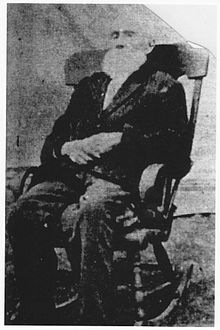
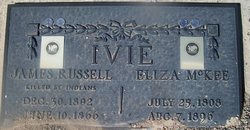
James Russell and Eliza McKee Faucett Ivie ~ Pioneers of the Month ~ April 2013


James Russell Ivie


CHILDREN
Richard Anderson Ivie
William Franklin Ivie
Sarah A Ivie
James Alexander Ivie
John Lehi Ivie
Polly Ann Ivie
Elizabeth Caroline Ivie
Joseph Orson Ivie   (11yrs)
Eliza Marie Ivie
Mari Betsy Ivie      (0yrs)
Isaac Thomas Ivie
Benjamin Martin Ivie
Hyrum Lewis Ivie
Heber Kimball Ivie
Martha Adeline Ivie (12yrs)
1825 - 1892
1826 - 1880
1829 - 1890
1830 - 1906
1833 - 1909
1835 - 1896
1837 - 1901
1840 - 1851
1842 - 1920
1842 - 1842
1844 - 1906
1846 - 1926
1849 - 1927
1852 - 1923
1855 - 1867
Eliza McKee Faucett Ivie


The Following Comes From Mount Pleasant History by Hilda Madsen Longsdorf:

After the burning of Hambleton Settlement, nothing was done so far as it is known towards re-establishing a settlement on Pleas­ant Creek, until about the middle of August, 1858, shortly after the arrival at Ephraim of the Big Move Caravan; James R. Ivie, Sr., Benjamin E. Clapp, Joseph R. Clement, Isaac Allred, Sr., Reuben W. Allred and Richard Ivie who were chosen at Fort Ephraim as an exploring committee to select a suitable location for a new settlement in the northern part of the valley, decided upon a site on

 Pleasant Creek. They returned to Fort Ephraim and stated their 

views to the immigrants and others, who had reached Fort Ephraim 

to remain over the winter.


A meeting was called and a petition was drafted, signed by sixty men who were desirous of locating farther north at the site selected. Not knowing just how to proceed or what to do, a meet­ing was called for the purpose of discussing necessary procedures. After some deliberations, James R. Ivie Sr., Joseph R. Clement, and Isaac Allred were chosen as a committee to wait upon Presi­dent Brigham Young in order to obtain his advice. Afterwards, however, it was deemed best for James Allred and James R. Ivie Sr. personally to present the petition. Leaving Fort Ephraim September 2nd, they arrived in Great Salt Lake City on September 6th. There they met Elder Orson Hyde on the street and at once stated the purpose of their visit. He kindly escorted them to Pres. Brigham Young's office. After considering the petition, President Young expressed himself as perfectly in favor of the new settle­ment. James R. Ivie stated that the petitioners were desirous that he, President Young, appoint men to take the lead. President Young, however, was not desirous of choosing their leaders or bishop at that time, and drafted the following letter which was sent back with the committee and presented to the petitioners: "Great Salt Lake City, Sept. 6, 1858.
"Brother John Reese and the rest of
the brethren whose names are on the list:
"In am perfectly willing that you should go there (Pleasant Creek) and make a settlement, but you must consider whether it will be safe or not. You wish to know my mind on the subject. It is this, that you must build you a good substantial fort and live in it, use every precaution that is necessary against the Indians. Your fort must be twelve feet high and four feet thick, built either of stone or adobe and laid in lime mortar. I also want you to select one of your number for president and one for bishop. You will have to be very careful of your stock or you will lose them. In choosing your farming land get it as nearly together as possible.

A meeting was called and a petition was drafted, signed by sixty men who were desirous of locating farther north at the site selected. Not knowing just how to proceed or what to do, a meet­ing was called for the purpose of discussing necessary procedures. After some deliberations, James R. Ivie Sr., Joseph R. Clement, and Isaac Allred were chosen as a committee to wait upon Presi­dent Brigham Young in order to obtain his advice. Afterwards, however, it was deemed best for James Allred and James R. Ivie Sr. personally to present the petition. Leaving Fort Ephraim September 2nd, they arrived in Great Salt Lake City on September 6th. There they met Elder Orson Hyde on the street and at once stated the purpose of their visit. He kindly escorted them to Pres. Brigham Young's office. After considering the petition, President Young expressed himself as perfectly in favor of the new settle­ment. James R. Ivie stated that the petitioners were desirous that he, President Young, appoint men to take the lead. President Young, however, was not desirous of choosing their leaders or bishop at that time, and drafted the following letter which was sent back with the committee and presented to the petitioners: "Great Salt Lake City, Sept. 6, 1858.
"Brother John Reese and the rest of
the brethren whose names are on the list:


"I am perfectly willing that you should go there (Pleasant Creek) and make a settlement, but you must consider whether it will be safe or not. You wish to know my mind on the subject. It is this, that you must build you a good substantial fort and live in it, use every precaution that is necessary against the Indians. Your fort must be twelve feet high and four feet thick, built either of stone or adobe and laid in lime mortar. I also want you to select one of your number for president and one for bishop. You will have to be very careful of your stock or you will lose them. In choosing your farming land get it as nearly together as possible."

June 20th, 1866, Indians under Chief Black Hawk made a raid on the stock of Scipio. During the skirmish Henry Wright and James R. Ivie, the father of Colonel J. L. Ivie, were killed. It will be remembered that in 1859 James R. Ivie had been chosen at Ephraim as leader for the company of pioneers who settled Mount Pleasant, and that he faithfully filled that position until W. S. Seeley was chosen bishop of the colony. A short time after the killing of Mr. Ivie, a son of Ivie, in retaliation for the killing of his father, killed a friendly Indian.  This enraged the Indians and they entered more vigorously in to the bloody work of massacre among the white settlers.


~~~~~~~~~~~~~~~~~~~~~~~~~~~~~~~~~~~~~~~~~~~~~~~~~~~~~~~~~~~~~~~~~~~~~~~~~


Submitted by: Sharon Allred Jessop 06/08/1999
JAMES RUSSELL IVIE & ; WIFE ELIZA MCKEE FAUCETT

Born: December 30, 1802 Born: July 5, 1808
Died: June 10, 1866 Died: August 7, 1861

Sketch of Their Lives By Hettie M. Robins

There is documentary evidence that Ivye, Ivie, Ivy, and Ivey are all of the same family. At the time there were no dictionaries, and the art of spelling was not highly developed. We find that most of the Ivies in the Southern and Eastern states have settled on spelling the name Ivey. We find the Ivey name in the United States as early as 1700. In the Revolutionary War the names of six soldiers are listed from Virginia and nine from North Carolina. In the Civil War there were hundreds, some of them in almost every Southern state and, perhaps, some listed in the Northern States.

Records show a Thomas Ivye or Ivie lived in Gloucestershire, England, about 1425, also of Ives coming to the United States from England as early as 1700, or even before. The above is sort of introductory of the Ivie family, the family tree of which our early grandparents are a branch of James Russell, the son of John Anderson Ivie, who was the sone of Anderson Ivey.

James Russell Ivie, son of John Anderson Ivie and Sarah Allred, daughter of William & Elizabeth Thresher, of North Carolina was born in Franklin County, Georgia, December 8, 1902. He was the second of nine children born to this union.

James Russell married Eliza McKee Faucett. She was born July 5, 1808, at West Columbia, Nuary County, Tennessee, to Richard Faucett and Mary McKee. There were married about June 1824. The location of their marriage is not definitely known, though the belief is that it may have been in Tennessee, since that is where they were living at the time, and their first three children were born, it is evident that they were moving from state to state - - going further west. The family spent from 1830 to 1844 in the State of Missouri, living in Paris, West Paris, and Caldwell Counties. They moved, then, to Council Bluffs, Pottowatamie County, Missouri, where their 11th child was born in 1846. From there they moved to Salt Lake City, where another child was born, and then to Provo, where the next child was born. Thirteen children in all were born to this union.

It was in the early 1830's in Missouri, that the Mormon Missionaries came to the areas in Missouri where the Ivies lived. Parley P. Pratt was one of the elders who came so often to their homes. It was he who brought the Book of Mormon to them and taught them the gospel, which converted them. He also helped to baptize them as members of the Church of Latter-Day Saints. Thereafter, their homes were always homes for the traveling missionaries.

I would like to relate an instance the Great Grandfather told us - - not just once, but many times.

I t happened some years after the Ivies had joined the Church. It was in November 1839, while the Elders were out preaching the Gospel that they were seized and put in prison without a hearing, or a trial. They were held prisoners from November 1839 to July 1940. Among them were Elder Parley P. Pratt, Elder Phelps, and others. The saints had planned a way of freeing the last three missionaries held prisoners. They had been changed from one prison to another during the seven months of confinement. At this time they were in Columbus, Missouri. The plan was worked out as Orson, brother of Parley P. Pratt, and others, had planned it, and happened on the eve of Independence day. The three prisoners, when their evening meal was served, crowded through the door and managed to evade bullets fired at them, and, upon reaching the three horses, brought for them by their brethren, were helped to mount and advised to separate, each going in a different direction, then, to hide themselves, in a deep cave until dark. One of the three was captured and taken back to prison for a short time. Elder Phelps managed to make his escape and reach Illinois, several days later. Elder Pratt was less fortunate and, apparently, headed off in another direction. Finally he made for a vast forest of trees, making his was some distance from his horse to await darkness. He climbed into a huge tree, laid his legs outstretched on top of the branches, locked his arms around two other limbs and, in this way, could not be so easily observed, had anyone come his way. After darkness, when he could no longer hear voices, he came down from his hiding place in the tree and went in search of his horse, which had broken loose and left him to make his way on foot.

On the third day of his escape he found himself in a neighborhood of settlers where he had had some acquaintances years previously, and where once there had been a small branch of the church; but, the saints had moved west, having been driven out of the state with other members of their faith. Elder Pratt remembered there were families of Ivies who had lived on the road, and in some clearing in the timber; so, he decided to make his way to them, and told us, in his own works as follows:

Quote: “ I was not sure if they were still friendly with the church, or if they had turned from it to avoid violence and being driven out. I hesitated, then decided to ask help from my Father in Heaven. I arose to my feet feeling much better. I asked in my prayers, that as I passed by the house, if they were still my friends, I would be recognized - - if not, that I might pass peaceably by. As I walked past their home that Sunday evening, about two hours before sundown, I got nearly by when the children playing in the front yard discovered me and cried out with surprise and much joy: “ There is Brother Pratt.” At this, a young man came running out to me who proved to be one of my acquaintances, still a member of the church, and who had been driven with others from the upper valley. Instead of going to Illinois, he had come back to his old neighborhood. I asked about Mr. Ivy and he said that he and his wife had gone to a neighbor’s home two or three miles away. He said “I am here on a visit.” He also advised that they had just received the news of my escape and were sending out warnings to be on the lookout. I told him of my plight. I was hungry and faint and my feet were covered with blisters. He told me of his brother’s wives and children who were also driven out of upper valley and were living in an obscure place in the woods, while the young man went in to see if it was all right. He came back with milk, cream, and bread. I ate of this and then went to the house. The wife said her husband would soon be home. I told her I was in constant fear of being found. She instructed the children not to say one word if anyone came, but to act like I was a total stranger. It was well she did, for just then a man came inquiring for her husband. She told him he was away and to come back but he said it was a matter of business he wanted to see her husband about and would wait. After an hour the dog barked and they knew her husband was returning. The children rushed out to see their father, and to tell him not to recognize me, as there was a strange young man there to see him. As he came in he gave me a cold look and a “howdy stranger, “ and turned to the other fellow. He was quite friendly with him. The young fellow told the man of the house he had some business with him and would he step out for awhile. He had come to borrow his saddle. As soon as he had gone the man of the house came in and threw his arms around my neck and welcomed me to his house. We ate supper and I asked if he would exchange hats with me as it had been winter when we were arrested. He gave me a hat that fully disguised me. The good wife made a lunch for me and Brother Ivie placed his wife’s saddle on her horse. After farewells to his wife and brother we were soon on our way. He went with me until I was safe - - way after midnight. He bade me God speed and returned to his family.” Unquote

This man and wife were James Russell Ivie and his wife, Eliza. I heard this story many times from Great Grandma and her son, Grandpa Ivie. Only, as I remember it, the side saddle and his horse got him well on his way, but the horse never found his way back.

I remember Grandmother telling: “I would go through the timber to a small spring for a pail of water. I was so frightened - - I could often hear the plaintiff cry of a panther or ‘panter’, as grandmother called it.

James Russell Ivie and Grandmother: Just where they met we don’t know. This is the tale she told, only it has lost its soft southern accent that was so pleasing in the way she would tell it: “I was milking my father’s cow one evening, the first time pop came a‘calling on me. He says, Eliza I’ve come a’ courting you. I looked up and there I saw a boy, plenty big enough to be wearing britches, and there he stood with a doe shirt on. I told him right out if I was to be his girl he better go home and ask his mother to make him some britches. The next time he came he wore britches.” (This was taken from Grandparents’ Martin and Martha Ivie’s family record.) His father John Anderson Ivie, owned a large tract of land, or plantation, and with 75 Negroes on it as slaves. When his son James Russell, and family left to join the saints to come west, his father gave him a little Negro boy. He was old enough to help Grandma with the smaller children. When they reached Omaha and near getting their outfits ready to start out, they were told not to burden themselves with extra mouths to feed, other than their families. So Grandpa, James Russell, gave the little boy his freedom and told him he could go to live with another family, or find his way back to his family. As they left, the little fellow cried and said, “Who will take of Missy, Betsy and Marie, I do love you Mama Ivie.” Both Grandmother and Grandfather loved the Negro boy and hated leaving him behind.

It was in the spring of 1848 in the month of May that the Ivies, James Russell, his wife and nine of their 11 children began plans for moving westward. Two of his sons were with the Mormon Battalion. Besides James Russell and family, two of his brothers, Thomas Isaac, or Kelton, and William Shelton, and families , got as far as Nerrion, Missouri, on their way to joint the wagon train which would have soon headed for the west (Utah). So they dropped out of the company. There was something about one of William’s girls marrying as a plural wife to a man by the name of Long. Both parents strongly opposed the marriage.

It was on the first of June 1948, that the Ivies left Elkhorn in the company of the saints - - 1,229 souls and 397 wagons, headed for the Great Salt Lake Valley. They were in Brigham Young’s second company. The Allred family, also, came at this time. Grandfather’s outfit was well equipped with a good wagon and teams. His son’s Richard’s wife, Elizabeth Dobson, was with them. The trip across the plains and mountains was made about the same as most of them in the company. Great Grandmother helped in cases of sickness and births in their company as well as others, where ever they were needed on their trip to Utah. The pioneers reached Great Salt Lake Valley about September 20, 1848. They must have spent the winter in Salt Lake City, for on February 25, 1849. Grandma gave birth to a son whom they called Hyrum Lewis Ivie. From Salt Lake City they went to what was then called Rhodes, or Roade Valley, and later called Provo Valley. Here another son was born, November 19, 1852. He was named Heber Charles Ivie. Their eighth child, a son, named Joseph Ivie died the year before in 1851. He was 11 years old at the time.

From Provo Valley some of the Ivie family went to Weber County to what is now Kamas. However, they weren’t satisfied with the outlook there, so they left and came to Mt. Pleasant. They had relatives there for a few years. During the time they were in Mt. Pleasant and the time they came to Round Valley (Scipio) in 1863, James Russell and some of his family and the Allred Family, made a trip to Rose Valley, Nevada, with the expectations of locating there. The Valley didn’t meet their expectations - - others having already located there. They came back to Scipio in the late spring of 1863. At that time the settlers were still in Graball or Robinville, where there was a branch of the church, the Ivies didn’t go there to make their home, but went a little further south, up the valley about two miles from Graball. This was where a little stream of water came from a small lake about seven or eight miles further south in the Valley. It separated into two streams. The west stream went by the settlers at Graball, the east stream just running to waste. It was on the east fork that James Russell and family stopped. It was known as Ivie Creek for years. Not long after this, President Young visited the people here, and advised them to locate closer together on a townsite in the Valley. It was called Rourl Valley, but later changed to Scipio.

The Ivies were the first to build homes on the new townsite. The first home built was a room put up of logs - - it was the old stable of the Joe Miller lot, built by William Franklin Ivie, a son of James Russell. His family lived there until he could get logs out to build a place for them to live in. This stable was used to keep a fine stallion in. He had it brought here with the livestock, horse and cattle. Grandfather James Russell built his home and they owned the old Joseph Stone lot - -it is on the northwest corner from the public square. In reading the record kept by the Branch Clerk, John Memmott, we find James Russell Ivie was interested both in his church and civil affairs. Both he and his son, William Franklin, were block teachers, and James Russell was President of the Field Committee, and Water Master. He was also very interested in education. He helped with the loan of his teams to move the log school house from Graball to the new homesite.

In the spring and summer of 1866 the Indians had become very hostile, and on the warpath; making raids on the stock owned by the settlers. A large band of Indians under Chief Black Hawk made a raid on a Sunday Morning, June 10, 1866, when Grandfather James Russell’s favorite milk cow was to freshen. Grandfather rose early and walked down to the pasture lands a little north and west of the settlement, in what was called the pond field. As he neared the spot where the cow was, he heard an Indian War Hoop and the people in town also heard it. They rushed out to look for Grandfather and found his body already pierced by several arrows. He was stripped of his clothing, all but his boots, as they were unable to get them off. The Indians made off with the cattle and horses owned by the families.

Both Grandparents had received their patriarchal blessings. I can remember so well, seeing dear little Grandma going to the old black box, or chest, as she called it. She would reach in, bring out her blessing, hand it to mother, and ask her to read it. It seemed such a source of strength and comfort to her in her last days. The one thing I remember in it, was that their posterity should be as Jacob’s of old, and as numerous as the sands of the sea. Of their 13 children, 12 grew to maturity, marrying, and are parents of large families. A host of grandchildren, some over 125 in number. I am happy to be counted among their great-grandchildren.

History obtained form Loya Moscon, 1888 E. Spring Creek Dr, Bountiful, Utah 84810

My records show that James Russell Ivie is the first born child of Anderson Ivie and Sarah Allred. James Anderson Ivie is the second child of James Russell and Sarah.

I have records of deeds and Anderson Ivie is the name shown on these. F.P.

Hettie M Robins gives us the following description of Eliza M Ivie’s last years.
“After the death of her husband, the care of Eliza fell on the shoulders of her son Martin and his wife, Martha Ivie. Her son moved a one-room log house onto his lot so his mother would be near them. When her son bought a larger home his mother was given a large sunny room to live in. I imagine I see it now with its fireplace and one or two pots hanging from hooks over the flames of coals. There was a very small cook stove in the corner. Her table was next to the fireplace. Just under the window was the large black box or chest that came across the plains with them. Next was the four-poster bed with rawhide stripes crisscrossed for slats or springs. The floor and hearth were scrubbed clean enough to eat on. White short curtains were at the windows The white cover on the black box and cover over the bed pillows all with knotted edging and made out of course white cotton yarn. I remember her telling everyone once that although she was dead and laid out of the cooling board, she said, "But I fooled them, I came back to life again because my mission on earth was not finished." She would sometimes get a little out-of-sorts at some of our pranks and say: "If you youngans  don't behave yourselves when I die I will come back and haunt ye."
"Both Grandparents had received their patriarchal blessings. I can remember so well, seeing dear little Grandma going to the old black box, or chest, as she called it. She would reach in, bring out her blessing, hand it to mother, and ask her to read it. It seemed such a source of strength and comfort to her in her last days. The one thing I remember in it, was that their posterity should be as Jacob's of old, and as numerous as the sands of the sea. Of their 13 children, 12 grew to maturity, marrying and are parents of large families. A host of grandchildren, some over 125 in number. I am happy to be counted among their great-grandchildren."


Sunday, March 31, 2013

Oh, What To Do With All Those Boiled Eggs?


Happy Easter to All   from David & Kathryn Gunderson

As I think back over all of the Easters in my life, I think the last Easter I celebrated in Japan during my mission was one of the most memorable. In Japanese, Easter is called the Fukkatsu Sai.  In English, that translates to the Celebration of the Resurrection, a much more fitting name than Easter, the name of an ancient European pagan fertility festival.
On that last Easter in Japan, I was assigned to be the President of a small branch of the LDS Church in the beautiful city of Kofu, at the foot of Mt. Fuji. 

My companion and I decided to invite several of the members[1], who had been especially helpful to us, to an Easter dinner.  Since we were living on tight budgets, the choice of food was important. Beef, chicken, pork and turkey were simply out of the question. However, the local butcher suggested that we might consider horsemeat, or perhaps as a last resort, lamb.
To us, lamb seemed to be the first and best choice, but our Japanese friends were not so sure.  They all said that Lamb was “Kusai”. (In English: smelly or bad tasting.) My companion and I immediately mounted a campaign to try to convince them to change their minds about lamb. We asked them if they had ever tasted lamb and they all admitted that they had not, We pointed out that Jesus had probably eaten lamb as much or more than any other meat and since Jesus himself was the Pascal Lamb on that last Passover before the beginning of the Christian Era, didn’t they think they should at least try it. Well that did it. They all agreed that since it was “Fukkastsu Sai”, they would give lamb a try.
Easter morning dawned bright and beautiful that year. In church services, we sang our favorite Easter hymns, the talks all centered on Jesus’ sacrifice and the blessing of everlasting life that Christians believe His sacrifice guarantee to us all.  We were all happy and felt greatly uplifted by the spirit of the day.
That afternoon, our small group gathered for the planned Easter dinner. It consisted of roast lamb (we roasted it in our stovetop oven and I thought it turned out great), potatoes, rice, lamb gravy, vegetables, fruit, and a Japanese cake (Kasutera cake, a sort of sponge cake). All seemed to go well. As the members were departing for their homes, I made the mistake of asking one of the older Sisters how she had liked the lamb. She turned to me and, with uncharacteristic frankness, said “well it was alright I guess, but I still think it was “kusai””.


I remember other great Easters in my life. Easters in Moab, Utah with my cousins and the Easter egg hunts in the red rocks and sand of Arches National Monument. I still wonder what happened to the eggs we could never seem to find.

I also remember Easters in New Jersey with my good friends the Hohmanns. I specially remember the giant chocolate Easter bunnies I always gave to my godson Matt and “Omah’s” wonderful red cabbage. It was always so delicious. After dinner, we often went to New York City to attend the memorable Easter Vesper services at River Side Church. They often performed the great composition “On the way to Emmaus” which recounts Jesus appearance to two disciples who were returning to their homes in the small village of Emmaus, just after the crucifixion (Luke 24:13).   .


I also remember the early morning Easter services Roger Stolen (a Lutheran) and I attended at  Trinity Episcopal Church in Asbury Park New Jersey (neutral ground to both Roger and I)  to hear our mutual friend Kent Olson (a Mormon) accompany the Trinity Church choir for their Easter Services.
Above all, Easter is the time Christians reaffirm their belief in the sacrifice that Jesus made to make it possible for all of us to go “back home”.  We hope that each of you will feel the hope, joy and renewal of life that is celebrated in this great and happy festival.

 
A Victorian Easter Card


[1] The families of most of our members did not share their Christian faith, so church meetings & activities had to serve many of the needs that are normally served by our families, especially for Christmas and Easter.

HAPPY EASTER


Saturday, March 30, 2013

Que and Eva Seely ~ Oh the Memories That Come Flooding Back ~ Posted with permission of Tonga Seely Titcomb, their daughter

Photo: Hard working Que...looks like he just changed the oil on the old family car.


Hard working Que...looks like he just changed the oil on the old family car.


Photo: Eva Tolman, September 1938, this is in Bountiful before she knew there was turkeys in Sanpete County...

Eva Tolman, September 1938, this is in Bountiful before she knew there was turkeys in Sanpete County...