Friday, October 3, 2014

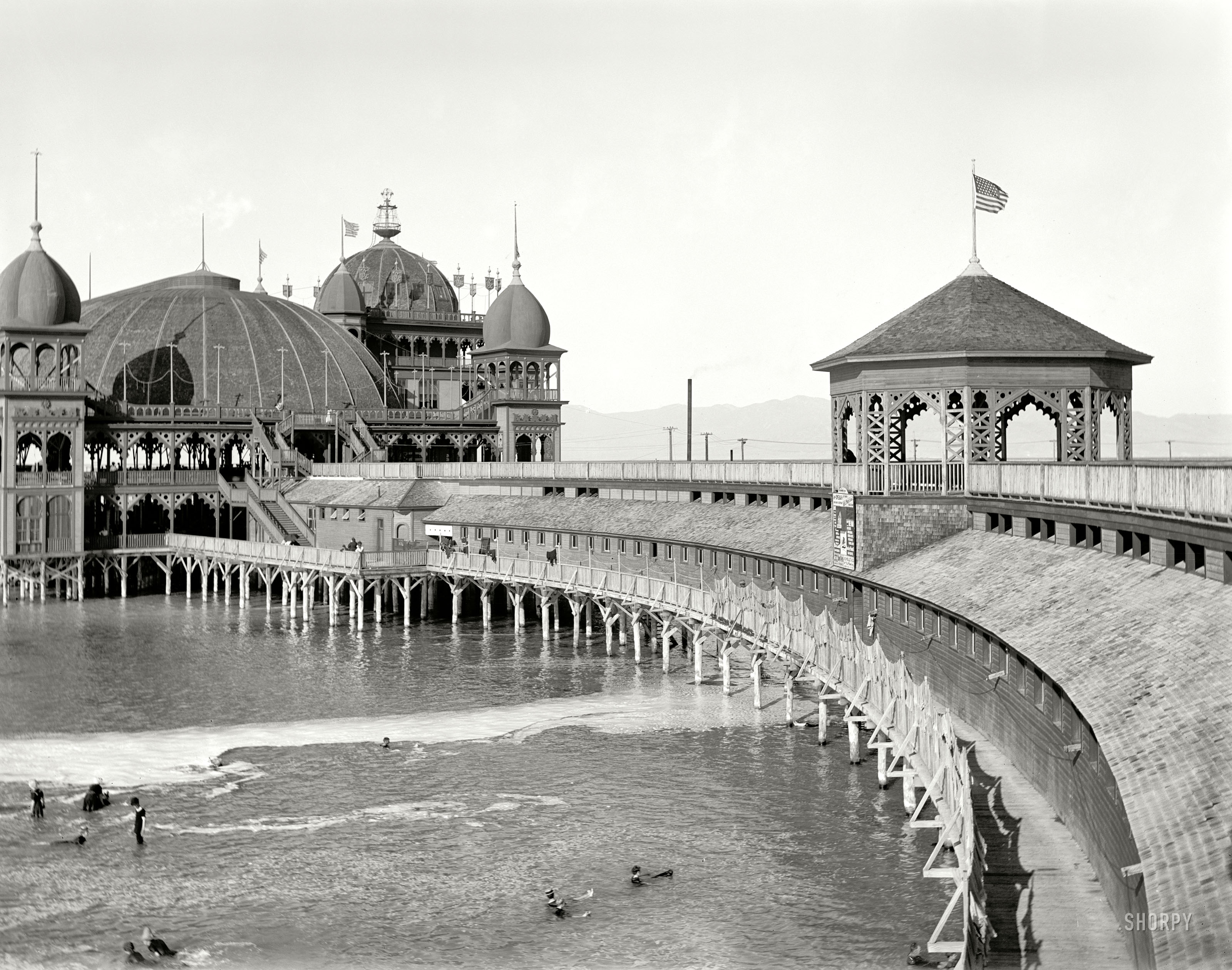
The Great Salt Lake circa 1900. "Saltair Pavilion." ~ additional info from Wikipedia


The first Saltair, completed in 1893, was jointly owned by a corporation associated with The Church of Jesus Christ of Latter-day Saints (commonly called Mormons) and the Salt Lake & Los Angeles Railway (later renamed as the Salt Lake, Garfield, and Western Railway), which was constructed for the express purpose of serving the resort.[1] Saltair was not the first resort built on the shores of the Great Salt Lake but was the most successful ever built. It was designed by well-known Utah architect Richard K.A. Kletting and rested on over 2,000 posts and pilings, many of which remain and are still visible over 110 years later.[2]
Saltair was a family place, intended to provide a safe and wholesome atmosphere with the open supervision of Church leaders. While some of the other resorts in the area were seen as "spiritually bleak", a young courting Mormon couple could visit Saltair without worrying about gossip. Trains left from Salt Lake City every 45 minutes,[1] and so long as the boy got the girl home at a reasonable time after the train arrived, parents weren't worried – in part because, from the moment of arriving at the station before the outing until they left the station coming home, they were usually never out of sight of trusted members of the community. More than once, a couple on the way home found themselves in the same car as their parents, who themselves had been dancing at Saltair.[examples needed]

Saltair viewed from the lake, c. 1900
Intended from the beginning as the Western counterpart to Coney Island, Saltair was one of the first amusement parks, and for a time was the most popular family destination west of New York. Some criticism was pointed at the Church over the sale of coffee, tea, or alcohol (all of which are prohibited by Mormon doctrine), as well as Saltair's being open on Sunday.[2] The church finally sold the resort in 1906.[3]

Saltair II[edit]

The first Saltair pavilion and a few other buildings were destroyed by fire on April 22, 1925.[3] A new pavilion was built and the resort was expanded at the same location by new investors (again, mostly prominent Mormons), but several factors prevented the second Saltair from achieving the success of its ancestor. The advent of motion pictures and radio, the Great Depression, and the interruption of the "go to Saltair" routine kept people closer to home. With a huge new dance floor – the world's largest at the time –[3] Saltair became more known as a dance palace, the amusement park becoming secondary to the great traveling bands of the day, such as Glenn Miller. Though Saltair showed motion pictures, there were other theaters more convenient to town.
In addition, the first Saltair had benefited from its location on the road from Salt Lake City to the Tooele Valley and to Skull Valley, which in the late 1800s was home to Iosepa, a large community of Polynesian Mormons. Being near a major intersection, Saltair also served as the first (or last) major facility on the road, making it a popular resting area for those travelling by horseback or wagon. When Saltair was rebuilt, however, this traffic was all but gone. Part of the reason was the advent of automobiles, bus and train service to the Tooele Valley, but the other cause was the abandonment of Iosepa, as Polynesians went to homes in the Salt Lake Valley or the community forming around the new LDS Temple in Laie, onOahu in the Hawaiian Islands.

Saltair III on May 22, 2005
Saltair thus had to survive solely against strong competition, and in a dwindling market. Disaster struck in 1931, in the form of a fire which caused over $100,000 in damage, then again in 1933 as the resort was left high and dry when lake waters receded (forcing the construction of a miniature railway to carry swimmers between the resort and the water). Saltair was forced to close during the Second World War, which forced the rationing of fuel and other resources while it took many of the resort's paying customers – and vital employees – out of Utah. Reopening after the war, the resort found the same situation that it had faced in the 1930s. There were so many other entertainment options, closer to home, and the public was no longer in the habit of going "all the way out there". The resort closed in 1958, causing the railroad to cease passenger operations at the same time.[4]
Attempts over the next decade to breathe new life into the resort finally ended in November 1970, when an arson fire was set in the center of the wooden dance floor, destroying Saltair.[1]

Saltair III[edit]

Proximity to Interstate Highway 80, plus new population expansion into the Tooele Valley and the western Salt Lake Valley, prompted the construction of a new Saltair (Saltair III) in 1981. The new pavilion was constructed out of a salvaged Air Force aircraft hangar and was located approximately a mile west of the original. Once again the lake was a problem, this time flooding the new resort only months after it opened. The waters again receded after several years, and again new investors restored and repaired and planned, only to discover that the waters continued to move away from the site, again leaving it high and dry.

Interior of Saltair III Pavilion, August 2002
Concerts and other events have been held at the newest facility, but by the end of the 1990s, Saltair was little more than a memory, too small to compete with larger venues which are closer to the public. While there is occasionally activity now and then, through most of the early twenty-first century, the third Saltair was all but abandoned. In 2005 several investors from the music industry pooled together to purchase the building and are now holding regular concerts there. Bands, singers, & dj's such as Marilyn Manson, Rob Zombie, Bob Dylan, The Used, Dave Matthews Band, The Black Crowes, Deadmau5, Tiesto, DJ Baby Anne, Evanescence, Panic at the Disco, Children Of Bodom, and other notablehip-hop music and rock music acts have all performed there recently. On February 18, 2011, Kesha performed to a sold out crowd on her Get Sleazy Tour.

Remnants[edit]

Relics of the age of the Great Salt Lake resorts are nearby, and can be seen from the highway. Until recently, the most noticeable of these was the skeleton of car "502", one of the Salt Lake, Garfield & Western's interurban rail cars which sat beside the ruins of an old powerhouse. The powerhouse once fed lights and roller coasters at the entrance to the original Saltair. The rail car was removed on February 18, 2012 by the property owner for safety concerns. Rows of pilings snake outward toward the lake, all that remains of the railway trestle and pier which once led to the earlier Saltair resort. The surviving buildings of Lake Park, one of Saltair's neighbors, were moved to a new site thirty miles away, where the Lagoon Amusement Park has grown around them.
The Salt Lake, Garfield & Western still exists as a common carrier shortline railroad, providing switching service in the Salt Lake City area. However, the tracks no longer reach to the resort itself.[4]

In popular culture[edit]

Saltair has occasionally been used as a backdrop for movies. Key scenes of the 1962 horror cult film Carnival of Soulswere shot in Saltair. The opening scene of the 1990 film The Giant Brine Shrimp was set in Saltair and the lake.[5] A 1960s photo of Saltair II was also featured on the cover of the bootleg Beach Boys album, Unsurpassed Masters, Vol. 19.
The Pixies 1991 song, "Palace of the Brine" is a reference to Saltair.[6]

Sources[edit]

  1. ^ Jump up to:a b c Carr, Stephen L. (1989). Utah Ghost Rails. Salt Lake City, Utah: Western Epics.
  2. ^ Jump up to:a b Utah State Historical Society. "Utah History to Go: Saltair". Retrieved 14 April 2011.
  3. ^ Jump up to:a b c Utah History Encyclpedia. "Saltair". Retrieved 14 April 2011.
  4. ^ Jump up to:a b Strack, Don. "Salt Lake, Garfield & Western Railway". Retrieved 14 April 2011.
  5. Jump up^ The Giant Brine Shrimp, OCLC 34600660
  6. Jump up^ Dan Nailen's Lounge Act: Pixies kill it at Saltair, Salt Lake Magazine

External links[edit]

  •  

Thursday, October 2, 2014

Mary Miranda Seely Peel ~ Pioneer of the Month ~ October 2014


Taken from "Scandinavia to Sanpete"
edited by Christian Peel

Mary Miranda Seeley was born before the Civil War (1857)


Wednesday, October 1, 2014

Christian Fredrick and Mary Miranda Seely Peel

Christian F. Peel and Mary Miranda Seely Peel  Family


After Christian's death, the farm wasn’t the happy place it once was, so the farm was leased out and Miranda and the children moved to town and lived with Miranda’s mother in the big house on 5th West and Main Street.

Peter Azel Peel and Mary Margaret Ericksen were married March 18, 1908.  They moved down to the log house, but they only lived there a little over a year and then moved back to town.

On November 27, 1912, John Peel and Esther Matson were married and moved to the Peel log house.  They lived there and raised twelve children.  

It was always hard to get to school in the winter.  They moved to town in 1934, where they rented and later bought the Brown Home.  John Peel’s sons worked the farm but the farmhouse almost fell apart. 

In 1996, Dan and Esther Peel Randall bought 39 acres around the farm house from the Peel boys.  They restored the old log house and made a fish pond, a play ground, and built a beautiful new home west and south of the log house.  But sorrow came again when Dan had a sudden heart attack and died May 31, 2003.  Esther still lives alone and is always happy when family comes to visit.
 Peel Homestead


  1. Land patent - Wikipedia, the free encyclopedia

    en.wikipedia.org/wiki/Land_patent

    Wikipedia
    A land patent is an exclusive land grant made by a sovereign entity with respect to a particular tract of land. To make such a grant “patent”, a sovereign ...

Tomorrow...... Much more on Mary Miranda Seely Peel

Tuesday, September 30, 2014

Home of Hans Christian Davidsen and wife Johanna Marie Nielsen ~ Researched and Compiled by Tudy Barentsen Standlee


Hans Christian Davidson


On page 92 of the Mt. Pleasant History by Hilda Madsen Longsdorf, she briefly mentions that H.C. Davidson had moved to town with his family and "erected an astrometer on his lot." The location was "west side of State, southwest corner of intersection of First North." I googled "H.C. Davidson" and "astronomy" and I discovered a blog entitled "Hans Christian Davidson and
Descendants".  http://hcdavidson.blogspot.com/

Here I found out quite a bit about Mr. H.C. Davidson.  Hans Christian Davidson was born in Horup, Alsen Island, Schleswig, Holstein, Denmark.  H.C. and his wife Annie Marie Jensen came across the plains to Utah in 1858.  In 1866 the family moved to Mt. Pleasant where H.C. was the first dentist and also the first newspaper editor.  He studied astronomy and made a perpetual calendar.

In the years 1876-77, during which time E.A. Day was teaching in Mt. Pleasant, Davidson, was asked to lecture to his pupils.  His talks and illustrations proved very interesting and beneficial.  Mr. Davidson was always eager and willing to be of help at any time.

"H.C. Davidson's sons, Lorenzo and Amasa Davidson attended the first Presbyterian school, now known as Wasatch Academy, founded here in 1875 by Dr. Duncan J. McMillan. The school was first conducted in an old dance hall which was converted by McMillan into a school and church. This building still stands on Main Street as one of the land marks of the early pioneer days, and is now the meeting hall of the Masonic Lodge."


"They moved to Birch Creek in 1879 and lived there until Mrs. Davidson died, May 2, 1886, after which they moved back into town. The farm was sold to James C. Meiling of Mt. Pleasant. Davidson remarried a few years later to a widow from Ephraim."

"During these early years, there was no dentist of course, so Mr. and Mrs. Davidson did their best to take one’s place and pulled teeth for people, using the old fashioned turn-keys, which we still have with the relics. Mr. Davidson was also the first printer in Mt. Pleasant, and did job printing up until the time of his death in 1891, making him seventy-one years old. "
 
"We know several prominent men of Utah who tell us that it was Hans C. Davidsen's lectures that inspired them to make great efforts for success. It remains for us as his progeny to carry on the work that he started, honoring and revering him for his high faith and courage to battle against big odds. May we not be found wanting."  by Sarah Davidson Wilcox, Daughter of Hans Christion Davidson.


Friday, September 26, 2014

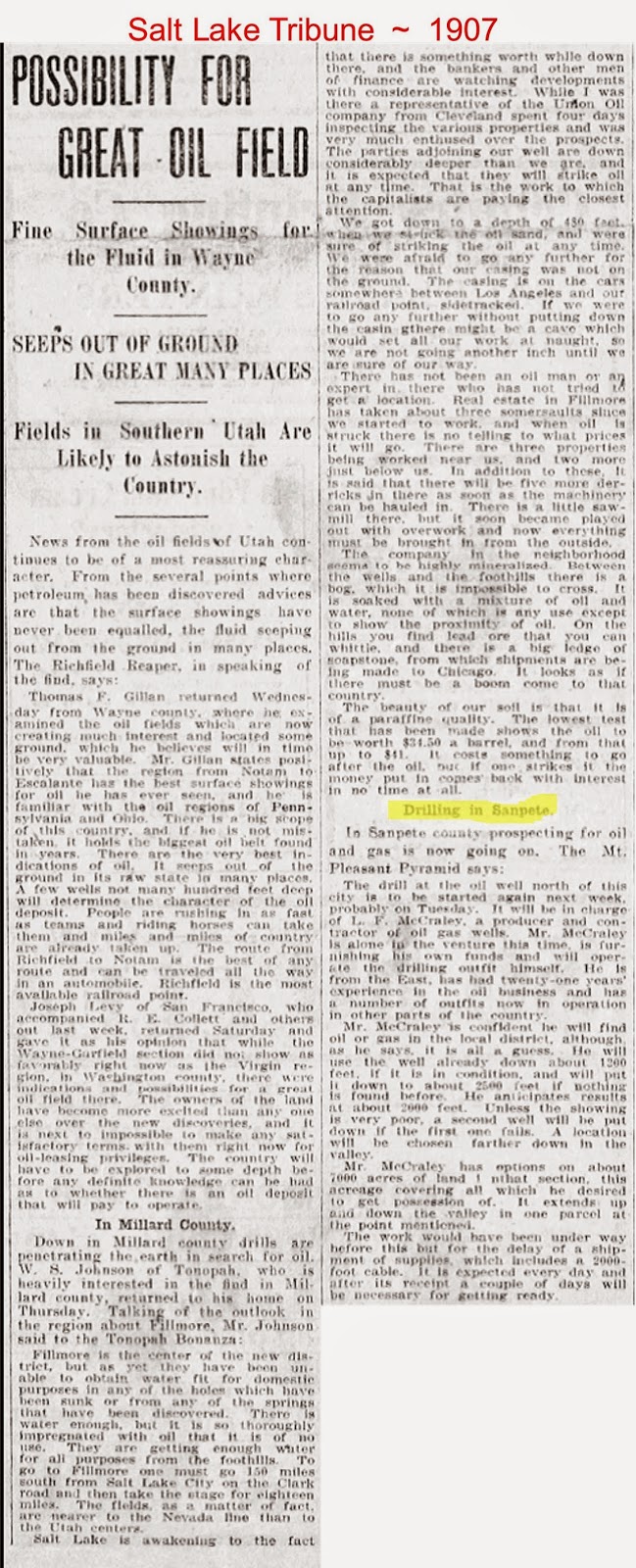
So Now We Have A New Oil Well

Drilling for Oil Again
East of Moroni


Just Off the Timms Hill 
(where the last one was drilled)

What Would The Pioneers Think?

My research of the Utah Digital Newspapers say it is not anything new.
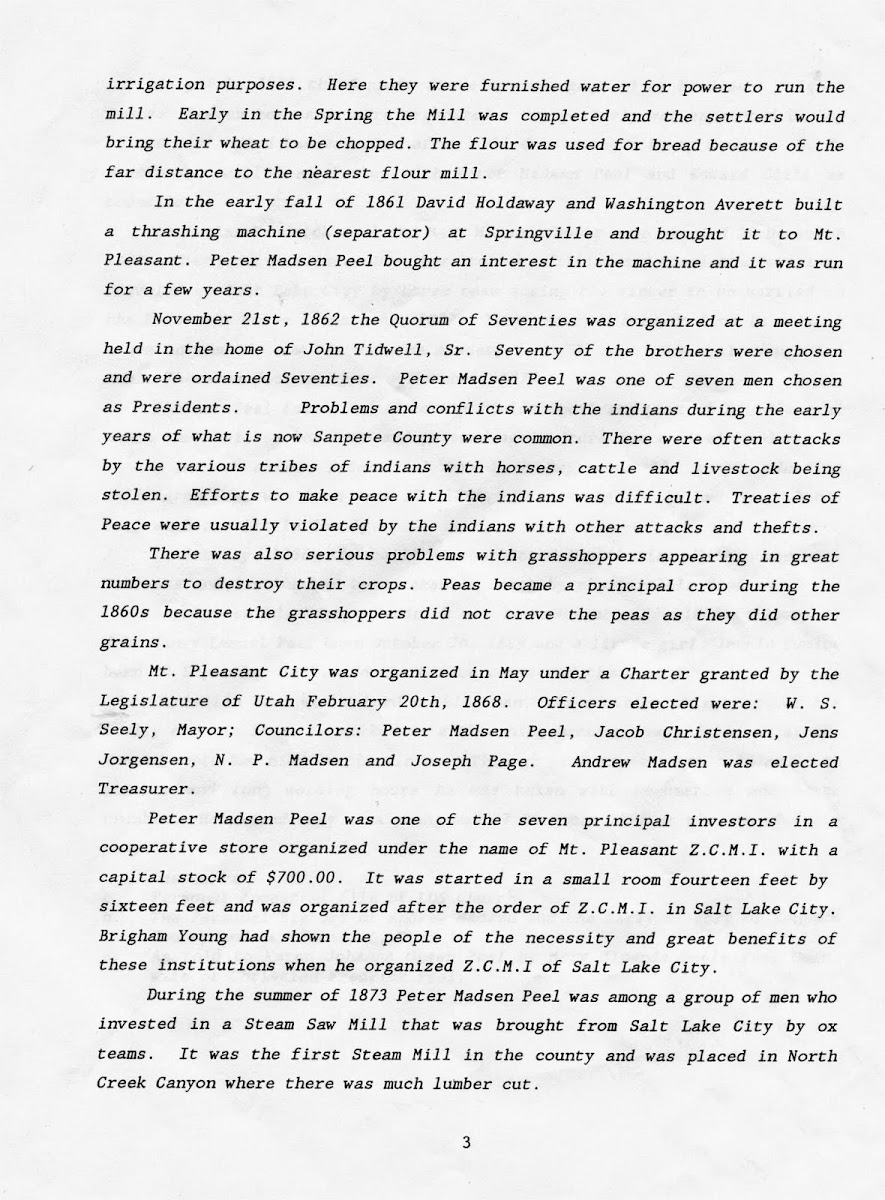
Newspaper reports as early as 1903, Sanpeters have been drilling for Black Gold.


Thursday, September 25, 2014

Female Relief Society ~ June 1878 ~ A visit from Eliza R. Snow

Meeting held June 22, 1878
Opened by singing by the Choir
Prayer by  Edward Cliff
Singing by the choir.
Sister Morrison called the congregation to order and introduced Sister Eliza R. Snow and Sister Zina Young.
Sister E. Snow addressed the meeting and said that she had the opportunity to meet with the Sisters and she read our  .......... report and found it very recommending(?) but that it was not all that she likes to see.  She likes to see just as much the important part of the work of the Society. If the sisters work morally and spiritually, if this cultivates the Spirit of God.

Ask all if they were aware of
the work as a member of the Society, such as a member of the Latter Day work or if some of us have gone to sleep and grown cold. If that is the case then
 maybe you are certainly unhappy and what is more in Heaven and on Earth then the happiness of this kingdom would be in this Last Days.(?)

Then she spoke about the celestial law when it was revealed to her in the days of
.......?  She did not understand a thing about it, but the Spirit of God taught her and ..... that she get it and understand more.  She was glad that.....said one more......shows what important duty lays upon the women to bring up our children as useful instruments in the Latter Day Work, and useful and worthy of a nation.  It says, show me the women of a nation and I will tell what this nation is. "Think about this Sister and think and put it to practice in your families and in your homes.  We have no time to..........that was the law for us.

She thanked the brethren for coming and was, and was always glad to see them come to meeting, hoped that they felt benefited by..

She did not come to preach to you because she thought she was better than you but we have our duties to perform and every day of our life we should think of our duty as mothers and as ......workers in the great and glorious work.

She spoke again about plural marriage as a principle that was given to us to.......... prepare us for exaltation and glory that God has promised to them that will practice it............

Sister Elisa is a little greedy, but I am only that much greedy that I want to obtain all the blessings and exaltation that God will restore upon us if we only keep His commandments.  If a man is married to one wife and thinks he can obtain the same blessings and glory than a man that has more wives and endure all the trials and troubles therewith.  We should not ........ourselves with that.  We have to overcome all things that will hinder us to keep the commandments of God.  Would you want a man that loves only one wife at the time.  Who would not despise such a man?  But would you want a man that would promise you that he would never take another?  I would not have him if he was the only man in the world.

If we want to come up to our duty, we have to meet often, and that way obtain the Spirit of God.  This makes our homes happy.  A woman that has the Spirit of God in her heart is kind to her husband, kind to her children.  A woman that attends her meetings can do more work. The woman that day after day works and toils will never overcome her work and certainly be unhappy and makes all her........unhappy.  A woman that day after day tries to do her duty and is willing to improve in all good things until she is called away....... she will meet her friends that have gone before her...... sisters they want to become


Monday, September 22, 2014

WHAT IS SALERATUS?


With their ox teams, the settlers would go to Manti to gather saleratus. That to be used for bread-making was carefully gathered with a spoon and that to be used for the washing was gathered with a shovel. In the making of bread, water was poured on about a cupful of saleratus, and when settled and clear, the top would be poured off and combined with buttermilk, then used for leavening bread. They also at this time made Salt Rising Bread and later the yeast from the home-made beer was used for the leavening. A beverage known as Brigham     Tea, made from a brush called Mountain Rush, was widely used with   or
    without milk or sweeten­ing. This tea was also used for medical purposes.

History of Mt. Pleasant by Hilda Madsen Longsdorf page 56


Wool was washed in two or three warm waters, softened with saleratus, and made white, fluffy and beautiful. Much was also washed and cleaned in the warm springs known as Crystal Springs, south of Manti, which is a soft, warm water, where it was made soft, clean and lovely.

Women also carded the wool with hand cards, spun it into yarn on home-made spinning wheels, and on home-made looms they wove it into cloth and made it into clothing. Some still re­member the never-ending irritations caused by home-spun under­wear.

History of  Mt. Pleasant by HML page283


Saleratus was a chalk-like powder used as a chemical leavener to produce carbon dioxide gas in dough.

 Saleratus was a naturally occurring mineral found in the western United States, especially in areas that were extremely high in alkaline. This bubbly white crust would be collected by pioneer women and used to leaven the biscuits and breads they baked in their dutch ovens. To make it even more confusing, this “new” product which we call baking soda today was referred to as saleratus as well after its introduction in 1860 and for some time afterwards. Today, some people still call baking soda biscuits “saleratus biscuits.” The proportions of the first saleratus and the later baking soda version of saleratus were slightly different: about 1 ¼ tsp. of baking soda to 1 tsp. of saleratus.


MILLING PROCESS


In the milling of the wheat, the grinding apparatus consisted of two circular stones fitted together. They were smooth on one side, and were called the upper and lower or nether millstone. which were held together with a perpendicular shaft. The upper stone was turned round and round upon the under one by means of the crank. The lower stone was stationary. A round hole in the upper one admitted a quart or two of grain at a time. As the stone evolved this would gravitate down and out from between the stones and during the slow movement it would be ground into more or less fineness. This then was bolted or sieved through a thin cloth, separating the flour from the coarse particles and bran.

This flour was made into dough and leavened with beer yeast, sour dough kept from the last baking, salt rising made from shorts and salt water set to rise, or saleratus. This last preparation was made by putting a certain amount of saleratus in a vessel and a quantity of water, according to the amount being made, stirring well. and allowing to settle until perfectly clear. This liquid was used to leaven biscuit dough and could be kept on hand some time. About the only saleratus beds to be found in this part of the state or nearest here, were down a little south of Manti.

History of Mt. Pleasant pp 284-285  HML


Plain But Wholesome: Adventures in Mormon Pioneer Food: Saleratus: 


Sunday, September 14, 2014


Patty Sessions was headed out of Nauvoo in 1846. So was her husband's second wife, Lovina. What we know about the circumstances comes from Patty's diary, so perhaps the facts are a little slanted. The Sessions's were not long on the trail before tensions between the two sister wives made life difficult, with all three sharing a tent. According to Patty, Lovina refused to help with camp chores such as cooking and laundry. She told Br. Sessions lies about Patty. Br. Sessions apparently came to feel that Patty was at fault. To demonstrate his condemnation of her, Br. Sessions took away Patty's stores of saleratus and locked it up. Patty was about 45 years old at the time.


Saleratus is a chemical compound (potassium carbonate) which naturally weeps from the ground as mineral-bearing water evaporates. Coming from Latin roots,sal aeratus means aerated salt, referring to its ability to produce carbon dioxide when mixed with another acidic food element such as vinegar or tartaric acid (cream of tartar). It is used instead of soda to make biscuits. Pioneers on the trail often gathered saleratus when they found it, for example near Independence Rock in Wyoming. It is also reported to occur on the shores of the Great Salt Lake. I believe I have seen some such deposits in the past.


In Utah, pioneer settlers continued to use saleratus to leaven their biscuits. Livvy Olsen, a Danish immigrant growing up near Manti, Utah in the 1860s, remembered collecting saleratus by the wagon load near the San Pitch river.


So today I went out to see if I could find some saleratus. South of Manti a mile or so is "Manti Meadows", a property managed by the Utah Division of Wildlife Resources. Most people go there to hunt ducks and pheasants. From the road, I could see bright white patches in the clay soil. We (my good wife sometimes shares my food adventures) walked a half-mile or so from the parking area, and spotted a patch of what we thought was saleratus. It crusted over the ground, with a slightly crystalline appearance, almost like salt. It seemed to be frozen in a bubbly foam. The crust was a quarter- to half-inch thick over the ground. I whipped out a small container of vinegar I had brought. A little saleratus in my palm foamed and fizzed when I poured vinegar on it. We had struck it rich!


Last night it rained considerably, so the deposits were softer than normal, and we had to be careful in collecting them so they wouldn't crumble. I imagine that if we had a dry spell, the saleratus would be more crusted and stable. Also with the rain, some sandy silt came up with the saleratus.

From what I have read, some pioneers dissolved the saleratus in a little water, and let the silt settle to the bottom. The mineral-bearing water could then be used to mix biscuits. I haven't tried it yet, but I'll let you know how it turns out. More than anything it makes me think we don't really know much about pioneer cooking, if we've never used saleratus before.


The above story is courtesy of Brock Cheney, a historian, primarily focused on Utah and Mormon themes in the 19th century. His recent work has centered on foodways among Mormon pioneers. His book on the subject, Plain But Wholesome is due out in the spring of 2011. He is also working on a companion volume of recipes.

You can contact Brock by writing to pioneerfoodie@gmail.com