

Sunday, April 26, 2015

Saturday, April 25, 2015

Friday, April 24, 2015


Wednesday, April 22, 2015
The most important member of the Community: THE BLACKSMITH

In the days gone by the doctor and blacksmith were the most important members of the community. Folks generally needed medical help.....such as it was...at least occasionally, but they needed a blacksmith frequently.
A blacksmith is a master iron worker who creates and repairs everything from agricultural implements to cooking essentials, to weapons, to furniture, to grills, railings and sculpture. Contrary to popular belief, a blacksmith does not shoe horses, though he or she may make horse shoes. A person who shoes horses is a farrier .
Blacksmiths primarily work with wrought iron and steel The "black" in blacksmith refers to the black layer of oxide that forms on the surface of the metal as it's heating. "Smith" comes from "smite" which means to hit. A blacksmith therefore is a person who hits black metal.
Conversely, a white smith works with light-colored metals like tin or pewter. And unlike blacksmiths who work mostly with hot metal, white smiths do most of their work on cold metal.
Peter Hafen, blacksmith at the Mt. Pleasant Relic Home likes to tell the story behind the special apron that he-----like all blacksmiths since King Arthur --- wears.
It seems that King Arthur gathered his craftsmen for a dinner celebration, to thank them for their contributions to his household. As they entered the great hall, they were instructed to seat themselves according to the level of their importance, with those who made the most significant contribution nearest the King.
Arthur then asked the men nearest to him what his contribution was. The man replied "why sir, I am your tailor. I make the fine robes that you're wearing and those beautiful tapestries hanging upon your wall".
Arthur thanked the tailor and asked the same question of the next man. "I am a goldsmith", he replied. "I made the beautiful platter that you eat from and the fine goblet that you drink from. I even made the gold thread in the tailor's tapestries."
Next was the cook, the stone mason and the carpenter, all of whom sang their loud praises. Finally Arthur reached the blacksmith.
"What have you contributed to my palace" Arthur asked. "Not much", replied the blacksmith, who was seated farthest from the King. "I made the hinges for your doors, your majesty, but not much else".
Arthur who was known as a wise and insightful man, returned to his seat. After a few minutes, he leaned over to the tailor and said, "Tell me sir, where do you scissors and needles come from?"
"Why from the blacksmith, Sir."
Arthur questioned the next man, "Goldsmith, your hammer and stakes, where do you get them from?" The Goldsmith replied, "Sir, I get them from the blacksmith."
And so it went, back around the table, until Arthur once again reached the blacksmith. "Sir, I make my own tools, and those of others.
Arthur exclaimed, "Blacksmith your hammer and hand, all crafts do stand, You should be seated closest to the King".
The humble blacksmith who had just come from his forge and was still wearing his apron, was embarrassed in unseating the tailor. And the tailor, it is said was livid. Determined to extract revenge, he crawled beneath the table with his scissors and cut a slash in the front of the blacksmith's apron.
After the banquet ended, the blacksmith noticed the cut in the apron and immediately understood who had made it. But he continued to wear the apron and when asked why there was a slash to it, he would reply, "The tailor gave me that in recognition of my services". And that is why, Peter says, blacksmith aprons are slashed in the front.
Tuesday, April 21, 2015
If Barns Could Talk
A few of these books are available at the Relic Home.
To purchase a copy of If Barns Could Talk, please email dgdogy@comcast.net for further details.
To purchase a copy of If Barns Could Talk, please email dgdogy@comcast.net for further details.

|

The Seely Barn is located in the middle of the block between
Fourth and Fifth West and Main and First North.
~~~~~~
A new book, If Barns Could Talk, compiled by Doug Mottonen features the Seely Barn as one of the first barns built in the Utah Territory. It was built in 1862 without the use of a single nail. But its history doesn't stop there. It also served as a jail for Native American women and children when Sanpete County Pioneers fought the Utes and other neighboring tribes from 1865 until 1972.
 |
| A look inside the Seely barn shows the master craftsmanship of early Pioneers. ~~~~~~~ |
When the men were lifting the timbers, one man, who they called "Joe Heave", would call out "heave" so that they could lift together the heavy beams into place. It's original construction site was on 5th west, halfway between Main Street and 1st North. It was later moved to Main Street on the creek so that the animals could have water more readily. From there it was moved to its present location.1

Looking closely at the barn's construction shows the care and craftsmanship it took to build in an era when nails were scarce. The barn's history tells us all of the hardships the early pioneers sustained in settling this area.
Doug Mottonen in his book says, "What I found over the years is that if you talked to somebody about barns, it not only told about who they were, but who we are as a people." "There's a little bit of barn in all of us." Doug's book also features the Mt. Pleasant Relic Home and Blacksmith Shop.
The book can be purchased at the Relic Home.
1. taken from history of the barn by Sue Ann Seely Crenshaw.
~~~~~~~~~~~~~~~~~~~~~~~~~~~~~~~~~~~~~~~~~~~~~
Also featured in "If Barns Could Talk"
Monday, April 20, 2015
Early Mormon Coins 1908

Photo courtesy of KSL
Rare Mormon Coins Go Up for Auction
April 23rd, 2014
Keith McCord

Sunday, April 19, 2015

Saturday, April 18, 2015

Friday, April 17, 2015
Female Relief Society October 28, 1878
These are the final pages of the minutes of the
Female Relief Society
donated by Beverley Anderson Olsen.


Meeting held Oktober 28, 1878
Opened with singing
Prayer by Sister Peel
Sister Peel opened the meeting.
Minutes from former meeting were read and accepted
Also donations and disbursements from the last month.
Sister Peel rose and felt thankful for the privilege to meet with the Sisters and felt so much pleased for the willingness of the Sisters in contributing their means and labor for the Temple, and hoped that they will continue in the good work. Some good ....... were brought in from the Sisters for the Temple and were handed over to the treasurer for to..... by Sister Morrison.
Sister Simpson felt to bless the Sisters for the good will they showed in the call to the temple, and was thankful that so doing they not neglect the poor, and said that she always felt glad when the poor could get what they need.
Sister Franzen spoke about the good meetings we had and felt benefited in the good instructions that was given, felt blessed for the plenty we had, by hearing the P...... talk about the H........ and the instruction that was telling about the foreign countries. It seemed curious (?) to go round taking, but felt alright anyway because she knew the Relief Society is organized from our Prophet, Joseph Smith. She felt very to hear the counsel in our day meetings.......
not to send our children to a school where we are not to send them ... how long will the priesthood bear with us; hoped we would repent from this ....... We know well enough that this is not right.
Many of the Sisters bore their testimony and meeting was closed with singing and prayer.
MFC Morrison, Pres
Louise Hasler, Sec.
Final pages were a listing of names who had donated to the emigration fund.
Thursday, April 16, 2015


Wednesday, April 15, 2015
Amelia's Palace or Gardo House and the Silver Queen

Mrs. E.F. Holmes was also known as Utah's Silver Queen. Her biography can be found in the following link:
http://www.uen.org/Centennial/10SilverA.shtml
Susanna epitomized an era of quick fortunes and expansive living from the gay nineties to the early nineteen hundreds. "Susie" to her friends, but "Utah's Silver Queen" to society writers, she was lauded by Washington newspapers as entertaining like a princess. Her exquisite gowns, rare jewels, and her $10,000 circular charm of platinum and diamonds were of paramount interest. She spent a great deal of time in Washington, much to the delight of that city's socialites who considered her vivacious, witty, sparkling, charming, and "much to behold."

Tuesday, April 14, 2015
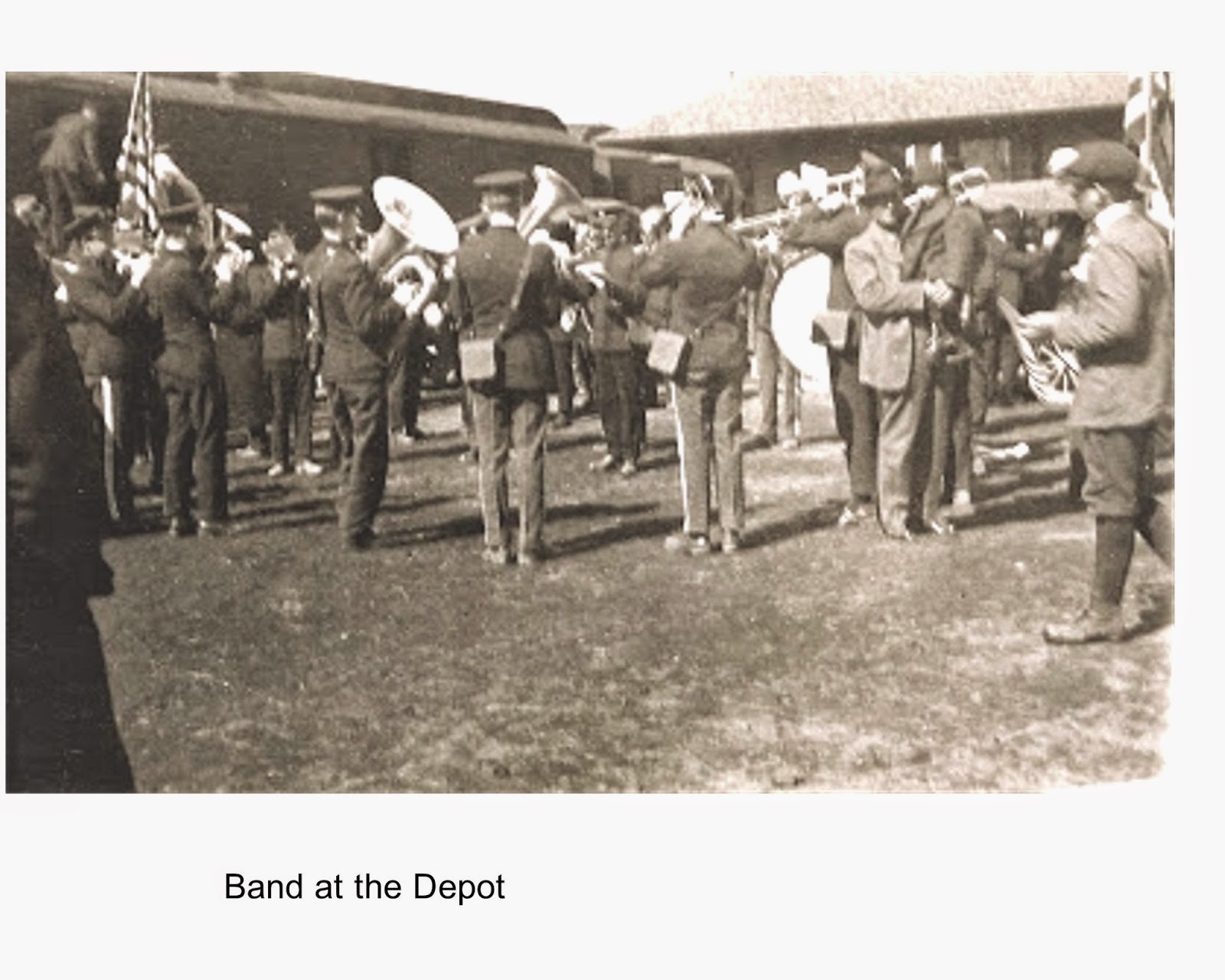
Photos Used for Place Mats for Pioneer Day


 |
| Fred Rasmussen Depot Agent on the left with unknown friend. |


Monday, April 13, 2015
Cyrus Wheelock ~ A History by Susan Berry Dansfield ~ Photos added by Kathy Hafen

 |
| He also lived here: 308 South State |
Susan Berry Dransfield’s
Great-Great Grandfather
Cyrus Hubbard (Hibbard) Wheelock
Cyrus Wheelock was a faithful laborer in the Gospel of Jesus Christ. A native of New York
State, he became a prominent leader in some to the early events of the Church. He was born Feb 28,
1813 in Henderson, New York.
As a young adult, Cyrus was captain of a ship and sailed for a number of years. He was
known as an extremely dedicated worked. While still a young man, he came to Illinois and worked
as the captain of a steamboat. It was there that he was introduced to the Gospel and soon became
intimately acquainted with the Prophet Joseph Smith. He joined the Church Sept. 1, 1839 and served
a mission to Vermont and other States.
Cyrus Wheelock was among Joseph and Hyrums’s most trusted friends. He visited with them
many times at Carthage Jail. He worked with Governor Ford to secure the safety of the two brothers.
He told the governor to the intention of their enemies to assassinate the Prophet and his brother and,
after repeated efforts, he obtained the assurance that the accused men should be protected and that
his friends would receive a fair trial by law.
He secured a pass from Governor Ford to visit the jail. A light rain had started, so Cyrus put
on a coat and packed a six-shooter, which he succeeded in pressing into the hand of the Prophet.
Already having a single barreled pistol in this possession, Joseph handed that pistol to Hyrum as he
received the revolver from Wheelock. As Hyrum reluctantly took the weapon, he said, “I the to use
such things or see them used.” “So do I,” agreed Joseph, “but we may have to, to defend ourselves.”
Cyrus Wheelock was given a list of witnesses to arrange for the trial the next day. Before he left, his
brethren gave him verbal messages for their families. Hyrum stated. “The Brother Wheelock will
remember all that we tell him, and he will never forget the occurrences of this day.”
Cyrus returned to the jail again just three hours before the martyrdom and is believed to the
one of the last persons to see the Prophet and Hyrum alive. he received a letter written by Joseph to
his wife, and was commissioned to deliver the precious message into her hands he was also charged
by the Prophet, first, to request the commander of the Nauvoo Legion to avoid all military display
and everything that would be likely to produce excitement, and, second, to use his influence with the
members of the Church to remain perfectly calm and quiet during the events Joseph knew were near
at hand. After the martyrdom he was instrumental in keeping the peace so that Nauvoo would not be
destroyed by the enemies of the Church.
He left for England June 26, 1846 on a mission. Before leaving, his journal states that he
visited Kirtland and held a debate for two days in the temple with SB Stoddard on the subject of the
Presidency of the Church.
He and his companion, Elder Moses Martin, preached along the way to New Your with good
success,. Upson arriving in New York, these men had the privilege of meeting Brothers Hyde and
Taylor bound also on a special mission to England.
He and his companion sailed for England Sept. 22, 1846 with Parley P. Pratt and Franklin D
Richards. Parley and Franklin both became very seasick, but Cyrus and Moses were fine and they ate
not only their portions of food but Parley’s and Franklin’s also.
-1
When landing in Liverpool, Cyrus wrote, “Met a the house of Brother Brown with present
apostles, Orson Hyde, John Taylor, Parley P Pratt, along with Franklin D. Richards. Moses Martin
and many of the English brethren and had a time of rejoicing. Elder Taylor prophesied that we
should be the means of bring thousands to the knowledge of the Truth in this mission. We all said
“Amen!”
apostles, Orson Hyde, John Taylor, Parley P Pratt, along with Franklin D. Richards. Moses Martin
and many of the English brethren and had a time of rejoicing. Elder Taylor prophesied that we
should be the means of bring thousands to the knowledge of the Truth in this mission. We all said
“Amen!”
Cyrus left Liverpool for Manchester to attend Conference. Orson Hyde was appointed to
preside over the Conference. “I was appointed to take charge of the Birmingham Conference.” Cyrus
recorded in his journal, While teaching in Birmingham, Cyrus walked for miles and miles in the rain
teaching the Gospel. He left for England again for another mission March 1. 1849 and served a
successful mission to Europe in 1856. Cyrus baptized over 7,000 people into the Gospel from these
missions, exemplifying the wonderful missionary spirit he had.
In 1853 he led a group of 400 pioneers with 52 wagons on the Overland Trail from Keokuk,
Iowa in June 1853, arriving in Salt Lake, October 1853.
Three years later, as the Martin Handcart Company was trapped and many dying in
Wyoming, Cyrus was part of the rescue party to go out after them. In the Martin Handcart Company
were some of the people he had converted in England and for which he had great love and respect.
Cyrus was a gifted orator and was set apart as the first President of the Northern States
mission May 1, 1878. This comprised Wisconsin, Michigan, Iowa Illinois and Minnesota. He wrote
the favorite hymn “Ye Elders of Israel,” because of his love for missionary work and his testimony
to the cause of truth.
Cyrus was one of the early settlers of the Territory of Utah. During the Blackhawk Indian
War, one hundred braves and Chief Blackhawk had great trust in their friend Cyrus Wheelock and
went to his home in Mt. Pleasant to receive help in sighing the peace
treaty that brought an end to the war.
Cyrus was the Patriarch of the Church in Mt. Pleasant and the acting Mayor of Mt. Pleasant.
he had the gift of healing the sick and was an instrument of healing for many souls.
In his later years, Cyrus was instrumental in collecting funds for the Manti Temple and was
called on to give the Dedicatory Prayer for the Temple.
While living in Nauvoo, he was sealed to Mary Ann Dallin in the Endowment House before
leaving Nauvoo They had seven children. Cyrus lived to a goodly age of 81 years and died Oct. 11,
1894.
Throughout his life he was always true to whatever he was entrusted, His devotion to the
cause of truth will always pave the way for his loved ones who follow.
-2
Subscribe to:
Posts (Atom)