

Tuesday, July 9, 2019

Monday, July 8, 2019
Pony Express Route and Stage Stops

Pony Express was a mail service delivering messages, newspapers, and mail using relays of horse-mounted riders that operated from April 3, 1860, to October 1861 between Missouri and California in the United States of America.
Operated by Central Overland California and Pike's Peak Express Company, the Pony Express was a great financial investment to the U.S. During its 18 months of operation, it reduced the time for messages to travel between the Atlantic and Pacific coasts to about 10 days.[1] It became the West's most direct means of east-west communication before the transcontinental telegraph was established (October 24, 1861), and was vital for tying the new U.S. state of California with the rest of the United States.
The Pony Express demonstrated that a unified transcontinental system of communications could be established and operated year-round. When replaced by the telegraph, the Pony Express quickly became romanticized and became part of the lore of the American West. Its reliance on the ability and endurance of individual young, hardy riders and fast horses was seen as evidence of rugged American individualism of the Frontier times.
The In 1860, there were about 186 Pony Express stations that were about 10 miles (16 km) apart along the Pony Express route.[7] At each station stop the express rider would change to a fresh horse, taking only the mail pouch called a mochila (from the Spanish for pouch or backpack) with him.
The employers stressed the importance of the pouch. They often said that, if it came to be, the horse and rider should perish before the mochila did. The mochila was thrown over the saddle and held in place by the weight of the rider sitting on it. Each corner had a cantina, or pocket. Bundles of mail were placed in these cantinas, which were padlocked for safety. The mochila could hold 20 pounds (9 kg) of mail along with the 20 pounds (9 kg) of material carried on the horse.[14]Eventually, everything except one revolver and a water sack was removed, allowing for a total of 165 pounds (75 kg) on the horse's back. Riders, who could not weigh over 125 pounds (57 kg), changed about every 75–100 miles (120–160 km), and rode day and night. In emergencies, a given rider might ride two stages back to back, over 20 hours on a quickly moving horse.
It is unknown if riders tried crossing the Sierra Nevada in winter, but they certainly crossed central Nevada. By 1860 there was a telegraph station in Carson City, Nevada Territory. The riders received $100 a month as pay. A comparable wage for unskilled labor at the time was about $0.43–$1 per day.
Alexander Majors, one of the founders of the Pony Express, had acquired more than 400 horses for the project. He selected horses from around the west, paying an average of $200.[15]These averaged about 14.2 hands (58 inches, 147 cm) high and averaged 900 pounds (410 kg)[16] each; thus, the name pony was appropriate, even if not strictly correct in all cases.
Pony Express route[edit]
The approximately 1,900-mile-long (3,100 km) route[17] roughly followed the Oregon and California Trails to Fort Bridger in Wyoming, and then the Mormon Trail (known as the Hastings Cutoff) to Salt Lake City, Utah. From there it followed the Central Nevada Route to Carson City, Nevada Territory before passing over the Sierra into Sacramento, California.[18]
 |
| Kimball Stage Stop |
The Kimball Stage Stop was a station on the Overland Trail near Park City, Utah. Located in the Parley's Park valley near U.S. Route 40 at the head of Parley's Canyon, the station was built by William H. Kimball in 1862. Kimball also built a bridge across nearby Kimball Creek. The station's hotel was notable for its dinners, and was visited by Mark Twain, Walt Whitman and Horace Greeley, served at first by Kimball's wife Melissa Burton Coray Kimball, and later by another of Kimball's wives, Martha Vance Kimball, .[2] The station also served the Holladay Stage and the Wells Fargo Express Company.[3]
The chief building in the complex is the hotel. It is a T-shaped two-story sandstone building, housing dining rooms, guest rooms, a store, and for a time, a post office. Two log barns are part of the complex.[2]
The Kimball Stage Stop was placed on the National Register of Historic Places on April 16, 1971.[1]
 |
| Stagecoach Inn |
Camp Floyd was a short-lived U.S. Army post in the Cedar Valley (and now part of Fairfield), Utah, United States. The Stagecoach Inn was a nearby hotel which also served as a stagecoach stop and, during 1860-1861, a Pony Express stop. Both were listed on the National Register of Historic Placesin the 1970s, and now are included in a Utah state park known as Camp Floyd / Stagecoach Inn State Park and Museum.

~~~~~~~~~~~~~~~~~~~
Youtube narrated by a British Man
Sunday, July 7, 2019
Mt. Pleasant Pioneer Monument
 MT. PLEASANT PIONEER MONUMENT
Did You Ever Wonder
How Mt. Pleasant Celebrated Its First 50 Years?Well, for starters, they sent out a letter to each household with the following statement in the first paragraph, “The labor of opening up a new country amid the vicissitudes of pioneer life surely draws upon the admiration of everyone who appreciates integrity. The pioneers made habitable for us this uninviting land and laid the foundation for all the comforts that we enjoy; and that too, under conditions of extreme poverty and constant fear of attack from the Indians. These facts place us who enjoy the fruits of their labor, under a debt of gratitude to which all will acknowledge by taking a part in the erection of a suitable monument to their honor.”
The monument to which reference was made is the very one that stands in front of the Mt. Pleasant Carnegie Library today. The names inscribed on the base of the monument are the original heads of families who settled here in 1859. The money raised to erect the monument came from the families of those original pioneers. Each family was assessed $35.00 to have their pioneer ancestor included on the monument. That $35.00 sum in the year 1909 would be the equivalent of today’s $850.00, according to Consumer Price Index of 2009.
The names that follow are the names found on the base of the monument:RIGHT PLATEWm. Seely
Neils P. Madsen
Rasmus Frandsen
M. C. Christensen
Nathan Staker
Jens C. Jensen
John Tidwell
Henry Wilcox
Peter Mogensen
John Carter
Orange Seely
George Coates
George Farnsworth
Jens Larsen
Peter Hansen
Svend Larsen
Rudolphus R. Bennett
Christian Brotherson
Daniel Page
Back Plate
Niels Widergreen Anderson
Andrew Madsen
Mads Madsen
Neils Madsen
Christian Madsen
John Meyrick
Jens Jorgensen
Jens Jensen
Peter Johansen
Neils Johansen
Justus Seely
James K. McClenahan
John Waldemar
Christian Hansen
Henry Ericksen
Andrew P. Oman
C.P. Anderson
Christian Jensen
James Harvey Tidwell
Martin Aldrich
Left Plate
Jefferson Tidwell
Paul Dehlin
Mortin Rasmussen
Hans C.H. Beck
Peter M. Peel
Erick Gunderson
Alma Zabriskie
Soren Jacob Hansen
John F. Fechser
Andrew P. Jensen
Wm. Morrison
Hans Y. Simpson
George Frandsen
Peter J. Jensen
Jacob Christensen
Frederick P. Neilson
John L. Ivie
Christian Neilson Christensen
Isaac Allred
Andrew Johansen
And the endeavor itself did not take years to complete. The proposal letter was sent out March 1st of 1909. The monument was in place and unveiled on July 5th, 1909, less than 6 months later. One can only imagine how long a similar endeavor would take today, not to mention the money that would need to be raised.
And what about the celebration itself? Who was there, who spoke at the unveiling of the statue? Joseph Fielding Smith, President of the Latter Day Saint Church, dedicated the monument. President Smith delivered an eloquent and impressive Dedicatory speech and prayer. President Smith began by saying “ it was rather out of his line to attempt to address on any subject except church work ; that to this discourse he would have to deal principally with the Church or he would not talk of the pioneers of Utah, but he did not wish any nonmember to take offense to his remarks or think that he considered no one else worthy of mention as he estimated all men by the lives they lived and their value as loyal, useful citizens”.
A three day celebration on the 5th 6th and 7th of July was held. According to the book of Mt.Pleasant, authored by Hilda Madsen Longsdorf. The following are excerpts from her book. The celebration was the greatest in the history of the town. People in the hundreds came from far and near. A non-resident described it as “ an unsurpassed success, without any unpleasant incident to mar the pleasure of the occasion under skies bright and blue – with stirring strains of music from martial and military bands, with salutes from canon and cracker; with eloquent oration and sweet singing, pleasing the large audiences; and to those inclined towards athletics, sports were provided daily”.
The monument was unveiled by Mrs. Sarah Borg, who was the second girl born in Mt. Pleasant. When the veil released by her from its fastenings, the flag with which the monument was covered, fluttered slowly to the ground, and amid the cheer of the vast crowd gathered, the beautiful shaft was revealed in all its splendor and glory; a splendid fitting tribute destined to stand throughout the years to come, to the work, trials and achievement of the Pioneers. A silent but emphatic testimonial of the great appreciation of the present generation for the mission so successfully performed by the brave men and women who settled Mt. Pleasant fifty years ago. (one hundred and fifty years ago in 2009).
This year, we the citizens of Mt. Pleasant have the opportunity to celebrate the founding of Mt. Pleasant with our own style and appreciation for those original brave pioneer families. On March 28th we hold our annual Pioneer Day, which is held at that time because it is significant to the fact that those original pioneers came north from Manti, Ephraim and Spring City in March of 1859 to once again try a new settlement, having been driven south a few years before by hostile indians. Because they recognized there was good ground here to raise crops, and good prospects to raise their families. We honor those families for their faith, courage and perseverance. We indeed owe them a great amount of gratitude whether we personally are a descendant or a newcomer, we reap the many abundant rewards of their unselfish labors.
Saturday, July 6, 2019

Friday, July 5, 2019

Thursday, July 4, 2019
Independence Day 1861


~~~~~~~~~~~~~~~~~~~~~~~~~~~~~~~~~~~~~~~~~~~~~~~~~~~~~~~~~~~~~~~~~~~~~~~~~~~
(From the History of Mt. Pleasant, by Hilda Madsen Longsdorf)
Independence Day, July the 4th, 1861, was celebrated with appropriate ceremonies. A new flag pole was erected on the Church Square. It was one straight, long pole brought from the mountains by Svend Larsen, Abraham Day, William Morrison Sr., and others, and prepared with a plane and' draw knife brought from Norway by Erick Gunderson Sr., was set up by Erick Gunderson Sr., Gunder E. Gunderson, Jacob Rolfson , William Morrison Sr., and others. There was much rejoicing; an ox had been killed for the occasion and a public dinner was given in the bowery, on the south side in the square. A pitch pine torch in each corner of the bowery furnished the light for the dance held in the evening, for which music was furnished by John Waldermar, James Hansen, Lars Nielsen (Fiddler), and others. All enjoyed them selves to the utmost. R. N. Bennett states, "I recall the dances held often in the old bowery, dancing on the dirt floor, some of us barefoot, but we would make the dust fly. Bishop Seeley was great on big eats. A saying was, 'We'll cut a squash, kill a chicken and have a treat.' The only fruit I remember we ever had were bull berries, service berries, and choke cherries, these were dried and used in the winter, too."
Wednesday, July 3, 2019

Tuesday, July 2, 2019
Fourth of July
The following is taken from History of Mt. Pleasant by Hilda Madsen Longsdorf:
The Fourth of July was appropriately celebrated. Wellington Seeley and George Frandsen had been appointed to see that a liberty pole was erected and that the American Flag was hoisted at sunrise. The 24th of July, honoring the pioneers, was also fittingly celebrated.
In the evenings, the voices of the children could be heard at their gatherings in the street. Among their popular games were Steal Sticks, Stink Base, Pomp, Pomp pull away, and many other similar games. For the grown-ups, there was buggy riding behind spirited horses, and with the first fall of snow, sleigh riding, in bob sleighs, and later on in the fancy cutter, drawn by fancy horses, bedecked with strands of tingling bells. There was always dancing.
Rasmus Frandsen and Perry McArthur were appointed managers and conducted all the dances. Sometimes other musicians joined the John Waldermar, Lars Nielsen group in furnishing the music.
Game: Pump, Pump, Pull AwayTwo 20 ft long imaginary lines are drawn about 50 ft apart. All the players line up on one or the other line. “It” stands between these two lines and calls out to both sides “Pump, Pump, Pull Away, Come Out Or I’ll Pull You Out.” Players from both sides try to race to the other side without getting caught by “It.” While the players are racing to the opposite side “It” tries to catch one of the players and taps him/her lightly three times on the back. If this player cannot get away before “It” has so tapped him, this player also becomes “It.” Now when the lead “It” calls out the same phrase the players again try to get safely to the other imaginary line. Both “It” people can catch these players and tap them three times gently on the back. Anyone caught becomes “It.” Sometimes a number of “It” persons will gang up on a person to catch him/her. The goal of the game is to be the last person caught. The last person caught becomes “It” for the next round of the game.
The following is taken from ConstitutionFacts.com https://www.constitutionfacts.com/
So what did happen on July 4, 1776?
The Continental Congress approved the final wording of the Declaration of Independence on July 4, 1776. They'd been working on it for a couple of days after the draft was submitted on July 2nd and finally agreed on all of the edits and changes.
July 4, 1776, became the date that was included on the Declaration of Independence, and the fancy handwritten copy that was signed in August (the copy now displayed at the National Archives in Washington, D.C.) It’s also the date that was printed on the Dunlap Broadsides, the original printed copies of the Declaration that were circulated throughout the new nation. So when people thought of the Declaration of Independence, July 4, 1776 was the date they remembered.
In contrast, we celebrate Constitution Day on September 17th of each year, the anniversary of the date the Constitution was signed, not the anniversary of the date it was approved. If we’d followed this same approach for the Declaration of Independence we’d being celebrating Independence Day on August 2nd of each year, the day the Declaration of Independence was signed!
How did the Fourth of July become a national holiday?
For the first 15 or 20 years after the Declaration was written, people didn’t celebrate it much on any date. It was too new and too much else was happening in the young nation. By the 1790s, a time of bitter partisan conflicts, the Declaration had become controversial. One party, the Democratic-Republicans, admired Jefferson and the Declaration. But the other party, the Federalists, thought the Declaration was too French and too anti-British, which went against their current policies.
By 1817, John Adams complained in a letter that America seemed uninterested in its past. But that would soon change.
After the War of 1812, the Federalist party began to come apart and the new parties of the 1820s and 1830s all considered themselves inheritors of Jefferson and the Democratic-Republicans. Printed copies of the Declaration began to circulate again, all with the date July 4, 1776, listed at the top. The deaths of Thomas Jefferson and John Adams on July 4, 1826, may even have helped to promote the idea of July 4 as an important date to be celebrated.
Celebrations of the Fourth of July became more common as the years went on and in 1870, almost a hundred years after the Declaration was written, Congress first declared July 4 to be a national holiday as part of a bill to officially recognize several holidays, including Christmas. Further legislation about national holidays, including July 4, was passed in 1939 and 1941.https://www.blogger.com/blogger.g?blogID=823365018368490611#editor/target=post;postID=612198047640260485
Monday, July 1, 2019
Jefferson Tidwell and wife Sarah Seely Tidwell ~~~ Pioneers of the Month July 2019


Jefferson Tidwell, fourth in a family of seven, was born Oct. 7, 1836, in Charleston, Clark county, Indiana. At an early age his parents moved to Nauvoo, Ill. he was there when Prophet Joseph Smith and his brother Hyrum were martred, in 1844.
June 5th, 1852, he left for Utah, in his father's company of Saints, who arrived in Pleasant Grove, Utah, in September of the same year. Here he spent his boyhood until the winter of 1857-8, which he spent in Lot Smith's company in Echo Canyon.
He fought in the Blackhawk and Walker wars, and in June, 1859, when President Smith called on some Saints to settle in Sanpete county, Jefferson, with his father, moved to Mt. Pleasant. Here, on Dec. 16, 1860, he was married to Sarah Seeley. To this union 11 children were born, two of whom died in infancy. The remaining nine, three girls and six boys, survive him, namely, W. J., John F., Hyrum, J. R., Orange and David A Tidwell, and Sarah S. Thayn, Mary M. Strong and Hannah Barnes.
He was the first bishop of Indianola, where numerous Indian families joined the church.
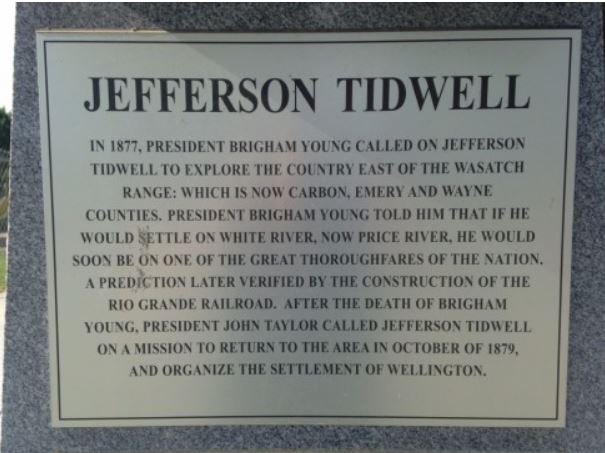
In 1877 President Young called on him to explore what is now Carbon, Emery and Wayne counties, with a view of settlement. When he delivered his message to President Young, the latter told him that if he would settle on White river (now Price river), he would soon be on one of the great thoroughfares of the nation. (A prediction later verified by the construction of the Rio Grande.) In response to this, Bishop Tidwell settled on Wellington townsite in October, 1879.
Jefferson William Tidwell | |
| Birthdate: | |
| Birthplace: | Charlestown, Marysville, Clark County, Indiana, United States |
| Death: | November 21, 1913 (76) Wellington, Carbon County, Utah, United States |
| Place of Burial: | Wellington, Carbon County, Utah, United States |
|---|---|
| Immediate Family: |
Son of John Tidwell and Jane Tidwell
Husband of Sarah Jane Tidwell Father of Justus Hyrum Tidwell; William Jefferson Tidwell; David Alonzo Tidwell and Beatrice Tidwell Brother of James Harvey Tidwell; William Neilson Tidwell; Mary Jane Johnson; Maria Emiline Tidwell; William Tidwell and 8 others |
Mrs. Sarah Seeley Tidwell, wife of Jefferson Tidwell, She was born on the 10th of April, 1841 in Lee county, Ia, and was the daughter of Justice Wellington Seeley and Clarissa Jane Seeley Wilcox of Toronto, Can. she emigrated to Utah with her parents in 1847 crossing the plains in John Lowry's company. Six sons and three daughters, thirty-three grandchildren and three great grandchildren survive her.
The sons are William J., John F., Hiram Joseph R. and D. A. Tidwell, and the daughters, Mrs. Sarah S. Thayn and Mrs. Hannah Barnes all of Wellington and Mrs. Miranda Strong of Twin Falls, Idaho.
Sarah had a varied and interesting experience, being one of the first children to be baptized in Salt Lake City. Some time afterward she was among the party that accompanied President Amasa Lyman to San Bernardino California, and in 1858 was called back with the Saints when Johnson's army was pressing on towards Utah. About that time she moved to Mt. Pleasant in Sanpete county, where she was married to Jefferson Tidwell.
In 1877 President Brigham Young called her husband Jefferson Tidwell to Wellington and in 1881 she followed him there where she resided until death summoned her.
While the family lived at Sunnyside for a short period, deceased was the first president and the organizer of the relief society there. During her long life Mrs. Tidwell was an ardent worker in the Church of Jesus Christ of Latter-day Saints.
Sarah Jane Tidwell (Seeley) | |
| Birthdate: | |
| Birthplace: | Nashville, Lee County, Iowa, United States |
| Death: | December 03, 1915 (71) Mount Pleasant, Sanpete County, Utah, United States |
| Place of Burial: | Wellington, Carbon County, Utah, United States |
|---|---|
| Immediate Family: |
Daughter of Justus Wellington Seeley and Clarissa Jane Seeley (Wilcox)
Wife of Jefferson William Tidwell Mother of Justus Hyrum Tidwell; William Jefferson Tidwell; David Alonzo Tidwell and Beatrice Tidwell Sister of Orange Seely; Don Carlos Seely; Hyrum Seeley; Justus Wellington Seely, II; William Hazard Seely and 5 others Half sister of Eva Rebecca Seeley |
 |
| Tidwell Luncheion in basement of Wellington Tabernacle |
 |
| Tidwell Shearing Company |

Sunday, June 30, 2019
Horseshoe and United States Flags ~~~ by Jon Hafen

The new flag banners that line State Street and Main Street of Mt. Pleasant
are adorned with this photo by Jon Hafen
Saturday, June 29, 2019
Cedar Creek Falls
https://www.facebook.com/jon.hafen.14/videos/10157565417974284/?t=2
Best kept secret falls in Utah running fast and furious .
Thursday, June 27, 2019

Lou Ann Hafen Osborne Has Passed On

Lou Ann Hafen Osborne, beloved wife, mother, and grandmother, passed away June 20, 2019 at her home surrounded by her family after a courageous battle with cancer.
She was born the third of four children on August 2, 1937 in Mt. Pleasant Utah to Mack and Merdith Hafen. She graduated from North Sanpete High School with honors. On December 9, 1955 she married Leo Osborne in the Manti Temple.
She raised her four children Lyle, Laura Lee, Lance and Lorette in Nephi Utah.
Lou Ann was an active member of The Church of Jesus Christ of Latter-day Saints and served faithfully her whole life in many callings, including President of the Young Women in her ward, Ward Relief Society President, Stake Relief Society President, Visiting Teacher, Chorister, and Choir Director. She developed many friendships while serving in these callings and she loved helping others and sharing her testimony through music. She also developed life-long friendships with those she worked with for 23 years as a school lunch lady.
Lou Ann was very organized, and kept everything around her immaculate. She honestly believed that “Cleanliness was next to Godliness.”
She loved music. Starting at a very young age she sang with her sisters and she continued throughout her life performing with her beautiful soprano voice in many programs and funerals. Many lives have been touched by her wonderful talent.
Lou Ann loved her family. She could always be seen at every function any of her children were involved in. Then she enjoyed even more supporting her grandchildren in everything they did. Every one of her grandchildren loved their “Grandma Honey.”
She is survived by her husband Leo of 58 years, her four children, Lyle, (Jodie) Osborne, Laura Lee (Kevin) Ockey, Lance (Tausha) Osborne and Lorette Nielsen, all of Nephi, two sisters, Shana Stevens of Ohio and Marcia Dansie of California, one brother, Ed Hafen of Idaho, 10 grandchildren and five great grandchildren.
Funeral services will be held Friday, June 28, 2019 at 11:00 am at the Nephi 7th Ward Chapel (222 S 100 E, Nephi, Utah) with a viewing 1 hour prior. Friends and family may call from 6:00-8:00 pm on Thursday, June 27, 2019 at the Anderson Funeral Home, 94 W 300 N, Nephi, Utah.
The family wishes to express their gratitude to all of you for your many acts of kindness and for your attendance at the service.
Subscribe to:
Posts (Atom)