Tuesday, December 13, 2022

Christmas Shopping With Hilda


Awake I have worried, fussed, fumed, and planned.

Asleep, I have sought over sea and land.

Wherever I went when I told them the price.

Clerks would smile, show sympathy and try to be nice.


I have been at the Wasatch, The Progress, and Squires

I have looked at all things a human admires
.
At Gunderson's, at Biddle's, and over at Pete's too,

I asked to see their goods, both old and new.


I went to Penney's and then to the Sanpete.

I am quite sure I visited all places on Main Street.

I roamed North and South, and up and down,

Almost decided to go to some other town.


At last discouraged and in despair,

I searched mail-order catalogs from everywhere.

But whenever I saw an article I thought would do,

I found that aft' their price, there was Uncle Sam's postage too.


I have seen radios, automobiles, blankets, mitts,


But darned if I could find anything for only two bits.

Today I decided on this present plain and queer.

Here is wishing you  

A Merry Christmas and a Happy New Year.

~~~


I've added a few more pictures and Hilda's Main Street Tour


(A fun walking tour of Main Street found amongst Hilda's Memorabilia)
Next stop is Mt. Pleasant City. As I step from the train, the first sign that meets my eye is "ROOMS 5 BLOCKS EAST 1 BLOCK NORTH". I am next attracted by a road sign that reads: "Fairview - 6 1/2 miles, Thistle - 37 1/2 miles, Provo - 57 miles, Price - 95 miles, Spring City - 5 miles, Ephraim - 15 1/2 miles, Manti- 23 miles, Gunnison - 38 miles. After sizing up the conveyances, I decided to walk up one side of the street and down the other. Between third and fourth west is a red BLACK SMITH SHOP sign with a sign PEERLESS, on the west side and LUCKY STRIKE TOBACCO on the east side. Nearly a block east we notice a blue sign advertising FIRESTONE on the west side of the building, with the sign BENT HANSEN AND COMPANY LUMBER in front. We pass the building painted yellow and two sign boards advertising DODGE BROTHERS and LUCKY STRIKE. As we pass the brick house surrounded by pines we see the sign SWEET CHOCOLATE. In front of the building is a painted sign SANPETE COUNTY COOP GENERAL MERCHANDISE. Next is the Mt. Pleasant Bank Building. On the front is painted 19BANK01. On the front of the LAMONT BUILDING upstairs are the following signs: A. SUNDWALL, M.D., and P.L. HOLMAN, SURGEON AND PHYSICIAN. In the east window, the sign reads W.D. TUELER, DENTIST. In the lower window is MRS. LAMONT MILLINERY and JAMES SQUIRE JEWELRY. Next we come to the GUNDERSON BLOCK. Next is the JAMES F. JENSEN building plainly labeled. Then we pass the CLEANING AND PRESSING and the MAYTAG SHOP. Next a frame building with a lot of CIRCUS posters; then the GOOD YEAR TIRES SERVICE STATION. On the corner of Main and 1st west is the MT. PLEASANT POST OFFICE and SEELY HINCKLEY GARAGE. and next is a BARBER SHOP. And now for a hot dog at REDI-QUICK LUNCH. Now the PYRAMID building, on the west side is the sign UTAH MEAT AND PRODUCE. The next building is the EQUITABLE building occupied by PROGRESS MERCANTILE CO. In the window upstairs is I.O.O.F. HALL. Now we are at SKAGGS', SAFEWAY. The WASATCH BLOCK comes next, L. A. PHILLIPS, DENTIST is located on the second floor, and J.C. PENNEY occupies the ground floor.
More than likely you have not observed the sign POST OFFICE and HENRY GEORGE CIGAR on the side of the building. The NORTH SANPETE BANK BUILDING which is built of stone with larger glass windows now greets the view. The next building we se is occupied by JOHANSEN BROTHERS and the MOUNTAIN STATES TELEPHONE AND TELEGRAPH COMPANY upstairs. Now the next building we see is built of stone with large glass windows now greets the view. The building has a sign: PALACE PHARMACY near the top and is occupied by SLIM'S BARBER SHOP. The next building is labeled at the top LUNDBERG BLOCK. In the front on the ground floor is the sign, big enough for near-sighted people to see CONSOLIDATED WAGON AND MACHINE. Over the door is the sign JOHN DEER PLOWS.
My, we are hungry again and here we are at the CITY LUNCH ROOM. On the second floor is the sign, beginning to age DR. A. LUNDBERG, DENTIST. on the ground floor is the RECREATION HALL. Last year the CONSOLIDATED FURNITURE COMPANY built a fine new building, putting the name F. C. JENSEN on a marble plate in front. Over the sidewalk, facing west, is the sign FURNITURE, and facing east, HARDWARE. We won't forget the RED FRONT SHOE SHOP just east and in the old BANK BUILDING is the OPTICAL SHOP and CONFECTIONARY. At the intersection of Main and State is the Doughboy erected by the Service Star Legion in 1926. On the southwest corner of the next block is the sign, MADSEN AND LONGSDORF, and in the front window is the sign, S.D. LONGSDORF. On first east we come to the BISHOP'S STOREHOUSE. Opposite is the PUBLIC SCHOOL, ERECTED IN THE YEAR OF THE LORD 1896. We now turn west and on the opposite side of the street from the one we have just traveled. The next building is the CARNEGIE LIBRARY. Next we know, although it is not labeled is the Pioneer Monument which was erected on the fiftieth anniversary of the coming of the pioneers in the year 1859.
Going west we pass JOHNSTON DRUG STORE. Two sign boards, advertising PEET GREENALDI SOAP and VELVET CIGARET are set in a distance from the street. A lumber building where cream and eggs are handled is labeled ELECTRIC SUPPLIES. It must be strictly up to date, according to the sign. The next sign west is BJELKE SHOE HOSPITAL. On the red brick building next, appears the sign ERICKSEN MEAT AND SUPPLY. And on an upstairs window reads L.P. NELSON AGENC Y, NOTARY PUBLIC. Across the alley is another cream station.
And now we are almost dead but are not ready for MERZ MONUMENT, although it is near Decoration Day. The beautiful MOBILE OIL HUB service station comes next. After passing a home with a hedge fence, there is a lumber building with the sign COMMERCIAL PRINTING and in the window is WATCH MAKING AND JEWELRY.
The train now whistles and we only notice the GUNDERSON CANDY SHOP, and on third west a house with the sign ROOMS FOR RENT. Just as we arrive at the station, we notice N.P. NIELSEN SERVICE, and R.R. CROSSING. On the depot stands out boldly, AMERICAN RAILWAY and WESTERN UNIION TELEGRAPH AND CABLE OFFICE. We now leave Mt. Pleasant at the elevation of 5857 feet and board the train for Denver, which is 719 mile away.
(Some of you no doubt will remember things differently as to the signs along Mt. Pleasant's Main Street. Different generations remember different things. some may argue that the railroad station was never American Railway, but always the Denver Rio Grande. We have retyped the original document for easier reading purposes. Also, in some cases the penciled in writing was very difficult to read. The original is at the Relic Home in Hilda's Scrapbook.)

Saturday, December 10, 2022

Odd Fellows Lodge (Early 1900)


 The Odd Fellows is a fraternity that was first documented to exist in 1790.
~~~~~~~~~~~~~~~~~~~~~~~~~~~~
Who Are We?

AS AN ORGANIZATION, THE INDEPENDENT ORDER OF ODD FELLOWS
 AIMS TO PROVIDE A FRAMEWORK THAT PROMOTES PERSONAL AND SOCIAL DEVELOPMENT. 

 FOR MEMBERS, THE DEGREES IN ODD FELLOWSHIP EMPHASIZE A LEAVING OF THE OLD LIFE AND THE START OF A BETTER ONE AND OF HELPING THOSE IN NEED. 

THE COMMAND OF THE IOOF IS TO“VISIT THE SICK, RELIEVE THE DISTRESSED, BURY THE DEAD AND EDUCATE THE ORPHAN.”

 SPECIFICALLY, IOOF MEMBERS TODAY ARE DEDICATED TO THE FOLLOWING PURPOSES:
To improve and elevate the character of mankind by promoting the principles of friendship, love, truth, faith, hope, charity, and universal justice.
To help make the world a better place to live in, by aiding each other, the community, the less fortunate, the youth, the elderly, and the environment in every way possible.
To promote goodwill and harmony amongst peoples and nations through the principle of universal fraternity, holding the belief that all men and women regardless of race, nationality, religion, social status, gender, rank, and station are brothers and sisters.

First Odd Fellows

The first, informal gatherings of Odd Fellows occurred in England, probably sometime in the early 1700s. It is widely speculated, though not proven, the order’s name comes from the disparate professions that their members belonged to. Unlike the Freemasons, who were once all masons or related to that trade, the Odd Fellows did not belong to one unifying profession.

The Freemasons have been around since the 1400s so the explanation above does seem in line with the notion that the Odd Fellow was a group that copied some of the ideals and customs of the Freemasons, hence the reference to varied lines of work.

Thursday, December 8, 2022

Hamilton School 1948


Back Row L to R:
Claris Stevens, Jerry Sorensen, ElRay Simons, Leon Brotherson, Paul Edmondson, Jerry Barentsen
Second Row: 
 ??? ,  Sandra Scow, Malene Carlson, Marlene Porter, Tonga Seely, Anna Lee Hill,
Front Row:
Karen Winterbottom, Pam Olsen, Carolyn Conlon, Deanna Brotherson, Arlene Jensen, Elva Rosenlof, Patsy Seely


Tuesday, December 6, 2022

The Gift of the Magi ~~~ by O. Henry


The Gift of the Magi

by 


This story was originally published on Dec 10, 1905 in The New York Sunday World as "Gifts of the Magi." It was subsequently published as The Gift of the Magi in O. Henry's 1906 short story collection The Four Million.
We created The Gift of the Magi Study Guide for this story to benefit teachers and students.

The Gift Of The Magi
The Wisest Treasure One Another

One dollar and eighty-seven cents. That was all. And sixty cents of it was in pennies. Pennies saved one and two at a time by bulldozing the grocer and the vegetable man and the butcher until one's cheeks burned with the silent imputation of parsimony that such close dealing implied. Three times Della counted it. One dollar and eighty-seven cents. And the next day would be Christmas.

There was clearly nothing left to do but flop down on the shabby little couch and howl. So Della did it. Which instigates the moral reflection that life is made up of sobs, sniffles, and smiles, with sniffles predominating.

While the mistress of the home is gradually subsiding from the first stage to the second, take a look at the home. A furnished flat at $8 per week. It did not exactly beggar description, but it certainly had that word on the lookout for the mendicancy squad.

In the vestibule below was a letterbox into which no letter would go, and an electric button from which no mortal finger could coax a ring. Also appertaining thereunto was a card bearing the name "Mr. James Dillingham Young."

The "Dillingham" had been flung to the breeze during a former period of prosperity when its possessor was being paid $30 per week. Now, when the income was shrunk to $20, the letters of "Dillingham" looked blurred, as though they were thinking seriously of contracting to a modest and unassuming D. But whenever Mr. James Dillingham Young came home and reached his flat above he was called "Jim" and greatly hugged by Mrs. James Dillingham Young, already introduced to you as Della. Which is all very good.

Della finished her cry and attended to her cheeks with the powder rag. She stood by the window and looked out dully at a grey cat walking a grey fence in a grey backyard. To-morrow would be Christmas Day, and she had only $1.87 with which to buy Jim a present. She had been saving every penny she could for months, with this result. Twenty dollars a week doesn't go far. Expenses had been greater than she had calculated. They always are. Only $1.87 to buy a present for Jim. Her Jim. Many a happy hour she had spent planning for something nice for him. Something fine and rare and sterling--something just a little bit near to being worthy of the honour of being owned by Jim.

There was a pier-glass between the windows of the room. Perhaps you have seen a pier-glass in an $8 Bat. A very thin and very agile person may, by observing his reflection in a rapid sequence of longitudinal strips, obtain a fairly accurate conception of his looks. Della, being slender, had mastered the art.

Suddenly she whirled from the window and stood before the glass. Her eyes were shining brilliantly, but her face had lost its colour within twenty seconds. Rapidly she pulled down her hair and let it fall to its full length.

Now, there were two possessions of the James Dillingham Youngs in which they both took a mighty pride. One was Jim's gold watch that had been his father's and his grandfather's. The other was Della's hair. Had the Queen of Sheba lived in the flat across the airshaft, Della would have let her hair hang out of the window some day to dry just to depreciate Her Majesty's jewels and gifts. Had King Solomon been the janitor, with all his treasures piled up in the basement, Jim would have pulled out his watch every time he passed, just to see him pluck at his beard from envy.

So now Della's beautiful hair fell about her, rippling and shining like a cascade of brown waters. It reached below her knee and made itself almost a garment for her. And then she did it up again nervously and quickly. Once she faltered for a minute and stood still while a tear or two splashed on the worn red carpet.

On went her old brown jacket; on went her old brown hat. With a whirl of skirts and with the brilliant sparkle still in her eyes, she cluttered out of the door and down the stairs to the street.

Where she stopped the sign read: "Mme Sofronie. Hair Goods of All Kinds." One Eight up Della ran, and collected herself, panting. Madame, large, too white, chilly, hardly looked the "Sofronie."

"Will you buy my hair?" asked Della.

"I buy hair," said Madame. "Take yer hat off and let's have a sight at the looks of it."

Down rippled the brown cascade.

"Twenty dollars," said Madame, lifting the mass with a practised hand.

"Give it to me quick" said Della.

Oh, and the next two hours tripped by on rosy wings. Forget the hashed metaphor. She was ransacking the stores for Jim's present.

She found it at last. It surely had been made for Jim and no one else. There was no other like it in any of the stores, and she had turned all of them inside out. It was a platinum fob chain simple and chaste in design, properly proclaiming its value by substance alone and not by meretricious ornamentation--as all good things should do. It was even worthy of The Watch. As soon as she saw it she knew that it must be Jim's. It was like him. Quietness and value--the description applied to both. Twenty-one dollars they took from her for it, and she hurried home with the 78 cents. With that chain on his watch Jim might be properly anxious about the time in any company. Grand as the watch was, he sometimes looked at it on the sly on account of the old leather strap that he used in place of a chain.

When Della reached home her intoxication gave way a little to prudence and reason. She got out her curling irons and lighted the gas and went to work repairing the ravages made by generosity added to love. Which is always a tremendous task dear friends--a mammoth task.

Within forty minutes her head was covered with tiny, close-lying curls that made her look wonderfully like a truant schoolboy. She looked at her reflection in the mirror long, carefully, and critically.

"If Jim doesn't kill me," she said to herself, "before he takes a second look at me, he'll say I look like a Coney Island chorus girl. But what could I do--oh! what could I do with a dollar and eighty-seven cents?"

At 7 o'clock the coffee was made and the frying-pan was on the back of the stove hot and ready to cook the chops.

Jim was never late. Della doubled the fob chain in her hand and sat on the corner of the table near the door that he always entered. Then she heard his step on the stair away down on the first flight, and she turned white for just a moment. She had a habit of saying little silent prayers about the simplest everyday things, and now she whispered: "Please, God, make him think I am still pretty."

The door opened and Jim stepped in and closed it. He looked thin and very serious. Poor fellow, he was only twenty-two--and to be burdened with a family! He needed a new overcoat and he was with out gloves.

Jim stepped inside the door, as immovable as a setter at the scent of quail. His eyes were fixed upon Della, and there was an expression in them that she could not read, and it terrified her. It was not anger, nor surprise, nor disapproval, nor horror, nor any of the sentiments that she had been prepared for. He simply stared at her fixedly with that peculiar expression on his face.

Della wriggled off the table and went for him.

"Jim, darling," she cried, "don't look at me that way. I had my hair cut off and sold it because I couldn't have lived through Christmas without giving you a present. It'll grow out again--you won't mind, will you? I just had to do it. My hair grows awfully fast. Say 'Merry Christmas!' Jim, and let's be happy. You don't know what a nice-what a beautiful, nice gift I've got for you."

"You've cut off your hair?" asked Jim, laboriously, as if he had not arrived at that patent fact yet, even after the hardest mental labour.

"Cut it off and sold it," said Della. "Don't you like me just as well, anyhow? I'm me without my hair, ain't I?"

Jim looked about the room curiously.

"You say your hair is gone?" he said, with an air almost of idiocy.

"You needn't look for it," said Della. "It's sold, I tell you--sold and gone, too. It's Christmas Eve, boy. Be good to me, for it went for you. Maybe the hairs of my head were numbered," she went on with a sudden serious sweetness, "but nobody could ever count my love for you. Shall I put the chops on, Jim?"

Out of his trance Jim seemed quickly to wake. He enfolded his Della. For ten seconds let us regard with discreet scrutiny some inconsequential object in the other direction. Eight dollars a week or a million a year--what is the difference? A mathematician or a wit would give you the wrong answer. The magi brought valuable gifts, but that was not among them. This dark assertion will be illuminated later on.

Jim drew a package from his overcoat pocket and threw it upon the table.

"Don't make any mistake, Dell," he said, "about me. I don't think there's anything in the way of a haircut or a shave or a shampoo that could make me like my girl any less. But if you'll unwrap that package you may see why you had me going a while at first."

White fingers and nimble tore at the string and paper. And then an ecstatic scream of joy; and then, alas! a quick feminine change to hysterical tears and wails, necessitating the immediate employment of all the comforting powers of the lord of the flat.

For there lay The Combs--the set of combs, side and back, that Della had worshipped for long in a Broadway window. Beautiful combs, pure tortoise-shell, with jewelled rims--just the shade to wear in the beautiful vanished hair. They were expensive combs, she knew, and her heart had simply craved and yearned over them without the least hope of possession. And now, they were hers, but the tresses that should have adorned the coveted adornments were gone.

But she hugged them to her bosom, and at length she was able to look up with dim eyes and a smile and say: "My hair grows so fast, Jim!"

And then Della leaped up like a little singed cat and cried, "Oh, oh!"

Jim had not yet seen his beautiful present. She held it out to him eagerly upon her open palm. The dull precious metal seemed to flash with a reflection of her bright and ardent spirit.

"Isn't it a dandy, Jim? I hunted all over town to find it. You'll have to look at the time a hundred times a day now. Give me your watch. I want to see how it looks on it."

Instead of obeying, Jim tumbled down on the couch and put his hands under the back of his head and smiled.

"Dell," said he, "let's put our Christmas presents away and keep 'em a while. They're too nice to use just at present. I sold the watch to get the money to buy your combs. And now suppose you put the chops on."

The magi, as you know, were wise men--wonderfully wise men-who brought gifts to the Babe in the manger. They invented the art of giving Christmas presents. Being wise, their gifts were no doubt wise ones, possibly bearing the privilege of exchange in case of duplication. And here I have lamely related to you the uneventful chronicle of two foolish children in a flat who most unwisely sacrificed for each other the greatest treasures of their house. But in a last word to the wise of these days let it be said that of all who give gifts these two were the wisest. Of all who give and receive gifts, such as they are wisest. Everywhere they are wisest. They are the magi.


The Gift of the Magi was featured as The Short Story of the Day on Thu, Dec 23, 2021

The Gift of the Magi is featured in our collections: Christmas Stories and Short Stories for Middle School. If you enjoyed it, try Giovanni Boccaccio's Federigo's Falcon, and The Necklace, both employing ironic twists, and great examples for comparative analysis.
Teachers and students may benefit from our The Gift of the Magi Study Guide to more fully enjoy the story.


Monday, December 5, 2022

Donna Graham Brunger


Donna Graham Brunger was born in Mt. Pleasant, Utah to Loyal and Ellen Vida Seeley Graham April 12, 1929. She left this life peacefully on February 26, 2016. She spent most of her life in Milburn then in Mt. Pleasant the last few years of her life.

She graduated from North Sanpete High School, Snow College and Brigham Young University. She earned a degree in social work and psychology when she was 47 years old. She worked at the sewing plant in Mount Pleasant and the turkey plant in Moroni to earn money for her tuition. She was a counselor at Central Utah Counseling Center for twenty years. She married Norman (Tommy) Brunger, January 1948. They were later divorced.

Reading, sewing, gardening, farming, and church service were some of her interests and hobbies. She had a driving ambition to write a history book about the north end of Sanpete County titled “Milburn and Its World.” In 2000, she developed health problems but continued to see it completed. She was an active member of the LDS Church and gave service two different times as a Relief Society President as well as served in many other ward and stake auxiliaries.

She is survived by four children: Paulette (Michael) Park, West Jordan, UT; Tom L (Mary) Brunger, Orem, UT; Randy Ray Brunger, Mount Pleasant, UT; Annette (Steven) Muir, Solon Ohio; 10 grandchildren and 18 great grandchildren. Brother, Grant E. (Shirley) Graham, West Jordan, UT; and sister-in-law Darlene Steusher Graham Bullough, West Valley, UT.
She was preceded in death by her parents, Loyal and Ellen Vida Seeley, brother Berkley and four sisters, Baby, Alice, Marie, and Vida Loy Graham.

Viewing will be at the LDS Church, 1465 West Bristol Ridge Drive (8420 South) in West Jordan, UT at 9:30 a.m. The funeral service will be 10:30 a.m. on Saturday, March 5, 2016 at the same location. Interment at Fairview City Cemetery at 3:00 p.m. under the direction of Broomhead Funeral Home.
In lieu of flowers, Donna requested donations given to a worthy charity in her name.SERVICES
Visitation

Saturday, March 05, 2016
9:30 AM

LDS Church
1465 West Bristol Ridge Dr. (8420 South)
West Jordan, Utah


Funeral Service

Saturday, March 05, 2016
10:30 AM

LDS Church
1465 West Bristol Ridge Dr. (8420 South)
West Jordan, Utah

 Brunger
MT. PLEASANT-- The Mt. Pleasant Pioneer Association has chosen to spotlight Donna Brunger for her hours of faithful volunteer work she performs at the Mt. Pleasant Relic Home.
Brunger was born in Mt. Pleasant on April 12, 1929, to Vida and Loyal Graham. She attended Fairview schools, and was valedictorian at Fairview Junior High School, and again at North Sanpete High School. The honor earned her a scholarship to Brigham Young University (BYU). She graduated from Snow College in 1971 and from BYU in 1974 in social work and psychology.


She raised her family of four children, Paulette, Tom, Randy, and Annette, in Milburn. Brunger worked for Central Utah Counseling Center for 20 years, taught at Snow College, served as chair for March of Dimes and cancer fundraisers, is a member of the Daughters of the Utah Pioneers and served twice as Relief Society and LDS Stake Primary president.

Brunger has written short stories published in the Ensign and Sanpete Saga. At the present time, she is writing a history of Milburn in northern Sanpete. She has been a faithful volunteer at the Relic Home since about 1999 and is currently there on Fridays, assisting in going through old local newspapers and making copies of obituaries to go in a file.
 

Saturday, December 3, 2022

SCOUTING ON THE SKYLINE ~~~ James L. Jacobs ~~~ Photos Included

 James L. Jacobs

1052 Darling Street

Ogden, Utah 84403

Senior Citizen Division

Second Place Historical Essay


Boy Scout camping trips were never better than those we Scouts

of Mt. Pleasant enjoyed in the mountains east of town in 1920 and

1922, The five-day trips each August were filled with high adven-

- ture and great scouting activities. Hiking, swimming, fishing,

nature study, games and sports, and practicing Scout lore in a

choice mountain setting were thrilling amd stimulsting.

The first trip included thirty-two Scouts of Troop 1 - the

North Ward boys - and a mumber of men officiating. Soren M.

Nielsen was scoutmaster and Ray Riley was his assistant. Daniel

Rasmussen of the stake presidency, Bishop H. C. Jacobs, and several

other men assisted with the trip.

Teans and wagons to haul us and our gear to canp were furnished

at no cost by Joseph Seely, Daniel Rasmussen and Amasa Scovil.

We rode in the wagons on our bedrolls and tents by way of North

Creek to our camp. We walked up all the steep hills to spare the

horses.

Canp was set up on Hog Flat - a rich mountain meadow surrounded

by a forest of spruce, fir and aspen trees. Tents were pitched

on the fringe of the forest. "Pine bough beds" were made of evergreen

tranches piled deep, with the tender tips up to meke spr'ngy

and fragrant mattresses. Clear spring water, abundant firewood,

colorful wildflowers, fresh mountain air and scenery, lush fordge

for horses, and stately trees made an ideal setting for the camp.

Cleveland Reservoir furnished excellent swimming, a five-mimite

walk away. Log seats were placed around a fireplace circle where

campfire programs were held. The camp was named “Camp Heber J.

- Grant® to honor the Church President.

A bugle call at six each morning summoned everyone to a flagraising

ceremony to start the day's activities. These were carefully

planned to promote scouting principles and provide enjoyment

to all who participated.

On Tuesday a hike was made to the top of Seely Mountain..

re we repeated the scout oath, law, and motto while we viewed

the beauties of the mountains. On Wednesday we visited the Larsen

coal mine and had scouting lessons on the mine dump. Everyone went

fishing on Thursday and caught speckled trout in the mountain streanms.

On Friday we returned home by way of Gooseberry ana Fairview Canyon.

o

Each day we studied hard to learn more about scouting and

qualify for advancement in the scouting program. Twenty-five of

the boys passed tests to make them tenderfoot scouts, and several

achieved second class rank.

Both Troop 1 and Troop 2 from the South Ward participated in

the 1922 trip. Many brought their fathers along, so there were 65

boys and men in the party. J. Seymour Jensen served as camp director,

Harold Oliverson was scoutmaster of Troop 1 With Evan Madsen

as assistant; Calvin Christensen was scoutmaster of Troop 2 with

Marvin Anderson as assistant. Frank Bohne was chief cook, Harry

Ericksen was butcher, and R. W. Weech was photographer, Additional

teams and wagons were furnished by Bruce Seely, Byron Hampshire and 9

Clair Jacobsen.

Some of the boys in the party, identified from a photograph

were; Nelson Aldrich, Ray Aldrich, Waldo Barton, Willie Barton,

Elvin Bills, Ray Bohne, Allie Christensen, Barl Christensen, Theodore

Christensen, Robert Ericksen, Boyd Hafen, Lynn Jensen, Ray

Jorgénsen, James Jacobs, Ralph Jacobsen, Kemnis Johansen, Floyd

Larson, Evan McArthur, Chesley Norman, Arley Munk, Nathan Nielson,

Edgar Olsen, Owen Olsen, Paul Rasmussen, Paul Reynolds, Theodore

Reynolds, William Reynolds, John Rosenberg, Carlton Seely, Ray

Seely, Theron Seely, Clayton Sorenson, Miles Sorenmson, Gordon Staker,

Charles Wall, Wendell Wall, Aristol White and Perry Wright.

We were organized into patrols of eight Scouts each. The

patrols competed with each other in learning scout lore, in passing

advancement tests, in games and sports, and in giving stunts at

the evening campfire programs. The patrols were named for animals

or birds. I was a member of the Beaver patrol, amd we worked like

the beavers we were to be the best patrol in camp.

To qualify for tenderfoot rank the Scouts had to know the

scout law; oath, sign, salute, motto, care and history of the U.S.

flag, and tle nine required knots. When one of the boys learned

to tie the difficult carrick band knot, he danced around the camp

chanting repeatedly, "I can tie the carrick band."

We also learned safety rules, first aid to the injured, signalling

by Morse code, semaphore and wigwag, how to use knife and

axe properly, to cook on a campfire, to read maps and to use a

compass. «

Forest Ranger Merrill Nielson, who was statloned at nearby

Lake Ranger Station, and Deputy Forest Supervisor Serrin Van Boskirk

took us on a nature hike and taught us to identify many native

plants. I still remember the beautiful columbine, bluebell, paintbrush,

elderberry, wild geraniun, niggerhead, and the names of the

trees in the forest. These men also showed us how to fight and

prevent forest fires, and to keep from getting lost in the woods.

Food never tasted so good. Cook Frank Bohne and his helpers

were experts at preparing camp meals. They served mutton we got

from a nearby sheep herd, beans, potatoes, and all the trimmings,

including gallons of dixie molasses we spread on bread for dessert.

We ate each meal like it was to be our last one.

Swinming in Cleveland reservoir was a special delight and we

21l swan every day in our birthday sults. Swimming races were held,

and some of the boys passed tests for advancement, including quali-

. fying for swimming merit badges.

There was one crisis. Senior Patrol Leader Theodore Christensen

supervised the boys while they were swimming. One of the swim-

- mers came running up to Theodore with tears streaming down his cheeks

and cried, “We can't find Paul anywhere. He must have drowned."

There was a frantic, fruitless search for the missing boy, then the

boys were ordered to dress and return to camp. There in his tent,

on his pine bough bed, Paul was found peacefully sleeping.

Foot-races were held daily on the smooth slope of the reservoir

just above the water level, which made an ideal racetrack. A

baseball game was played with the boys against their fathers, and

the boys won by a small margin. We leaped and rolled and tunbled

in a large sawdust pile which had been left by an old sawmill.

After supper each night everyone gathered around the campfire

for a program. There were stories and recitations, appropriate

talks by the leaders, and peppy stunts acted out by the patrols.

But the part T enjoyed most was the lusty singing of songs. We

sang patriotic songs, church hynns, and many of the lively songs

fron the Boy Scout Songbook. We always bellowed forth our favorite

ditty, which ran something like this:


Friday, December 2, 2022

STONEHENGE ~~~ Shared byJeff McDonald


~~~~


In the 1950s, a major project was underway to restore some fallen stones at Stonehenge. This included an entire trilithon that had fallen in 1797. Even with the technology of the day, it proved to be a huge challenge and one of the largest cranes in the country had to be brought in for the job.
The specialist crane, known as a Curran crane, was built for lifting an aircraft up to 60 tons and there happened to be one nearby at Boscombe Down. The heaviest of the stones combined with its cradle weighed around 60 tons, so it was right on the edge of its maximum capability.
Crane operator David Healy remembers when he got the call to help with the restoration work at Stonehenge:
‘At RAF Boscombe Down we were preparing numerous aircraft for the Cold War … I was asked to help the crane operators at Stonehenge … I knew about cranes from the aircraft … We got into the main circle … one of the main sarsen stones had fallen down … we got it up into position and the other workers packed stones round the bottom … we got one of the lintel stones up and put up a blue stone on the way out.’

Thursday, December 1, 2022

THE ELLERTSON FAMILY ~~~ Pioneers of the Month ~~~ December 2022


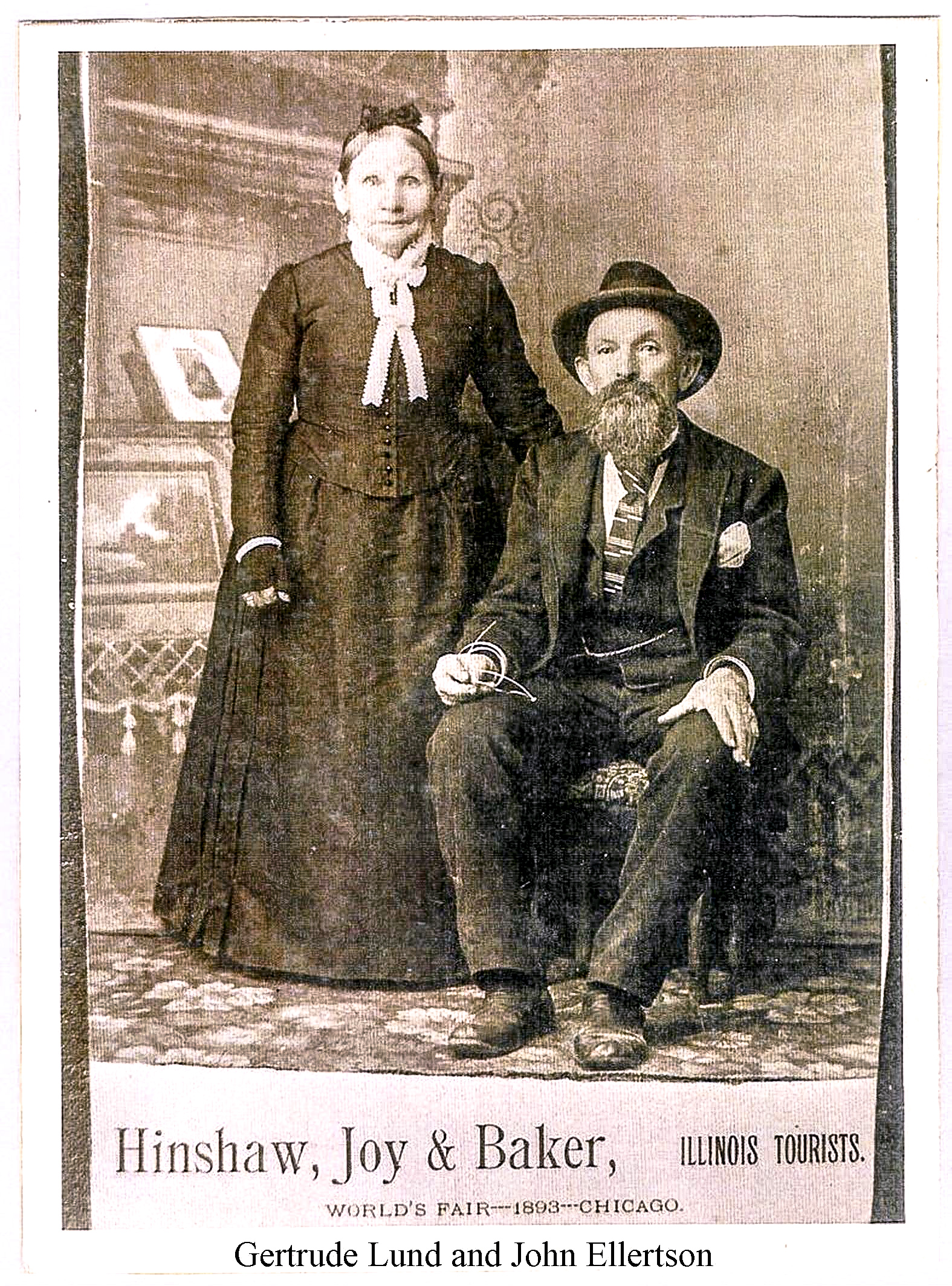
Even though John and Gertrude Ellertson were not listed as Mt. Pleasant Pioneers, many of their family
were.  And many of the family still live here in Mt. Pleasant.
Including Speakman, Reams, Barentsen,Syndergaard 


   HISTORY OF JOHN EILERTSEN & GERTRUDE CHRISTENA LUND


by Ephraim Ellertsen


   John Eilertsen was born on 13 September 1823 in Carlsgave, Frederiksborg, Denmark, the son of Eilert & Barbara (Schadt) Henriksen.  John’s father was a cottager and tailor in Carlsgave.   


   Eilert & Barbara’s family consisted of 10 children, 2 of them dying in infancy.  When John was seven years old his father died leaving his family of eight, with the youngest only four years old.  Because of this death, the family became scattered very young.  John left home between the ages of ten and thirteen years and went to Copenhagen where he learned the trades of blacksmithing and milling. After several years he seldom heard from his family.

  His mother lived to be 92 years old. 

On April 13, 1844 John Eilertsen married Gertrude Christena Lund, daughter of Hans Peter & Gertrude Margareth (Larsen) Lund.  To them were born seven children, the first four being born in Denmark while the other three were born in America.


  In June 1850, Erastus and Willard Snow arrived in Copenhagen as missionaries.  They became very dear friends to the Lunds and Eilertsens.  Two of the Eilertsen children bear their names as also do some in the next generation.


   Gertrude Christena Eilertsen joined the Church with the first converts.  Later that year (1850) John Eilertsen, his mother-in-law Gertrude Margareth Larsen Lund, and her children Hans Peter Lund and Barbara Christena Lund, and her step-children Lars Peter Lund and Angelica Christena Lund.


   John Eilertsen did some missionary work in Copenhagen and then, Friday morning  November 7, 1854, John, his wife Gertrude Christena, three children, mother-in-law, and Lars Peter Lund set sail for America.  Barbara Christenea Lund planned to come to America but at the last minute changed her mind and never did emigrate.  Hans Peter Lund remained to do missionary work.  He came to America in 1857 and returned on the second mission in 1860. The others believed in the Gospel taught by the elders but did not feel that it would be the right thing to give up all they had and emigrate.


  The Ellertsens spent their last night with Sophia Louise who after became the fifth wife of Apostle Orson Hyde.


   They sailed on the steamer “Cimbra”, under the direction of Peter O. Hansen.  They safely arrived at Fredrickhaven on the east coast of Jutland where more emigrants joined them.  Upon leaving there, a fierce wind began to blow.  After several days of practically drifting around, the captain, though an experienced sailor, deemed it necessary to seek the nearest harbor in Norway.  This brought them into a beautiful harbor called Mendel, surrounded by very high cliffs.  In a few days, they again put out to sea.  The captain soon learned that the change was only for a short spell.  He then decided to go back to Mendal, but could not.  They were forced to go back to Fredrickhaven, their first stopping point.  They arrived there on December 9th, 1854.  On the 20th they set sail again.  The weather was worse than ever before.  For two days the ship fought her way against the raging winds and was forced to start back.  The wind suddenly changed, and immediately they steered for Hull landing there on the 24th of December.  The following day they continued their journey by rail to Liverpool, England. 


   They were checked to sail on the ship Helios, but because of the delay, they sailed on the James Nesmith.  Captain Mills was secured for their company.  They set sail from Liverpool on January 7, 1855.  They landed in New Orleans on February 8, 1855.


They sailed up the Mississippi, arriving at St. Louis, Missouri.  In March they continued their journey to Mormon Grove, Weston, Missouri, where Norman Willard was born on the 16th of April 1855.  They remained there for six weeks.  From there they crossed the plains in Noah T. Guyman’s Company.  They arrived in Salt Lake City on September 9, 1855.  They lived in Salt Lake City on 3rd East Street between 7th and 8th South, in part of the home of Lars Peter Lund’s three daughters.  Their mother had died while crossing the plains.  Later John Eilertsen bought two lots between 9th and 10th East and 8th and 9th South Streets.  They then moved o Spanish Fork in 1856 where they bought a home. 


It was there that John Louis and Ephraim were born.  John Eilertsen’s mother-in-law died in Spanish Fork at the age of eighty in 1861.


   John Eilertsen was the first councilor to the Bishop, and his wife was the Relief Society President.  He also married a second wife, Mary Hansen, and one son was born to them, John Paul Eilertsen.


   In January or April 1863 they moved to Spring City, Sanpete County, Utah, where they again bought a home and some farming land.  From there they moved to Mona, Juab County, Utah in June of 1873.  They owned a home on the main street and kept campers and travelers and also worked in the mercantile business.  Gertrude Christena died there on March 26, 1900.  He then married Christena Burrison but lived only one and one-half years after his marriage.


Addendum:

1. From another letter, probably by Ephraim Ellertsen, states:

a. The father of John Ellertson died at age 50.

b. the children of John Ellertson were Henry Peter, Julian Barbara, 

    Hannah Rosetta, Erastus, Norman Willard, John Louis, and Ephraim.

c. Erastus died shortly before they came to America at one year of age.

d. Those remaining said the Lord had blessed them wonderfully and felt

   they should stay and take care of it

2. The fifth wife of Apostle Orson Hyde was Sophia Margaret Lyon.

3. This history as relayed through the Ellertsen Family organization indicated

    that the Eilertsen home in Mona is still standing and that it was purchased by Ray Newton in the winter of 1929 and has been remodeled.  John Louis and his wife Eveline Dinitia lived in this home, after the death of their daughter Floosie  Rosetta lived in the home.  Mrs. Ray Newton was living in the home, in 1977.

4. The spelling of the Eilertsen name was changed to Ellertson.  The descendant of  John, Paul Ellertsen took the name of Ellison.


Transcribed by Elaine Speakman


Neola Gertrude Ellertson Olson One very special spiritual experience for Neola, occurred when she was twelve years old. Because her mother was the Relief Society president, she often attended the meetings to help with the music by playing the organ. She had been taught by her mother and was quite gifted. In one of the meetings, a woman stood and spoke in tongues. She said that Neola would one day cross the waters to preach the Gospel. Another woman then stood and gave the interpretation of this prophecy. This would indeed come to pass because she later served a mission for the Church in the Hawaiian Islands. A cousin who was in attendance at this meeting would later stand and relate the events at another church function. (Neola, my grandmother, told me this story.)


George and Neola Ellertson Olsen


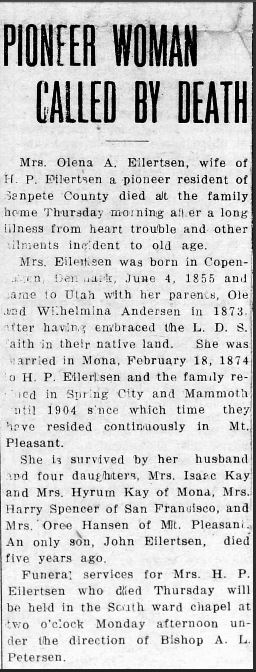
Henry P. Ellertson
A veteran of the Indian War
listed ninth from the bottom 


more information and pictures (including names)
can be found at: https://www.familysearch.org/photos/artifacts/17849010?p=40159700&returnLabel=Neola%20Gertrude%20Ellertson%20(KWCP-GDB)&returnUrl=https%3A%2F%2Fwww.familysearch.org%2Ftree%2Fperson%2Fmemories%2FKWCP-GDB