

Tuesday, June 21, 2016

Monday, June 20, 2016
Madsen Family at Scofield

Andrew Madsen, Hilda M. Longsdorf, Neil M. Madsen, Louise Madsen, Alice Madsen, Willis Madsen, Abbie Madsen, Bruce Madsen, Nellie Madsen, Ann Madsen, Johanna Madsen, Anthon Madsen, (Anthon and Annie Madsen Children)
Sunday, June 19, 2016


Saturday, June 18, 2016
Friday, June 17, 2016
A Little Fashion History
Crinoline
Crinoline foundations and petticoat supports.

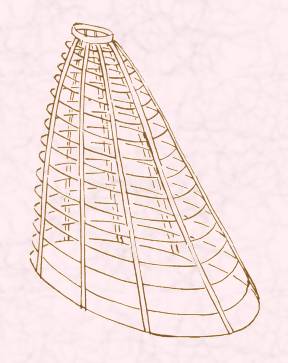
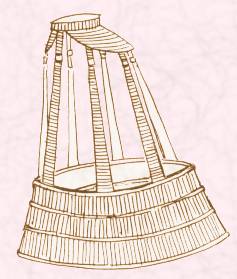

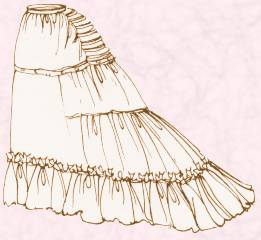
1863 1867 1869 1873 1875
From Wikipedia, the free encyclopedia:


A crinoline /krɪn.əl.ɪn/ is a stiffened or structured petticoat designed to hold out a woman's skirt, popular at various times since the mid-19th century. Originally, crinoline described a stiff fabric made of horsehair("crin") and cotton or linen which was used to make underskirts and as a dress lining.
By the 1850s the term crinoline was more usually applied to the fashionable silhouette provided by horsehair petticoats, and to the hoop skirts that replaced them in the mid-1850s. In form and function these hoop skirts were similar to the 16th- and 17th-centuryfarthingale and to 18th-century panniers, in that they too enabled skirts to spread even wider and more fully.
The steel-hooped cage crinoline, first patented in April 1856 by R.C. Milliet in Paris, and by their agent in Britain a few months later, became extremely popular. Steel cage crinolines were mass-produced in huge quantity, with factories across the Western world producing tens of thousands in a year. Alternative materials, such as whalebone, cane, gutta-percha and even inflatable caoutchouc (natural rubber) were all used for hoops, although steel was the most popular. At its widest point, the crinoline could reach a circumference of up to six yards, although by the late 1860s, crinolines were beginning to reduce in size. By the early 1870s, the smallercrinolette and the bustle had largely replaced the crinoline.
Crinolines were worn by women of every social standing and class across the Western world, from royalty to factory workers. This led to widespread media scrutiny and criticism, particularly in satirical magazines such as Punch. They were also hazardous if worn without due care. Thousands of women died in the mid-19th century as a result of their hooped skirts catching fire. Alongside fire, other hazards included the hoops being caught in machinery, carriage wheels, gusts of wind, or other obstacles.
The crinoline silhouette was revived several times in the 20th century, particularly in the late 1940s as a result of Christian Dior's "New Look" of 1947. The flounced nylon and net petticoats worn in the 1950s and 1960s to poof out skirts also became known as crinolines even when there were no hoops in their construction. In the mid-1980s Vivienne Westwood designed the mini-crini, a mini-length crinoline which was highly influential on 1980s fashion. Late 20th and early 21st century designers such as John Galliano and Alexander McQueenhave become famous for their updated crinoline designs. Since the 1980s and well into the 21st century the crinoline has remained a popular option for formal evening dresses, wedding dresses, and ball gowns.
 |
| Accidents Could Happen http://www.vam.ac.uk/content/articles/c/corsets-and-crinolines-in-victorian-fashion/ |
Thursday, June 16, 2016

Wednesday, June 15, 2016


Tuesday, June 14, 2016
History of Mads Christian and Mariane Jensen Gjettrup
Wandering the Cemetery on Memorial Day I ran onto these graves. GJETTRUP
A name I wasn't familiar with. And so I did some research and I found this wonderful history.
Enjoy


Posted 10 Nov 2012 by triniheese
Prepared by Winona Hoyal
Mariane Jensen, my maternal grandmother, was born in Denmark on January 2, 1839. Mads Christian Gjettrup was born in Denmark on September 23, 1831. They were married on December 20, 1857. They had 12 children, 5 of them died as children. At least 3 died of what was then called "galloping consumption," now known as tuberculosis. All but 3 of the children were born in Denmark. They lost a child in 1864, a baby boy, an 8 year old in 1869, a 1 year old and a 10 year old in 1876, and their last boy dide soon after birth, 4 years after coming to America. Losing 5 children in all.
In the 1860's, missionaries from the church of Jesus Christ of latter-day saints came to their door in Denmark. Mariane knew the gospel was true long before Mads who wouldn'glisten to the message. She would read the Book of Mormon when grandpa was away at work. She had a false-bottom chair in which she'd hide the Book of Mormon when she knew he was coming, because she knew he would get angry if he caught her reading it. In 1864, one of their children died, and the missionaries were so good to them that grandpa was impressed and listened to their message. On November 20, 1864, they were baptized. In 1877 they came to the U.S.A. Mariane said it took a year to get ready to come to Zion. She sewed all their clothing which was a loan to help members come to Zion. It was under this plan that they came. My mother said that she remembered as a little girl tha last cowas that were sold to finish paying the Church for the passage.
They landed in Ogden Utah after weeks in "steerage," the bottom of the ship where the poor were put, with 4 children, .50 cents, and speaking no English. A man who had come from Sanpete County Utah with his produce, and had an empty wagon going back, took their .50 cents to take them to Sanpete. They must have known someone in Sanpete, a former missionary, or some person who had gone there earlier, but I do not kinow. Grandma was pregnant. Thine, (known as Tenie) was born in a dug-out in September, 3 months after they arrived. When the man who took them to Sanpete got there it was dark, and he left them at what he thought was a straw stack. In the morning it appeared to Grandpa to be a manure pile becase it was so full of manure, a distasteful thinkg to Grandpa who was quite fastidious when possible. If he'd had the money then, I'm sure that he would ha ve gone back to Denmark. Mother said that grandpa was very indignant.
Where they stayed the first few days, I do not know. I know that Carl who was 18, worked for a man who gave him a lot in Fairview, Sandpete County, Utah for his work. Here they made a dug-out where Thine was born. A dug-out is a hole dug in the ground with branches covering the top to keep out some of the cold and sun. Four years later, Mads Christian was born but did not live. and 3 years after that, my mother Mariane was born.
The first year they lived on milk from a tithing cow, carrots and a whole-wheat bread. Grandpa was a carpenter, and someone who owned an old house in bad disrepair offered them the house to live in if they would repair it. This grandpa did but as soon as it was fixed, the people did not want it back. After they had been here the number of prescribed years, they got a homestead. I think it was 160 acres, but i'm not sure. In signing the contract or deed, grandpa was cheated out of his water right to theland becasue he was unable to read English. All the water they had left was a well near the house they eventually bult, made out of rock from the fields. They raised a garden with the water from the spring, but did not know what to do with the rest of the land with no water. Grandpa had heard of ta new kind of wheat grown on dry land. He sent for some of the seed, and because he was the first in the Balley to grow that kind of wheat, it was called "Gjettrupwheat." At one time he was building a housae, whether it eas the rock house or not, I do not know. At any rate, he had bought shingles for his new house, but because of harvesting, had been unable to finish the roof. One man in the ward came to grandpa and said, "brother Gjettrup, you have shingles you are not using. I need shingles and the saw mill is out of them at present. Le me use yours, and when the saw mill gets some, I will returnthem." Mads consented. A few days later, the man came over with a papter to sign saying it was a contract for the shingles. When weeks went by and no shingles arrived, grandpa went to the man and asked him about them. The man said "What shingles?" Grandpa learned taht the paper he signed wa a statement that the man had paid for the shingles. These are a few things that happened to them to try their faith. Grandma adid that some people in the Church should be called "Latter-day Devils" instead of "Latter-day Saints." But she alwasys told her family that the Gospel was true, and taht even though men did wrong, the important things were the principles of the gospel, and not to worry about what men did. Later they sold their farm and moved to Mount Pleasant to the little house we visited last year.
They were called by the Stake President in January 1907 to receive their 2nd anointing. Probably ill health prevented their receiving it while he was alive, because it was done by proxy on July 1, 1908. He died January 31, 1908 fo cyctitis due to an enlarged prostrate. Grandma died April 11, 1914, the week after my brother Jim was born. Grandma had a tumor which interfered with her eating of solid food. The doctor had her on gruel, but she was so hungry for a piece of breda and cheese. Aunt Tenie who came every day to look after her while her mother was in bed. funally gave in to her pleadings for the bread and cheese. The food would not go up or down. I'm sure she enjoyed her last bit of bread and cheese. I remember as a small child how much whe like bread and cheese. When I went into her room to visit her she would make sandwiches of bread and cheese and cut them into very small squares to feed to me. Today, they probably would have operated on grandma and grandpa but they were sondidered too old in those days to risk and operation. I also remember coughing a great deal an spitting up blood. She uded to call me "tor mikel" becasue she'd give me magazines to play with, and didn't mind if I tore them. I called her "spit mikel." I'm sure this isn't the right way to say or spell the Danish words but that is how I remember them.
Monday, June 13, 2016
MAJOR ALDEN P. RIGBY ~ Fairview Utah

a cousin to my Dad

| ||||||


One of the Greats of that "Greatest Generation", Alden Peter Rigby, Maj. USAF Ret., passed into history May 3, 2015 at his home in Bountiful UT. He was born January 4, 1923 to Martin and Elva Rigby in Fairview UT. He married the love of his life and eternal companion of 73 years, Eleen Barker, June 4, 1942 in the Manti Temple.
He served his country heroically as an ace fighter pilot flying P-51s in the ETO, earning the Silver Star, DFC, Air Medal with 21 OLC along with many other awards.
He served again during the Korean War with the Utah National Guard and retired from the service in 1978. He was a supervisor with the Federal Aviation Admin., and was responsible for setting up the air traffic grid for the western U.S. In 2010, in recognition of his war service and many contributions in the field of aviation, Alden was inducted into the Utah Aviation Hall of Fame at Hill AFB.
He served in many church positions including missions with Eleen to India/Sri Lanka and the Jerusalem Center in Israel. He was a sealer in the Salt Lake and Bountiful Temples for 30 years, performing over 2000 marriages. He valued his unwavering testimony of the Gospel and was an example to all. He leaves behind a legacy of much love, kindness, hard work, selflessness, generosity, humility, and so much more.
Alden has friends without number from all around the world and the Rigby home was open to many visitors.
Alden is survived by his wife, Eleen and their four children, Jerilyn (Al Drummond), Larry (Susan), Kevin (Estelle), and Greg (Faye), 25 grandchildren and 67 great-grandchildren.
Funeral services were held May 8,(VE Day) 2015 at the Oak Hills Ward, 455 S. 1200 E. Bountiful, UT. at 11:00am.
Sunday, June 12, 2016

Saturday, June 11, 2016
Ray Arley Jensen
Ray Arley Jensen
1/14/1929 ~ 5/15/2016
 Ray Arley Jensen passed away surrounded by his family on May 15, 2016 from pneumonia. He was born in Flowell, Utah on January 14, 1929 to Arley Peter and June Ladora Robison Jensen. He was raised east of Mt. Pleasant, Utah on a large ranch up Cedar Creek.
Ray graduated from North Sanpete High School class of 1947. After working for one year at Deseret Chemical Depot he joined the U.S. Airforce as an airman and was trained as a mechanic on B29, B36, and B52 engines. Ray served military assignments in Korea, Vietnam, Japan, Guam, Okinawa, and Thailand and flew mission over North Vietnam. He retired in July 1972, after 24 years of service as a Chief Master Sergeant.
While he was stationed in Spokane, Washington he met and married the love of his life, Dorothy Florence Shumway Jensen on July 25, 1951. Their marriage was later solemnized in the St. George Temple on December 11, 1971. Ray and Dorothy were married for 65 very happy years!
Ray and Dorothy settled in Mt. Pleasant, Utah where they had bought a small farm south of town. They enjoyed raising sheep and chickens, especially in the spring when the baby lambs came. He also raised a beautiful garden every year and would share his vegetables with many relatives and friends. Ray could not stay retired and worked 11 years as Mt. Pleasant City Sexton. He also served in the VFW, Lions Club, American Legion, Timpanogos Gem and Mineral Society, and Senior Citizens.
In his spare time he enjoyed fishing, hunting, camping, and traveling with his wife. He was an active member of the LDS Church and served in many different callings.
Ray is survived by his wife, two children, Steven Ray (Lorraine) Jensen, Fountain Green, Utah; and Rebecca Lee (Jorge) Riveros, Redding California; 6 grandchildren and 5 great-grandchildren; sister, Carolyn (Ralph) Jensen, Moroni, Utah; and, many nieces and nephews and cousins.
He was preceded in death by his parents; sister, Arlene Sheaffer; and, brother Peter Yale Jensen.
A viewing will be held on Wednesday May 18th from 6:00 to 8:00 p.m. at the Rasmussen Mortuary in Mt. Pleasant, Utah. Funeral services will be held Thursday May 19, in the Mt. Pleasant 3rd Ward Chapel (295 South State) at 11:00 a.m. with a viewing prior to the service from 9:30 to 10:30 a.m. Interment in the Mt. Pleasant City Cemetery. Online condolence rasmussenmortuary.com
Friday, June 10, 2016
William John Unopolos
Willian John Unopulos
1/4/1944 ~ 4/18/2016
 Willian John Unopulos, 72 of Mt. Pleasant, UT, passed away April 18, 2016 in Nephi, UT after a long battle with many health problems. John was born January 4, 1944 to William J & Dorothy June Monson Unopulos in Mt. Pleasant, UT. Married Pamla Priscilla Bowles April 1, 1963 and had two children John Leo and Marjorie June, later divorced. Married Doris Jean Dalton on August 3, 1990, later divorced.
John served in the US Air Force for four years. Two years in Roswell, NM and two years in England. After his services he moved back to his hometown Mt. Pleasant, UT. He worked many jobs, Rancher, Miner, Truck Driver and was always quick to help those in need. John had a sense of humor, loved music, singing, playing guitar and harmonica. He was known for signing at retirement homes and also did a good Elvis impersonation. John loved all animals and was known for riding his white horses roman style. He belonged to the Mt. Pleasant riding club and was a riding instructor to many of the youth and people in the community.
John had a passion for automobiles especially his 1962 T-Bird he bought to commemorate graduating from North Sanpete in 1962.
He was a member of the LDS church and served in many callings. John took great joy helping out his friends and neighbors.
John is survived by his children, John Leo Unopulos, Nephi, UT and Marjorie June (Rick) Rosevear, Nephi, UT; brother DeWayne (Sharon) Monson, Sioux Falls, SD; 4 grandchildren and 2 great grandchildren. Preceded in death by his parents, brother David Lee Unopulos and one great granddaughter.
Graveside services will be held May 21, 2016 at 11:00 a.m. in the Mt. Pleasant City Cemetery under the care of Rasmussen Mortuary.
Thursday, June 9, 2016


Subscribe to:
Posts (Atom)