Friday, February 17, 2017

Mount Pleasant's Very Own Music Man

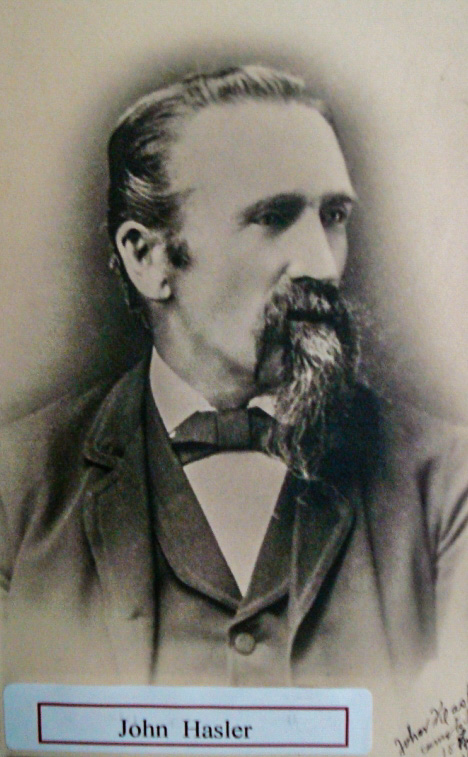
Johannes Hasler - Mt. Pleasant's Very Own Music Man


· 26 January 2016 ·


This article was published in 1980 in Beehive History #6, by the Utah State Hisitorical Society, written by Marilyn Miller Smolka, a great granddaughter. 

Music Man -- Right Here in Mt. Pleasant City

 At the Liverpool dock, Louisa Hasler sat on the trunk containing her wedding trousseau and cried. The emigrant ship carrying the Mormon company to America had been overbooked and some of the luggage would have to be left. It wasn't fair, she wept, that the dozens of pillow cases, sheets, feather-bed covers, table linens, dresses, underclothes, and even shirts for the groom that she so carefully had sewn by hand (not to mention the raising and preparation of the flax and wool in the first place!) had to be left in preference to her husband's trunk of organ and band instrument parts, Preference for things musical, however, was an indication of things to come for the Haslers—newly converted to the Mormon church, newly married, newly departed from their native Switzerland, and about to set off for Utah. 

For John and Louisa Hasler the fourteen-day ocean voyage wasn't nearly as tedious as some of the earlier emigrant trips, and even the trek across the country from New York to Utah could be termed as almost enjoyable as they were among the first of the Mormon companies to travel on the newly completed transcontinental railroad. 

They arrived in the late summer or early fall of 1869 and were met by Louisa's sister and brother-in-law who drove them to Mt. Pleasant, which in itself was a four-day journey. 

The Haslers had been in Mt. Pleasant less than a week then they learned that there was to be a military drill for Governor Brigham Young held in the fields between Ephraim and Manti and that no less than a military band was needed to lead the procession. So John, who had literally taught himself to play the various band instruments in Switzerland, opened his trunk. In three weeks he was able to assemble the instruments, copy each of the musical parts by hand, round up a contingent of band members whom he rehearsed day and night, and put on a performance of rousing anthems to astound the local populace. 

His brass band continued to play and was always in demand for holiday celebrations, political meetings and theater performances. John eventually printed and bound an edition of band music, probably the first available in Sanpete County. But that was only the beginning. Shortly thereafter he was called to lead the choir in his ward* a position which he held for approximately seventeen years. 

At first the local bishop was dismayed to hear that John expected the ward meetinghouse to be lighted and heated the night of choir practice. Unheard of! Why, singing, like preaching, was supposed to be unrehearsed and only performed spontaneously according to the inspiration of the spirit! But John very politely put his foot down. Spirit or no spirit, his choir was going to rehearse, and rehearse they did. John also discovered that there was precious little musical talent available, so he set about instructing several ladies in the ward sufficiently that they could accompany the choir on the organ which he also kept in repair for all those long years. 

By 1882 the Haslers were firmly established in Sanpete County. After having lived five years in the two-room basement of their home, they had managed to finish constriction of their adobe home. John had survived a near-death bout with typhoid fever, pneumonia, and rheumatic fever which left him unable to walk without a cane for the rest of his life. He had served a mission for the church to Switzerland where he had organized a choir in every branch in the mission and also arranged the music and written a number of hymns for an LDS German hymnbook. He had taught music lessons in Sanpete County as his contribution to the United Order which the Haslers had joined in 1875, and seven of their nine children had been born to them (four of whom died in childhood). At this time John began a program of applied music which drew students from all over southern Utah. 

Three organs were installed in as many rooms in the Hasler house, and for $15 to $20, from four to six students would receive board and room for a six-week intensive music course, usually held during the summer months. John would teach group and individual lessons to students all day long, and each student was expected to practice what he had learned in each of his two or three daily lessons, which amounted to several hours of practicing as well. Mina Hasler Sorensen, the youngest daughter in the family, remembers vividly lessons beginning at six o clock in the morning and organ music coming from every room all day long, all summer long! Louisa for her part cooked, cooked, cooked! Besides her own family and the students, she often fed the families of the students who would come and stay for several days at the beginning and end of the sessions to deliver or reclaim their children, as well as numbers of other emigrant pioneers who always seemed to be a part of the Hasler household for various periods of time.

 Luckily a bounteous garden was able to supply produce, and the Haslers also raised chickens and some pigs and cows. Mina also relates that by the end of the day, the students had more than enough energy stored up after sitting at their organs all day and that it was a real trick to invent meaningful activities to keep them out of trouble. This intensive group method, however, proved to be very effective and was used by a number of succeeding music educators within Utah and throughout the country. Among John Hasler's students were J. J. McClellan and Anthony D. Lund, who were associated with the Tabernacle Choir for many years. 

In 1890 as a salesman for the Crown Piano Company, John began travelling around an eight- or nine-county area with horse and buggy selling pianos and organs door-to-door. As part of the sales contract he would agree to teach one member of the family twelve tunes with the purchase of an organ, or twenty-four for a piano. The lessons were conducted on his regular monthly trips, and often he would be seen returning home with payment "in kind" — cans of molasses or honey, cheeses, or sometimes even a horse or cow tied behind his buggy. 

C. W. Reid, one of his pupils who became a music instructor at Brigham Young University, once said of him that no other man had made it possible for music to get into the homes of so many people and over so wide a territory as did John Hasler. He continued to sell musical instruments until he was about seventy years old, at which time he retired to his small farm in Mt. Pleasant. Even then he tried to organize a male chorus in his High Priest’s Quorum, an experience which was a test of his patience and musicianship because as he said, "Those old men had no ear for music!" 

John Hasler died on January 10, 1914, at the age of 75. Coincidentally the cuckoo clock which he had brought with him from Switzerland} like the grandfather clock in the song, stopped short the morning he died, and it seemed that no repairman could make it work again. 

He left a musical legacy in southern Utah that undoubtedly justified the trunk of musical instruments brought so many years before from Switzerland. — 

Marilyn M. Smolka References: Unpublished, undated personal histories written by Johannes (John) Hasler, Louisa Thalmann Hasler, Mina Hasler Sorensen, and Walter Thalmann Hasler in the possession of Marilyn M. Smolka and also deposited with the Utah Historical Society and the LDS Church Historical Department.


"BANNER CELEBRATION of OLD TIMERS HELD IN
MT. PLEASANT.

"Mt. Pleasant, March 21, 1910.-Yesterday was Pioneer Day in this City, but the Pioneers and their descendants held their celebration Saturday. A program was given at the North Ward Meeting House. An interesting feature of the day was a collection of Pioneer relics, displayed at the Opera House. There were old spinning wheels, wooden shoes, flint-lock guns of over a hundred years ago, Indian millstones, pewter ware brought across the plains in the handcart companies, and many other things. The day's festivities closed with a grand ball in the evening at the Madsen Opera House." p. 195

In 1913-14, the old "meeting house" was remodeled and new benches purchased. At this time, the gallery was taken out, and a vestibule was built on the west. The building was dedicated by President Anthon H. Lund, and then became known as the North Ward Chapel. p. 198

Later (John Hasler) took the leadership of the ward choir; George Farnsworth, the former leader had resigned. At that time, no printed
music was arranged to the Church Hymn books, he wrote all the notes and arranged them to the Latter-day Saints' Hymns, until the Psalmody was edited. No heated rooms were provided for their practices, a leader had to make his own fires, and bring his own coal oil for their lights. Later, when an organ was pro­vided for the meeting house, the leader had to teach the organists before the practices. Entertainments had to be arranged to en­courage the members as well as the public. In this capacity, Mr. Hastler labored for over twenty years. . . . He was greatly thankful to be able to enjoy his work. He was noted for his punctuality, he never was known to have been late to meet an ap­pointment where duty called.
He was an organizer in this line of work, not only in Mt. Pleasant, but in many other towns he organized choirs and bands. p. 243


Tuesday, February 14, 2017

Sunday, February 12, 2017

DONNA GRAHAM BRUNGER BOOK TO BE PUBLISHED

SEELY DESCENDANT PUBLISHES LOCAL HISTORY BOOK

 Milburn Utah and Its World, a new history book in two volumes, will soon be available. The book was written by Donna Graham Brunger, a JASFO descendant who passed away in 2016. Milburn is a small agricultural community located about five miles north of Fairview, Utah. An unincorporated village settled by Mormon pioneers in about 1876, Milburn once boasted a school, a Church building, a Co-op Store/dance hall, and a mill. This history has 2088 pages of text and photos and costs $93. To purchase, contact the author’s daughter, Paulette Park, at (801) 255- 0562 or paulettepark49@hotmail.com.


Donna Graham Brunger was born in Mt. Pleasant, Utah to Loyal and Ellen Vida Seeley Graham April 12, 1929. She left this life peacefully on February 26, 2016. She spent most of her life in Milburn then in Mt. Pleasant the last few years of her life.


She graduated from North Sanpete High School, Snow College and Brigham Young University. She earned a degree in social work and psychology when she was 47 years old. She worked at the sewing plant in Mount Pleasant and the turkey plant in Moroni to earn money for her tuition. She was a counselor at Central Utah Counseling Center for twenty years. She married Norman (Tommy) Brunger, January 1948. They were later divorced.


Reading, sewing, gardening, farming, and church service were some of her interests and hobbies. She had a driving ambition to write a history book about the north end of Sanpete County titled “Milburn and Its World.” In 2000, she developed health problems but continued to see it completed. She was an active member of the LDS Church and gave service two different times as a Relief Society President as well as served in many other ward and stake auxiliaries.

She is survived by four children: Paulette (Michael) Park, West Jordan, UT; Tom L (Mary) Brunger, Orem, UT; Randy Ray Brunger, Mount Pleasant, UT; Annette (Steven) Muir, Solon Ohio; 10 grandchildren and 18 great grandchildren. Brother, Grant E. (Shirley) Graham, West Jordan, UT; and sister-in-law Darlene Steusher Graham Bullough, West Valley, UT.


She was preceded in death by her parents, Loyal and Ellen Vida Seeley, brother Berkley and four sisters, Baby, Alice, Marie, and Vida Loy Graham.

Friday, February 10, 2017

History Today ~ Green Comet

http://spaceweathergallery.com/indiv_upload.php?upload_id=132092


GREEN COMET APPROACHES EARTH: This week, a small green comet named "45P/Honda-Mrkos-Pajdusakova" (45P for short) is approaching Earth for one of the closest comet flybys of the Space Age. On the nights around Feb. 11th, Comet 45P will be an easy target for binoculars and small telescopes, revealing itself in eyepieces as an emerald colored fuzzball. Visit today's edition of Spaceweather.com for sky maps and to find out what makes this little comet so green.

Lee R.Christensen's WWII Diary continued....


By Way of Explanation

     I started my diary 8th December 1941.  Not because that is the day after Pearl Harbor, but because that was the day the 2nd Battalion 222 Field Artillery Regiment was scheduled to leave for the Oakland (California) Port of Embarkation and the Philippines Islands, code name “Plum.”

     The attack on Pearl Harbor 7th December drastically altered the schedule but it was 3 days before new orders were issued.  In the meantime, we left Camp San Luis Obispo on schedule, motored to San Francisco, crossed the Bay Bridge and spent 4 days at the Oakland Army Base waiting for new orders, unloading our equipment and moving out to a new assignment.

     When this diary starts, I’m a gun Sgt in Btry “D”, 2nd Bn 222 FA Reg. 40th Division.  When the army modernized the Infantry Division in early 1942 Btry “D” became Btry “A” 204 FA Bn-a separate FA battalion.

     Btry “D” (which became Btry “A”) was a Utah National Guard unit federalized 3rd March 1941 and from Mt. Pleasant, Utah.  It was still 65% men from in and around Mt. Pleasant on 8th December.

     I don’t know how good an Army unit had to be to be sent to the Philippines fall of 1941.  But I’ve always thought being selected to go 6 months after going on active duty was commendable recognition.  However, after passing the GHQ tests and being selected, all our over age-in-grade officers were reassigned, one of whom was my father, Major Lee R. Christensen.  We lost the officers’ who made us good.
    The officers we lost went on to lead service units overseas.  The Battalion, at the 204th, regrouped, lost many men to other services, OCS, Air Force, and Cadres but earned 5 battle stars in the ETO.  (European Theatre of Operation.) By then they had modern equipment; radios, jeeps, machine guns and a 155 howitzer that was not a rusting relic of WWl.


Sunday, April 19, 1942
The week in review.  Monday morning R.S.O.P.  Afternoon 37mm firing.  A welcomed rain settled the evening dust.  Tuesday morning Bn. R.S.O.P. with its camouflage nets and fox holes.  Military courtesy and map reading ever bored into us while we shivered in a cold breeze during afternoon.


 Wednesday R.S.O.P. (can’t you see we have one every morning).  Following dinner lectures were given by trained non coms. Thursday mid-day saw us firing 37mm guns again.  Second section fired 19 rounds.  The first section fired a round that was very unusual.  On pulling the trigger a weak blast was faintly heard.  No projectile came screaming from the tube.  It was plainly a misfire.  They waited ten minutes then tried extracting it.  The shell came out but the lead remained in the tube.  Even the mighty Col. Duffin has tried to dislodge it but it still remains firmly and disobediently in the 37 mm. tube.  Friday afternoon saw a return to lectures.  Saturday, ah sweet Saturday.  It wasn’t the second sections day.  Mrs. Prime mover (the truck) was in bad shape, disagreeable and put puttering.  Col Daniels had reason to complain to the section for not following fire commands.  Guess the Chief of Section is slipping.  Lastly, the camouflage net was knifed to allow simulated fire.  Saturday, hell I wish I could of slept.  Sunday no R.S.O.P. and bore talks.  The hot cakes were exceptionally good this morning.  It might have been the blue plum jam instead of the thick syrup that we so commonly use on them.  Baseball came into my schedule at about 9 am.  It was a good workout.


After a Sunday dinner of turkey I showered.  The water certainly felt good and the dust removed.  After seeing the dust in the air it’s easy to see why we get so dirty here.


Wednesday, April 22, 1942
Wind, dust, dust, and wind, a monument to April 22, 1942.  The wind came strong and the wind came weak.  Always the cold and the dust were with it.  The cold chilling, the dust blinding.  We will be well trained for meeting the enemy in a Sahara sandstorm.  Blow on ye dust winds.


It’s apple blossom time in Yakima valley.  The trees are proving to God that not all is bad on earth.
They’ve snowed forth with miniature angel wings giving to the mad mad world a baby kissed perfume that’s lost in gun smoke.  Man will again be man when he can enjoy an Apple Blossom Time.

Helen Howitzer worked out yesterday.  She spit four lead pellets into the air.  She belched flame and smoke.  Her innards were black with burnt powder.  She wore a gun smoke perfume.  Helen was in her glory as an old maid shooting gossip to the world.

 Sunday, April 26, 1942
The second week at Camp Dust has been blown into eternity.  The days have been long and dusty.  The nights short, too short and cold. The wind, ill as it may seem to be its doing good by fertilizing the apple blossoms.  Yes, it is a truly bad wind that does no good.
I made a brief appearance in Yakima Thursday night.  My mission was to buy flowers for mother.  I telegraphed her a dozen red roses.  Filmland held my attention for a couple of hours.  It was a Western mining camp show with a new setting, Alaska.
Most my nights are talked away near the one sided heat of camp fire.  I vow every morning to retire early but it’s always late when I reach the “don’t leave meekness” of my bed roll.
We had a salad of apples and raisons that tasted extra delicious for dinner.  The only meal I can pick about is breakfast.  (my spelling getting bad.)


Monday, April 27, 1942
The tent shook.  The earth shuddered.  The stars trembled.  There it was again.  Snoreblur.  Then deathly silence.  Had the “squinteyes” come?  Was that their heavy artillery laying down a barrage.  Once again.  The moon turned pale.  The stars blinked.  My heart double timed.  Why had they raided defenseless Camp God Forbid?  Snoreblur closer and closer.  The clouds did number one in their pants and fled.  Still Snoreblur.   Come, come Jensen wakes up and get a new start.  No need of causing a black out in Los Angles.
BTRY. “A” had test day today.  The weather was wet due to Jensen scaring the clouds.  He couldn’t scare the wind and cold.  Both were with us till retreat.  The long lost sun then made a brief appearance.  The test problem went over in a fair way.  Coalminer Feck was unable to pierce the rocky ledge chosen for our fox holes.  Let’s go to bed.

Tuesday, April 28, 1942
The air was cold.  The rubberized raincoat was colder.  Goosebumps puckered up on my ice blue skin.  I unsuccessfully attempted to shrink so small the raincoat wouldn’t touch me. I shivered for the monthly physical. (another short arms inspection-about every 90 days or less)
It was a good ballgame.  Hard fought and close.  The score was 1 to 0 favor B Btry.  The bases were loaded.  Creed was winding up his fast ball.  The O.D. (officer of the day) intervened, stopping the game, order of Col. Duffin.  To hell with Duffin.

Wednesday, April 29, 1942
We’ve trained on the 155 howitzer for 13 months.  We’ve worked hard through dust and cold.  We’ve fired in daylight hours, simulated fire at night.  Now we have really fired them at night.
The problem was a high burst adjustment.  Howitzers were taken to the firing ground after dinner and made ready to shoot.  The sun was well down when the fun started. “ No. 1 adjust”, “shell shrapnel”, “correction 100”, “time 2-1”, “base deflection”.  “No 1 one round”, “quadrant 3-5-0”. The precision working of the gun crew echoed through the night, “cut”, “ram”, “set”, “fire”.  For a quivering instance the place was alight.  The shell was on its way.
21 seconds later, far out into the night, the sky gave birth to a ball of light that lived oh so short.  End of problem.  March Order.


 Thursday, April 30, 1942
Cpl. Seeley is well on his way toward Utah and home by now.  He has been trying since last Monday to get granted an emergency furlough today.  This is a blitz army.
The rains came.  They have made short work of the dust.  I hope they don’t make a nuisance of themselves.
The boys of the second section tried drowning their section chief this morning.  It seems that he threw water on them from the safety of his cab.  They foxily waited for him to emerge, then let the water fly.  The odds were too great and the Sgt. got wet.


Sunday, May 3, 1942
A very extraordinary day.  I have written four letters.  Who would have thought it possible for me?
Most of the men are in town drowning their sorrows.  Those that are still here have been sleeping their sorrows away.
We were paid Friday and given the afternoon off.  You guessed it, Duffins away.
Last night I happened into a dice game.  I put one dollar aside that I’d give to the game.  With beginners luck I won eight dollars.


 The rumor around now is that Col. Duffin is looking for a guard duty assignment for the am.  It might be that we will pull before too much longer.
An artic wind is blowing tonight.  Open those blankets here I come.

Monday, May 4, 1942
The second section has been very much in need of some camouflage poles.  Leo Truscott and I noticed some piping that looked cut out for the job.  Late Saturday night, we removed them to the safety of our prime mover.  On examining them this morning, I found them to be chromium steel of very high grade.  So good and much too expensive for hold up our camouflage net.  So tonight under cover of darkness I will return them.
The men were all tired today.  Joe Bautros slept through one class and a rest period while the class enjoyed his slumber.


Sunday, May 10, 1942
Tough week that last one.  Tuesday and Thursday were normal.  Wednesday, Friday, and Saturday were some of labor.
Wednesday umpires peeked from behind every sage brush.  It was 1st Bt 204th FA test day.  Airplanes, from their perch above, scanned the earth surface for us.  Stop watches ticked away the seconds as we went into position.  Everything was watched, nothing went unnoticed.  First section fired 15, second section fired 3 rounds.  It was a good test and one weaker outfits had failed on but not 1st Bt 204 F.A.
Friday was showdown.  Uncle Sam checked up on what he had issued his fighting men.
Saturday!  “Let’s get those guns to shining men.”  “Wonder where the hell my clean socks are.”  “Lend me soap Bill.”  The back of this truck looks like a madmans nightmare, slick it up Jensen.”
Saturday inspection!  Helen passed.
The baseball team played a game with a town team today.  They took the band with them and plan on having a bar-be-que.


I explained some of the secrets of Helen’s mouth to Lt. Sharp this afternoon.  He hasn’t had any experience of a 155 before but he’s willing to learn.
Capt. Staker has gone and Lieutenant Nickanecky has taken over C.O. (commanding officer) duties.
The biggest rumor in months has us going to Tennessee about the 10th of June.  Sounds like a good go.