

Sunday, May 19, 2019

Saturday, May 18, 2019
Linking the Jensen, Nielsen, Hafen, and Christiansen Families
 |
Niels Christiansen Jensen |
Niels Christiansen or Jensen
Niels Christiansen or Jensen
( Family Search PID: KWN2-PVD)
(A brief biography)
The following biography consists of bits and pieces I found in several histories, modified, combined and changed some of them a little, but for the most part they are the same as originally written. ----Robert Jensen, great, great grandson of Niels Christiansen or Jensen
Niels was born in Denmark 15 June 1826. He was the son of Christiansen Rudolph Phillip Jensen of Northaven and Annie Johanne Rasmussen. Niels father had joined the then “unpopular” Mormon Church in 1852. Later Niels joined the the church, being baptized Oct 28, 1855. They were in their section of Denmark to join the new religion from America. Niels became a staunch defender and supporter of the church.
Under Danish law, the local parish priests of the state Lutheran church acted as the registrars of the government and were required to keep the official records of births, deaths, marriages, census, and the military roll. Apparently it “irked” the local priest to be required to enter the records of a Mormon in his good Lutheran Parish Register. The priest could not christen the child and receive a fee, yet he was required to enter the birth and so for the son Andrew his name does appear in the register of the Trandjberg Parish, but the entry merely states that “on July 20, 1865, a son was born to Niels Christiansen and Karen Jensen, the Mormons of Osterby."
Under the old Danish custom the children of Niels are known by the surname of Nielsen. However, Elders of the church suggested that the family should all keep the same surname of the father, so the children took the surname of Christiansen. When the family settled in Fountain Green the church authorities suggested the family of Niels should take the same surname as their grandfather which was Jensen. Accordingly , all the children changed their surname from Christiansen to Jensen. However, Niels continued to go by the surname of Christiansen and the two children who were born to him in Fountain Green also kept the surname of Christiansen.
It would appear from the Parish Register that Niels and his family were the only Mormons in the village at this time, and undoubtedly they were subject to considerable “unsocial” treatment from the local populace. At least, Niels soon moved (about 1857) to the village of Ravnholt, Parish of Tiset, Aarus Amt. This was the home of his wife's father and family. And, no doubt, Niels commenced to make plans to “go up to 'Zion'--the promised land in the rocky mountains”.
The 1860 Census of Aarus County, Tiset Parish:
Niels Christiansen Age 34 Husfadder Mormon
Karen Jensdater 32 Wife “
Jens Christian Nielsen 7 Born Trandjborg P.
Annie Johana Nielsdater 5 Born “
Andrew Christian Nielsen 4 Born “
Johan Young Nielsen 2 Born Tiset P.
Niels was a poor country farmer and America was a long way from Denmark. It appears that Niels soon decided if nothing better could be arranged, he would send the family to America one by one. For, according to Fred Anderson, of Huntington, Utah, Annie Johana, was sent Zion alone in 1864 when she was only nine ears old. According to this story, young Anna walked across the plains. Sometimes she was permitted to ride on the wagon tongue, or cross-trees of a wagon. She would help gather prairie “firewood” (buffalo chips) in her apron for the evening fires of the company she traveled with. When she arrived in Salt Lake City, she was alone and nearly starved for two months, living only on potatoes. She was finally able to make her way to Fountain Green, Sanpete, Utah where an an uncle was living (Soren, brother to Niels).
Luck seemed to come to the family, either through the emigration fund or some other means. The entire family left Denmark in 1866, sailing for America from Liverpool, England, May 2 on a ship called the Kendworth or Kenelworth. The company was under the direction of Samuel Sprague. They arrived in New York, July 17. They crossed the plains in an ox team train, under a Captain Joseph Rawlings (another source says Captain Reynolds). They did not stop long in Salt Lake, but made their way to Ephraim where they stopped for a short time. Then on to Fountain Green, Sanpete County, Utah, where they made their home. The grandfather, Christian Rudolph Phillip Jensen, and a brother of Niels (Soren) had preceded them to Zion, and were already located in Fountain Green. The old original Fountain Green L.D.S. Ward records list these families as among the first members of the ward.
Living was hard, and the family was poor. Niels and his wife had to “farm out” the children. They worked for other people for board and room and a few clothes, but the children learned to work.
Niels Christiansen went to Castle Dale in 1890. His sons James and Andrew had preceded him, going to the Castle Valley area in 1877, arriving in November of that year. Prior to this time while living in Fountain Green, Niels was a farmer and apiarist and continued to do such in Castle Dale. He took part in the Black Hawk war as a home guard. He served two years as water master in Fountain Green and was a shareholder in the Co-op store. He was a ward teacher for many years. He did about ten years missionary work in his native land of Denmark before coming to Utah. He was married in Denmark, July 7, 1853 to Karen, a daughter of Sire and Johannah Jensen, born February 13, 1828. They had nine children: James C., Johannah, Andrew, Mary, (married N. P. Nielsen Jr.) Maria, John Y., Niels and Joseph, living, and Soren, deceased. John Y. is bishop of Castle Dale, being ordained April 17, 1898 by Francis N Lyman. Niels C. has forty-three grandchildren.
--The above paragraph was taken from the early Sanpete-Emery Co. History book.
Another similar biography that says its source is taken from the early Sanpete-Emery County history book:
Niels C. Jensen, farmer and apiarist, son of Christian and Jannie J. was born in Denmark, June 15, 1826. He joined the Mormon Church in Denmark and came to Utah in 1866, crossing the plains in an oxtrain under Captain Reynolds and located at fountain Green. He took part in the Black Hawk war as a home guard; Served two years as water master in Fountain green and was a shareholder in the Co-op store; Has been for many years a ward teacher. He did about ten years missionary work in his native land before coming to Utah; Came to Castle Dale in 1890 and has since been engaged in farming and beekeeping. Was married ...(the rest is exactly the same as the last two sentences above)
Castle Dale Utah City Cemetery records give the following information for:
Jensen, Niels Christiansen
Birth: 15 June 1826 Death: 7 Apr 1908 Burial: 10 April 1908
Place of Birth: Solbjerg, Tiset, Aarsus, Denmark, Place of Death: Castle Dale, Emery, Utah
Cause of Death: Pneumonia and old age
Grave Location: Castle Dale City Cemeterry, Block 1 lot 2 grave unmarked
Relatives: Father: Christian Randolph Phillip Jensen Mother: Ane Johnanne Rasmussen
Spouse: Anna Nielsen, Spouse: Karen Seirsen
Fountain Green Utah City Cemetery records give the following for Niels wife:
Christiansen, Karen Jensen Siersen
Birth: 13 Feb 1828 Death: 27 May 1908 Burial: 0/0/0
Place of Birth: Tingskoven, Tiset, Aarhus, Denmark, Place of Death: blank Cause of Death: blank
Grave Location: Fountain Green Cemetery, Sec 2 Lot 13
Relatives: Father: Jens Seirsen or Siersen Mother: Johanne Rasmussen
Spouse: Niels Cristiansen Sr.
Source: LaVon S. Coombs, Meth Mikkelson and the Crowther family.

Mary Maria Christiansen, a daughter of Niels Christiansen or Jensen married N. P. Nielsen of Mt. Pleasant

Carrie Nielsen Hafen
was born August 13, 1889 in Mt. Pleasant Sanpete County , Utah
Her father was a blacksmith and wheelright. She grew up in pioneer times with many hardships. She helped her family with the duties of early pioneer life. Times were very different then. Homes were small with none of the conveniences of today. They had no running water, electric lights or indoor bathrooms. Each home would have a coal or wood cooking stove and a coal or wood heating stove or fireplace.
She, along with her sister, Bertha, had a normal childhood of that era. They would work and play together as a family. She was a beautiful young lady and at the age of 19, she married Wilford Hafen.

She and Wilford had three boys, Boyd, Neil and Bert. Carrie was a very nurturing and caring mother. When the boys were very young, they were playing in the kitchen while Carrie was preparing to do her laundry. While the boys were playing, they bumped into the stove which had a large kettle of boiling water on it. This caused the kettle to fall and send boiling water onto Neil. This resulted in causing extensive burns all over his back and neck. He was in a coma for over 30 days. The local doctor would come to check on things every day. Neil was nursed back to good health by his mother after many months of care. This all had to be done at home as there were no hospitals in the area at that time.
This was the beginning of Carrie becoming a nurse. She became an efficient midwife and also helped the local doctors who visited those in need at their homes.
In her early family life she became a widow. Her husband was killed by being thrown from his horse while separating cattle. The horse fell on a snow and ice covered area, killing Wilford. This left Carrie alone to raise her three boys, ages 7, 11, and 13.
She went to work for the local doctor while she studied nursing and gained her license. She was one of the first practical nurses in the State of Utah
She worked for four or more doctors at different times; Dr. Winters, Dr. Sundwall, Dr. Holman and Dr. Madsen. She also took care of her aging mother in her later years of life. Many children were brought into the world by her as a midwife and many were nursed to health and wellness by her.
In her later years, Carrie loved having her children and their families in her home often for the evening meal. Her favorite meal would be homemade soup…all you could eat. She would make either cabbage or dumpling soup, served with homemade bread.
She loved Christmas Eve. She would invite her extended family and all the grandkids on Christmas Eve to enjoy supper and open their presents from her. A player piano would be listened to on this and other occasions.
She had many hobbies including being very proficient with firearms. She enjoyed hunting rabbits and small game. She liked going on rides in her car. She purchased a new Ford Coup in 1925. Many of the extended family of today would love to have that car.

Carrie was also good at farming, as she and her boys had to take care of the farm and livestock after the loss of her husband. She could ride a horse and work a team of horses in order to do the farm work. She also did beautiful crochet work. She was no stranger to Hard Work!

Spouse: Niels Cristiansen Sr.
Source: LaVon S. Coombs, Meth Mikkelson and the Crowther family

Friday, May 17, 2019
Journey Of Faith ~ Erick and Caroline Gunderson ~ David R. Gunderson ~ Temples
With permission of David R. Gunderson, we include the following book to our blog. I will do a few increments at a time, as I have done with the Andrew Madsen and James Monsen histories. I will also paste the pages over to David's own blog page: http://davidrgunderson.blogspot.com/
This book will be of interest to not only the Gunderson Family but also to the Brotherson, Ericksen, Peel, Madsen, Larsen and more.
TEMPLES


Thursday, May 16, 2019

Wednesday, May 15, 2019


Tuesday, May 14, 2019

Monday, May 13, 2019
Straight Razor Display

Straight Razor Display
A display to honor the local barbers throughout the history of our established community. It is a collection of straight-edge razors once used to shave the beards of pioneers as well as the more modern day gentlemen who preferred to go to a barber than to do it themselves.
The first two barbers on record, found in Hilda Madsen Longdorf’s History of Mt. Pleasant are J. C. Barton and C. E. Hampshire. Both of these barbers lost their barber shops in a devastating fire in the early morning of July 24th 1898. Many other businesses on the north side of Main Street were a total loss as well.
Peter Hafen has been working on this collection for some time. He has been able to collect straight-edge razors from the families of known barbers of our community. For those barbers that he was not able to find a razor, he has substituted from his own collection, as this is a hobby for him.
Peter is a licensed barber and has given many gentlemen a clean shave. He once worked in the Hotel Utah Barbershop. He also owned and operated his own shop in Provo, called Yogi’s. After moving back to Mt. Pleasant, he cut hair at night in his barbershop on State Street.
The barbers remembered in this collection are: J.C. Barton, C.E. Hampshire, James Walker, Bill Rowe, Slim Borg, Lorraine Beck, Keith Allred, Wayne Stansfield, Deb Miller, Bardell Beck, Bernard Burnside, Jim Fillis, Dewey Scow, Alt Brotherson, Orval Simons, and Peter Hafen.
It is hoped that this collection will be viewed by many generations in the years to come. It marks a very important trade practiced here in Mt. Pleasant, and brings back memories of those days when the local barbershop was not only where locals went to get a haircut or shave, but also to catch up on the news of the day.
Sunday, May 12, 2019


Saturday, May 11, 2019
Thursday, May 9, 2019
Golden Spike ----Transcontinental Railroad and Utah

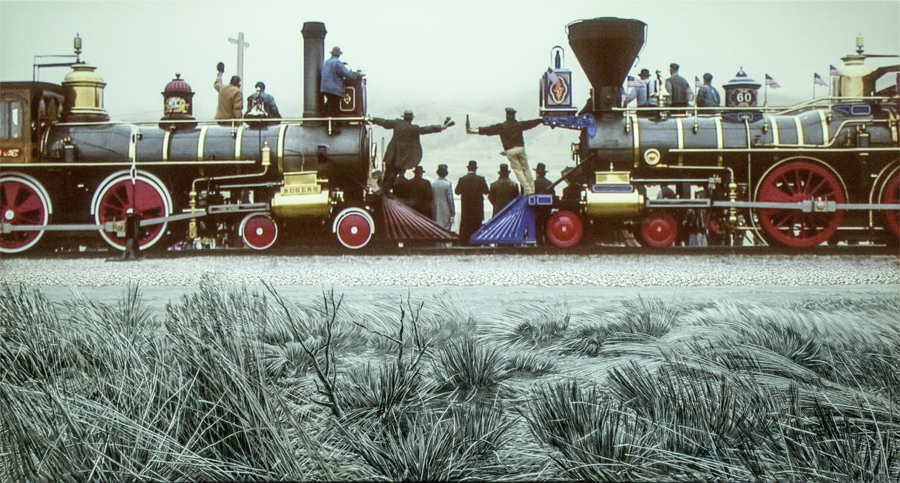 |
| Zhi Lin: “Chinaman’s Chance” on Promontory Summit. |

May 10, 1869
From Wikipedia, the free encyclopedia
Comments from Lee R. Christensen:
Today I think is the yearly celebration of the driving of the Golden Spike. For years I’ve thought my great grandfather Charles Parke played a part in the building of the railroad and could be in the famous photo taken at the time. He lived in Willard, Utah and supposedly worked on the Echo canyon part of the building. Years ago I wrote Union Pacific and they had no personnel records covering that period. Now! Today! I’ve learned the Brigham Young had a contract with the railroad companies to build the road in Utah and that Mormons built all of it thru Weber Canyon. Could you (I’m hiring you this time) check with the History division and see what records they have>?
From Wikipedia, the free encyclopedia
Completing the last link in the Transcontinental Railroad with a spike of gold was the brainchild of David Hewes, a San Francisco financier and contractor. The spike had been manufactured earlier that year especially for the event by the William T. Garratt Foundry in San Francisco. Two of the sides were engraved with the names of the railroad officers and directors. A special tie of polished California laurel was chosen to complete the line where the spike would be driven. The ceremony was originally to be held on May 8, 1869 (the date actually engraved on the spike; see below), but it was postponed two days because of bad weather and a labor dispute that delayed the arrival of the Union Pacific side of the rail line.

On May 10, in anticipation of the ceremony, Union Pacific No. 119 and Central Pacific No. 60 (better known as the Jupiter) locomotives were drawn up face-to-face on Promontory Summit, separated only by the width of a single tie. It is unknown how many people attended the event; estimates run from as low as 500 to as many as 3,000; government and railroad officials and track workers were present to witness the event.
Before the last spike was driven, three other commemorative spikes, presented on behalf of the other three members of the Central Pacific's Big Four who did not attend the ceremony, had been driven in the pre-bored laurel tie:
- a second, lower-quality gold spike, supplied by the San Francisco News Letter was made of $200.00 worth of gold and inscribed: With this spike the San Francisco News Letter offers its homage to the great work which has joined the Atlantic and Pacific Oceans.
- a silver spike, supplied by the State of Nevada; forged, rather than cast, of 25 ounces of unpolished silver.
- a blended iron, silver and gold spike, supplied by the Arizona Territory, engraved: Ribbed with iron clad in silver and crowned with gold Arizona presents her offering to the enterprise that has banded a continent and dictated a pathway to commerce. (Source: Deseret Morning News, Salt Lake City, April 24, 2007)
The golden spike was made of 17.6-karat(73%) copper-alloyed gold, and weighed 14.03 troy ounces (436 g). It was dropped into a pre-drilled hole in the laurel ceremonial last tie, and gently tapped into place with a silver ceremonial spike maul. The spike was engraved on all four sides:
- The Pacific Railroad ground broken January 8, 1863, and completed May 8, 1869.
- Directors of the C. P. R. R. of Cal. Hon. Leland Stanford. C. P. Huntington. E. B. Crocker. Mark Hopkins. A. P. Stanford. E. H. Miller Jr.
- Officers. Hon. Leland Stanford. Presdt. C. P. Huntington Vice Presdt. E. B. Crocker. Atty. Mark Hopkins. Tresr. Chas Crocker Gen. Supdt. E. H. Miller Jr. Secty. S. S. Montague. Chief Engr.
- May God continue the unity of our Country, as this Railroad unites the two great Oceans of the world. Presented by David Hewes San Francisco.
A second golden spike, exactly like the one from the ceremony, was cast and engraved at the same time. It was held, unknown to the public, by the Hewes family until 2005. This second spike is now on permanent display, along with Thomas Hill's famous painting The Last Spike, at the California State Railroad Museum in Sacramento.[2]
With the locomotives drawn so near, the crowd pressed so closely around Stanford and the other railroad officials that the ceremony became somewhat disorganized, leading to varying accounts of the actual events. Contrary to the myth that the Central Pacific's Chinese laborers were specifically excluded from the festivities, A.J. Russell stereoview #539 shows the"Chinese at Laying Last Rail UPRR" (8 Chinese laid the last rail, and three of these men, Ging Cui, Wong Fook, and Lee Shao, lived long enough to also participate in the 50th anniversary parade. At the conclusion of the ceremony, the Chinese participating were honored and cheered by the CPRR officials.)
To drive the final spike, Stanford lifted a silver spike maul and drove the spike into the tie, completing the line. Stanford and Hewes missed the spike, but the single word "done" was nevertheless flashed by telegraph around the country. In the United States, the event has come to be considered one of the first nationwide media events. Immediately afterwards, the golden spike and the laurel tie were removed and replaced with a regular iron spike and normal tie. At exactly 12:47 p.m., the last iron spike was driven, finally completing the line.
After the ceremony, the Golden Spike was donated to the Stanford Museum (now Cantor Arts Center) in 1898. The last laurel tie was destroyed in the fires caused by the 1906 San Francisco earthquake.


Aftermath
Although the Promontory event marked the completion of the transcontinental railroad line, it did not actually mark the completion of a seamless coast-to-coast rail network. The Mossdale Bridge, which was the final section across the San Joaquin River near Lathrop, California, was finally completed in September 1869 connecting Sacramento in California. [3] Passengers were required to cross the Missouri River between Council Bluffs, Iowa and Omaha, Nebraska by boat until the building of the Union Pacific Missouri River Bridge in 1872. In the meantime, a coast-to-coast rail link was achieved in August 1870 in Strasburg, Colorado by the completion of the Denver extension of the Kansas Pacific Railway.
In 1904 a new railroad route called the Lucin Cutoff was built by-passing the Promontory location to the south. By going west across the Great Salt Lake from Ogden, Utah to Lucin, Utah, the new railroad line shortened the distance by 43 miles and avoided curves and grades. Main line trains no longer passed over Promontory Summit.
In 1939, following the premiere of the Cecil B. De Mille motion picture Union Pacific in Omaha and Council Bluffs a gold-colored concrete spike 56 feet (17 m) in height was unveiled on 9th Avenue in Council Bluffs on the approximate location of milepost 0.0 of the First Transcontinental Railroad.

In 1942, the old rails over Promontory Summit were salvaged for the war effort; the event was marked by a ceremonial "undriving" of the last iron spike. The original event had been all but forgotten except by local residents, who erected a commemorative marker in 1943. The years after the war saw a revival of interest in the event; the first re-enactment was staged in 1948.
In 1957, Congress established the Golden Spike National Historic Site to preserve the area around Promontory Summit as closely as possible to its appearance in 1869. The site contains working replicas of the locomotives present at the original ceremony, which are drawn up face-to-face each Saturday during the summer for a re-enactment of the event.
For the May 10, 1969 centennial of the driving of the last spike, the High Iron Company ran a steam powered excursion train round trip from New York City to Promontory. The Golden Spike Centennial Limited transported over 100 passengers including, for the last leg into Salt Lake City, actor John Wayne. The Union Pacific Railroad also sent a special display train and the US Army Transportation Corp sent a steam powered 3-car special from Fort Eustis, Virginia.
On May 10, 2006, on the anniversary of the driving of the spike, Utah announced that its state quarter design would be a depiction of the driving of the spike. The Golden Spike design was the conception of Syracuse, Utah Junior High School special education students under the direction of instructor Scott Price. The design was selected as the winner from among several others by Utah's governor, Jon Huntsman, Jr., following a period during which Utah residents voted and commented on their favorite of three finalists.


Comments from Lee R. Christensen:
“Interestingly enough, there were actually two grades built, both parallel and adjacent to each other. Both the Union Pacific and Central Pacific were under contract by the U.S. Government to build, and each were paid by the mile. It wasn't until after the construction crews passed each other (working in opposite directions) that the meeting point was established. The Central Pacific grade is now the famous one, and is the one preserved by the BLM. The Union Pacific grade was abandoned in 1870, less than a year after the Golden Spike was driven, qualifying it as one of the oldest abandoned grades that it still clearly visible”
~~~~~~~~~~~~~~~~~~~~~~~~~~~~~~~~~~~~~~~~~~~~~~~~~
~~~~~~~~~~~~~~~~~~~~~~~~~~~~~~~~~~~~~~~~~~~~~~~~~
Below from Lee R. Christensen
Today I think is the yearly celebration of the driving of the Golden Spike. For years I’ve thought my great grandfather Charles Parke played a part in the building of the railroad and could be in the famous photo taken at the time. He lived in Willard, Utah and supposedly worked on the Echo canyon part of the building. Years ago I wrote Union Pacific and they had no personnel records covering that period. Now! Today! I’ve learned the Brigham Young had a contract with the railroad companies to build the road in Utah and that Mormons built all of it thru Weber Canyon. Could you (I’m hiring you this time) check with the History division and see what records they have>?
Subscribe to:
Posts (Atom)