
Saturday, June 4, 2022

Friday, June 3, 2022
A Proclamation From Brigham Young

On May 4th, 1866, President Orson Hyde visited Mount Pleasant and read to the people a proclamation from the First Presidency, addressed to the people of Sanpete, Sevier, Piute, and other settlements which were not safe from the Indians. The Presidency begged the people to be of good cheer and advised that all settlements that had not over 150 families should move to larger settlements.
They should arm themselves. The stock should be guarded so that the Indians would not be able to steal anymore. If the Indians desired peace and came into the settlements, they should be treated with kindness, for if a peaceable Indian was killed it was just as much murder as if it had been a white man.
Quoting R. N. Bennett: "David Candland was sent with the epistle for the people of Fairview to move to Mount Pleasant, the people of Fountain Green to Moroni, and the people of Spring City to move to Ephraim. John L. Ivie and myself were sent as Candland's bodyguards. After these families had moved, the minutemen of Mount Pleasant and other settlements had to go as guards for the men while they did their work."
Soon after President Hyde's visit, the people of Mount Pleasant sent teams to Fairview to help the people move. The move of the people to Mount Pleasant took place in one day. They were located within the fort, and with families outside the fort. During the time they were living at Mount Pleasant, men went to Fairview to build a fort for their protection and in August, when the work was completed, they were prepared to return. President Hyde came to Mount Pleasant and held a meeting with the citizens of Fairview, and released Andrew Petersen, the acting bishop, and ordained Amasa Tucker, of Mount Pleasant, to act in his stead.
In Mount Pleasant, it was now found necessary, in order to protect the cattle, to erect a fort. Some today, claim this was never completed, yet we find recorded in Andrew Madsen's Journal, "On June 4th the wall was commenced, and the fort, the same size as the one erected in 1859, was completed on June 19th, 1866."
The walls enclosed the block consisting of a little more than five acres, lying directly north of the old fort. (This block is now known as the North Sanpete High School Block.) Andrew Rolph states that the east, north and west walls were the same height as those of the old fort, but that the south wall was only about half as high, and there was a gate in the center of it. In due time four herders, who were paid so much ahead for herding the cattle had been appointed. The tingling of the many cowbells was a familiar sound as the herd was taken out at seven o'clock every morning. One man was assigned as gatekeeper, and after the cattle were accounted for and claimed by the owners, the gate was locked.
Horses for the guards were always on hand. He further states that the first break in this fort wall was made near the northeast corner by Thomas Fuller, who used the rocks to wall up a ditch which passed in front of his mother, Mrs. Sarah Scoville's, place, which was opposite on the north side of the street.
General Daniel H. Wells and their escort visited Mount Pleasant on June 19th and gave the people timely advice in regards to protecting themselves against the Indians.
The minutemen were often called to scout about without finding the enemies. The country was sparsely settled, the raids day and night of so frequent occurrence, the scanty crops must be harvested, the wood must be hauled, and other preparations for winter be made, so that it was impossible for men to attend to their farms and stock and other duties, and fight the Indians day and night without some assistance.
Previous to this, Colonel O. H. Irish had called on General Doty asking for Military assistance from Fort Douglas, but had been informed by the commander at the fort that the settlers must take care of themselves.
The people of Salt Lake and Utah Counties, learning the real condition with their friends in the south, made preparations for the re-enforcing of the military power. A little later Captain P. W. Conover, with fifty men from Utah County, reported to General Snow for orders. Colonel Heber P. Kimball, having a company of fifty men from Salt Lake County, reached Manti. Colonel E. B. Page took command of the forces under Captain" Conover, and with such an additional force, the citizens felt secure and proceeded to their daily duties in comparative safety. The Indians kept away from the troops but managed to continue their depredations.
June 20th, 1866, Indians under Chief Black Hawk made a raid on the stock of Scipio. During the skirmish Henry Wright and James R. Ivie, the father of Colonel J. L. Ivie were killed. It will be remembered that in 1859 James R. Ivie had been chosen at Ephraim as a leader for the company of pioneers who settled Mount Pleasant and that he faithfully filled that position until W. S. Seeley was chosen bishop of the colony. A short time after the killing of Mr. Ivie, a son of Ivie, in retaliation for the killing of his father, killed a friendly Indian. This enraged the Indians and they entered more vigorously into the bloody work of massacre among the white settlers.his father killed a friendly Indian. This enraged the Indians and they entered more vigorously into the bloody work of massacre among the white settlers.
Captain Kimball's company, under command of Captain A. P. Dewey, was stationed at Thistle Valley. Sunday, June 24th, Captain Dewey sent out two companies of scouts, four in each company, one company going north and the other south. Two of those who were going south had stopped at the warm springs on the west side of the valley. The members of the camp were not aware that Indians were at that time scattered through the cedars and ravines surrounding the camp. However, Horner Roberts and John Hambleton, being at the spring, saw them. Roberts succeeded in evading the Indians and took the report to Mount Pleasant and Fairview. Charles Brown, of Draper, and a companion who were in the cedars, also seeing the Indians, made their way towards camp. Brown was shot in the back and, upon falling, the Indians shot him with arrows. Some of the company at camp, seeing him fall, rushed out and brought him to camp where he expired. The Indians immediately surrounded the camp, which consisted of six baggage wagons that had been placed along with a wall of wood built around the camp for their protection. This enabled the company to keep out of sight of the Indians. However, the Indians shot into the camp, wounding Thomas Snaar of Salt Lake City. When the news of the attack reached Mount Pleasant, Colonel John L. Ivie and his company were in Pleasant Creek Canyon. At about 2 p. m., upon hearing three shots fired followed by five more, which they knew to be a signal, immediately left the stock they were helping to gather and rode down to the mouth of the canyon about four miles east of Mount Pleasant, where the message was delivered to them. They were ordered to get to the scene as quickly as their horses could carry them.
A cavalry consisting of about eighteen or twenty men, including Colonel Ivie, George Tucker, Orange Seely, R. N. Bennett (Dolph), Martin Aldrich, Aaron Oman, Niels Madsen, and Peter Fredricksen started with great speed for Dewey's camp, at Fairview, others joined them.
They arrived in Thistle Valley about one hour before sundown, just in time to save the whole camp from being massacred. After a hard skirmish, the company succeeded in routing the Indians. Some Indians were killed and many wounded as they fled into the mountains; the Indians, as was their custom, took their dead and wounded with them. A chase was taken up; after following them to Soldiers Summit at the head of Spanish Fork Canyon, the Indians resorted to their old tactics, that of separating and going in all directions, and the men were compelled to return. During the skirmish in Thistle Valley, Orange Seely and Dolph Bennett, seeing an Indian leave his horse and sneak into the wash towards camp, captured the horse, saddle, bridle, a buckskin jacket, and a long lasso rope. Seely kept the horse for some time as a trophy of war. All horses, excepting five or six head of saddle horses, were missing. These were hitched by the rescuing party to the wagons and the camp was moved to a more protected location, where Indianola now stands. The body of Charles Brown was taken to Mount Pleasant for burial.
R. N. Bennett made the following statement concerning the attack: "June 24, 1866, Black Hawk warriors attacked Captain Peter Dewey's company at Thistle Valley, killing one man, Charles Brown, of Draper, and wounding Thomas Snaar, and driving off twenty or more head of horses. John L. Ivie, Orange Seely, George Tucker, myself, and others went to recover the horses. We followed Black Hawk and his band nearly to the head of Spanish Fork River, going a distance of about forty or fifty miles, then following down the Spanish Fork River, to about where Thistle Junction now is. During this engagement, three or four Indians were killed, and a number wounded."
Three days after the attack on Captain Dewey's camp, the red skins raided Spanish Fork and killed John Edmonston, of Manti, wounded another man, and drove away the stock. Settlers of Spanish Fork and Springville combined their forces and pursued the Indians up the canyon as far as they dared, securing most of the cattle. The Indians continued on into Sanpete, then into Sevier County, and caught the unprotected points as places for attacks. They kept on the mountain when near Manti, or in the vicinity of the troops, thus avoiding engagements. About July 1st, 1866, General Y. Kimball Wells, obeying the instructions of President Brigham Young, issued an order for the abandonment of the settlements in Piute County, and the colonists moved to Sanpete County, most of them located at Ephraim.
July 12th, Captain Bigler, with sixty men from Davis County, reached Manti, relieving the troops from Salt Lake County. Though new men soon had an opportunity for a conflict with the savages, for on the 27th, the Indians made a night raid on the cattle of Ephraim and Manti, driving away about 150 head of cattle. General Snow and Captain Bigler, with their commands, pursued the thieves into Castle Valley, but did not succeed in recovering the cattle, nor were they able to capture any Indians. This successful raid no doubt gave the Red Men enough beef for the winter. Few people had trouble with the Indians until the following spring. They managed to keep at a safe distance from the troops, enjoying the fruit of their many raids during the summer, and making their plans for the spring.
R. N. Bennett states: "About September 1866, the Black Hawk Indians drove off a herd of cattle, John L. Ivie, Orange Seely, myself and others, were with the company that followed them over the mountains east of Ephraim, via Joe's Valley, from there down Cotton Wood Canyon, on to Huntington River, where the town of Lawrence now stands, a distance of about seventy five miles. Then we came back to the Cotton Wood River, and then, camped and patrolled the valley two days, searching for Indians. We were gone from home about ten days."
Taken from History of Mt. Pleasant by Hilda Madsen Longsdorf pp 110-115
Thursday, June 2, 2022
Two Story Outhouse ~~~ Shared by Jeff McDonald

Did you know outhouses in the past often had more than one story: Believe it or not, high-rise outhouses actually existed. Back in the old days, they had two-story hotels in towns so they would build two-story outhouses. On the upper floor, you’d go back in a little bit further than the outhouse below. Waste from above would fall down a shaft behind the first-floor loo’s wall, allowing for a seamless flow of sewage. This is a 1941 photograph of a two-story outhouse.
' xlink:href='%23b'/%3e%3cuse fill='black' filter='url(%23c)' xlink:href='%23b'/%3e%3cpath fill='url(%23d)' d='M3 8.008C3 10.023 4.006 14 8 14c3.993 0 5-3.977 5-5.992C13 7.849 11.39 7 8 7c-3.39 0-5 .849-5 1.008'/%3e%3cpath fill='url(%23e)' d='M4.541 12.5c.804.995 1.907 1.5 3.469 1.5 1.563 0 2.655-.505 3.459-1.5-.551-.588-1.599-1.5-3.459-1.5s-2.917.912-3.469 1.5'/%3e%3cpath fill='%232A3755' d='M6.213 4.144c.263.188.502.455.41.788-.071.254-.194.369-.422.371-.78.011-1.708.255-2.506.612-.065.029-.197.088-.332.085-.124-.003-.251-.058-.327-.237-.067-.157-.073-.388.276-.598.545-.33 1.257-.48 1.909-.604a7.077 7.077 0 00-1.315-.768c-.427-.194-.38-.457-.323-.6.127-.317.609-.196 1.078.026a9 9 0 011.552.925zm3.577 0a8.953 8.953 0 011.55-.925c.47-.222.95-.343 1.078-.026.057.143.104.406-.323.6a7.029 7.029 0 00-1.313.768c.65.123 1.363.274 1.907.604.349.21.342.44.276.598-.077.18-.203.234-.327.237-.135.003-.267-.056-.332-.085-.797-.357-1.725-.6-2.504-.612-.228-.002-.351-.117-.422-.37-.091-.333.147-.6.41-.788z'/%3e%3c/g%3e%3c/svg%3e)
' xlink:href='%23b'/%3e%3cuse fill='black' filter='url(%23c)' xlink:href='%23b'/%3e%3cpath fill='white' d='M12.162 7.338c.176.123.338.245.338.674 0 .43-.229.604-.474.725a.73.73 0 01.089.546c-.077.344-.392.611-.672.69.121.194.159.385.015.62-.185.295-.346.407-1.058.407H7.5c-.988 0-1.5-.546-1.5-1V7.665c0-1.23 1.467-2.275 1.467-3.13L7.361 3.47c-.005-.065.008-.224.058-.27.08-.079.301-.2.635-.2.218 0 .363.041.534.123.581.277.732.978.732 1.542 0 .271-.414 1.083-.47 1.364 0 0 .867-.192 1.879-.199 1.061-.006 1.749.19 1.749.842 0 .261-.219.523-.316.666zM3.6 7h.8a.6.6 0 01.6.6v3.8a.6.6 0 01-.6.6h-.8a.6.6 0 01-.6-.6V7.6a.6.6 0 01.6-.6z'/%3e%3c/g%3e%3c/svg%3e)
' xlink:href='%23b'/%3e%3cuse fill='black' filter='url(%23c)' xlink:href='%23b'/%3e%3cpath fill='url(%23d)' d='M5.643 10.888C5.485 12.733 6.369 14 8 14c1.63 0 2.515-1.267 2.357-3.112C10.2 9.042 9.242 8 8 8c-1.242 0-2.2 1.042-2.357 2.888'/%3e%3cuse fill='url(%23e)' xlink:href='%23f'/%3e%3cuse fill='black' filter='url(%23g)' xlink:href='%23f'/%3e%3cpath fill='%234E506A' d='M4.481 4.567c.186.042.29.252.232.469-.057.218-.254.36-.44.318-.186-.042-.29-.252-.232-.47.057-.216.254-.36.44-.317zm6.658.063c.206.047.322.28.258.52-.064.243-.282.4-.489.354-.206-.046-.322-.28-.258-.521.063-.242.282-.4.49-.353z'/%3e%3cuse fill='black' filter='url(%23h)' xlink:href='%23i'/%3e%3cuse fill='url(%23j)' xlink:href='%23i'/%3e%3c/g%3e%3c/svg%3e)
Wednesday, June 1, 2022
Willard Lauritz Frandsen and Bothilda Johanna Hansen Frandsen ~~~ Pioneers of the Month ~~~ June 2022
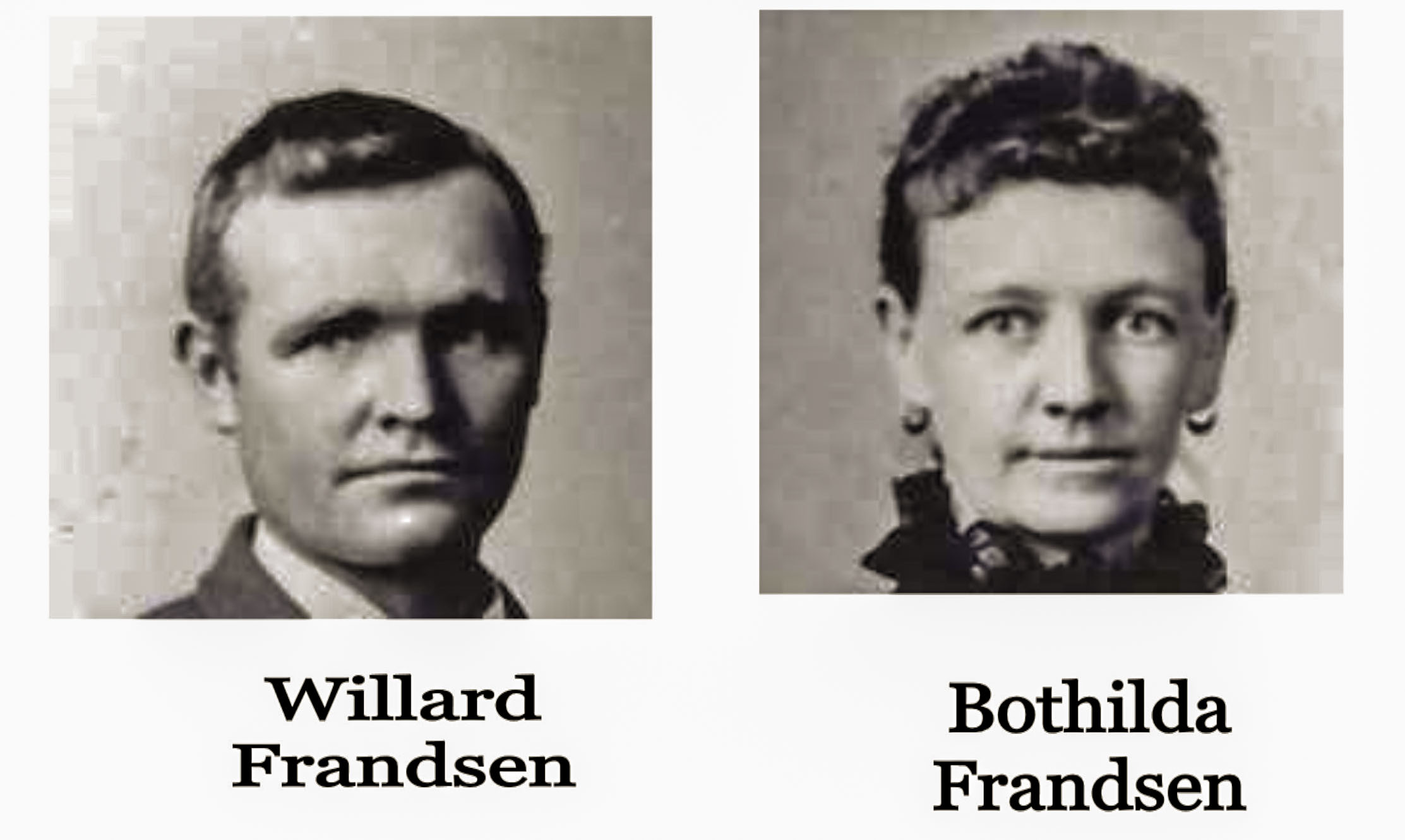
Willard was born on 14 August 1963 (7) in Mount Pleasant, Utah. He was the third and youngest son of Margretha and Rasmus Frandsen. He was born into a polygamous home, as there were 10 children in 12 years to the two sister wives.
During these 12 years, the third wife gave birth to four children. She had six children later.
It was a busy household. Willard spent many years on the floor of the large living room and kitchen with his homemade toys. While his mother churned, sewed, baked, and ___, he loved the beehive of activity. He always dreaded the days his mother was away caring for the sick or just visiting.
His dresses were kept clean (boys wore dresses until they were six years old) and his soft white curly hair, which he wore in ringlets, was washed every Saturday night when the family bath hour arrived.
He loved to eat. He always enjoyed the crisp carrots they grew in the garden and especially the Codling and Sweet Bough apples that grew in the orchard. He was always hungry. He lived across the street from the school. Many times he would take a sandwich to eat at recess and then go home for dinner.
He loved the farm animals, especially horses. When the men rode away to fight the Indians, it was his greatest desire to get big so he could ride away on a fast horse. His father had chosen horses for this purpose.
At the early age of six years, he herded the cows in the field. He loved the cows, but his stick horse became rather boring. Catching frogs was his favorite pastime. At times, he would get so interested his cows would stray and he would be worried until he found them. He loved to catch birds. The birds would make their nests in old tree stumps. He would thrust his hand in quickly before the bird had a chance to fly out. One day a large black snake wound itself around his arm. Its ugly head was near his face. After that, he was more cautious about catching birds.
At times he would go with his father at haying time. He would help rake the hay his father had cut with the ____. All the men would set the day for haying. They would go to the open fields and cut fast for all they cut was ends. It was hard work with but little rest while the race was on. The boys enjoyed seeing their fathers cut more than their neighbors. Also enjoyed the huge lunches and jugs of homemade beer brewed especially for the occasion. Too much water made the thirsty men ill. When the new invention of unloading hay with a fork came his father would not accept it. He said that it was a sign of laziness and anyway he could pitch the hay off the load faster.
He loved the Indian stories his father would tell after a scrimmage. When they became friendly came to the homes and begged. One day his father was giving an Indian some flour and he stuck his hand in the flour and the Indian slapped him. He never forgot the result. While he was herding he often came in contact with the Indians as they crossed the fields going to town. He learned many of their customs and spoke a good deal of their language. One day he was hanging around their camp watching them prepare a meal of cricket soup. He was playing with the Indian boys when the father invited him to eat. He was afraid to say no as they were easily provoked and he didn’t want trouble. The soup went down but he didn’t want a second helping. Because of his acquaintance with the Indians, Brigham Young sent him to Indianola to get the Indians to come to Mount Pleasant to sign the peace treaty with Black Hawk. This treaty was signed in the Bishop Seeley home, now the Mount Pleasant Relic Hall.
He went to school in several different buildings in Mount Pleasant. He finished the eighth grade. One time he climbed on his father's chicken coop and found a piece of mirror in the sun and into the teacher’s eyes. He was immediately caught and given a sound whipping with a hickory stick which the teacher kept on hand for such tricks. He went to Provo where he attended the Brigham Young Academy. He was a good student and always loved to read. He often quoted from his teacher, Karl G. Maeser.
He was an active boy. He loved to play with the neighborhood children. Run Sheep Run and Kick the Can be favorite games along with Ball and Tap Cat. He loved to dance. He often paid his ticket with a post or bushel of potatoes he had earned by hard work.
It was at a dance he met Bothilda Hansen. It was no easy matter to court her as she lived three miles west of town. But loved the horseback ride, which was his only means of transportation. She would always carry her dress. She would always wear something warmer for riding and she must keep her lovely dress fresh and clean for dancing. Many nights after Choir practice he would pick her up on his horse and they would ride the long distance on one horse. She would always ride side-saddle. He loved his horses and always kept them clean and well-groomed. He felt a man was judged by the way he kept his horses. Sleigh riding was a favorite pastime. The bobsleigh was made ready with straw and quilts and hot rocks. Then it filled with young people. After a few hours of riding, the gang would go to Bothilda’s place or some other home for donuts and buttermilk or homemade beer if the girl could talk her mother into it.
At the age of 23, he married Bathilda. The date was 24 June 1886. This was a very happy relationship. She was a good housekeeper, cook, and mother. She loved to sing. She was the daughter of James Hansen. He played the violin at the dances and led the choir. They continued their love for dancing and horseback riding all through their lives. They were on the dance floor at the Church Parties, old folks parties, and masquerade balls. And would often waltz in their own home by music from the radio when they were in their early 60s.
They spent the first year of their married life in his mother’s home as the house was large and the family is mostly gone. During this yar, Willard built the one-room frame house on the Homestead farm north of town. They moved into it soon after their first child, Farrie was born.
The farm was in its primitive state. It was covered with sagebrush even higher than their heads. Much hard work was required to get the land in shape to be cultivated. The bush was grubbed and stacked in piles by hand. In the evening the piles were set on fire and burned, much to the delight of the children. Potatoes and onions were roasted. The hard work was turned into fun and frolic. Mother’s flowers made the desert farm blossom as a rose. New rooms were added to the house as the family grew larger. Eight children, to boys and six girls, were born and raised in this house, just outside the city limits.
Willard was very good and kind to his family always wanting them to have the things he had missed in life. Willard spent his summers on the farm and his winters on the desert herding sheep. He had invested his hard-earned savings in sheep and was anxious to see them thrive and produce well. This was difficult work. Horses and wagons were used to haul food and supplies. This was difficult work. Tents were used for sleeping. Most of the cooking was done in the open. Dutch ovens and open kettles were their utensils. Many nights the young wife spent in tears when a letter was received saying that he had gone to bed with his eyes full of ashes and belly full of burned bread. Then in the hard times of Pres. Cleveland and the panic of 1893, prices were low and the winter was hard. The expenses were too great. The result was the complete loss of his sheep. This was a hard blow, as he now had a family of several children to support. His wife, Bothilda, took on sewing at this time to help over the crises. She dried corn to sell and also churned butter to sell.
Cattle were his means of making a living but he also loved horses and would have a fine animal to sell. These horses always brought top prices.
He owned a hay bailer, the first in Mount Pleasant. He would bale his hay then pull the bailer near the stack. The men would pitch the hay to a table. From this he himself would feed it into the bailer in small forkfuls. A man would arrange the wire and tie it. When a certain length was reached a block of wood was placed in the bailer to separate the bales. A team was hitched to the plunger and were driven around and around to furnish the power. This was hard work for the men but they seemed to enjoy it. The said while they worked. One of us children followed the team to keep them at a regular speed. This was extremely monotonous as we followed around and around. He would move his bailer wherever hay was to be bailed. Often going to the Schofield valley where enough hay was bailed to keep him busy all fall. One time he went to Abraham Millard County. While bailing here the youngest son was born. He named him Abraham after the beautiful Abraham valley. This baby was a beautiful little fellow, so fat and healthy, but at the age of 9 months he became ill and died. This was a great sorrow to them both. Bothilda never quite got over it. She was so happy when he came to their home. She felt she couldn’t spare him.
One day we children came home from school and a large box was on the porch. We knew at a glance a piano had been in the strange box. Sure enough, when we went inside to see it, there stood a beautiful piano, the grandest sight we had ever seen so large and shiny. This piano was one of the first three in town. We were indeed proud. This replaced the organ we had used to practice on. Brother John Hastler who had sold us the piano gave lessons as a bonus. On Saturday mornings at 6 a.m. every three weeks, he would come to our home to give 5 of us children lessons. He would always have breakfast with us and then on to his next students for dinner he would go. The piano was bought on the installment plan as few things were. $500.00 was a very large sum to raise. One time he hardly knew where to get the $50 due and we were all worried about our precious piano. Then one day, he came in the house all smiling. He had found a way. The Ringling Brothers Circus was coming to town and wanted his ground for a few days. We were excited waiting and wondering what the circus was like. Finally the day arrived. We were all up at daylight and down to the depot to see the train unload. What a thrill—so many cars loaded with strange animals and beautiful floars. We hardly knew where to go to see the most. We reached home ot see the huge tents raised by the elephants. The cook tent was a buzz as the cooks prepared food for all the workmen. Finally, the 10:00 parade started.
Never had we seen such beautiful cages with wild animals, steam callia, clowns, and beautiful horses with lady riders. How we were thrilled when the leader would call, “Follow the parade to the showground”, and we knew that they were going to our farm. All that day we watched the circus three rings of acts, sideshows, and menagerie. We watched far into the night as they lowered the tents and led the elephants back to the train. The small town had become a large city as people came from distant towns and pitched their tents or parked their covered wagons in the streets. Her they cooked on open fires, many brought their milk cow for their fresh milk. Boxes of chickens were brought to supply meat. Baskets were baked in dutch ovens. Every street was a campground. This circus was a never-to-be-forgotten experience. They returned to our farm for three years.
One day a large iron box affair was being loaded into our home. When the men had completed the job it was the first Home Comfort Range in town. Peddlers always stayed at our farm where they could get feed and care for their horses and so the range for their company. Fruit peddlers always stayed with us. Jews came as peddlers to sell their wares. One Mr. Pink made his early visit a new folding cane part for care of the team. His yard was often filled with horses and wagons as many as 20 or 30 campfires in the evening and mornings brought the smell of bacon and coffee being prepare. He always worried about the fires and would often make a trip to the yard late at night to make sure the fires were out.
Occasionally a fruit peddler would become discouraged and ready to pull out, Will would feel sorry for him especially the young men and buy the balance of his load. Our cellar would be full of peaches, melons, or sweet potatoes, often mother would dry the peaches to keep them as her jars were already full.
His fear of fire urged him to buy hanging lamps to replace the high foot lamps on the table when the children got big enough to climb. It was a fear of starting a fire from the coal oil. The only water supply was a creek one and half blocks away. Later a well was dug and a central pump put in. But as there is little in Mount Pleasant most of the water was pumped by hand. This was a big chore for him on wash day. Filling the reservoir on the range and a large copper kettle outside.
Willard had large gallows where he would butcher for individuals and the butcher shop. Often Indians came begging. While they were tame and quiet, white people never lost their fear of them. They would camp by the Tithing Yard when the Bishop would supply them with hay and grain for their horses. The school children all loved to see them, with their bright-colored shawls and gay clothes. It was always a thrill to see a tiny papoose. Their tiny papooses were always smiling and good-natured. As a squaw came to the door begging you always felt like giving more if she had a cute little baby jogging along on her back. Two or three squaws would come together. When they would receive anything, they would immediately sit on the ground and (END OF DOC)
Bothilda Johanna Hansen Frandsen
My grandmother, Talula Johanna Nelson, told me this story about her Mother, Bothilda Johanna Hansen. Bothilda and Hannah Seeley were born the same year (1866) in Mt. Pleasant and were extremely good friends. It was a sad day for both of them when Orange Seeley and Hanna Olsson Seeley answered a call to go to Emery County to settle that country in 1879. They were all packed up and it was very early in the morning, but Orange knew how much these two friends loved one another. He stopped his team and Botilda ran out to hug her friend and say goodbye. Talula thinks that was the last time they saw each other, but I read that Hannah rode to Mt. Pleasant to see a dentist. She may or may not have visited with her friend Bothilda.
My daughter Victoria Ferris has been friends with Jenny Oaks and I have second cousins who descend from Orange Seeley and am reading the book President Oaks wrote, "Lessons Learned." My reading in this book made me think of the little story I have written here. If any of you want to see Bothilda Johanna Hansen on Family Search.Tuesday, May 31, 2022


_edited.jpg)


_edited.jpg)
Monday, May 30, 2022
REMEMBERING THE UNITED STATES MILITARY PERSONNEL
Mourning the U.S. military personnel who have died while serving in the United States armed forces.  |
| ARLINGTON VIRGINIA ~~~~~  TOMB OF THE UNKNOWN SOLDIER ~~~~~~~~~The following comes from Wikipedia: The history of Memorial Day in the United States is complex. The U.S. Department of Veterans Affairs recognizes that approximately 25 places claim to have originated the holiday.[6] At Columbus [Georgia] State University there is a Center for Memorial Day Research,[citation needed] and the University of Mississippi incorporates a Center for Civil War Research that has also led research into Memorial Day's origins.[7] The practice of decorating soldiers' graves with flowers is an ancient custom.[8] Soldiers' graves were decorated in the U.S. before[9] and during the American Civil War. Many of the origination claims are myths, unsupported by evidence, while others are one-time cemetery dedications or funeral tributes. In 2014, one scholarly effort attempted to separate the myths and one-time events from the activities that actually led to the establishment of the federal holiday. \   |
Sunday, May 29, 2022
.jpeg&container=blogger&gadget=a&rewriteMime=image%2F*)
Saturday, May 28, 2022
Postcards Sent Home
Have you ever put something away in an old dresser
and then forgotten that you ever had it? I was looking
for some old curtains that I had used years ago and then
found an old postcard and greeting card album
that my Grandmother Rigby had. Over 20 years ago
this album had been passed on to me by a sister-in-law.
The two postcards that I have posted here were
sent to Grandma Rigby back in the 1930s or 1940s.
My dad had gone to Utah State Agricultural College
to learn carpentry.
When World War II broke out, he was then able to go to
San Diego and work at Consolidated Aircraft.
This was all before I was born.
My mother and dad would often talk about these experiences.
My mother told me that when they lived in Logan
they lived next to the Logan Temple. She said it was
on the same block.

Well, now the temple and surroundings take up the whole block.
During their time in San Diego, they lived in a housing development in
Linda Vista California where my father worked building airplanes.
The houses in Linda Vista were built just to accommodate
the workers at Consolidated Aircraft.
The Memorial Day after my mother passed away,
my husband and I as well as our youngest son, Jon and also Peter's mother,
Alice flew down to San Diego.
I had found an old address from a friend that my mother had when living in Linda Vista.
I was hoping to see the home in which they had lived.
We walked up and down the sidewalks talking to all who were outside in that area.
Soon one younger woman said, "You better go talk to my Grandmother Eps".
It turned out that Grandmother Eps was who my mother called "Epsy". They
had been good friends and neighbors. She pointed out
the house where my mother and father lived. Just for a few moments,
I could feel my mother's spiritual presence there.


Friday, May 27, 2022
Mt. Pleasant South Ward Sunday School 1923


On December 9, 1900, Mt. Pleasant was divided into two wards, the North and the South. The original Southward chapel was built and dedicated in 1908. Lars P. Madsen was made Bishop, with Thomas West and Joseph Seeley as counselors of the Northward, and James Larsen, Bishop, with Christian Johansen and James Monsen as counselors of the Southward.
February 23, 1937, the South Ward L. D. S. Chapel was destroyed by fire, and on Sunday, March 27th, the corner stone for the new chapel laid. Although the new building was not complete, the opening social was held there May 12, 1939. In excavating for the new building, it was found that all that had been placed in the corner stone of the former building had decayed and the cement box had filled with moisture.
Rocks from the old building were used in constructing the west wall at the cemetery, a W. P. A. project.
MT. PLEASANT SOUTH WARD
1877, W. S. Seely, Bishop; Counselors, Jacob Christensen, Wm. F.
Reynolds, C. N. Lund, Peter Mogensen (Monsen).
MT. PLEASANT SOUTH WARD
December 1900, James Larsen, Bishop; Christian Johansen and
James Monsen, Counselors.
1923, A. Merz, Bishop; A. E. Mcintosh and J. W. Anderson, Counselors.
1914, A. E. Mcintosh, Bishop; Clarence Stewart, Kimbal Johansen, Mads Anderson and Louis A. Peterson, Counselors.
1926, Andrew L. Peterson, Bishop; Clarence Stewart and Joseph Johansen, Counselors.
1877, W. S. Seely, Bishop; Counselors, Jacob Christensen, Wm. F.
Reynolds, C. N. Lund, Peter Mogensen (Monsen).
MT. PLEASANT SOUTH WARD
December 1900, James Larsen, Bishop; Christian Johansen and
James Monsen, Counselors.
1923, A. Merz, Bishop; A. E. Mcintosh and J. W. Anderson, Counselors.
1914, A. E. Mcintosh, Bishop; Clarence Stewart, Kimbal Johansen, Mads Anderson and Louis A. Peterson, Counselors.
1926, Andrew L. Peterson, Bishop; Clarence Stewart and Joseph Johansen, Counselors.


photo by David R. Gunderson

(Excerpts taken from the Mt. Pleasant book by Hilda Madsen Longsdorf)
Photos available at the Mt. Pleasant Relic Home
Subscribe to:
Posts (Atom)