Wednesday, January 15, 2025
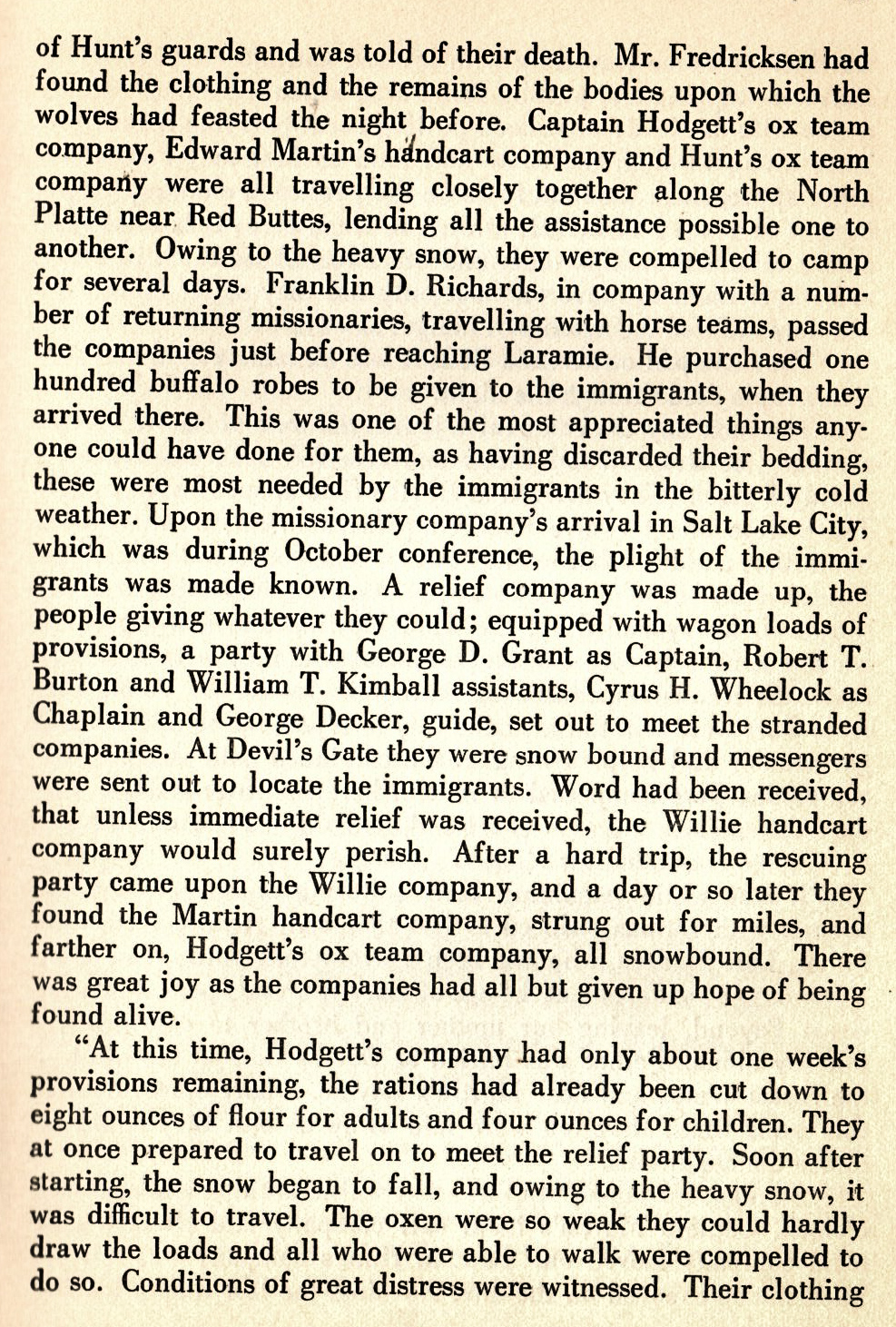
IMMIGRATION EXPERIENCES (Taken from History of Mt. Pleasant by Hilda Madsen Longsdorf)

Tuesday, January 14, 2025
Monday, January 13, 2025
BUILDING OF ST. GEORGE TEMPLE ~~From Our Archives

Building of St. George Temple
Work was commenced on the St. George Temple, March II. 1873; as in the past, the citizens of Mt. Pleasant readily responded to the call. Those at home donated liberally and on December 2nd. the following men and boys left their homes to perform labor on the temple: Lars Rasmussen, Christian Christensen, Hans Hansen, Soren Jacobsen, Chris Peel, August Nelson, William Olson, Jacob Jensen, Hans Davidson, Olaf Rosenlof, Thomas Coates, Christian Madsen, Thomas Fuller, Andrew Rolph, Abraham Day, Ezra Day, James C. Christensen, Joseph Burton, Fred Mauritz Petersen, Nels Syndergaard, Frank Keller, with Andrew Madsen (Harbro), Jake Bohne, Bennett Monk and Peter Rasmussen as teamsters. The four last named soon returned to Mt. Pleasant, while the others remained until during the spring of 1874. At the present writing, 1939. the only two of the entire party now living are Andrew Rolph and William Olson. At the time the party left Mt. Pleasant, they were instructed by the bishop to apply to the bishops of the Wards for shelter and supplies while camping; however, at Indian Creek or Pine Dug Way they encountered a very severe blizzard, and after vainly endeavoring to travel on, were compelled to camp in the open without any shelter whatsoever, and for a time feared they would all perish. Finally, December 14th, after having traveled in a heavy, blinding snowstorm most of the way, they reached St. George safely. January 4th, four loads of sup plies were taken to them by James Larsen, Sylvester Barton, Soren Hansen Jacobsen, and Christopher Johnson. taken from History of Mt Pleasant by Hilda Madsen
Sunday, January 12, 2025
PIONEER CELEBRATION 1914
Saturday, January 11, 2025
Dr. Samuel Allen and Ida Mae Lowry Allen
The home of Samuel Allen and Ida Mae Lowry Allen when they lived in Provo, Utah. The home is still standing today. Address is: 135 E. 200 N. Provo. Samuel and Ida Mae are near the steps. Here is a very interesting history of the home and the families that have owned it: https://en.wikipedia.org/wiki/Dr._Samuel_H._Allen_House_and_Carriage_House It has been painted a blue/gray. Photo found in the L. Tom Perry Special Collections at BYU. George Edward Anderson, photographer.
SAMUEL H. ALLEN AND IDA MAY LOWRY ALLEN
The home of Samuel Allen and Ida Mae Lowry Allen when they lived in Provo, Utah. The home is still standing today. Address is: 135 E. 200 N. Provo. Samuel and Ida Mae are near the steps. Here is a very interesting history of the home and the families that have owned it: https://en.wikipedia.org/wiki/Dr._Samuel_H._Allen_House_and_Carriage_House It has been painted a blue/gray. Photo found in the L. Tom Perry Special Collections at BYU. George Edward Anderson, photographer.
~~~~~~~~~~~~~~~~~~~~~~~~~~~~~~~~~~~~~~~~~~~~~~~~~~~~~~~~~~~~~~~~~~~~~~~~~~~
Ida May Lowry was born 30 July 1865 in Manti, Sanpete, Utah Territory to John and Sarah Jane Brown Lowry Jr. Her family was with the Saints in Missouri when all their tribulations were so bad. They went to Nauvoo, probably in 1839 when they were expelled from Missouri.
After they were expelled from Nauvoo, they started toward the west with the Saints. Two of the youngest children, Elizabeth Eunice and William Mahonri died at Mt. Pisgah, Iowa. Elizabeth was five and William was two. They lost another son Hyrum Madison at Winter Quarters, Douglas, Nebraska. He was 20 years old.
They came to Utah Territory with the Edward Hunter- Jacob Foutz Company. Her grandfather, John was 47, his grandmother Mary was 44, and the following children were in the company: John (his father) age 18; Abner, age 15; Susan Lucretia, age 13; Mary Artimesis, age 13; George Moroni, age 10; and Sarah Jane, age 13.
They departed on 19 June 1847 from the outfitting post on the Elkhorn River about 27 miles west of Winter Quarters, Nebraska with 158 individuals and 59 wagons. They traveled from day to day feeling as happy and cheerful as possible under the conditions, covering from ten to fifteen miles a day. Their last camp before entering the Salt Lake valley would be a short distance above the mouth of Emigration Canyon. After a journey of about four or five months, they reached Salt Lake on the 29th day of September 1847.
They settled in the Salt Lake Valley. Her father was baptized into the Church of Jesus Christ of Latter-day Saints on 23 February 1851 at the age of 22. He married Sarah Jane Brown on 7 July 1852 in Salt Lake City, Salt Lake, Utah Territory. They moved to Manti, Sanpete,Utah Territory where they lived while their children were growing up.
They had nine children, six girls and three boys. Ida May was the seventh child born to John and Sarah Jane. She was baptized into the Church of Jesus Christ of Latter-day Saints on 24 October 1875 at the age of ten.
She married Samuel H. Allen on 8 June 1892 in the Manti Temple, Manti, Sanpete, Utah Territory at the age of 26. Samuel was born 15 August 1862 in Mt.Pleasant, Sanpete, Utah Territory to Samuel and Harriet Moore Allen. He was baptized into the Church on 7 September 1870 at the age of eight. He was endowed on 25 July 1888 in the Manti Temple, Manti, Sanpete, Utah at the age of 25. He was 29 when they married.
Samuel’s family came to Utah Territory with the Cyrus H. Wheelock Company. There were 439 individuals and 52 wagons were in the company when it began its journey from the outfitting post at Keokuk, Iowa. This company included a California company. They departed on 1 June 1853. There were also seven individuals as part of the California Company traveling with them. His grandparents and his father were in the company. They arrived in the Salt Lake valley on 6 October 1853.
Samuel and Ida May had six children, five girls and one boy. Moore Lowry was born April 3 1893 in Mount Pleasant, Sanpete, Utah Territory. The next four children were born in Provo, Utah, Utah. Erma was born 12 November 1894; Olive was born 11 May 1897 and died 12 May 1897; Ruth was born 3 April 1899; Ethel was born 18 April 1901; and Marjorie was born 26 August 1905.
Her husband worked on his father’s farm until he went to school at the University of Utah graduating in 1880. He taught school from 1881 to 1883. He was a missionary to England from 1883 to 1885. He went to Brigham Young University at Provo and graduated in 1887. He was the first principal of Mount Pleasant High School in 1887 and 1888.
He received his medical education at the College of Physicians and Surgeons, Johns Hopkins University, and the London University Medical Department. He was there from 1888 to 1891.
He started his practice in Salt Lake City, Salt Lake, Utah in 1902. He also served two terms on the Mount Pleasant City Council. They lived in a beautiful home on the 4th Ward at 206 Eight Avenue.
Samuel died on 30 August 1926 in Salt Lake City, Salt Lake, Utah at the age of 64. He was buried on 1 September 1926 in the Salt Lake City Cemetery, Salt Lake City, Salt Lake, Utah.
Ida May died on 12 May 1963 at the age of 97. She was buried in the Salt Lake City Cemetery, Salt Lake City, Salt Lake, Utah.
Ida May died on 12 May 1963 at the age of 97. There is no record of where she was buried.
Friday, January 10, 2025
Thursday, January 9, 2025
Wednesday, January 8, 2025
PATRICIA NEILSON BREWER ~~ ~ Our High School Friend
Patricia Brewer
December 11, 1946 — December 25, 2024
Spring City
Patricia (Trish) Neilson Brewer
On a peaceful Christmas morning (December 25, 2024), just days following her 78th birthday, we said goodbye to our beloved wife, mother, grandmother, sister, aunt, and friend.
Trish was born to Pherris and Guyla Neilson in Manti on December 11, 1946. She grew up in Moroni and graduated from North Sanpete High School. She married her soulmate, Lonnie J. Brewer on March 14, 1964, and their marriage was later solemnized in the Manti LDS Temple. Together they had five children, Lesa Edmunds, Christine Schleidt, Scott Brewer, Ryan Brewer, and Karen Brewer. Spring City has been their long-standing home.
She held various church callings throughout her life and served many years as a North Sanpete School District lunch lady.
She treasured her family and was deeply loved by them. She and Lonnie recently celebrated their 60th wedding anniversary as a devoted wife. Her children and grandchildren were her everything and she was always there for them. She was a great cook and a talented quilter who enjoyed tole painting, and antiquing (especially for old keys). She liked Western movies and her favorite drink, Pepsi. She genuinely cherished her talks and traditional birthday lunches with her sisters. We will all miss her warm hugs, gentle smile, and sweet laugh.
Trish is survived by her husband, her children, her sisters Grace Tucker, Doris Brunson, and Carol Johnson, her 16 grandchildren, and 11 great-grandchildren. She was preceded in death by her parents and brother Jimmy Neilson.
A viewing was held on Friday, January 3rd from 6:00 to 8:00 p.m. at the Spring City LDS Rock Church, located at 164 S. Main Street.
To Watch Recorded Funeral Service, Click Here.
To Watch Recorded Graveside Service , Click Here.
Recordings are available for 60 days from date of service.
Tuesday, January 7, 2025
THE SYNOPSIS OF THE THIRTY SIXTH ANNUAL CELEBRATION OF THE MT. PLEASANT PIONEER HISTORICAL ASSOCIATION
Monday, January 6, 2025
Sunday, January 5, 2025
MARIE WILHELMINA CATHERINE KRAUSE,
MARIE WILHELMINA CATHERINE KRAUSE 350 Born: 27 April 1847 Svenborg, Fuenert (Fynn), Denmark Age: 9 Hodgett Wagon Company. Wilhelmina's biography is taken mostly from a well researched account written by two of her granddaughters, Pearle M. Olsen and Aleen M. Summers. All accounts speak of Wilhelmina as a very "comely" and beautiful girl. Her parents were both from Germany, her mother, Anna Lucia Simonsen Abel, having been widowed previously. When Anna's first husband died, she inherited a wheelwright nail factory. Anna advertised in the "Danish Star News" for a manager to take care of the business and Johan H. F. A. Krause answered that advertisement, was hired, and proved to be very capable. He and Anna married and became the parents of six children. Wilhelmina went to her father's nail factory one day and picked up a red-hot nail that had dropped on the floor, thinking it very beautiful. It left a terrible scar the rest of her life. Another incident at the nail factory would also influence the course of Wilhelmina's life. A crowd had gathered outside the factory where two "Mormon" missionaries were passing out literature and announcing a meeting they would hold in the woods that night. Wilhelmina's mother and her friend, Marie Frandsen, attended and participated in the singing. A mob of persecutors soon came with ropes and clubs, but the missionaries were able to escape and find shelter in the woods. Anna and Marie -learned where the Elders were hiding, took food to them, and invited them to Anna's home to hold another meeting. At this meeting, the same mob came, broke the door to the Krause home, and told the missionaries to leave the country. Before leaving, the missionaries gave each of those present some literature and a song book. Wilhelmina received one of those books and cherished it throughout her life. She loved to sing and had a beautiful singing voice. Other missionaries soon came and taught the gospel to the Krause family. Johan was not interested, but Anna requested baptism, and did not tell her husband. She secretly attended meetings for about two years and finally revealed her actions to her husband, requesting that he take her to "Zion" to gather with the Saints. Johan did not wish to leave his successful business, but he was also a kind man who didn't like to see his wife unhappy. She would often sing from her little book this hymn: "Oh, Zion, when I think ofthee, I long for pinions like the dove, And mourn to think that I should be so distant from the land I love. A captive exile, far from home, for Zion's sacred walls I sigh, With ransomed kindred there to come and see Messiah eye to eye. While here I walk on hostile ground, the few that I can call my friends, are, like myself, in fetters bound, and weariness our steps attends. But yet we hope to see the day When Zion's children shall return. When all our grief shall flee away, and w~ a~ain no more shall mourn. The thoughts that such a day will come makes e'en the exiles r£f£"i:Mi'~weet; Though now we wander far from home, in Zion soon we all shall meet." Johann finally decided to sell the business and go to the United States to begin a new business in St. Louis, Missouri, making wagons and handcarts for the Saints to use in crossing the plains. This relocation and reestablishment of a business required so much money for this family of eight that it was decided to let one child remain in Denmark with friends and go to America the following year with those friends. The children drew lots to see who would stay and the lot fell to Wilhelmina. The rest of the family left from Copenhagen in 1855 with a company of four hundred Saints aboard the ship Charles Buck. 1855 was a terrible year for cholera outbreaks in St. Louis and two of Wilhelmina's little sisters and her mother died in July of that year. From Wilhelmina's biography we read, "Thus, 351 -'" Wilhelmina Krause - Page 2 Anna's hope and cherished dream of gathering to Zion with the Saints was not to become a reality, but her great faith paved the way for her daughter, Wilhelmina, to be among those whose names were to be carved in Utah's history." Meanwhile, in Denmark,Wilhelmina was unaware of the tragedy in her family and was preparing to sail with the Frandsen's when Marie Frandsen's brother tried to prevent Marie from going to Utah by telling the officials that Marie was stealing a child to take with her. The police officers took Wilhelmina's clothes and precious song book and placed her in an orphanage with little but a gray uniform. The missionaries were finally able to make the truth known and obtained her release, but the Frandsen family had been compelled to leave Denmark in the meantime. The Elders arranged for Wilhelmina to travel with the Lars (62) and Bodil (50) Madsen family in the next emigrant group. Wilhelmina became very close to Brother Madsen. One morning while waiting out the bad weather and unloading of the wagons at Devil's Gate, Wilhelmina went with Brother Madsen a ways from the camp. When he collapsed in the snow, Wilhelmina cried and wanted to stay with him, but he took his cane and pushed her away, telling her she couldn't stay. By the time she returned with help, Lars had died. Wilhelmina stayed with the widow Madsen's family and eventually married her son, Niels Peter. They settled in Mt. Pleasant where they had a home in town and also homesteaded a 160- acre piece of property. Wilhelmina and the children did a great deal of the work and became quite self-sufficient. She developed an infection in one eye, causing her to go blind in that eye, but she continued to read to her children from the Book of Mormon every night and work very hard. Her children said that many times they saw her crying as though her heart would break, then going to her bedroom to pray and coming out smiling, feeling God had given her strength to bear her troubles. Eventually, Wilhelmina placed an ad in a St. Louis, Missouri, newspaper to advertise for her family. Her father was notified and soon he and his daughter, Augusta, arrived in Salt Lake City. They stood on the steps ofthe Deseret News Building each day for a week, inquiring of passers-by for infonnation. They were about to give up when they met a man from Sanpete County and asked him if he knew a George Frandsen. The man knew the Frandsen's and Wilhelmina and after 32 years this family was reunited. Her father stayed for a month. When Johan Krause returned to Missouri, he still maintained that the "Mormons" had stolen his daughter and he was embittered toward them. He and his step-son, Frederick Abel, had become wealthy in St. Louis, having pioneered the plumbing business. They were both reputed to be millionaires and bought one of the first Pierce-Arrow automobiles in that area. Frederick visited Wilhelmina a few years later and offered her anything to renounce her faith and return with her children to St. Louis where she would be given every advantage but she refused. She did keep up communication with her sisters, Augusta and Caroline, in St. Louis. Caroline sent her a gold band ring and told her if she didn't see her in this life she would know her by her ring in the next world. After Wilhelmina's very full, but happy life, she was buried with the ring on her finger. "Sister Mina" served as Relief Society President and I,. .. " was beloved by all. She played her accordian and sang to her neighbors. Her children wrote in a tribute to her: "By her teachings and her good example she instilled into our hearts the good things of life, and taught us to live the Gospel which was so dear to her. She has been a beacon light to us all our lives and made an impression on us that will always be with us. She had a testimony of the gospel. She knew it was true and that there is a God who answers prayers. She paid a full tithing and she kept the Word of Wisdom and we never heard her swear or even use s[ang." Lars & Bodil Neilsen Madsen
The following information is taken from "Madsen Family History"


.jpg)