Thursday, April 7, 2016

Thomas Cyrus Coates Family

Joseph and Ann Coates,
Thomas Coates' Parents


~~~~~~~~~~~~~~~~~~~~~~~~~~~

The following are parents of Lucy Wheelock Coates

Mary Ann Wheelock (Dallin)

Birthdate:
Birthplace:West Bromwich, Sandwell, UK 
Death:Died 
Immediate Family:

Cyrus Hubard Wheelock 
Birth: Feb. 28, 1813
Jefferson County
New York, USA
Death: Oct. 11, 1894
Mount Pleasant
Sanpete County
Utah, USA

Son of Asa Wheelock and Lucy Hubbard

Married Olive Parrish, abt 1835

Children - Asa Nathan Wheelock, Brittanicus Wheelock, Henry Alphonzo Wheelock

Married Desdemona Jemima Rose, 24 January 1846, Fort Madison, Lee, Iowa

Married Mary Ann Broomhead, 1 Jul 1847

Daughter - Kate Wheelock

Married Louisa Godsall, 1 Jan 1857, Salt Lake City, Salt Lake Utah

Married Mary Ann Dallin, 10 Dec 1853, Salt Lake City, Salt Lake, Utah

Children - Lucy Anthea Wheelock, Julian Russell Wheelock, Cyrus Alberto Wheelock, Marion Ella Wheelock, Maud W. Wheelock, Erminia May Wheelock, Byron Grandville Wheelock

Married Elizabeth Burgess Neslen, 21 Apr 1854, Salt Lake City, Salt Lake, Utah

LDS Biographical Encyclopedia, Andrew Jenson, Vol. 4, p. 363

Wheelock, Cyrus Hubbard, president of the Northern States Mission from 1878 to 1879, was born Feb. 28, 1813, in Henderson, Jefferson Co., N. Y., a son of Asa Wheelock and Lucy Hubbard. He was baptized Sept. 1, 1839, filled a mission to Vermont, and other missions to the States in early days. His labor with Governor Ford in behalf of the Prophet Joseph Smith and others, while they were incarcerated in Carthage jail, is a matter of history. He was a gifted orator, and was set apart May 6, 1878, as president of the Northern States Mission, then comprising Michigan, Wisconsin, Minnesota, Iowa and Illinois. He returned in August, 1879, and died Oct. 11, 1894, in Mt. Pleasant, Utah. 

Sunday, April 3, 2016

History of the Washboard for Laundry and also for Music ~~~ Taken from Wikipedia

Washboard

Washboard may refer to:
  •  

    Washboard (laundry)

    This article is about the tool used to hand wash laundry. For the musical percussion instrument, see Washboard (musical instrument). For other uses, see Washboard (disambiguation).

    a glass washboard

    Woman on an Israeli Kibbutz using a washboard to do laundry
    A washboard is a tool designed for hand washing clothing. With mechanized cleaning of clothing becoming more common by the end of the 20th century, the washboard has become better known for its secondary use as a musical instrument.
    The traditional washboard is usually constructed with a rectangular wooden frame in which are mounted a series of ridges or corrugations for the clothing to be rubbed upon. For 19th-century washboards, the ridges were often of wood; by the 20th century, ridges of metal were more common. A "fluted" metal washboard was patented in the United States by Stephen Rust in 1833.[1] Zinc washboards were manufactured in the United States from the middle of the 19th century. In the late 20th century and early 21st century, ridges of galvanized steel are most common, but some modern boards are made of glass. Washboards with brass ridges are still made.
    Many parts of the world still use washboards for washing clothes.[2] Clothes are soaked in hot soapy water in a washtub or sink, then squeezed and rubbed against the ridged surface of the washboard to force the cleansing fluid through the cloth to carry away dirt. Washboards may also be used for washing in a river, with or without soap. Then the clothes are rinsed. The rubbing has a similar effect to beating the clothes and household linen on rocks, an ancient method, but is less abrasive. Military personnel often use washboards to do their laundry when no local laundry facilities exist.[3]
    Some experts emphasize that using a washboard is superior to using modern laundry machines because it saves water and electricity and is not so hard on the clothing.[4]

    Contents

    ReferencesEdit

  • Washboard (laundry), a tool for washing clothes

 Contents

  •  

    See alsoEdit

    Music
    Geography
    Other


    Washboard (musical instrument)


    This article is about the musical percussion instrument. For the tool used to wash clothing, see Washboard (laundry). For other uses, see Washboard (disambiguation).


    Washboard player accompanying piano


    The washboard and frottoir (from Cajun French "frotter", to rub) are used as apercussion instrument, employing the ribbed metal surface of the cleaning device as a rhythm instrument. As traditionally used in jazz, zydeco, skiffle, jug band, andold-time music, the washboard remained in its wooden frame and is played primarily by tapping, but also scraping the washboard with thimbles. Often the washboard has additional traps, such as a wood block, a cowbell, and even smallcymbals. Conversely, the frottoir (zydeco rubboard) dispenses with the frame and consists simply of the metal ribbing hung around the neck. It is played primarily with spoon handles or bottle openers in a combination of strumming, scratching, tapping and rolling. The frottoir or vest frottoir is played as a stroked percussion instrument, often in a band with a drummer, while the washboard generally is a replacement for drums. In Zydeco bands, the frottoir is usually played with bottle openers, to make a louder sound. It tends to play counter-rhythms to the drummer. In a jug band, the washboard can also be stroked with a single whisk broom and functions as the drums for the band, playing only on the back-beat for most songs, a substitute for a snare drum. In a four-beat measure, the washboard will stroke on the 2-beat and the 4-beat. Its best sound is achieved using a single steel-wire snare-brush or whisk broom. However, in a jazz setting, the washboard can also be played with thimbles on all fingers, tapping out much more complex rhythms, as in The Washboard Rhythm Kings, a full-sized band, and Newman Taylor Baker.


    Busking on a washboard.


    There are three general ways of deploying the washboard for use as an instrument. The first, mainly used by American players like Washboard Chaz of the Washboard Chaz Blues Trio and Ralf Reynolds of the Reynolds Brothers Rhythm Rascals, is to drape it vertically down the chest. The second, used by European players like David Langlois of the Blue Vipers of Brooklyn and Stephane Seva of Paris Washboard, is to hold it horizontally across the lap, or, for more complex setups, to mount it horizontally on a purpose-built stand. The third (and least common) method, used byWashboard Sam and Deryck Guyler, is to hold it in a perpendicular orientation between the legs while seated, so that both sides of the board might be played at the same time.


    There is a Polish traditional jazz festival and music award named "Złota Tarka" (Golden Washboard). Washboards, called "zatulas", are also occasionally used in Ukrainian folk music.


    Contents

    History
    Well known washboard musicians
    References
    Further reading
    External links


    History


    The washboard as a percussion instrument ultimately derives from the practice of hamboning as practiced in West Africa and brought to the new world by African slaves. This led to the development ofJug bands which used jugs, spoons, and washboards to provide the rhythm.[1] Jug bands became popular in the 1920


    Steve Katz


    Saturday, April 2, 2016

    J. Golden Kimball Story ~~~ It Happened In Spring City


    Stories of J. Golden told by his grand nephew, Jim Kimball.

     J. Golden Kimball went to Spring City to help the ward there. It seems the Relief Society president was basically running the ward. 

    Things went so far that she told the bishop whether or not someone should be called to the Sunday School because they failed to return borrowed items. Apparently, the bishop did enough of her bidding that people’s complaints alerted Church headquarters. 

    After talking with the bishop and Relief Society president, Kimball took care of things in sacrament meeting. At the close of the meeting Golden was called to speak. “I want to ask you all a question. Would you please show by the raise of hands: How many of you have ever had a sliver in your ass? One little girl who’d recently gotten one going down a slippery slide raised her hand. Slowly other people started raising theirs. Good—you know you need somebody else to help you take it out. You can’t do it by yourself. Well, that’s why I’m here.

     You have a sliver in your ass, brothers and sisters, and I’m here to help you take it out. Now, all who can release Sister Brown as the Relief Society president, would you do so by the usual sign? 

    Are there any opposed? Good. Thank you. 


    ~~~~~~~~~~~~~~~~~~~~~~~~~~~~~~~~~~~~~~~~~~~~~~~~~~~~~~~
    Another J. Golden Kimball Story 
    from Sanpete 
     

    In a church welfare meeting Golden was assigned to check on a piece of property in Manti for a possible welfare farm. He was headed that way for a Stake Conference. In the next meeting President Grant asked if he'd had the opportunity to visit the parcel. Golden answered that he had.

    "How was it?" asked President Grant.
    "Well now, it was a nice piece of ground, about 180 acres, with a nice slope to it and a good stream of water at the head." responded Golden.

    "How big was the stream?" queried the prophet.
    "I could piss about half way acrossed it." answered Golden.
    To which Rudger Clawson huffed, "Bro-ther Kimball, you're out of order!"


    "Of course I am," said Golden matter of factly, "if I wasn't I could've pissed all the way across."


    Pink Polka Dot Creations:  J. Golden Kimball thought:  I may not be perfect...:

    Wednesday, March 30, 2016

    Our Own State Flower for Utah


    Information taken from  Wikipedia® 

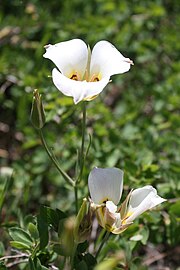
    THE SEGO LILY


    Native Americans had culinary uses for the bulbs, seeds, and flowers of the plant. Bulbs were roasted, boiled, or made into a porridge by the Hopi, Havasupai, Navajo, Paiute, Gosiute, and Ute peoples. The Hopi used the yellow flower ceremonially.

    They taught the Mormon pioneer immigrants to use the bulb for badly needed food. This resulted in the sego lily being formally designated as the Utah State Flower in 1911. 

    The following is taken from: 

    Pioneer: Utah's Online Library


    Utah State Flower - Sego Lily


    Sego Lily along the Bonneville Shoreline Trail, 6/16/2010, Photo by Staci Card Green
    By an act of the Utah State Legislature, approved on March 18, 1911, the sego lily was declared to be the State floral emblem (Utah Code). Kate C. Snow, President of the Daughters of Utah Pioneers, in a letter dated April 17, 1930, says that "between 1840 and 1851" food became very scarce in Utah due to a crop-devouring plague of crickets, and that "the families were put on rations, and during this time they learned to dig for and to eat the soft, bulbous root of the sego lily. The memory of this use, quite as much as the natural beauty of the flower, caused it to be selected in after years by the Legislature as the floral emblem of the State." 

    The sego lily was made the official state flower after a census was taken of the state's school children as to their preference for a state flower. 

    The sego lily, Calochortus nuttalli, has white, lilac, or yellow flowers and grows six to eight inches high on open grass and sage rangelands in the Great Basin during the late spring and early summer months. The USDA symbol is CANU3.