Sunday, February 6, 2022

Robert H. Hinckley and Leonard Seely Opens Dodge Dealership


1915 Dodge Touring


Robert H. Hinckley opened Seely Hinckley Dodge in 1915 right here in Mt. Pleasant - making it one of the oldest continuously run Dodge dealerships in the world. The oldest, that is, until last Thursday, when Chrysler LLC terminated its franchise agreements with 789 of its U.S. dealerships. Reported by the Salt Lake Tribune May 18th, ten of those stores are in Utah, and one is Hinckley Dodge of Ogden. Until early next month, there were 24 in the state. The car manufacturer did stick with Hinckley Dodge Chrysler Jeep in Salt Lake City, overseen by Robert H. Hinckley's grandson, Jim Hinckley. Born in Fillmore, Utah, June 8, 1891, Robert Henry Hinckley, was the son of Edwin S. and Addie Henry Hinckley. His father was a professor of geology at Brigham Young University and Robert moved with his parents as they lived in different places connected with his father’s work. Robert served an LDS mission in Germany from 1910-1913 and returned to establish the Seely-Hinckley Automobile Co., in 1915. That same year he married Abrelia Clarissa Seely, daughter of John H. and Margaret Peel Seely of Mt. Pleasant. Robert H. Hinckley borrowed $500 from his father-in-law to further his education. But instead, he bought into a Dodge franchise. They were the parents of four children: Robert Jr. Paul, John S. and Elizabeth. His public service career began in 1918 when he was elected to the Utah legislature as a representative from Sanpete County. He was subsequently elected to be mayor of Mt. Pleasant in 1924. In 1931, he helped organize Utah’s relief work. In 1934 he was appointed assistant administrator of Federal Emergency Relief Administration, with responsibility for the western states. Involvement in one of his main interests, aviation, began with his service in the U.S. Civil Aeronautical Authority in 1938. In that position, he was instrumental in establishing training programs for civilian pilots in 600 colleges and universities. He was assistant director of the Department of Commerce from 1940-42 and directed the Contract Settlement Office in 1944-45 to settle all terminated wartime service contracts. He also served on the War production Board. Robert H. Hinckley shown on the right
Orval Wright on the left

His business career was also national in scope. During World War II and continuing afterwards, he was an officer of Sperry Rand Corporation and joined with Ed Noble in the founding of American Broadcasting Corporation (ABC). He served as director and officer in ABC until 1966. Robert H. Hinckley was appointed to be a regent of the University of Utah for several terms throughout his life. In 1956, he purchased property on the north bench of the Ogden River at middle fork and established his home there. It became known as the “Garden of Eden” to friends and family. There he raised welsh ponies and directed the affairs of Robert H. Hinckley Inc. until retirement in 1973. He founded the Hinckley Institute of Politics at the University of Utah in 1965. He established the Edwin Smith Hinckley Scholarship Fund at Brigham Young University as well as the Abrelia Hinckley Scholarship Fund at Weber State University in 1954 and the Seely-Hinckley Scholarship Fund in 1984. After the death of his wife in 1973, Robert H. Hinckley retired as director of RHH Incorporated. He died in Ogden at the age of 96 on April 30, 1988. Resource: Robert H. Hinckley Family Business Papers, Weber State College Library Jim Hinckley, a great grandson of Robert H. is now the General Manager of Ogden's Hinckley Dodge. Jim Hinckley Sr. (grandson) oversees the Salt Lake City Hinckley Dodge Chrysler and Jeep operation.


~~~~~~~~~~~~~~~~~~~~~~~~~~~~~~~~~~~~~~~~~~~~~~~~~~~~~~~~~~~~~~~~~~~~~~~~~~~~~~~~~

Robert H.Hinckley AlsoServed as May of Mt. Pleasant 


The following are are references and page numbers to Robert H. Hinckley from Hilda Madsen Longdorf's "History of Mt. Pleasant".


June 24, 1917, Mary Elizabeth, thirteen months old child of Charles M. and Josephine Peterson, was drowned in Twin Creek channel east of the city.


For a number of years, a Traveling Library, free to the public, was sponsored by members of the Twentieth Century Literary Club and the Home Culture Club of Mt. Pleasant.


During Daniel Rasmussen's term as mayor, the Carnegie Li­brary was built, being formally opened to the public, February 15, 1917. This year the Seely-Hinckley building, corner First West and Main, was built by John H. Seely and Robert H. Hinckley.  P 199


In December 1925, during Robert H. Hinckley's term as mayor, the White Way was completed by the paving of Main Street. This was celebrated by an appropriate program and danc­ing on the pavement. This year the Lion's Club was organized in Mt. Pleasant, with Charles Eatinger as president, and Earl F. Gardemann, as secretary. P 202


The new city hall was dedicated August 23rd. Following  aparade, a program was held on the steps of the building. Senator Ed Johnston presided. Invocation was offered by Daniel  Rasmussen and the dedicatory prayer by C. W. Sorensen, and an historical sketch was given by Mrs. S. D. Longsdorf. Talks by Judge.  George Christensen, of Price; Robert H. Hinckley, of Ogden, Chairman Civil Aeronautics Commission; and Darrell Greenwell, of Salt Lake City, State WP A Director, who also, in behalf of the WP A, presented the building to Mt. Pleasant. The response and acceptance speech was given by Councilman A. L. Peterson. Mus­ical numbers were rendered by Mr. and Mrs. Roger Hansen, Dean and Wayne Peterson, Grant, Vernon, and Don Johansen, Mrs. G. B. Madsen, Mrs. S. H. Gill, and Mrs. H. G. Ericksen. P 207-208


1924-25. Mayor, Robert H. Hinckley; Recorder, Calvin Christen­sen; Teasurer, Effie R. Larsen; Councilors, O. F. Wall, four years; P. A. Poulsen, Joseph Matson, M. C. Petersen, Joseph Johansen Jr.


P 238


Saturday, February 5, 2022

DUP Marker Is Dedicated 1967


The foundation of the marker was replaced with a stone base and was lowered

to about 4 feet. The  clapper on the bell was welded stationary so it could not

be rung by mischevios folk.  However, during the Fourth of July Parade 

a hammer from the blacksmith shop  is used to ring it in honor of the

"Honored Citizens" or "Grand Marshals". 

The historical bell came from the old Hamilton School that stood south and east of the old north ward church .  
It was rung at 8:00 a.m., 9: 00 a.m. at 9:00 p.m. and anytime  there was a fire.  


The old North Ward Church.  It was torn down circa 1951.


Friday, February 4, 2022

CASTILLA HOT SPRINGS


Castilla Hot Springs Attracted Trainloads of Visitors

Linda Thatcher
History Blazer, October 1995

The Utah landscape is dotted with hot springs resorts that have come and gone. Although a few remain, most are merely memories to aging Utahns. One such popular resort during the 1890s and early 1900s was Castilla Hot Springs in Spanish Fork Canyon, Utah County. The name Castilla was suggested either by the castlelike rock formations nearby or because the Spanish priest-explorers Escalante and Dominguez discovered the springs in September 1776 as they followed the Spanish Fork River down the canyon. They called it Rio de Aguas Calientes (“River of Hot Waters”) because of the hot springs flowing into the river.
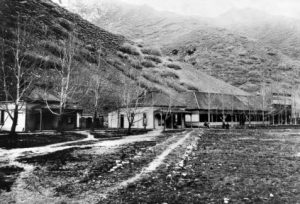
CASTILLA SPRINGS, SPANISH FORK, SHOWING HOUSES AND STORES, C. 1917. G. E. ANDERSON PHOTOGRAPHER/BYU

In 1889, more than 100 years later, William Fuller filed for a patent on the hot springs property with the U. S. government. On the land he built a small house which contained a wooden tub for bathing in the mineral water. Later, the Southworth family became interested in the property. Mrs. Southworth, the family matriarch, felt that her health had been improved by bathing in water from the springs. She urged her two sons, Sid and Walter, to buy the springs to “make a resort for people who have hopeless afflictions, that they may come and be cured.” The Southworths obtained the land from Fuller and began to improve it. They filled the swampy area with gravel and built a three-story, red sandstone hotel. Other structures included indoor and outdoor swimming pools, a store, a dance pavilion, private bathhouses, several private cottages, and a saloon. Picnic areas, a baseball diamond, and stables were also provided.

During the summer months the Denver & Rio Grande Railroad ran excursion trains to Castilla. One of the most popular runs was the “moonlight excursion” from the Tintic Mining District in Juab County to Castilla. The train stopped at stations along the way to pick up passengers for an evening of dining and dancing.
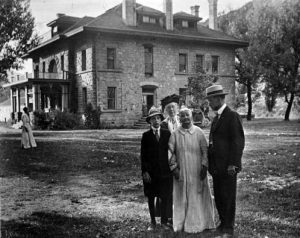
CASTILLA SPRINGS HOTEL, 1917 IN SPANISH FORK. CYRUS E. DALLIN AND FAMILY. G. E. ANDERSON PHOTOGRAHER/BYU DIGITAL IMAGE © 2009 UTAH STATE HISTORICAL SOCIETY.

Besides providing recreation for many Utahns, the resort area was the site of several enterprises, including a cigar factory and a quarry that furnished silica used as flux by the Columbia Steel Company in Ironton, Utah. Nevertheless, the warm, sulfuric water remained the principal attraction at Castilla. Bathers came from far and near for the relief they believed they would find for such illnesses as rheumatism and arthritis. The springs’ water also became popular as a “cure” for other ailments such as alcoholism, chain-smoking, moral dissipation, and the “tendency to use profane language.”

In 1912 Sid Southworth died. Noted sculptor Cyrus Dallin, a native of Springville, helped his sister Daisy (Sid’s widow) financially with the resort. Eventually, he gained controlling interest in Castilla, but he had to rely on relatives to run it as he lived in Boston. The resort enjoyed a brief renewal of popularity in the 1920s, but by the 1930s it had fallen into disuse. Lack of funds and competition from other resorts contributed to its downfall.

In the 1940s a fire destroyed most of the hotel. What remained was eventually torn down. Today only a few ponds created by the springs mark the spot where the once-thriving resort stood.

See Linda Thatcher, “Castilla Hot Springs,” Beehive History 7 (1981).


Wednesday, February 2, 2022

Remember When??? February 2004


Mt. Pleasant Water - Best in the State (February 4, 2004)

It's OFFICIAL......get the details now:

http://www.utahheritage.com/press_releases/2004/pr-02-29-2004.htm


We really do have the best water in the state of Utah, and maybe in the Nation. Does that sound too bold? No, not to me. We maybe need to start bottling it. I'm not sure about selling it. We have too little as it is. Why not just promote the fact we have the best here and then encourage people to come here to visit and enjoy it with us. Thereby, encouraging more tourist traffic. Well, just to get everyone to come and see what a really cool place Mt. Pleasant is. And its residents aren't bad either...

Tuesday, February 1, 2022

Caratat C. Rowe and Mary Napier Row ~~~ Pioneers of the Month !~~~ February 2022


 Way back in 2009  we posted Caratat Conderset and Mary Napier Rowe As Pioneers of the Month.  I have found so much more information on them and have had a lot of requests for more information on them.   You can read the original post here: 

 https://draft.blogger.com/blog/post/edit/2217707143168230507/8499223279971595742


BIOGRAPHY OF CARATAT C. ROWE BORN 1823, PERRY, DELAWARE COUNTY, INDIANA Arrive in Utah, July 29,1847 Written by a Granddaughter, Candace B. Michelson  

  Grandfather Caratat Conderset Rowe, a son of William Niblo Rowe and Candace Blanchard Rowe was born in Perry Delaway County, Indiana in 1823. When young Tat was baptized into the Church of Jesus Christ of Latter Day Saints the family moved westward. When the Mormon Battalion was organized Tat and his brother William enlisted and he was a member of Company A. However, the Rowe brothers were with the "Sick Detachment" under Captain James Brown which was compelled to winter during 1846=1847 at Peublo, Colorado. The main body of the battalion continued the journey into California, to San Diego. Among these latter were some friends of the Rowe brother, James, Riley, Alfred and Reddick N. Alfred later of Spring City. During the travels toward Utah, brother William Rowe became very ill and was unable to travel. He lay down on the ground and his brother Tat was tenderly watching over him. As the others of the company were passing by one of the Captains said to Tat, "We must move on, it seems that your brother will live but a short time. You had better come along with us." Tat sat beside his brother, cross-legged with his gun across his knees. "I am staying here," he said to the Captain. Then the Captain turned to several of his men and told them to place the dying man in the wagon. The men did so and the company moved on slowly. The group consisted of besides Captain Brow, Captains Nelson Higgins, and William W. Willis. There were 140 of the sick detachment and 40 of the Mississippi Saints also bound for Utah. There were only 29 wagons, 1 carriage, 100 horses and mules, and 300 head of cattle to make the journey. This company arrived in Utah just five days after the arrival of the original company on July 29, 1847. The sick were cared for by the Brothers and Sisters who had arrived there previously. When President Brigham Young and a few companies returned to the Missouri River where the most of the Saints were, a number of the Battalion Boys in Iowa had returned from California and some of the Pueblo detachment who had recovered from illness also went back east with President Young to be with their families. In this group were William and Caratat Rowe. Tat's wife, Grandma Mary Napier Rowe while living at Fremont, Iowa gave birth to a daughter, Candace Blanchard, born July 24, 18_. Mary was a Scotch lassie, who joined the Church and came as a young girl to America. In 1852 the C. C. Rowe family came to Utah in the company of Captain B. M. Jolley's train of covered wagons. They left Kanesville, Iowa in 1852 and arrived in Utah September 15, 1852. There were 340 people in the pioneer company. After a while at Salt Lake City the family located at Payson where a daughter Janette Sterling Rowe was born on August 24, 1855. She was baptized in 1864. When the Walker Indian War was raging in Utah County grandfather C.C. Rowe served his part being commissioned a Second-Lieutenant was on of "The Silver Grey's, a member of Company B of the Nauvoo Legion of the Payson Post. They removed to Sanpete County and in 1860 settled in Mt. Pleasant. He served in the Black Hawk Indian War, for which service he received his old age which is a pension from the U.S. Government. He was very grateful. For sometime grandfather C.C. Rowe did farming and herding in Thistle Valley at Indianola in early times. Others were Aaron, Joseph and Nathan Staker, later of Mt. Pleasant. Later he removed with his sons, Con and Allen to the "Round Hills," or Mountainville, north east of Mount Pleasant, where they did farming. Each of them reared a good sized family of line healthy children who were well respected. Uncle Con Rowe went back East to help bring in the Mormon immigrants. Uncle Allen "Lene" Rowe, filled a mission for the Church, all of these men were firm in the Faith. Grandfather Rowe was always concerned over the welfare of his family and friends. When people were ill in Mt. Pleasant he would go out with another Elder into the homes of the sick and administer to them in the authority of the Holy Priesthood. He always exercised Faith, and was rewarded in that the sick were healed, etc. and his family received many blessings as a result of the faithful devotion of this great and good man. Tat was not wealthy in his worldly goods and he had suffered much privation in pioneer days but he enjoyed the peace of mind of a good conscience and the happy association of his large family and many many friends. He kept a weed less vegetable garden. He was witty, and full of fun. He enjoyed singing jolly songs to his children and grandchildren. It is a family tradition that Grandpa Rowe was one possessed with power over sickness, doubtless because of his authority in the Holy Priesthood, and his pure life of service. At one time he was called for by someone who told him of someone else who was bleeding excessively. Grandpa told them that the bleeding had stopped, though he did not go to their home. No doubt, he offered a silent prayer to our Heavenly Father, for the one afflicted and the prayer was answered as desired.


BIOGRAPHY OF MARY NAPIER ROWE BORN MARCH 30, 1823 at KILSYTH, LARRACK, SCOTLAND ARRIVED IN UTAH SEPTEMBER 15, 1852 


By Mary Loretta Rowe Burnside  
 Mary Napier was born March 30, 1823 in Kilsyth, Lanarkshire, Scotland. Her parents were Janette Gillis and John Napier. Mary is descended from the Royal family of Scotland and of Ireland. Genealogists have traced her linage back for many generations, on one line to 1700 B.C. she is of the Royal line of Judah through King Zedekiah according to Church records. Many interesting facts are thus brought out concerning her ancestral lives and their history. Of her parents family we have the names of five other children, her sisters, as follows: Jean, Christena, Agnes, Nesbit, and Isabella. The parents probably were in humble circumstances, as Mary worked in a textile mill in the city of Glasgow.

 When missionaries of the Church of Jesus Christ of Latter-Day Saints preached the gospel there, Mary and her sister Isabella were converted. They were baptized, though it is not known if at the same time. Mary and Isabella were the only ones of their family to come to America. It is not known if the sister Isabella ever came to Utah as she was not known by her sisters family. Elder Franklin D. Richards was one of the missionaries who preached the gospel to Mary. It was in the fall of 1847 when Mary was reunited with her husband who had been gone for more than a year with the Mormon Battalion. It was September 15, 1852, when Mary and her family came to Utah. Mary did not have the funds to come to Utah immediately. After her marriage to Caratat Conderset Rowe, she lived at the home of her husband's parents William Nible (he held the public office of a judge) and Candace Blanchard Rowe. Mary's very great faith and the friendships she gained kept her happy. She seemed to enjoy the spiritual gift of vision or prophecy. Many times she knew of coming events before they actually occurred. She told of seeing a light which filled the room. Within this light, sat her sister who lived in Scotland. WTien Mary saw her sister sitting in a rocking chair, she spoke the sister's name. It was not long until she heard of the passing of her sister.


 While living at Payson, Mary gave bread to two girls who were survivors of the Mountain Meadows Massacre. An Indian whose name was James Onuph used to come to the home of Mary and Caratat Condrset Rowe quite often when they were living at Mountainville. Once when he was visiting with them "Indian Jim" as he was called, was talking with Grandma Mary. He asked her a question pertaining to a principle of the gospel, restored, and Mary was attempting to answer the question. She started to speak, then said, "I wish that I could answer your question so that you could understand. I would like to have the language to explain it to you, and make it clear to you. Then the Indian said to her, "Stand Up", She began to speak. Again he said, "Stand Up". Mary stood up and began to speak to him. Onuph nodded his head because he understood what she was saying. She continued to speak and Onumph again nodded his head. It was plain that he knew what she meant. But no one else in the room could understand, even her sons and daughter-in-law, my uncle and my father and mother who were there, did not know what Mary was saying, because she spoke in a language which her children did not understand. But James Onumph or 'Indian Jim", clearly understood what she said. Grandma Mary Napier Rowe had spoken with the spiritual gift of tongues. James blessing was in fulfillment of the Lord's promise; and this great blessing was in fulfillment.

 From the History of Indianola we read the Onemph learned to speak the English language quite well. Our Uncle Con Rowe, among other settlers there, learned to speak the Indian language, to make himself understood by the Indians. The Bishop of Indianola, John Spencer, a former resident of Payson, also learned to speak Indian. Bishop John Spencer, chose Indian Jim to be his second counselor in the Bishopric there. Indian Jim was very faithful in his calling. Other Indians who were active in Indianola were Moroni and Ephi. Indian Pennywatch was a frequent visitor there. At one time, or for some years about the only shite people there were the Danish Indian Missionary, Elder August A. Hjorthand and his wife. Hjorth taught Indian Santaquin how to make ditches on Santaquin's farm which was north of Indianola, between there and Clinton. Indian Jim's wife, Phoebe, was of high rank among the Indians there. It seems that whenever Phoebe spoke to the other Indians, they all listened attentively, and obeyed her instructions. When James Onumph was just a young lad, he warned the settlers of Mt. Pleasant of impending attack by the Indians. A lumber saw mill was burned but no settlers were slain. Grandma Mary Napier Rowe passed away March 4, 1902. She is buried at Mt. Pleasant City, Cemetery.


Tuesday, January 25, 2022

Perpspective... submitted by Larry Staker and Ruth Ann Beck


For a small amount of perspective at this moment, imagine you were born in 1900. When you are 14, World War I starts, and ends on your 18th birthday with 22 million people killed. Later in the year, a Spanish Flu epidemic hits the planet and runs until you are 20. Fifty million people die from it in those two years. Yes, 50 million.

When you're 29, the Great Depression begins. Unemployment hits 25%, global GDP drops 27%. That runs until you are 33. The country nearly collapses along with the world economy. When you turn 39, World War II starts. You aren't even over the hill yet.

When you're 41, the United States is fully pulled into WWII. Between your 39th and 45th birthday, 75 million people perish in the war and the Holocaust kills six million. At 52, the Korean War starts and five million perish.

At 64 the Vietnam War begins, and it doesn't end for many years. Four million people die in that conflict. Approaching your 62nd birthday you have the Cuban Missile Crisis, a tipping point in the Cold War. Life on our planet, as we know it, could well have ended. Great leaders prevented that from happening.

As you turn 75, the Vietnam War finally ends. Think of everyone on the planet born in 1900. How do you survive all of that? A kid in 1985 didn't think their 85 year old grandparent understood how hard school was. Yet those grandparents (and now great grandparents) survived through everything listed above.

Perspective is an amazing art. Let's try and keep things in perspective. Let's be smart, help each other out, and we will get through this. In the history of the world, there has never been a storm that lasted. This too, shall pass.


When I received this from Larry, I thought about my mother-in-law Alice Hafen who often told us about the Spanish Flu and that they missed two years of school and then had to combine classes to catch up.  The following is her class and names she remembered. 


If you double click the picture it will enlarge itself. However, to read the names, you will have to stay in the smaller window.

Alice has helped me identify these children as it is her class. 
They are numbered in red in the enlarged view. Some were not identifiable but here is what we have:
Teachers
1.Vern Seely
2. ? Rasmussen
Students:
3. Alice Hafen
4. Sylvia Hutchison
5. Nellie Wilcox
6. Phyllis Matson
7. Fern Olsen
8. Vida Allred
9. Birdella Peterson
10. Ruth Christensen
11. Grace Simpson
12. Ada Wright
13. Mary Trontwine
14. Eleanore Peterson
15. Wanda Matson
16. Iris Rasmussen
17. Wanda Nelson
18. Esther Madsen
19. Arvina Monsen
20. Lizetta Seely
21. Ina Rowe
22. Goldie Coates
23. Brooks Madsen
24. Ray Christensen
25. Harold Beckstrom
26. Warren Nolan
27. Elmer Syndergaard
28. Rex Anderson
29. Morris ?
30. Margaret Jensen
31. Cleo Staker
32. ? ?
33. Margaret Stansfield
34. Louise Fowles
35. Margaret Peterson
36. Ina Seely
37. Eva Monroe
38. Dale Nelson
39. Eva Beck
40. Ila Draper
41. Ila Allred
42. Wanda Smith
43. Rowe Olson
44. Grant Brotherson
45. Ivan Gunderson
46. Ralph Brotherson
47. ? ?
48. Roy Weech
49. Armond Wright
50. LeRoy Moss
51. Ivan Christensen
52. Dick Candland
53. Alan Smith
54. Cheratin Jacobs
55. Morris Olsen
56. ? Allerton
57. ? ?
58. ? ?
59. Asa Reynolds
60. Clarence Anderson
61. ?
62. Grant Larsen
63. ? ?
64. blank
65. Dean Peterson
66. Royal Sorensen
67. Roy Romero
68. ? Marx
69. ? ?
70. ? ?
71. ? ?
Please let us know if you have any corrections or questions.