Sunday, April 3, 2022


Obituary  Salt Lake Tribune September 20, 1934.

Mrs. Emma Allred West, 76, one of the original group of pioneers who settled Mt. Pleasant, died at a late hour Tuesday night of heart failure following a long illness.

Mrs. West was born in Ogden, October 15, 1857, a daughter of Isaac and Emma Dewey Allred. Her parents were among the early settlers of Ephraim and then came to Mt. Peasant with the original group of settlers in the spring of 1859. They also lived in Moroni and Richfield and were establishing settlements in the Sevier valley when driven out by the Indians in 1866. She lived in Nephi until her marriage, March 11, 1875, to Thomas West of Mt. Pleasant. They lived at Chester until moving to Mt. Pleasant in 1895. Mrs. West died in 1921.

Mrs. West was a charter member of the Mt. Pleasant Pioneer Historical association and had served as a director more than 20 years. She was first counselor in the Chester Relief Society during her residence there, and was treasurer in the Mt. Pleasant North ward Relief Society nine years.

Surviving are a daughter and two sons; Mrs. Burke, McArthur and Thomas Wilford West, Mt. Pleasant and Ray West, Payson; ten grandchildren and four great-grandchildren, and a brother, Thomas Hayward, Bountiful.


Hamilton Cherry Crunch


One of my favorite memories of Hamilton Elementary was the delicious Cherry Crunch with Caramel Sauce.  Alice, my mother in law, worked for school lunch for several years.  This came from her recipe album. And so now I share it with you:

1 1/2 Cups of Flour

1 1/2 Cups of Oatmeal

! Cup of brown sugar

1 square of margarine

1/2 tsp of salt

1/2 tsp of soda


Mix dry ingredients together with melted butter.


Sweeten and thicken 1 quart of cherries

Add almond flavoring and coloring to suit your own taste.

Put of the crumbly mixture on the bottom of a casserole dish.

Then put the thickened cherry mixture on top of the bottom crumbs.

Put the other half of the crumbly mixture on top of the cherry mixture.


Bake 20 minutes at 375 degrees.

Serve with whipped cream and the following sauce.


1 Cup of hot water

2 cups of sugar

1//4 cup of Margarine

4 cups of instant dry milk

Combine hot water and sugar and heat until the sugar is dissolved.  Then add the margarine.

Place in a blender and add instant dry milk, gradually blending until smooth.  Makes the equivalent of two cans (14 ozs each) of commercial sweetened condensed milk.


ENJOY!

Saturday, April 2, 2022

ANDREW PETER’S PROMISE ~~~ A sketch of the life of John Henry Owen Wilcox by Eleanor Peterson Madsen

 A sketch of the life of John Henry Owen Wilcox

ANDREW PETER’S PROMISE

Eleanor P. Madsen


  ANDREW PETER’S PROMISE 

The day was hot and sultry. Andrew Peter had been up since before daylight coaxing the small stream of water through the sparse alfalfa patch. “Golly, I’m tired! I must be getting’ old,” he said aloud, more to himself than to his nephew who was cutting some weeds out of a ditch nearby. The older man sat down on a clump of grass on the ditch bank to rest a few minutes before resuming his task. The younger man, whose name was also Peter, leaned on the shovel handle as he said, “Old? Why, you’ll outlast me twenty years. I’ll tell you what. If you go first, no matter where I am I’ll be to your funeral. If I go first, you gotta promise me you’ll come to mine no matter where it is.” “It’s a deal,” exclaimed Andrew Peter as he stretched out his arm to shake hands on the bargain. Many years passed. Peter left Sanpete County and moved across the mountain to Ferron, Emery County, where he lived for some time. One day in August 1914, Andrew Peter, who was then 82 years old, was out in his field north of Ephraim harvesting peas. Word was brought to him that his nephew Peter, had died and the funeral would be on Wednesday, just two days away. It was a busy time of year for farmers and that black cloud in the west looked like rain. Andrew Peter had given his word to be to the funeral of his namesake so the farming would have to wait. It rained most of the night but Andrew Peter had no intention of breaking his word. He arose early and said to his wife, “Martha, tell Ali and Minnie they can ride with us and Nels and Lilly can take Suzy with them. We’ll be better off taking the two cars of it’s going to rain. It was 9 a.m. before the Olsens with their two Model T”s were on their way. There was still a fine mist of rain in the air as they left Ephraim and drove south. All went well until the group reached Sumper’s Ranch in Salina Canyon. To their dismay the road leading through the railroad tunnel had been washed out by the heavy rain. “We better go back, Dad, “Ali suggested. “We’ll never get through this.” “We’re not going back!” exclaimed Andrew Peter. “I promised Pete I’d go to this funeral and that’s what we’re going to do.” The boys knew it was no use to try to persuade their father to turn around. They started making their way cautiously over the steep bank. Martha sat motionless hardly daring to breathe as one wheel slipped into a deep gulley made by the flood water. She wanted to get out and walk but knew that was impossible. Just as she thought they were on more sure ground again, the car sank into the sticky mud and stopped.

Andrew Peter climbed out of the car and looked around to see what could be done. As he kicked around in the mud with his toe, he shouted, “Look, here’s a piece of rail! Maybe we can pry the wheels loose with it.” Ali scoffed, “Why you can’t even lift one end of that rail let alone pry the wheels up with it.” “Well, I’m going to try. We’ve got to do something,” answered Andrew Peter. After several tries he found that he couldn’t lift the rail. On closer examination the elderly man found a piece that had broken off which he could use. With this to aid him and the boys and the other car helping to push they were out of the mud hole and on their way again. A second tunnel proved to be less hazardous. There was enough road not covered with mud and water that the cars could get through. Martha kept her eyes focused on the road ahead. Her fingers ached from clasping them together so tight. As they rounded each precarious curve, Martha wondered if the floor board under her feet would last to their destination. The Model T’s made it across the top of the mountain and down Red Creek. Here the boys were ready to turn back again. The complete road had been washed out and floods had piled mud and debris as much as eight feet high. Martha moaned, “What on earth can we do now?” “Now, Martha, don’t get excited.” Andrew Peter tried to reassure her. “We’ll go down in the creek bed.” At once he started driving his car in that direction. Ali said, “Dad, you can’t do that. We’ll never make it through. We can still go back.” Andrew Peter was determined. Martha and the boys knew it was no use to say any more. Martha shut her eyes, held her breath and prayed silently. She was numb all over. As the car lurched forward into a deep gully she wanted to scream but even her jaws were too rigid to move. She was sure they were going to roll down the hill. Somehow the car stayed upright and at last they were on level ground. The mud holes were almost a welcome relief to her. It was getting dark as they drove on to the road again. Martha could barely see the outline of the solid rock wall that towered 100 feet above them. The headlights were so mud-splattered that it was difficult to see where the road was. Martha’s prayers helped and the little party traveled for some time without incident. As they reached the division of the road that led to Emery and to the Pony Mines (the road that now leads to I-70) once more the first car mired in the swampy mud. Ali, peering through the blackness said, “I think the road is full of water.” Andrew Peter replies, “I’ll soon find out. I think it’s just mud.” He got out of the car and found himself wading in water up to his ankles. With the aid of the second car and more pushing and pulling, the men were able to get the cars moving slowly again through mud and water. It was 3 a.m. when the weary travelers reached the town of Emery and made their way to the home of Minnie’s brother, Lou Peterson. After waking the Petersons, they were treated to bowls of bread and milk and sank into bed and exhausted sleep. It was late in the forenoon before the Olsen’s were able to get on their way toward Ferron. Their problems were not over as they encountered roads that had been washed out. The mud and water caused some mechanical problems with their cars. Martha was afraid they would never reach Ferron in time for the funeral. Andrew Peter and the boys were so covered with mud they didn’t look very presentable to be going into a church, she thought. Martha rubbed some of the mud from the bottom of her own black skirt and pushed a stray lock of her gray hair from her face.

It was very quiet as the group stopped their cars by the small adobe church in Ferron. The hearse with its two white horses and several other cars and buggies were standing by the fence where the mud had been scraped away for the mourners to park. As she climbed out of the car, Martha lifted her eyes to a ray of light pushing its way through the clouds. Andrew Peter led the way as they entered the church. They could see the Bishop standing at the pulpit and the rest of the congregation standing. The funeral was over. As the Bishop saw the door open and the Olsen’s enter, he announced to the audience, “Here are the Kesko’s from Sanpete.” There was handshaking, embracing and words of welcome for Andrew Peter, Martha and the others. The body of Peter in the wooden casket was forgotten for a moment. Ali, Nels, and their families never forgot that when Andrew Peter made a promise, he kept it.

~~~~~~~~~~~~~~~~~~~~~~~~~~~~~~~~~~~~~~~~~~~~~~~~~~~


Eleanor Kjar Madsen Ephraim, Utah 


Eleanor Dianna Peterson Kjar Madsen, 95, of Ephriam, Utah died July 26, 2008, at the Gunnison Valley Hospital. She was born April 19, 1913 in Mt. Pleasant, Utah the daughter of Mouritz and Mathilda Lund Peterson. She married Ronald Melroy Kjar September 1, 1934 in the Salt Lake Temple. He died August 12, 1946. She married Leslie L. Madsen July 31, 1964 in the Manti temple. He died August 6, 1984. Eleanor graduated from North Sanpete High School and from Snow College. She taught elementary school in Manti and was Deputy Recorder in the Sanpete County Courthouse for 25 years. She served in all auxiliary organizations of The Church of Jesus Christ of Latter-day-Saints in ward and stake capacities. She and her husband, Leslie, served an LDS Church mission in Sacramento, California in 1976-1977. She served in the Family History Mission in Salt Lake City in 1992-1993. She served as an Ordinance Worker in the Manti Temple for 12 years. She was an avid genealogist and served in the Family History Libraries in Manti and Ephraim. She had just completed the genealogy for four family lines as far back as records are available. She was a vice president for the Ladies Guild for the Mormon Miracle Pageant. She was President of the Sanpete PTA, and did tutoring at the Ephraim Elementary School up to age 93. Next to her love for her family was her love of writing. She served as Editor and committee member of the "Saga of the Sanpitch" during all the 30 years of its publication. She was Co-editor of the "Golden Quarter," a 25 year history of Ephraim; and, with her brother Albert C. Peterson, a history of the "Fredrick and Ane M. Peterson family." She also authored other family histories and a volume of poetry. She served as President of the Utah Federation of the Sanpete Poetry Chapter for several years. She wrote local items of news for the Messenger-Enterprise for 42 years. Her 34 grandchildren and 81 great-grandchildren and one great-great-grandchild were the recipients of many of her crocheted afghans and quilts. She was also steadfast in her affection for the Madsen family of three children, six grandchildren, and nine great-grandchildren. She is survived by two sons: R. Bruce (Judy) Kjar, Woods Cross; R. Michael (Janet) Kjar, Salt Lake; one daughter: Janet (R Dee) Hughes, Clinton; two daughters-in-law: Marcia Kjar, Gunnison; Marianne Kjar, Provo; two sisters: Dorothy Blackham, Judith Sperry; one brother: David L. Peterson She was preceded in death by her parents; her two husbands; two sons, David Kjar and Richard Kjar; two brothers, Lyman Peterson and Albert C. Peterson; a sister, Lucile Blackham; three grandchildren; one great-grandchild. 

Friday, April 1, 2022

John H. Seely and Margaret Folkman Peel Seely ~~~ Pioneers of the Month ~~~ April 2022


~~~~~~~~~~~~~~~~~~~~~~~~~~~~~~~~~~~

Margaret Folkman Peel Seely 


Annie on the left and Maggie 
The above history is taken from "Your Roots Are Showing"
History of Peter Madsen Pihl.

~~~~~~~~~~~~~~~~~~~~~~~~~~~~~~~~~~

FINAL TRIBUTE PAID MRS. SEELY

Prominent Mt. Pleasant Woman Laid at Rest; Business Houses Close

Special to The Tribune

MT. PLEASANT, Jan. 10. – Out of respect to the memory of Mrs. Margaret Peel Seely, all business houses and banks here were closed today during the hours of the funeral service. The North ward chapel was filled to capacity by the many relatives and friends of the Seely family, one of the most prominent families in central Utah.

Bishop H.C. Jacobs was in charge of the services. Musical numbers were rendered by the ward choir. The invocation was offered by Joseph Seely, and the speakers were State Senator W.D. Candland. Judge George Christensen of Provo, William C. Clos, E.S. Hinckley of Provo and Bishop Jacobs. Miss Afton Argyle sang “O Love Divine,” and Miss Gertrude Rolfson and Miss Venetta Standfield sang a duet “Face to Face.” A violin solo, “Resignation,” was rendered by Mrs. J.D. Simpson, with piano accompaniment by Mrs. E.F. Gardemann. The benediction was pronounced by Daniel Rasmussen and P.A. Peel dedicated the grace. Six nephews of Mrs. Seely were pallbearers: P.A. Peel, Fred Peel, John Peel, R.W. Candland, Justus Seely, and Guy L. Candland. A wealth of floral offerings covered the casket and were banked on surrounding stands.

Among the many out-of-town relatives and friends in attendance were Supreme Court Justice J.W. Cherry of Salt Lake, Judge George Christensen of Price, State Senator and Mrs. W.D. Candland of Salt Lake, Mr. and Mrs. E.S. Hinckley of Provo, Dr. and Mrs. W.L. Easton of Richfield, Mr. and Mrs. Frank Cox of Manti, Mrs. E.S. Walker of Salt Lake, Orson Folkman of Ogden, William Barber of Salt Lake and Dr. W.P. Winters of Prince.

Published in The Salt Lake Tribune, Thursday, January 11, 1923 page 12


~~~~~~~~~~~~~~~~~~~~~~~~~~~~~~~~~~~~~~~~~~~~~~~


John H. Seely Home 


Thursday, March 31, 2022

World War One ~~~ 1914-1918 (from our archives)


World War I and Utah

Allan Kent Powell
Utah History Encyclopedia, 1994
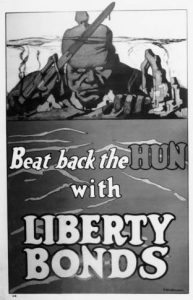
WORLD WAR I POSTER ENCOURAGING THE PURCHASING OF LIBERTY BONDS

Known as “The Great War” until the outbreak of World War II, World War I began on 1 August 1914 and ended with armistice on 11 November 1918. The two warring sides were the Allies—comprised of Russia, France, Great Britain, Italy, United States, Japan, Romania, Belgium, Serbia, Greece, Portugal, and Montenegro; and the Central Powers which included Germany, Austria-Hungary, Turkey, and Bulgaria. During the course of the war, Utahns were affected by the events in many ways. Immigrants followed events in their warring homelands, sent aid, volunteered to return to fight, and encouraged other Utahns to sympathize with the side they favored. Utah’s economy prospered because of the war. New coal mines were opened, metal and copper mining expanded, smelters ran at or near full capacity, and farmers and ranchers received more for their crops and animals than any other time in recent decades.


After the United States entered the war on 6 April 1917, many Utahns were directly affected as relatives and friends joined the armed services or were drafted. Approximately 21,000 Utahns saw military service; of these, 665 died and 864 were wounded. Of the 665 deaths, 219 were killed on the battlefield or died from wounds received in action; 32 died of accidental causes; the remaining 414 died from disease and illness. Approximately 10 percent (2,156) of the Utahns who served were of foreign birth or were members of U. S. ethnic or racial minorities. A number of Utah women, including eighty registered nurses, served during the war as nurses, ambulance drivers, and clerical and canteen workers.

In the summer of 1914, most Utahns were little concerned with the rumblings of war in Europe. Most felt that the fight had little to do with United States interests, advocated a strict policy of neutrality, and insisted that the United States not become embroiled in a European conflict. There were exceptions, of course, primarily among the Utah immigrant groups including the South Slavs, Germans, Greeks, and Italians whose homelands had been caught up in the Great War. Utah German-Americans openly demonstrated their sympathy for Germany, held rallies, collected money for the German Red Cross, complained of the virulent anti-German propaganda in most English-language newspapers, and, in some cases returned to Germany to fight.

As the war continued, America’s position as a neutral became continually more difficult, especially with the loss of 124 American lives when the passenger ship Lusitania was sunk off the coast of Ireland in May 1915. After the outcry against Germany over the sinking of the Lusitania, Germany complied with American demands that ships carrying neutral passengers and cargo be allowed to sail without attack. By 1917, German strategists concluded that their best hope for victory was to resume unrestricted submarine warfare to keep essential war material from reaching the French and English, launch an offensive along the Western Front designed to end the nearly three years of stalemate, and to seek a secret alliance with Mexico which would restore to that nation the territory (including Utah, Arizona, New Mexico, and California) lost to the United States in 1848. Faced with these events, President Woodrow Wilson saw no other option than to ask Congress for a declaration of war against Germany, which was passed on 6 April 1917.

Even before war was officially declared, Governor Simon Bamberger issued a proclamation on 24 March 1917 calling for Utahns to enlist in the Utah National Guard. Four months after war was declared, the Utah National Guard was drafted into Federal Service on 5 August 1917, sent to California, and then on to Europe where Utahns saw action along in the Argonne Forest, and at Chateau Thierry, Champagne, Soissons, St. Mihiel, Verdun, and other locations on the Western Front.

World War I helped bring Utah into the mainstream of American life as much as anything during the first two decades of the twentieth century. As part of the national war effort, Utahns planted “victory gardens,” preserved food, volunteered for work in the beet fields and on Utah’s fruit farms, purchased Liberty Bonds, gave “Four Minute” patriotic speeches, collected money for the Red Cross, used meat and sugar substitutes, observed meatless days, knitted socks, afghans, and shoulder wraps, wove rugs for soldiers’ hospitals, made posters, prohibited the teaching of the German language in some schools, and cultivated patriotism at every opportunity.

Utah’s economy prospered as wartime demands for farm and orchard produce, sugar, beef, coal, and copper placed a demand on production far beyond peacetime conditions.

Fort Douglas was an important military facility during the War. Thousands of recruits were trained at the fort and a prison was set up at the fort to house 870 enemy aliens, who had expressed pro-German sentiments or were considered dangerous, and as well as draft resisters from all states west of the Mississippi. An adjacent but separate part of the prison housed 686 German naval prisoners of war, who were sent to Utah after their ships were seized by American forces in Guam and Hawaii.
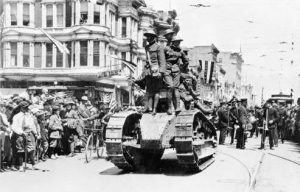
VETERANS’ PARADE IN OGDEN, 1919

Most Utah servicemen returned home early in 1919 to cheering crowds, impressive parades, enthusiastic celebrations, and generous parties even though the influenza epidemic necessitated some precautions. Many joined the American Legion as posts were established in most Utah cities and towns. They were honored when the nation proclaimed 11 November as Armistice Day, a national holiday, and were moved when “Memory Grove,” located along City Creek at the mouth of City Creek Canyon just north of the downtown Salt Lake City, was dedicated on 27 June 1924, as a permanent memorial to the soldiers killed during the war.

Like many other Americans, Utahns became disillusioned with the formal peace treaty ending the war. They were also divided over Woodrow Wilson’s primary objective, the establishment of the League of Nations. Heber J. Grant, who became President of the LDS church in 1918, was an advocate of the League of Nations while Reed Smoot, an LDS apostle and Utah’s senior senator in Washington D. C. was an outspoken critic of the League. The war was something that many seemed to never really understand, a situation that hampered international cooperation and understanding and led to increased tensions and another war within a generation.

See: “Utah and World War I,” Utah Historical Quarterly, (fall 1990); and Noble Warrum, Utah in the World War (1924). John Sillito, “Drawing the Sword Against the War: B.H. Roberts, World War I, and the Quest For Peace,” Utah Historical Quarterly 87, no. 2, 2019, Tammy M. Proctor, “The Great War and The Making of a Modern World,” Utah Historical Quarterly 86, no. 3 (2018), Allan Kent Powell, “Utah and World War I,” Utah Historical Quarterly 86, no. 3 (2018), Robert S. Means, “Try To Be As Brave Cross-Continental Comparisons of Great War Poetry,” Utah Historical Quarterly 86, no. 3 (2018), 


People Respond to Every Call During World War I


 When the United States entered the World War, the people of Mt. Pleasant loyally responded to every call, and made a record of which it may well be proud. One hundred and eighteen boys enlisted from Mt. Pleasant, and a number of Mt. Pleasant's sons enlisted from other communities. As the boys, one by one or in groups, boarded the train, great crowds, although sad at heart, cheered them as they left for the front. 

Three of the number died in service. Ralph Braby, while in California, was drowned, Jacob Hafen died of disease, and Henry Merville Zabriskie was killed in action, over seas. The Sanpete County Council of Defense was organized as follows: J. W. Cherry, chairman; Burke McArthur, secretary; Ed. Johnston, treasurer; Committee chairmen, Finance, N. S. Nielsen; Publicity, ,Burke McArthur; Legal, J. W. Cherry; Sanitation and Medicine, Ed. Johnston; Food supply and conservation, L. R. Anderson; Industrial survey, Orlando Bradley; Labor, Christian Willardsen; Military affairs, J. Morgan Johnson; State protection, H. R. Thomas; Survey of man power, L. P. Brady; Woman's work, Mrs. G. W. Martin. In June 1918, there were deposited in the Mt. Pleasant Com-mercial and Savings Bank, by Mr. N. S. Nielsen, county chairman of finance, to the credit of W. G. McAdoo, treasurer of the National American Red Cross, seven thousand five hundred dollars. 200 The citizens went over the top in the various other drives conducted. 

Liberty bonds, postal savings, Soldier's Welfare Relief, Christmas boxes, tobacco, conservation of food, etc. Local committees were organized, among them the local Red Cross. The officers of this organization visited the neighboring cities, Fairview, Fountain Green, Moroni, Wales, Chester and Spring City, and in cooperation with them, purchased material and sewed articles called for. There were checked out something over $3000, which had been obtained by weekly canvasses made by wo¬men and girls, and by other volunteer donations other than the National drives. Mt. Pleasant headquarters were established at about 122 West Main, where the women, some representing differ¬ent organizations, met and did sewing, etc., required. Many ship¬ments of goods were made. The officers at this time were: C. L. Johns, president; Mrs. Grace Madsen and Miss Irene Nielsen, vice presidents; Miss Hilda Madsen, secretary and treasurer. History of Mt. Pleasant HML pp 199-200

Wednesday, March 30, 2022

Leather Postcards


The above postcard from 1903 shows the City and County Building
in Salt Lake City.  The photo was pasted onto a leather postcard.


What do you do when faced with lots of competition? Make something completely different! That’s what publishers did during the postcard boom of the early 1900s. All kinds of interesting materials were used to pique the interest of buyers. One of these different materials was leather.


Starting in 1903, postcards made of leather were decorated by pyrography (literally “fire-writing”). Also known as pokerwork, it involved decorating the postcards using the tip of a sharp tool heated by fire. Surprisingly, it was a popular craft among ladies. Designs were burned into deerskin and color was often applied afterward. While the leather in newer postcards is often stiff, the leather of the pre-1915 era is very thin and soft.

About 1909, the post office banned the mailing of leather postcards because they were getting hung up in the new sorting machines. But dedicated collectors still sent them using envelopes. In later years when postal machinery became sturdier, the cards were again permitted in the mail. They can still be purchased in souvenir shops, especially in the American West.


Bonnie Wilpon is the author of Postcard History of Sarasota and Bradenton, Florida and Postcard History of Hollywood, Florida (published by Arcadia Books) and is a postcard dealer and collector in Tampa, Florida. She is Membership Chair of the Sunshine Post Card Club and a Contributing Editor for Postcard History. Bonnie can be contacted at: bonnpon@att.net.

Monday, March 28, 2022

Hans Christian Davidson~~~ Astrometer


Hans Christian Davidson

On page 92 of the Mt. Pleasant History by Hilda Madsen Longsdorf, she briefly mentions that H.C. Davidson had moved to town with his family and "erected an astrometer on his lot." The location was "west side of State, southwest corner of intersection of First North." I googled "H.C. Davidson" and "astronomy" and I discovered a blog entitled "Hans Christian Davidson and
Descendants".  http://hcdavidson.blogspot.com/

Here I found out quite a bit about Mr. H.C. Davidson.  Hans Christian Davidson was born in Horup, Alsen Island, Schleswig, Holstein, Denmark.  H.C. and his wife Annie Marie Jensen came across the plains to Utah in 1858.  In 1866 the family moved to Mt. Pleasant where H.C. was the first dentist and also the first newspaper editor.  He studied astronomy and made a perpetual calendar.

In the years 1876-77, during which time E.A. Day was teaching in Mt. Pleasant, Davidson, was asked to lecture to his pupils.  His talks and illustrations proved very interesting and beneficial.  Mr. Davidson was always eager and willing to be of help at any time.

"H.C. Davidson's sons, Lorenzo and Amasa Davidson attended the first Presbyterian school, now known as Wasatch Academy, founded here in 1875 by Dr. Duncan J. McMillan. The school was first conducted in an old dance hall which was converted by McMillan into a school and church. This building still stands on Main Street as one of the land marks of the early pioneer days, and is now the meeting hall of the Masonic Lodge."


"They moved to Birch Creek in 1879 and lived there until Mrs. Davidson died, May 2, 1886, after which they moved back into town. The farm was sold to James C. Meiling of Mt. Pleasant. Davidson remarried a few years later to a widow from Ephraim."

"During these early years, there was no dentist of course, so Mr. and Mrs. Davidson did their best to take one’s place and pulled teeth for people, using the old fashioned turn-keys, which we still have with the relics. Mr. Davidson was also the first printer in Mt. Pleasant, and did job printing up until the time of his death in 1891, making him seventy-one years old. "
 
"We know several prominent men of Utah who tell us that it was Hans C. Davidsen's lectures that inspired them to make great efforts for success. It remains for us as his progeny to carry on the work that he started, honoring and revering him for his high faith and courage to battle against big odds. May we not be found wanting."  by Sarah Davidson Wilcox, Daughter of Hans Christion Davidson.


Wednesday, March 23, 2022

Two Tombstones of Note


Two Tombstones of Note: Left, Charlotte Staunton Hyde - Right, Cyrus H. Wheelock


Charlotte was our Pioneer of the Month for October. She was an early school teacher and also the wife of Orson Hyde.
She had a very liberal education. She inspired many of her students to go on to become school teachers themselves. Her only pay was vegetables, fruit and heating supplies given to her by the parents of her students. She was also a seamstress. It was also said that she smoked a pipe. Brigham Young granted she and Orson Hyde an honorable separation.
----
Cyrus was our Pioneer of the Month for August. He was a courageous, honorable pioneer, who took 
a personal interest in everyone he knew, and was always there to help anyway he could. He is best known for smuggling a gun into Joseph Smith the day of Joseph and Hyrum's martyrdom. He also took back a letter to Emma that same day. He wrote the LDS hymn: "Ye Elders of Israel".---

Both markers are located on the south side of the middle road of the older part of the cemetery. Charlotte's about one third of the way traveling east toward the middle lane. Cyrus' is located just two or three rows east of the middle lane.


We owe much to these early pioneers of Mt. Pleasant. Most of the earliest pioneers are buried in this area of the cemetery. It is fun just to wander up that middle lane and view their markers and their epitaphs.